The 120A Compliance System: Launch Your Minnesota Micro-School with Legal Protection, Cost-Sharing Templates, and a Complete Operational Framework.
Minnesota homeschool law is structured but navigable. File a Compulsory Instruction Report with your local superintendent (or register as a nonpublic school), ensure instruction covers ten mandated subjects, meet one of four instructor qualification pathways, and submit to annual standardised testing where students must score at or above the 30th percentile on a nationally normed test. No curriculum approval. No home visits. No portfolio reviews. Minnesota gives you real autonomy — wrapped in real accountability.
But the Compulsory Instruction Report is the education compliance side. It covers individual families. What it doesn't cover is the operational complexity of running a group learning environment — and that's where every informal Minnesota pod falls apart. When four families pool money to pay a shared facilitator in someone's Edina living room, you need an LLC for tax and financial compliance. You need a liability waiver that holds up in Minnesota civil court. You need a parent agreement that spells out what happens when a family leaves mid-year and the remaining families absorb an unplanned cost increase. You need to know whether Minneapolis residential zoning permits a group learning environment in your home, whether your pod triggers KDHE childcare licensing requirements, and whether your homeowner's insurance covers injuries to children who aren't yours.
Minnesota has no ESA, no voucher, and no state funding for micro-schools. You are self-funding 100% of your learning community. But Minnesota does offer something most states don't: the K-12 Education Credit (up to $1,500 refundable per child) and Education Subtraction (up to $2,500 per child for grades 7–12) that can offset a significant portion of your micro-school expenses. The catch is that most pod families never claim these because they don't know which expenses qualify or how to document them correctly.
The Minnesota Micro-School & Pod Kit — the 120A Compliance System — is the complete operational framework for building a self-funded Minnesota micro-school or learning pod that's legally protected, financially transparent, and structured to survive beyond the first semester.
What's Inside the 120A Compliance System
The Dual-Pathway Legal Framework
Because Minnesota gives you two distinct legal structures for group learning — and the decision you make on day one determines your reporting obligations, instructor requirements, and institutional identity for years to come. Option A: operate as a cooperative of individual homeschool families, where each family files their own Compulsory Instruction Report with their resident superintendent under M.S. §120A.22 Subd. 10. Option B: register as a nonpublic (private) school with the local superintendent — one institution, one registration, one administrator managing enrollment and transcripts. This section walks you through both pathways with a plain-English decision framework: when a co-op model works (informal, parent-taught, no tuition), when nonpublic school registration is necessary (hired facilitator, charged tuition, institutional identity), and the specific implications for testing coordination, instructor qualifications, and legal liability under each structure.
The Instructor Qualification Decision Tree
Because "do I need a bachelor's degree to run a pod?" is the single most common question Minnesota micro-school founders ask — and the answer depends on which pathway you chose. Minnesota law provides four qualification routes: valid teaching licence, supervised by a licensed teacher, instruction through an accredited school, or a bachelor's degree in any field. But here's what the statute doesn't spell out: if your pod operates as a co-op (Option A), each parent is the legally recognised instructor for their own children — the facilitator's credentials don't matter to the state. If you register as a nonpublic school (Option B), the facilitator must meet one of the four pathways. This decision tree maps every combination so you know exactly which pathway applies to your setup before you hire anyone.
The 30th Percentile Testing Protocol
Because Minnesota's annual standardised testing requirement is the single largest source of anxiety for new micro-school families — and most of that anxiety is based on misunderstanding. The rule is straightforward: each student must take a nationally normed achievement test annually (Iowa, Stanford, NWEA MAP, CAT, or Woodcock-Johnson). If a student scores at or above the 30th percentile, you file the results and move on. If a student scores below the 30th percentile, you arrange a professional evaluation for possible learning difficulties — it's a diagnostic trigger, not a shutdown order. Test results are private. You do not report scores to the district. This section covers how to choose a test, how to coordinate group testing in your pod, what happens if a student flags below the threshold, and how to handle superintendent communication with confidence rather than fear.
Minnesota Liability Waiver and Parent Agreement Templates
Because the most common reason pods collapse isn't bad curriculum — it's undefined expectations between adults about money, discipline, and what happens when someone wants out. Customisable templates covering cost-sharing, curriculum authority, health and medication policies, behavioural expectations, emergency contacts, dispute resolution, and withdrawal terms with financial penalties. Written without religious language or ideological prerequisites — secular families, faith-based families, and mixed groups all use the same legal foundation. The liability waiver addresses Minnesota-specific premise liability for host homes, so your personal assets stay protected when other families' children are in your space.
The Cost-Splitting Calculator and Budget Planner
Because splitting costs "evenly" between a family with four children and a family with one sounds fair until the first invoice arrives — and financial resentment is the second most common reason pods dissolve. Real Minnesota benchmarks: experienced facilitators in the Twin Cities average $20–$35/hour, general liability insurance runs $1,500–$3,500/year for a $1M policy, and space rental ranges from $0 (host home) to $250–$1,000/month for a church or community centre classroom. The budget planner includes per-child, equal-split, and sliding-scale formulas with worked examples — an 8-student pod in Minneapolis averaging $350/month per family, a 12-student micro-school in Rochester averaging $275/month. Every family sees the math before signing.
Facilitator Hiring and Background Check Guide
Because hiring someone to teach other people's children without the correct checks isn't just risky — it's the kind of oversight that destroys trust between pod families overnight. Minnesota requires a DHS NETStudy 2.0 background study ($44 plus fingerprinting) for anyone working with minors. This section covers how to run a NETStudy check, whether to add a BCA criminal history check, how to classify facilitators correctly (W-2 employee vs. 1099 contractor — misclassification carries IRS penalties), and real pay benchmarks for the Minnesota market. Plus a customisable facilitator employment contract template.
Zoning, Licensing, and Insurance
Because Minneapolis residential zoning treats a "home occupation" differently from Bloomington or Edina, and your pod may trigger municipal enrollment caps, signage restrictions, or a Conditional Use Permit requirement depending on where you operate. This section covers municipal zoning rules for the major Minnesota metros (Minneapolis, St. Paul, Bloomington, Edina, Woodbury, Rochester, Duluth), the childcare licensing threshold, fire marshal capacity limits, and the insurance types your pod needs: general liability for the space, professional liability (E&O) for the facilitator, and what your existing homeowner's policy does and doesn't cover.
PSEO Integration and MSHSL Sports Access
Because your micro-school students don't have to give up competitive sports or college-credit coursework — and Minnesota's PSEO programme is one of the strongest dual enrollment systems in the country. PSEO allows 10th, 11th, and 12th graders to take college courses at zero tuition cost at participating institutions (University of Minnesota, Metro State, Minnesota State system). This section covers the exact enrollment process, GPA requirements, the May 30 notification deadline, credit transfer, and how PSEO coursework strengthens transcripts for University of Minnesota, St. Olaf, Carleton, and Macalester admissions. Plus MSHSL eligibility rules for homeschool and nonpublic school students participating in public school athletics.
The K-12 Tax Credit Optimisation Guide
Because Minnesota offers one of the most generous education tax benefits in the country — and most homeschool families leave money on the table. The K-12 Education Subtraction (up to $2,500/child for grades 7–12, $1,625 for K–6) reduces taxable income. The Refundable K-12 Education Credit (up to $1,500/child for income-qualified families) is a direct refund. This section details exactly which micro-school expenses qualify — curriculum, instructor fees, educational equipment, testing fees — and provides a reproducible template for pod leaders to distribute to enrolled families so every family claims what they're owed on Schedule M1ED.
Who This Kit Is For
- Parents who want to form a small learning community of 3–8 students with two to four families — sharing the teaching load, splitting costs, and building something intentional rather than defaulting to a massive co-op that doesn't fit your schedule or values
- Twin Cities families (Minneapolis, St. Paul, Bloomington, Edina, Woodbury, Maple Grove) who want a high-quality small-group learning environment without surrendering $2,199/student/year to Prenda's platform fees or paying private school tuition that runs $6,700–$12,000 annually
- Current homeschoolers in Rochester, Duluth, or St. Cloud who find solo teaching unsustainable after two or three semesters and want to share facilitation with other families without losing control of their child's education
- Secular and inclusive families in the Twin Cities metro who have been turned away by MACHE-affiliated co-ops with statements of faith and want an ideologically neutral operational framework — you choose the curriculum, the kit provides the legal and business structure
- Somali, Hmong, and Hispanic families in Minneapolis and St. Paul who want a culturally responsive micro-school model that serves their community's specific language and cultural needs — the kit provides the operational structure, you bring the cultural vision
- Parents of neurodivergent children (autism, ADHD, dyslexia, twice-exceptional) who need a calmer, self-paced environment with a small group that actually accommodates their child — rather than a school system built around standardised benchmarks
- Former educators who want to serve their community by running a small paid pod or micro-school — without the overhead and control of a Prenda, KaiPod, or Acton franchise
- Parents of high schoolers who want to integrate PSEO college credit and maintain MSHSL sports eligibility while learning in a small-group environment
After Using the Kit, You'll Be Able To
- Choose the right legal structure for your pod — nonpublic school registration for a formalised micro-school or cooperative homeschool model for maximum flexibility — using the dual-pathway framework instead of guessing
- Run your first parent meeting using a signed family agreement and liability waiver that protects every family in the pod — without spending $300+ on a Minnesota education attorney consultation
- Navigate the instructor qualification question with confidence — knowing exactly whether your facilitator needs a bachelor's degree, a licensed supervisor, or neither, based on the pathway you've chosen
- Handle annual standardised testing without anxiety — choosing the right test, coordinating group testing, and knowing exactly what happens (and what doesn't) if a student scores below the 30th percentile
- Build a budget that every family agrees on — using real Minnesota cost benchmarks for your specific metro area and a cost-sharing formula that prevents resentment and financial surprises
- Help every family in your pod claim the K-12 Education Credit and Subtraction — using the tax optimisation template and expense documentation guide to recover up to $1,500 per child
- Set up PSEO dual enrollment for high schoolers — giving them free college credit at University of Minnesota, Metro State, or Minnesota State campuses with credit that transfers to four-year institutions
Why Not Just Use the Free Resources?
The MDE provides homeschool compliance forms. MACHE runs conventions and bill trackers. Facebook groups share experiences. Here is exactly what you run into when you try to build a pod from those sources alone:
- The MDE website is built for compliance, not pod formation. It tells you that instruction must cover ten subjects, that you must file a Compulsory Instruction Report, and that students must take annual standardised tests. It does not tell you how to form an LLC, draft a parent agreement, hire a facilitator with correct tax classification, or structure the cost-sharing math for a 6-family pod. The tone is clinical and mildly punitive — heavy on truancy consequences, silent on operational guidance.
- MACHE is built for traditional homeschoolers, not micro-school founders. They provide excellent convention resources, legislative advocacy, and community networking. They offer virtually zero guidance on multi-family legal structures, facilitator employment contracts, cost-sharing models, or the zoning complexities of running a group learning environment in a residential home. And MACHE is explicitly Christian — secular families looking for an ideologically neutral framework won't find it there.
- Generic Etsy templates are legally dangerous in Minnesota. A $27 "Learning Pod Agreement" from Etsy gives you a three-page contract written for a different state — no Minnesota-specific instructor qualification guidance, no dual-pathway legal framework, no 30th percentile testing protocol, no DHS NETStudy background check process. Most Etsy kits don't even know Minnesota eliminated the teacher competency exam in 2023.
- Franchise networks charge premium fees for operational details you can own. Prenda charges $2,199 per student per year in platform fees — on top of the guide's own fees. KaiPod and Acton offer vision and community but restrict your curriculum choices and take a cut of every dollar. And because Minnesota has no ESA or voucher, you're paying 100% out of pocket.
- Facebook groups are well-meaning but legally unreliable. Parents routinely share liability advice that amounts to "just have them sign a waiver" — without understanding that a generic waiver doesn't protect against negligence claims in Minnesota civil court. They confuse homeschool co-op reporting with nonpublic school registration. Following crowd-sourced legal guidance is how pods end up with uninsured spaces, misclassified facilitators, and no written agreement when a family leaves mid-year.
Free resources give you the legal baseline and the community connections. The 120A Compliance System gives you the templates, checklists, and decision frameworks to execute this week.
— Less Than One Hour with a Minnesota Attorney
A single consultation with a Minnesota education attorney costs $250–$350 per hour. Prenda charges $2,199 per student per year in platform fees. The Kit costs less than a single attorney consultation and gives you the legal clarity, operational templates, and financial planning tools those alternatives are designed to sell piecemeal.
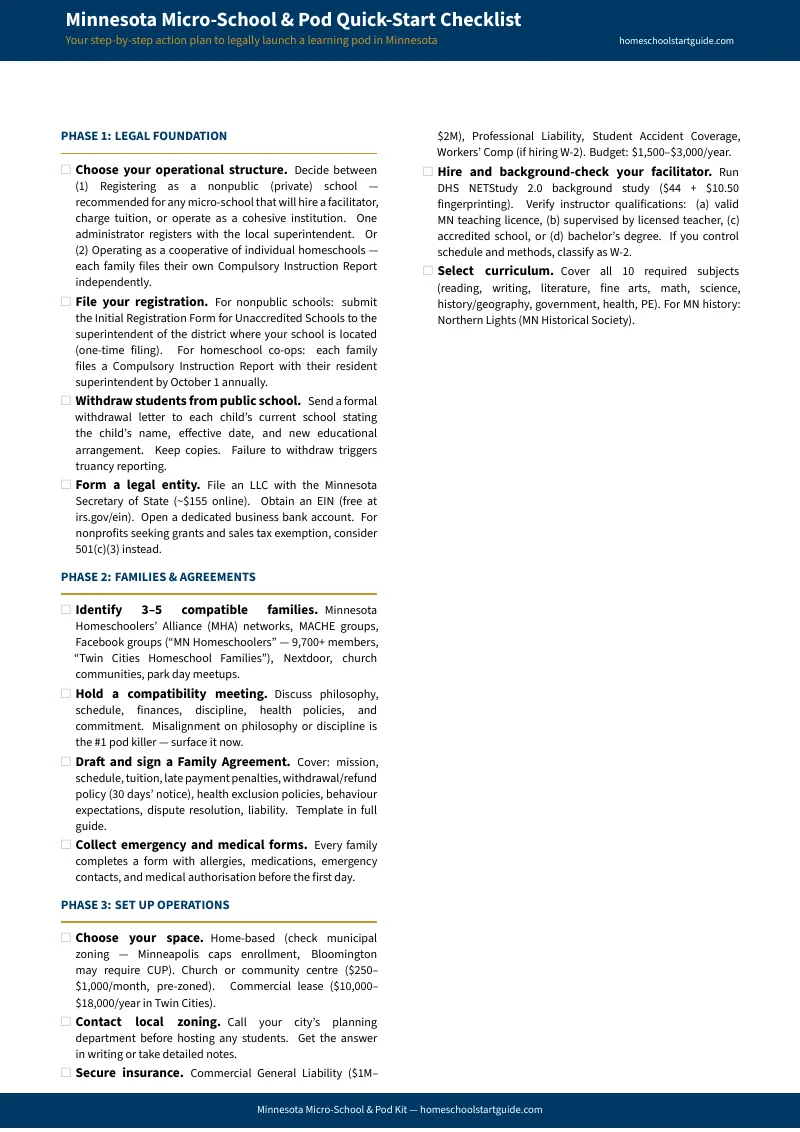
Your download includes the complete 19-chapter guide, the Quick-Start Checklist, and standalone printable templates: a Family Participation Agreement, a Liability Waiver with emergency contact form, a Facilitator Employment Contract, a Budget Tracker, and a Compliance Calendar. Instant download, no account required.
30-day money-back guarantee. If the Kit doesn't give you the legal clarity and operational confidence to move forward with your pod, email us and we'll refund you. No questions asked.
Not ready for the full Kit? Download the free Minnesota Homeschool Quick-Start Checklist — a one-page summary of the dual-pathway registration process, the key legal distinctions between homeschool co-op and nonpublic school structures, and the critical steps that apply to your pod from day one. It's enough to understand your rights tonight.
Minnesota parents have the legal right to build this. The 120A framework makes it possible. The 120A Compliance System makes sure you build it correctly.