Michigan Has Two Legal Pathways for Micro-Schools. LARA Has a Third That Shuts You Down.
You want to pull together four or five families, hire a teacher your kids actually respond to, and build a small school that works. Maybe you're burned out from solo homeschooling and need to share the load. Maybe your child has ADHD and the 28-student classroom is making things worse, not better. Maybe you're a former teacher who left the system and wants to run a small school without surrendering your tuition to a $2,200-per-year franchise platform. Whatever brought you here, you've arrived at the same conclusion: I need to build this myself.
The problem is that Michigan's legal framework for micro-schools is a maze with real consequences for getting lost. The Revised School Code gives you two legal pathways — Exemption (3)(f) for parent-led homeschool pods and Exemption (3)(a) for nonpublic schools with hired teachers — but the internet conflates them, and the wrong choice can mean your micro-school is technically operating as an unlicensed daycare under LARA. That's not a theoretical risk. LARA's child care licensing rules apply to any facility caring for unrelated children for pay, and the penalties for operating without a license include fines, forced closure, and referral to the state attorney general.
The Michigan Micro-School & Pod Kit is the only resource that maps the exact boundary between a legal micro-school and an unlicensed childcare facility under Michigan law — and gives you the templates, agreements, and checklists to stay on the right side of that line from day one.
What's Inside the Kit
The Two Legal Pathways, Side by Side
Exemption (3)(f) and Exemption (3)(a) of the Revised School Code are not interchangeable. Under Exemption (f), the parent or legal guardian must be the primary instructor — you cannot hire a teacher and charge tuition. Under Exemption (a), you operate as a nonpublic school: the teacher needs a bachelor's degree or teaching certificate, you file the annual Form SM4325 with MDE, and you can legally charge tuition without triggering LARA's daycare licensing rules. The Kit includes a diagnostic flowchart — three questions to determine which pathway fits your pod's structure, your staffing model, and your family count.
The LARA Licensing Boundary Map
This is the section that doesn't exist anywhere else. LARA's child care licensing applies to facilities caring for one or more unrelated children under age 13 for compensation. But if your micro-school qualifies as a bona fide educational entity under the Private, Denominational and Parochial Schools Act (PA 302 of 1921), you are exempt from daycare licensing. The Kit gives you the exact structural checklist — curriculum records, academic calendar, Form SM4325 filing, instructor qualifications — that establishes your micro-school as an educational entity, not a daycare, if LARA ever asks. Because the difference between "legal micro-school" and "unlicensed daycare" in Michigan is not what you teach — it's how you're structured.
The MHSAA Sports Access Playbook
Michigan's equal access law (MCL 380.1289) gives homeschooled students the legal right to participate in local school district athletics and extracurricular activities. But this law collides with the MHSAA's 66% enrollment rule, which requires students to take 66% of a full credit load at the school they represent. The Kit decodes both rules, explains the three legal options for sports access today — shared-time enrollment, independent homeschool leagues, and the pending Senate Bill 589 — and provides a negotiation framework for approaching your district's athletic director with the correct statutory citations. Your micro-school student's sports career does not have to end because you left the public school system.
The Dual Enrollment Pipeline
Under the Postsecondary Enrollment Options Act (MCL 388.514), nonpublic school students can dual-enroll at Michigan community colleges and universities with the state covering a portion of the tuition. But only if the administrative process is executed correctly — and it starts with your micro-school's official eligibility letter. The Kit walks you through the exact steps to establish your micro-school as a recognized nonpublic school, submit the eligibility letter, and secure state-funded dual enrollment for your high school students. An associate's degree before graduation is not a fantasy — it's a documented pathway for Michigan micro-school families.
The Multi-Family Pod Agreement Templates
The Kit includes customizable parent agreements, liability waivers, and financial agreements drafted specifically for Michigan law. Every clause addresses a real failure mode: what happens when a family stops paying, when a child is injured, when parents disagree on curriculum, or when the pod needs to remove a family. Michigan courts apply strict scrutiny to liability waivers involving minors — the Kit explains what protections you can and cannot contractually establish, and structures the agreement to provide maximum enforceable protection without requiring an attorney.
Hiring, Background Checks, and the Payroll Trap
If you hire a teacher, Michigan requires ICHAT ($10, state criminal records) and LiveScan digital fingerprinting ($50-$70, FBI database and National Sex Offender Registry) for anyone "employed or regularly and continuously working" with children. But the bigger trap is classification: if you set the curriculum, schedule, location, and methods, your educator is a W-2 employee under IRS rules, not a 1099 independent contractor. Misclassifying a household employee is a federal tax violation. The Kit includes the payroll primer for splitting FICA, Michigan SUTA, and withholding across multiple families — so you don't accidentally commit tax evasion while trying to give your kids a better education.
Insurance, Zoning, and Facility Setup
Standard homeowner's insurance excludes regular hosting of non-resident children for paid educational activities — the "business pursuit" exclusion. The Kit walks you through the exact insurance requirements (Commercial General Liability, minimum $1,000,000 per occurrence), the zoning rules for Detroit, Grand Rapids, Ann Arbor, and suburban townships, and the facility options from family homes to church classrooms to commercial leases. Church partnerships — at $200-$800/month via a Facility Use Agreement — are the most common scaling strategy for Michigan micro-schools, and the Kit explains how to negotiate the arrangement.
Four Scheduling Models for Every Pod Size
Full-time micro-school (4-5 days/week), university-model hybrid (2-3 days in-person), part-time enrichment pod (1-2 days), and seasonal or block schedule. The Kit provides weekly scheduling frameworks for mixed-age pods, transition protocols between independent work and group sessions, and the facilitation shift from "teacher" to "learning guide" that prevents instructor burnout in the first month.
Who This Kit Is For
- Parents burned out from solo homeschooling who want to share the instructional load with two to five other families — without accidentally creating an unlicensed daycare
- Parents pulling their children from Michigan public schools who want a small, structured alternative with consistent peers and a dedicated teacher — not isolation at the kitchen table
- Former teachers who left the Michigan school system and want to serve their community by running a small micro-school — without the $2,200/year franchise fees or proprietary curriculum requirements of Prenda or KaiPod
- Parents of student-athletes who need their children to remain eligible for school district sports under the equal access law while attending a micro-school for academics
- Secular or inclusive families who've been shut out of existing co-ops that require statements of faith, and who need a legally sound framework for an academically rigorous, non-ideological pod
- Parents of neurodivergent children (ADHD, autism, dyslexia) who need a calmer, self-paced learning environment with a student-to-teacher ratio that actually allows individualized attention
- Faith-based families in West Michigan and Grand Rapids who want to build a classical Christian micro-school or supplement their existing co-op with a more structured, tuition-funded model
- Families in Dearborn and Detroit interested in bilingual micro-schools (English/Arabic, English/Spanish) who need the legal framework to operate a dual-language pod under Michigan law
Why Not Just Use the Free Resources?
MiCHN publishes FAQs. The MDE website has compliance manuals. LARA has licensing regulations. Reddit has hundreds of threads. Here's what actually happens when you try to build a micro-school from free sources alone:
- MiCHN is ideologically opposed to the pathways you need. As the state's largest homeschool organization, MiCHN provides excellent advocacy and community — but they actively discourage dual enrollment, shared-time participation, and any partnership with public schools, fearing that state money invites state control. If you want your micro-school students to access dual enrollment or public school sports, MiCHN will not help you navigate those systems. They'll tell you to avoid them.
- The MDE website is a bureaucratic maze. Understanding the exact threshold at which your pod legally transitions from "cooperative homeschool" to "unlicensed childcare facility" requires cross-referencing multiple 100-page regulatory manuals across MDE and LARA. The tone is sterile and implicitly threatening — frequent mentions of penalties and enforcement actions. It induces anxiety rather than providing clarity.
- LARA's licensing rules are written to regulate daycare centers, not micro-schools. The regulations discuss nap schedules, diaper-changing stations, and playground fencing — none of which apply to your eight-student academic pod. But somewhere in those pages is the educational exemption that protects you. Finding it, understanding it, and documenting your compliance takes hours of parsing regulatory language written for a completely different audience.
- Generic Etsy templates don't know Michigan law. A $12 "Pod Agreement" from Etsy doesn't address LARA licensing exemptions, ICHAT background check requirements, Form SM4325 filing, W-2 payroll splitting across families, or the specific liability standards Michigan courts apply to waivers involving minors. It's a blank contract with no state-specific legal context.
- The franchise platforms withhold the operational details. Prenda, KaiPod, and similar platforms will walk you through launch — for $2,200 per student per year in platform fees. The actual how-to — the state registration steps, the LARA exemption documentation, the MHSAA negotiation framework — is exactly the operational knowledge they charge thousands for annually.
Free resources give you scattered puzzle pieces. The Kit is the assembled picture — both legal pathways explained, the LARA boundary mapped, the templates drafted, ready to use this week.
— Less Than One Month of a Franchise Platform Fee
Prenda charges approximately $2,200 per student per year. KaiPod's Catalyst accelerator starts at $249 upfront. A single consultation with a Michigan education attorney runs $200-$400. HSLDA membership is $150/year. The Kit costs less than a single family's share of one month's insurance premium — and gives you the operational independence those platforms are designed to prevent.
Your download includes:
- guide.pdf — The complete Michigan Micro-School & Pod Kit: 28 chapters covering both legal pathways (Exemption 3(f) and 3(a)), the LARA licensing boundary and educational exemption, withdrawal from public school, pod formation and family agreements, facility options and zoning for Detroit, Grand Rapids, Ann Arbor, and suburban townships, budgets and cost-sharing, business entity formation (LLC vs. nonprofit), hiring and background checks (ICHAT + LiveScan), insurance and liability, four scheduling models, curriculum for multi-age settings, assessment, field trips across Michigan, high school transcripts, dual enrollment under MCL 388.514, driver's education, MHSAA sports access and equal access law, neurodivergent-friendly pods, bilingual micro-schools, faith-based models, Upper Peninsula logistics, and scaling.
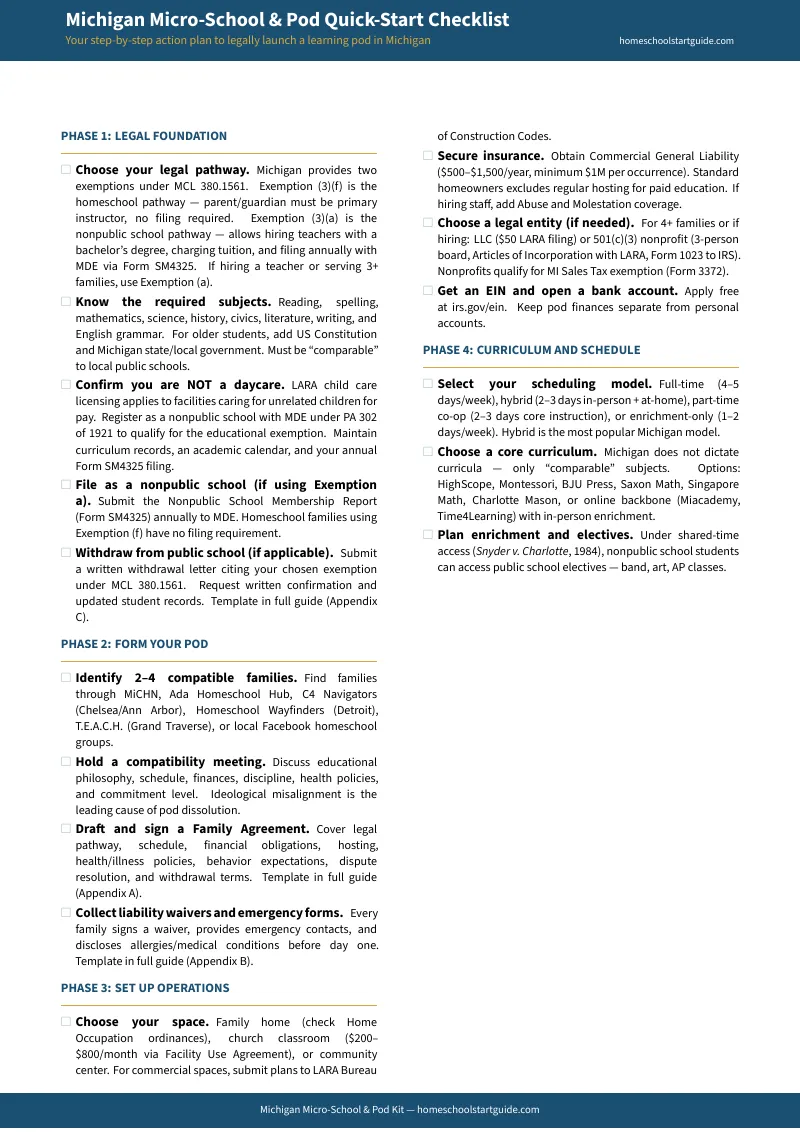
- checklist.pdf — The Michigan Micro-School Quick-Start Checklist: a printable 6-phase action plan from choosing your legal pathway through launch week, with a key legal references table covering every statute, court case, and filing you need.
- parent-agreement.pdf — Ready-to-customize family participation agreement with Michigan-specific legal structure options (Exemption 3(f) and 3(a)), ICHAT/LiveScan checkboxes for hired instructors, financial terms, behavioral expectations, dispute resolution, and signature blocks.
- liability-waiver.pdf — Printable liability waiver and assumption of risk with medical consent, photo/video release, emergency contact form, and Michigan strict scrutiny note — fill in and sign before your first pod day.
- withdrawal-letter.pdf — Template withdrawal letter citing MCL 380.1561 with records request checklist — print, customize, and send to your child's school principal.
- lara-compliance-checklist.pdf — The six documentation requirements that establish your micro-school as an educational entity exempt from LARA daycare licensing under PA 302 of 1921 — post where you will see it.
- legal-quick-reference.pdf — One-page reference card: both legal pathways compared side by side, every key statute (MCL 380.1561, PA 302, MCL 380.1289, MCL 388.514), background check requirements, MHSAA rules, and key contacts.
7 PDFs. Instant download, no account required.
30-day money-back guarantee. If the Kit doesn't give you the legal clarity and operational confidence to move forward with your micro-school, email us and we'll refund you. No questions asked.
Not ready for the full Kit? Download the free Michigan Homeschool Quick-Start Checklist — a printable overview of your legal rights under both pathways, the LARA licensing exemption basics, and the first steps to forming your pod. It's enough to understand whether you need Exemption (f) or Exemption (a), and it's free.
Michigan law gives you two fully legal pathways to build the school your children deserve. The franchise platforms want $2,200/year per student to walk you through it. The Kit does it for the price of a takeout dinner — and you keep every dollar of your tuition.