Massachusetts Won't Let You Homeschool Until Your School Committee Says Yes. Here's How to Make Sure They Do.
You've made the decision. Your child is struggling — anxious every Sunday night, bullied, stuck in a classroom that treats every kid the same, or drowning in an IEP that the district won't follow. Maybe you just moved to Massachusetts from Texas or Florida and you're in shock: in your old state, you sent a letter and started homeschooling. Here, you need prior approval from the superintendent or school committee before you can legally pull your child out. You Googled "how to homeschool in Massachusetts" and within twenty minutes you found a phrase that stopped you cold: Care and Protection of Charles.
That's the 1987 Supreme Judicial Court case that defines everything. It says your school committee can evaluate your education plan against four specific legal standards — and only those four. But the case also says you have a constitutional right to homeschool, that the committee cannot require home visits (Brunelle v. Lynn, 1998), and that they cannot dictate your curriculum. The problem is that most superintendents don't tell you any of this. They hand you forms that ask for more than the law requires. They push you toward online portals — Boston's, Worcester's, Needham's — that trap you into volunteering information the Charles guidelines never authorised them to demand. And every unnecessary detail you provide sets a precedent they'll hold you to for years.
The Prior-Approval Compliance System inside this Blueprint eliminates the guesswork. It translates the Charles and Brunelle decisions into plain English, walks you through writing an education plan that satisfies all four legal prongs without over-reporting, gives you the exact withdrawal letter templates and pushback scripts you need, and shows you how to navigate district-specific portals without surrendering data the law doesn't require.
What's Inside the Blueprint
The Charles Guidelines Decoder
Massachusetts law requires that your education plan demonstrate instruction "equal in thoroughness and efficiency" to public school — but the only legal standard for evaluating that claim comes from the four prongs of the Charles decision: curriculum and hours, parental competency, instructional materials, and annual assessment. The Blueprint breaks each prong into plain English, shows you exactly what to include in your plan to satisfy it, and — critically — explains what falls outside the four prongs so you know what to refuse when the superintendent asks for it.
The Education Plan Templates
Fill-in-the-blank templates for every grade band: elementary (K-5), middle school (6-8), and high school (9-12). Each template is structured around the four Charles prongs so the school committee receives a document that addresses every legal requirement and nothing else. No daily schedules. No weekly lesson plans. No textbook page numbers. No reasons for withdrawing. Just the information the law entitles them to — formatted so they have no grounds for denial.
The Withdrawal Letter Templates
Ready-to-send templates for every withdrawal scenario: standard withdrawal, mid-year withdrawal, IEP/504 withdrawal, and withdrawal from a private or parochial school. Each template includes a records request so you get your child's cumulative file. Print, fill in the bracketed fields, send via certified mail — done.
The Anti-Over-Reporting Strategy
This is the core differentiator. AHEM warns against over-reporting. MassHOPE mentions it. But no resource gives you a practical, line-by-line framework for deciding what to include and what to leave out of your education plan. The Blueprint does. Every section of your plan is calibrated to satisfy the Charles standard without creating precedents that lock you into providing daily schedules, specific textbook lists, or teaching credential documentation that the law does not require.
The Pushback Script Library
When the superintendent demands home visits (banned by Brunelle), requests MCAS testing (not required for homeschoolers), insists on curriculum approval (not within the committee's authority), or tells you to fill out a district-specific withdrawal form instead of accepting your certified letter — you don't panic or call a lawyer. The Script Library provides copy-and-paste email responses citing the Charles and Brunelle decisions and the specific legal principles that make each demand baseless.
The Mid-Year Crisis Protocol
No Massachusetts resource addresses what happens when you need to pull your child out in November because of panic attacks, in January because the IEP is failing, or in March because of bullying the school won't address. The Protocol gives you a 48-hour triage plan: how to notify the school today, how to submit an interim education plan that buys you time while the committee reviews, and how to protect your family against truancy charges during the gap between submission and approval.
District-Specific Protocols
Boston Public Schools forces families through an online application portal requiring specific PDF uploads and rejecting links to online curricula. Worcester's portal historically nudged parents into providing non-mandated data. Needham requires a formal intent form 14 days before withdrawal. The Blueprint includes submission strategies for the highest-friction districts in the state — how to use the portals without getting trapped into over-reporting, and when to bypass the portal entirely by submitting a PDF education plan via certified mail.
The College Readiness Roadmap
Covers transcript creation for Massachusetts homeschoolers, dual enrollment at Massachusetts community colleges, and admissions requirements at UMass Amherst, Boston University, Northeastern, MIT, and other Massachusetts institutions. Your homeschooler won't be at a disadvantage — but only if you build the documentation now.
Who This Blueprint Is For
- Parents who need to withdraw their child this week — not after months of research — and want an education plan and withdrawal letter ready to submit tonight
- Parents who are overwhelmed by the prior-approval requirement and need someone to explain exactly what the school committee can and cannot demand under the Charles guidelines
- Parents who've been told by the school that they need to fill out district forms, attend a meeting, agree to home visits, or submit to MCAS testing — and who need the exact legal citations to refuse
- Parents moving to Massachusetts from a low-regulation state who are in shock that they need permission to homeschool and need to understand the system fast
- Parents in the Boston metro, Worcester, Springfield, or affluent suburban districts where institutional rigidity and localized portal requirements create extra friction
- Parents whose child has an IEP or 504 Plan and who need to understand what happens to special education services after withdrawal — and how to maintain Child Find protections
- Secular families who need Massachusetts-specific guidance without MassHOPE's Christian worldview framing or HSLDA's $130/year membership requirement
Why Not Just Use the Free Resources?
You can. AHEM has detailed legal summaries. MassHOPE has a getting-started page. DESE has a homeschooling overview. Here's what actually happens when you try to assemble a withdrawal strategy from free sources:
- AHEM gives you the ingredients but not the recipe. Their legal summaries are accurate — the best free resource in the state. But you have to read through dozens of dense web pages, synthesise the sequential steps yourself, and draft your own documents from scratch by copying and pasting sample text. A parent managing a child's mental health crisis at 11pm on a Tuesday doesn't have time to become a legal researcher. The Blueprint gives you the formatted, fill-in-the-blank templates that AHEM's sample text becomes after ten hours of work.
- MassHOPE is Christian-first. Their resources are excellent for families within the Christian homeschool community, but every page is framed through a biblical worldview. Their legal guidance funnels you toward HSLDA memberships ($130/year) and convention registrations ($69+). A secular parent, a progressive family, or a parent withdrawing purely because of bullying will find the ecosystem alienating — and still won't get the pushback scripts or district-specific portal walkthroughs they actually need.
- DESE pushes everything to your local district. The state website acknowledges that homeschooling is legal and then sends you to your superintendent. That's where the trouble starts — because each of Massachusetts's 351 cities and towns enforces the Charles guidelines differently, and some districts have built online portals that systematically extract more information than the law requires.
- Facebook groups give you 2022 advice in 2026. For every accurate comment, there are three that confuse Massachusetts law with Connecticut or New Hampshire, claim you need a teaching degree (you don't), or tell you to just stop sending your kid to school (that's truancy in a prior-approval state). Following localised bad advice in Massachusetts — where you need committee approval before withdrawing — can trigger a truancy investigation before you've even started.
— Less Than One Hour With a Consultant
A private educational consultant in Massachusetts charges $150-$250 per hour. An HSLDA membership costs $130 per year. An AHEM workshop requests a $100 donation. MassHOPE's convention runs $69+ per person. A truancy investigation triggered by withdrawing without prior approval costs you weeks of anxiety and potentially a DCF visit. The Blueprint costs less than the gas to drive to the district office to ask questions the superintendent isn't obligated to answer clearly.
Your download includes the complete Blueprint guide covering all 15 chapters — the Charles and Brunelle legal framework, the withdrawal process step by step, education plan templates for every grade band, the anti-over-reporting strategy, the mid-year crisis protocol, annual assessment options, district pushback scripts and appeal procedures, truancy and DCF protection, IEP/504 transition guidance, high school transcripts and university admissions, sports and extracurricular access, financial realities and 529 plans, relocation guidance for families moving to Massachusetts, and district-specific protocols for Boston, Worcester, Springfield, and high-friction suburban districts — plus 6 standalone printable tools: education plan templates, withdrawal letter templates, pushback scripts, the Charles guidelines quick-reference card, the mid-year crisis protocol, and the compliance binder reference. Plus the Quick-Start Checklist. Instant download, no account required.
30-day money-back guarantee. If the Blueprint doesn't give you the confidence and legal clarity to execute your withdrawal, email us and we'll refund you. No questions asked.
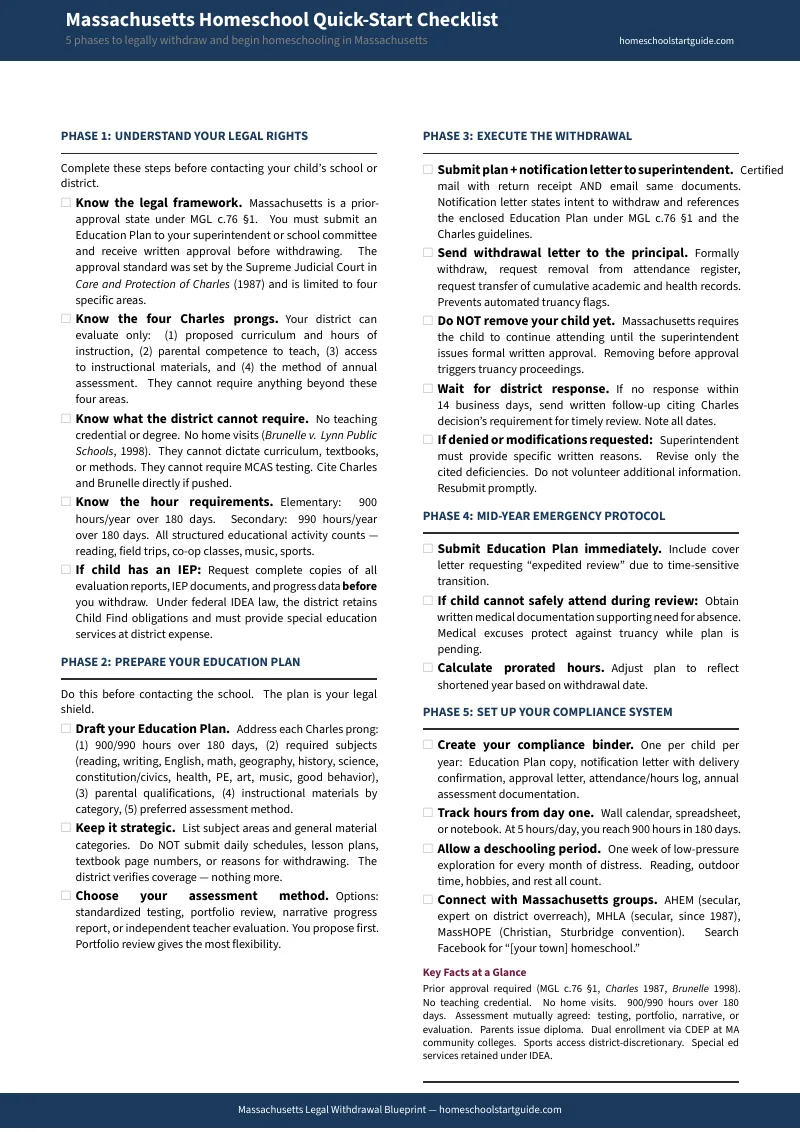
Not ready for the full Blueprint? Download the free Massachusetts Homeschool Quick-Start Checklist — a one-page overview of the prior-approval process, the four Charles prongs your education plan must address, and the single most important thing to know about over-reporting. It's enough to get oriented, and it's free.
Your child doesn't have to go back on Monday. Massachusetts law protects your right to educate at home — but the district hasn't told you how to exercise it without giving them more power than the law allows. The Blueprint makes sure they can't pretend otherwise.