The School Committee Wants Your Education Plan. Make It Bulletproof.
You've decided to homeschool in Massachusetts — maybe you're pulling your child out of a failing IEP situation, maybe the school just isn't working, maybe you've been educating at home for years and the paperwork still stresses you out. Whatever brought you here, one thing is certain: Massachusetts isn't a notification state. You can't just file a form and start teaching. Under MGL c.76 §1, you must submit an education plan to your local school committee and get it approved before you legally begin. If they reject it, your child is truant. If you never submit one, your child is truant from day one.
The Care and Protection of Charles decision (1987) defines what your school committee can evaluate — curriculum, hours, materials, parent competence, and an assessment method. But Charles also sets limits: they can't require home visits, teaching certification, alignment with MCAS standards, or a daily schedule. The problem is that most school committees don't know the limits. Boston Public Schools runs a formal online portal that asks for more than Charles allows. Worcester provides multilingual forms that embed district expectations into the application. Suburban districts in Concord, Wellesley, and Arlington each have their own interpretation. And every homeschool Facebook group has a different opinion about how much information is "too much" to share.
The Massachusetts Portfolio & Assessment Templates is a Charles-Compliant Documentation System — 16 chapters covering every documentation requirement in Massachusetts homeschool law, every grade level from kindergarten through high school, and every template you need for education plan approval and annual assessment — designed to satisfy the school committee with exactly what the law requires and not a single word more. No daily schedules they never asked for. No MCAS alignment that invites public school comparisons. No generic planners built for states that don't require prior approval.
What's Inside
The Charles Decision Decoded
The legal foundation of your rights as a Massachusetts homeschooler sits in two court decisions most parents have heard of but few understand in detail. Chapter 2 maps the complete legal framework — what school committees can evaluate under Charles (1987), what they cannot require under Brunelle v. Lynn Public Schools (1998), and how MGL c.76 §1 creates the prior-approval structure that makes Massachusetts unique. When you understand the five things a school committee can review and the specific overreach practices the courts have prohibited, every interaction with your district becomes a negotiation you're equipped to win.
Constructing Your Education Plan
Your education plan is the single most important document in your homeschool. It must be approved before you legally begin. Chapter 3 breaks it into five sections: a statement of intent, subject mapping for all required subjects, instructional hours (900 elementary / 990 secondary), instructor qualifications, and your proposed assessment method. Each section includes the exact language to use — broad enough to preserve your flexibility ("Instruction will include, but is not limited to...") and specific enough to satisfy the school committee. Most parents either submit too little (triggering rejection) or too much (inviting scrutiny they didn't need). These templates hit the precise middle.
Required Subjects — Including the Ones That Catch You Off Guard
Massachusetts requires reading, writing, spelling (the statute uses "orthography"), English grammar, mathematics, US history and the Constitution, geography, drawing, music, health education including CPR, physical education, duties of citizenship, and good behavior. Grades 7 and above add American literature and general science. Chapter 5 maps every required subject with documentation strategies that work for structured curricula, Charlotte Mason, unschooling, and everything in between — because the school committee doesn't care about your educational philosophy, only that every subject appears somewhere in your plan.
Assessment Options — Standardized Testing, Portfolio Review, or Progress Report
Massachusetts doesn't dictate a single assessment method. The method should be mutually agreed upon between you and the school committee. Chapter 6 covers all three primary options — standardized testing (CAT, ITBS, Stanford 10, Woodcock-Johnson), portfolio review by a Massachusetts-certified teacher, and a written progress report — with the exact pre-written clauses to insert into your education plan. Proposing your assessment method in the education plan gives you leverage. Letting the school committee choose means accepting whatever method they prefer, which is often the most intrusive option.
Grade-Banded Portfolio Frameworks
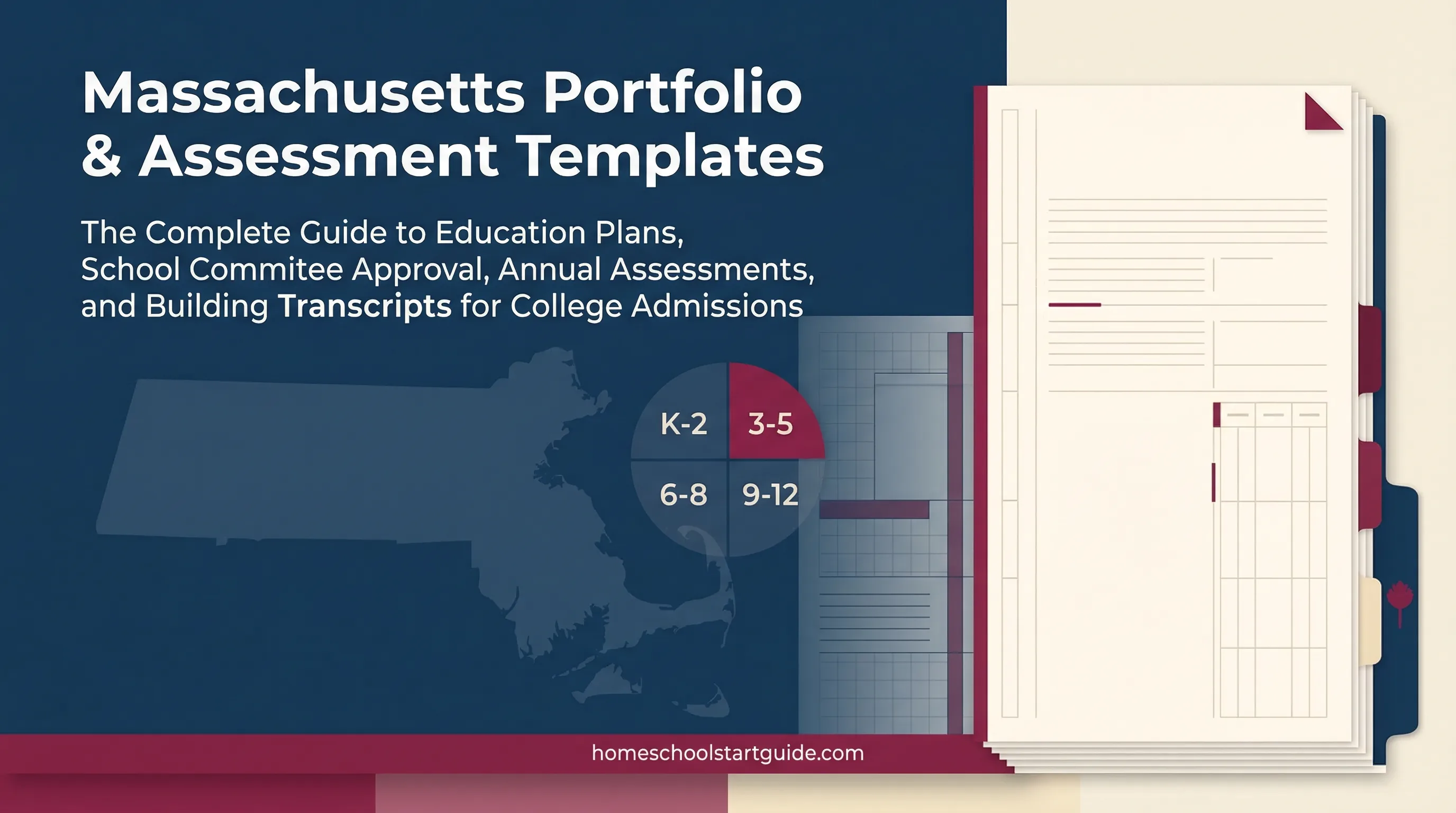
An elementary portfolio looks nothing like a high schooler's transcript. Chapter 8 provides grade-banded documentation frameworks — K-2, 3-5, 6-8, and 9-12 — with specific guidance on what to collect, how many samples per subject across the year, what "adequate progress" looks like at each developmental stage, and how to organize evidence that satisfies your school committee without inviting district overreach. Each framework includes a weekly 15-minute filing system so you never face a last-minute portfolio scramble before your annual assessment.
District Variations Across Massachusetts
Massachusetts has 351 cities and towns, each with its own school committee. Chapter 10 maps the specific procedures, deadlines, and quirks of Boston, Worcester, Springfield, New Bedford, Cambridge, and the suburban districts — because the family submitting to BPS through an online portal has a completely different experience than the family mailing a letter to a rural school committee that hasn't processed a homeschool plan in three years.
Handling District Pushback
Some school committees are supportive. Others demand documentation the law doesn't authorize — home visits, daily schedules, MCAS alignment, specific curriculum choices, or in-person interviews. Chapter 11 provides word-for-word response scripts citing the specific provisions of Charles and Brunelle that limit school committee authority — because a confident, legally grounded response stops overreach before it escalates to a rejected plan or a truancy threat.
High School Transcript Templates
The transcript is the highest-stakes document you'll produce as a homeschool parent. Massachusetts universities, community colleges, employers, and the military all expect professionally formatted academic records. Chapter 12 provides a transcript template designed for Massachusetts institutions — with fields for course title, credits, grade, grading scale, cumulative GPA, and your signature as the instructing parent. Plus: how to calculate weighted and unweighted GPAs, how to document dual enrollment credits from Bunker Hill, Middlesex, or Bristol Community College, and how to write course descriptions that UMass, Boston College, Harvard, MIT, Tufts, Northeastern, and BU admissions offices expect.
Massachusetts University Admissions
Chapter 13 covers the admissions requirements specific to Massachusetts homeschoolers — UMass system pathways (the 27-credit transcript alternative, MassTransfer, the SRAR), elite private university expectations (Harvard, MIT, Boston College, Tufts, Northeastern, BU each handle homeschoolers differently), dual enrollment at Massachusetts community colleges, AP course documentation and exam registration as a private candidate, FAFSA documentation, and the homeschool SAT/ACT code. Each university has different documentation expectations, and the chapter maps them individually.
Special Situations
Chapter 14 covers the scenarios that generic templates completely ignore: neurodivergent learners (IEP considerations, IDEA evaluation requests, documenting accommodations), military families at Hanscom AFB and Joint Base Cape Cod (PCS transitions, cross-state compliance), mid-year withdrawal procedures, multilingual households documenting heritage language instruction, single-parent logistics, families moving into Massachusetts from other states, and the interaction between homeschool documentation and custody agreements.
Who This Is For
- First-year Massachusetts homeschool parents writing their education plan and anxious about whether the school committee will approve it
- Parents approaching an annual assessment with scattered work samples and no system for assembling the evidence their school committee expects
- Parents who have been using Boston Public Schools forms, Worcester district forms, or other district-provided templates — and didn't realize those forms ask for more than the law requires
- Parents whose education plan was rejected or questioned by the school committee and need legally grounded language to respond
- High school parents who need a professional transcript for UMass, Boston College, Northeastern, or any Massachusetts university — and have no template formatted for these institutions
- Parents dealing with a school committee that demands home visits, daily schedules, MCAS alignment, or other unauthorized requirements
- Secular, eclectic, and post-pandemic homeschoolers who want a documentation system that isn't embedded inside MassHOPE's religious framework or buried in hours of convention audio
- Military families who just PCSed to Hanscom AFB from a notification state and need to navigate Massachusetts's prior-approval process for the first time
Why Not Just Use the Free Resources?
You can. AHEM has excellent legal guidance. The Massachusetts DESE publishes the statute. YouTube has portfolio walkthrough videos. Here's what actually happens when you try to assemble a documentation system from free sources:
- AHEM is the gold standard for legal interpretation — and their templates are bare minimums. AHEM expertly deconstructs the Charles decision and offers free sample education plans. But the samples are sparse text documents designed to provide the absolute legal minimum. Anxious first-year parents looking at a one-paragraph plan feel exposed and unprofessional. They want a document that looks authoritative enough to command respect from the school committee — without accidentally over-sharing.
- District-provided forms are a trap. Boston Public Schools, Worcester, and many other districts provide their own application forms. Veteran homeschoolers actively warn newcomers against these forms because they routinely request more information than Charles allows — daily schedules, curriculum details, specific textbook lists. Submitting your own education plan PDF keeps you in control of what the district sees.
- Etsy planners are built for other states. Generic homeschool planners include daily schedule grids, chore charts, and curriculum trackers designed for states without prior-approval requirements. They lack Massachusetts's required subject mapping (orthography, duties of citizenship, CPR), the 900/990 hour structure, education plan formatting, and assessment method clauses. Worse, some "state compliant" planners align with Common Core or MCAS standards that homeschoolers are legally exempt from following.
- Teachers Pay Teachers materials are dangerous in Massachusetts. TPT products map to DESE standards and MCAS frameworks. Using an MCAS-aligned portfolio invites the exact school committee scrutiny home educators seek to avoid — and creates a precedent that you're willing to be measured against public school benchmarks.
- Homeschool Tracker and My School Year cost $60-$65/year and require a learning curve. Software solutions are built for year-round daily data entry. For a parent who needs an education plan approved next month and a portfolio assembled by spring, learning a complex database is an impossible barrier. You need templates, not software.
- Facebook group advice conflates Massachusetts with other states. Parents routinely share portfolio tips from Pennsylvania, Virginia, and Florida — states with completely different legal frameworks. Massachusetts doesn't have evaluator reviews like Pennsylvania. It doesn't have an annual notification like Virginia. Its prior-approval system is unique, and advice from other states can actively harm your compliance.
The free resources explain what the law says. These templates are engineered to do exactly what the law requires — and nothing more.
— Less Than a Single Hour of Education Attorney Fees
An education attorney in Massachusetts charges $250-$500+ per hour. A rejected education plan means weeks of stress, potential truancy threats, and possibly hiring that attorney anyway. Homeschool Tracker costs $65/year. MassHOPE convention recordings cost $99. These templates cost less than a single standardized test booklet — and they cover every document you need from education plan through high school transcript.
Your download includes the complete guide, the Quick-Start Checklist, and 6 standalone printable tools — 8 PDFs:
- guide.pdf — The full 16-chapter guide covering the legal framework (Charles, Brunelle, MGL c.76 §1), constructing your education plan, the annual compliance cycle, required subjects, assessment options, building your documentation system, grade-banded portfolio architecture, documenting non-traditional learning, district variations across Massachusetts, handling district pushback, high school transcripts, Massachusetts university admissions, special situations, MIAA athletic eligibility, and reference tables.
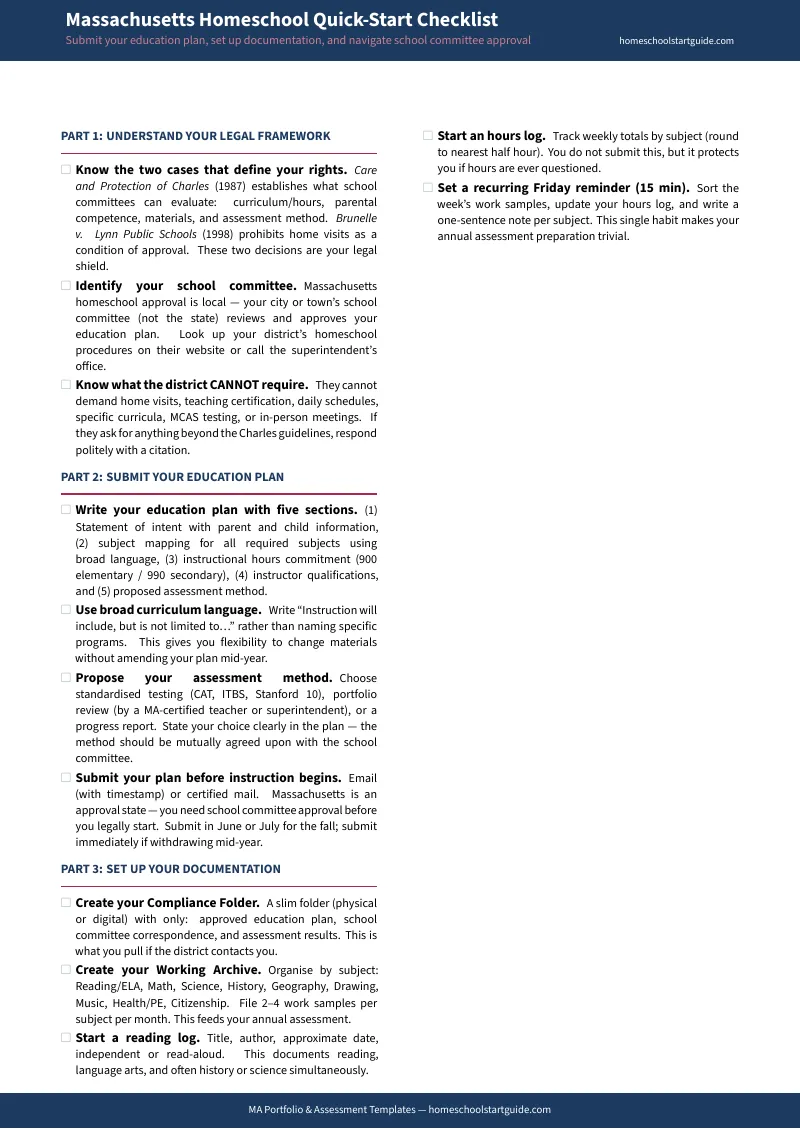
- checklist.pdf — Quick-Start Checklist: a printable action plan covering legal framework orientation, education plan submission, documentation system setup, required subjects, and high school essentials.
- education-plan-templates.pdf — Fill-in-the-bracket education plan templates with all five Charles-required sections: statement of intent, subject mapping, instructional hours, instructor qualifications, and pre-written assessment method clauses.
- required-subjects-checklist.pdf — One-page reference card listing every subject Massachusetts law requires, by grade band, with documentation targets and common surprises (orthography, duties of citizenship, CPR).
- assessment-comparison.pdf — Side-by-side comparison of standardized testing, portfolio review, and progress report options with cost, time, and fit guidance — plus copy-and-paste clauses for your education plan.
- portfolio-frameworks.pdf — Grade-banded portfolio architecture (K-2, 3-5, 6-8, 9-12) with what to include, what to leave out, and target sample volumes for each level.
- pushback-scripts.pdf — Word-for-word response scripts for unauthorized school committee demands — citing Charles and Brunelle provisions for overreach, home visits, delayed approval, plan rejection, MCAS alignment, and in-person meetings.
- transcript-template.pdf — Fillable high school transcript formatted for Massachusetts university admissions, with 4-year course tables, GPA calculation scale, recommended credit framework, and parent certification block.
8 PDFs. Instant download, no account required.
30-day money-back guarantee. If these templates don't give you the structure and confidence to get your education plan approved and your documentation organized, email us and we'll refund you. No questions asked.
Not ready for the full guide? Download the free Massachusetts Homeschool Quick-Start Checklist — a printable overview of the legal framework, education plan requirements, documentation system basics, required subjects, and high school essentials. It's enough to get oriented, and it's free.
Massachusetts doesn't require you to replicate the public school experience. It requires your school committee to confirm that an appropriate education is occurring. These templates make the proof effortless.