Build Your Massachusetts Micro-School Legally, Confidently, and Without the School Committee Guesswork.
Massachusetts is the only state where every homeschooling family must get school committee approval before they start teaching. Under MGL c. 76, § 1 and the 1987 Care and Protection of Charles guidelines, your local school committee evaluates your education plan on four specific criteria — curriculum, instructor competency, materials, and assessment — and can reject it if they're not satisfied. Now imagine coordinating that process for four or five families simultaneously, while also navigating zoning laws, liability exposure, CORI background checks, and the question of whether your living room pod needs an EEC childcare license. That's the reality of starting a micro-school in Massachusetts. And nobody walks you through it.
You want to bring together three or four families in the Boston metro, Worcester, Springfield, or the Cape — share the teaching, split the costs, and build something that actually fits your children. Maybe you're burned out on solo homeschooling and need other adults in the room. Maybe you're paying $27,000 a year for private school and realizing a micro-school delivers the same 6:1 ratio at a fraction of the cost. Maybe you're a secular family and every co-op you've found is run through MassHOPE's evangelical framework. Maybe your neurodivergent child's IEP has been ignored for the third year running and you need an environment built around them. Whatever brought you here, you've reached the same conclusion: I need to build this myself — and I need to get the legal part right.
The problem is that Massachusetts gives you fragments. AHEM explains your rights — but their focus is individual homeschooling, not multi-family pods. MassHOPE runs co-op directories — but their mission statement opens with "to the Glory of God" and secular families aren't their audience. DESE publishes the statute text in dense legalese that tells you what standard to meet without showing you how to format the proof for a skeptical superintendent. Facebook groups have 11,000 members offering fiercely contradictory advice about whether your pod needs a private school application, whether the Dover Amendment protects your home, and whether collecting tuition triggers daycare licensing. You need a School Committee Compliance System — the complete operational framework without the religious prerequisites, the franchise fees, or the dangerous legal improvisation.
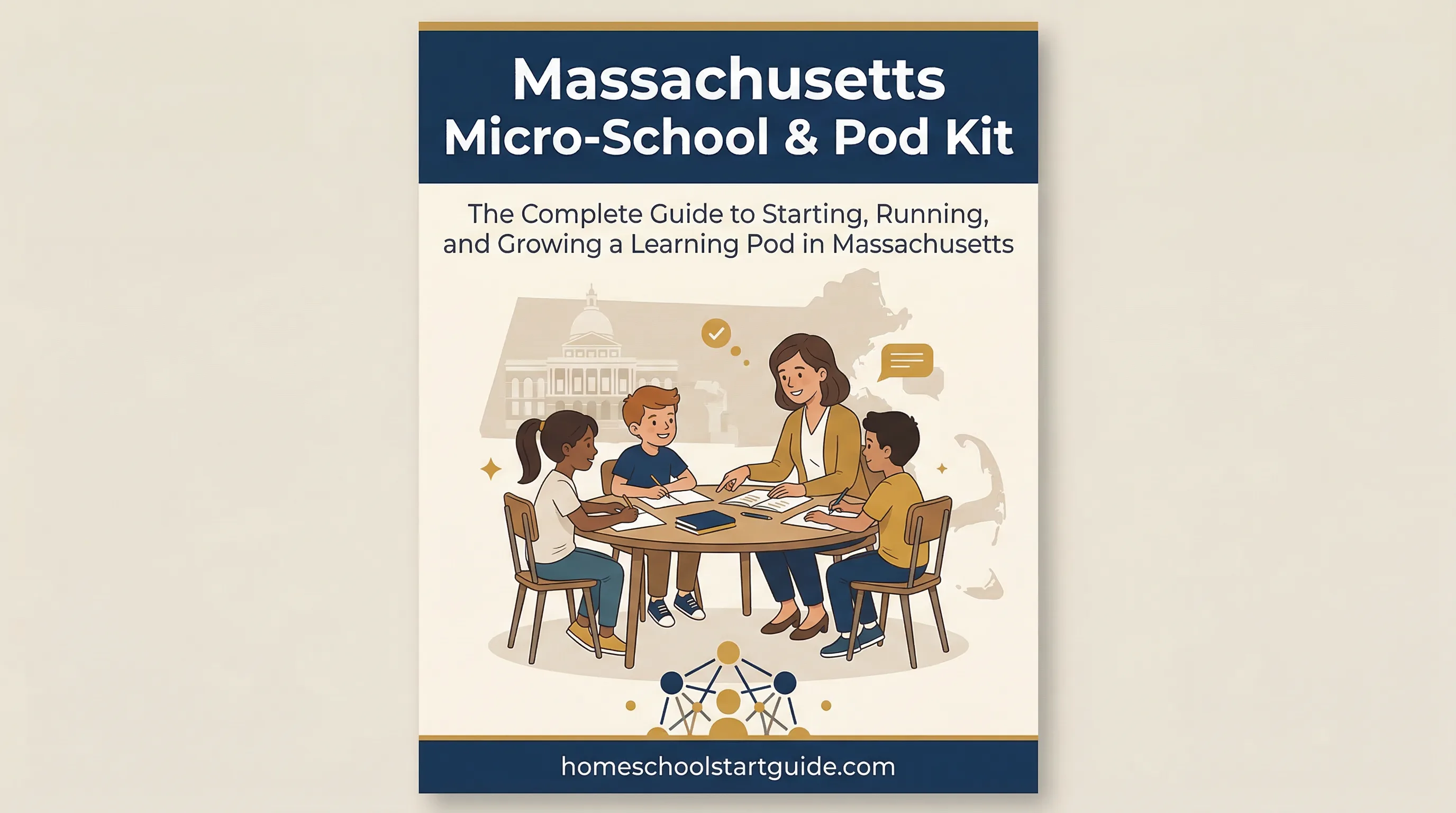
The Massachusetts Micro-School & Pod Kit is that School Committee Compliance System.
What's Inside the School Committee Compliance System
The Two Legal Pathways Decision Framework
Because the single most consequential question for every Massachusetts pod founder is whether each family files individually under the homeschool cooperative model (MGL c. 76, § 1) or the micro-school applies as a private school through DESE (MGL c. 71, § 1). This framework walks you through the exact criteria — number of students, whether you're charging tuition, who holds legal responsibility, and whether you want to issue transcripts — so you choose the right structure before your first family meeting, not after a school committee letter forces the question.
The Care and Protection of Charles Education Plan Template
Because Massachusetts school committees evaluate your plan on exactly four criteria from the 1987 Charles decision — and most rejections happen because parents address the wrong things or miss a criterion entirely. A fill-in-the-blank template that maps directly to the four Charles criteria: proposed curriculum and instructional hours, instructor competency, instructional materials, and assessment method. Specifically written to present group instruction in language that satisfies individual school committee review. This is the template that the free resources don't provide.
The Dover Amendment Zoning Protection Guide
Because most aspiring founders assume that running a multi-family pod in a residential zone is illegal — and most of the time, they're wrong. Massachusetts's Dover Amendment (MGL c. 40A, § 3) prohibits municipalities from using zoning to restrict educational use of land, provided the entity is structured as a non-profit or religious organization. This section explains exactly how to incorporate as a 501(c)(3) non-profit educational entity to trigger Dover Amendment protection, bypassing local childcare zoning restrictions that would otherwise shut your pod down. This is the single most valuable legal maneuver in the kit — and it's entirely absent from competitor resources.
The CORI and Background Check Protocol
Because the moment you hire a facilitator or allow a non-parent adult around other people's children, you cross into territory that requires state background checks — and Massachusetts has specific protocols most pod founders don't know exist. Step-by-step instructions for processing CORI (Criminal Offender Record Information) checks through DCJIS, national fingerprint-based CHRI checks through IdentoGO, and DCF screenings. Includes how to register as an authorized CORI-requesting entity, the three-year renewal cycle, and what disqualifying offenses mean for your hiring decisions.
The Multi-Family Liability Protection Framework
Because a child's injury in your home shouldn't end the pod — and it won't, if you've prepared correctly. Standard homeowner's insurance explicitly excludes coverage for educational activities involving non-family children. This section walks you through securing Commercial General Liability insurance ($1M minimum per occurrence), adding Sexual Abuse and Molestation coverage, drafting enforceable liability waivers under Massachusetts law (valid for ordinary negligence per Cahalane v. City of Newton, void for gross negligence), and structuring your entity so personal assets stay protected.
The Massachusetts Regional Budget Planner
Because running a pod in Newton costs nothing like running one in New Bedford. Region-specific budget templates covering facilitator compensation ($45–$51/hour in Boston metro, $25–$30/hour in Worcester and Western MA), space rental ($50–$78/sq ft commercial in Boston, $14–$22/sq ft in Worcester, $400–$1,200/month for church space in metro Boston), curriculum materials, insurance, and field trips. Includes cost-sharing models for 3-family, 5-family, and 8-family pods with the real numbers for Massachusetts's high cost-of-living market.
The Facilitator Hiring and Contract Framework
Because Massachusetts's ABC test for employee classification carries significant penalties if you get it wrong — and most pod founders don't realize their "independent contractor" facilitator is legally an employee. Includes the three-prong ABC test analysis for pod facilitators, W-2 versus 1099 decision criteria, pay benchmarks by region, a customizable facilitator contract template, and workers' compensation requirements (mandatory in Massachusetts for any W-2 employee).
The Bilingual Micro-School Planning Framework
Because Massachusetts has the fourth-largest Portuguese-speaking population in the U.S., significant Spanish, Chinese, and Haitian Creole communities, and growing demand for heritage-language micro-schools — but zero guidance on how to structure bilingual instruction within the Charles framework. This section covers dual-language curriculum integration, how to present bilingual instruction in education plans, and how to serve English Language Learners in a micro-school setting.
The University Admissions and Transcript Guide
Because Massachusetts families live within commuting distance of MIT, Harvard, Boston College, Boston University, Northeastern, Tufts, and the entire UMass system — and every one of those schools has specific homeschool and micro-school admissions policies. This section covers transcript creation for micro-school students, GPA calculation methods, course description formatting, SAT/ACT preparation, dual enrollment at Massachusetts community colleges, and school-specific application guidance for the state's most competitive universities.
Who This Kit Is For
- Parents in the Boston metro, Worcester, Springfield, or Cape Cod who've decided the public school system isn't serving their child — whether because of overcrowding, curriculum frustrations, IEP failures, or the safety anxiety that keeps you checking your phone every afternoon — and want to build a small, intentional alternative with a handful of trusted families
- Solo homeschoolers who've reached the burnout wall and need a shared-responsibility model — other adults, other children, shared instruction — without losing control of their child's education or starting the school committee approval process from scratch
- Secular families who've been shut out of the state's largest homeschool networks by religious prerequisites and need a legally sound framework for an inclusive, non-religious pod
- Parents of neurodivergent children (autism, ADHD, dyslexia, twice-exceptional) who are exhausted by IEP battles and need an ultra-low-ratio, self-paced learning environment — while retaining legal access to district special education evaluations and therapies
- Families priced out of Massachusetts private schools ($27,000+ average tuition) who want private-school-quality ratios without private-school-sized bills
- Former educators leaving the public school system who want to serve their community by running a small, paid micro-school — without the overhead of an Acton franchise, the revenue share of a Prenda partnership, or the $249 entry fee of a KaiPod accelerator
- Military families at Hanscom AFB or Joint Base Cape Cod who need a pod model that survives PCS moves without disrupting their child's learning continuity
After Using the Kit, You'll Be Able To
- Choose the correct legal pathway — homeschool cooperative versus approved private school — based on your pod's size, structure, and growth plans, before a school committee letter forces the decision
- File each family's education plan correctly and confidently, using a template that maps directly to the four Charles criteria — so the school committee approves it instead of requesting revisions or scheduling a meeting you didn't expect
- Run your first parent intake meeting using a signed Parent Agreement and liability waiver that protects every family in the pod — without spending $300 on a Boston education attorney
- Structure your micro-school as a non-profit to trigger Dover Amendment zoning protection — so your municipality cannot block educational use of your space
- Process CORI, CHRI, and DCF background checks on every facilitator and adult with unsupervised student access — correctly, legally, and before the first day of instruction
- Build a realistic budget based on your actual region — not national averages — and split costs transparently across participating families
- Create high school transcripts and course descriptions that meet the specific admissions requirements of UMass, MIT, Harvard, Boston College, Northeastern, and Tufts
Why Not Just Use the Free Resources?
AHEM provides excellent secular advocacy and legal rights information for individual homeschoolers. MassHOPE runs co-op directories and annual conventions. DESE publishes the statute text. Facebook groups have thousands of Massachusetts homeschool parents trading advice daily. Here is exactly what you run into when you try to build a micro-school from those sources alone:
- AHEM gives you your rights — and nothing for multi-family operations. Their resources are focused on the individual homeschooling family. They explain Charles, they explain Brunelle, they defend parental authority brilliantly. But they don't provide templates for multi-family liability waivers, facilitator contracts, cost-sharing agreements, or the operational architecture of a cooperative pod. If you're teaching only your own children, AHEM is excellent. If you're building a pod with other families, you need more.
- MassHOPE requires a theological alignment your family may not share. Their mission is "Promoting and safeguarding home-education to the Glory of God." Their co-op directories, convention resources, and support networks are built for evangelical Christian families. Secular families, interfaith families, and progressive families consistently report feeling excluded. If your micro-school is values-neutral, their infrastructure doesn't serve you.
- DESE tells you the standard without showing you the format. The Department of Elementary and Secondary Education publishes the legal requirements for alternative education in Massachusetts. It tells you that school committees evaluate "thoroughness and efficiency." It does not provide a single template, a single example education plan, or a single practical framework for demonstrating compliance. The guidance is bureaucratic, impenetrable, and entirely unhelpful for a parent trying to file paperwork this month.
- Facebook groups are an echo chamber of contradictory legal advice. Parents confidently claim that pods under five kids don't need school committee approval, that the Dover Amendment protects any home regardless of entity structure, and that CORI checks are optional for hired tutors — statements that are legally wrong and could trigger a truancy investigation. The emotional support is real. The legal guidance is dangerous.
- Etsy "micro-school starter kits" are generic daily planners with a micro-school label. Canva templates and enrollment forms priced at $5–$55. Not one references MGL c. 76, § 1, the Charles criteria, the Dover Amendment, CORI protocols, or the Massachusetts ABC employment test. They help you organize a schedule. They don't help you form a legally compliant micro-school in a prior-approval state.
Free resources give you the legal baseline and the inspiration. The School Committee Compliance System gives you the templates, checklists, and frameworks to execute this month.
— Less Than One Hour With a Boston Education Attorney
A single consultation with a Massachusetts education attorney costs $250 to $400 per hour. The KaiPod Catalyst accelerator starts at $249 upfront. An Acton Academy franchise requires $20,000 plus a percentage of annual revenue. Prenda charges approximately $2,200 per student per year in platform fees. The Kit costs less than one hour of professional advice and gives you the operational independence those platforms are designed to prevent.
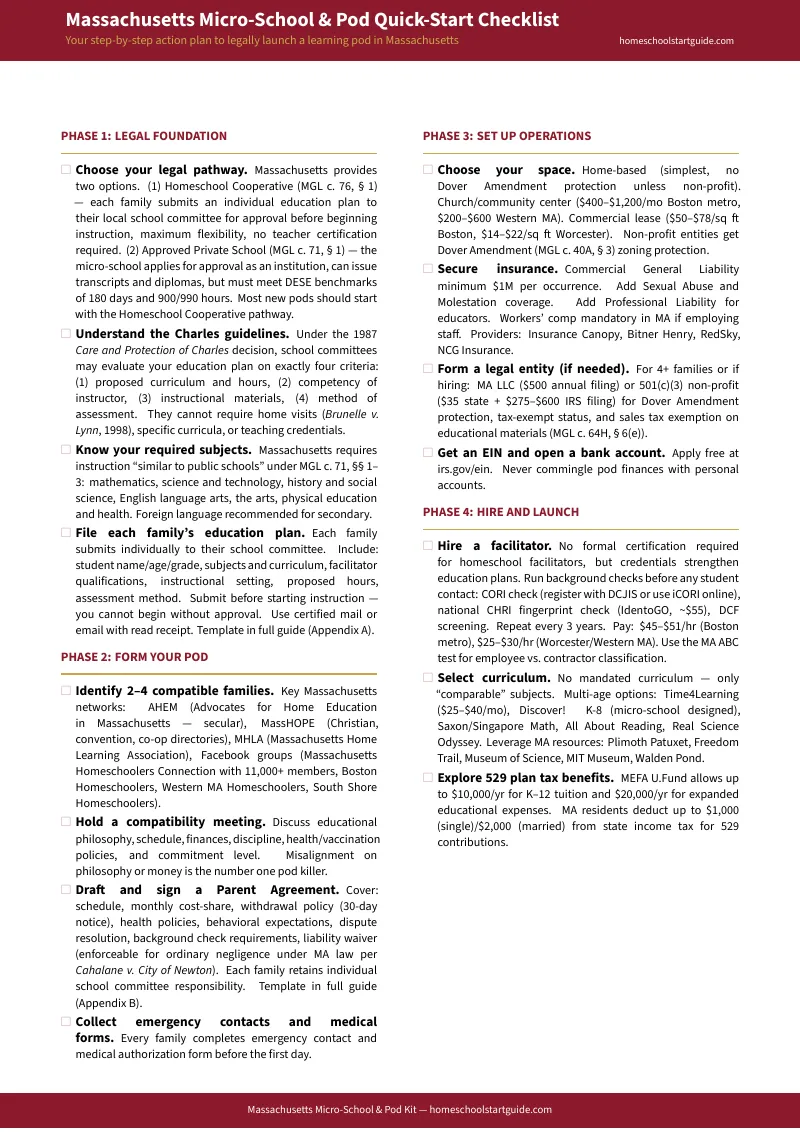
Your download includes the complete guide (21 chapters and 6 appendices covering both legal pathways, the Charles education plan template, Dover Amendment zoning, CORI protocols, liability frameworks, bilingual micro-school planning, university admissions, and scaling), the Massachusetts Pod Quick-Start Checklist (print-and-pin), plus standalone printable templates — the Parent Agreement, the Liability Waiver, the Facilitator Contract, the Massachusetts Regional Budget Planner, the Education Plan Template mapped to the four Charles criteria, and the Background Check Processing Checklist. Instant download, no account required.
30-day money-back guarantee. If the Kit doesn't give you the legal clarity and operational confidence to move forward with your micro-school, email us and we'll refund you. No questions asked.
Not ready for the full Kit? Download the free Massachusetts Homeschool Quick-Start Checklist — a one-page summary of the two legal pathways, school committee filing basics, the Charles criteria, and the key operational steps to launch a learning pod. It's enough to understand your rights and your obligations tonight.
Massachusetts requires school committee approval before you start. The School Committee Compliance System makes sure you get it right the first time.