Your County Portfolio Review Is Scheduled. Is Your Documentation Ready?
You've been homeschooling in Maryland all year — maybe your first year, maybe your fifth. The daily teaching works. Your child is learning, growing, making real progress. But now the email arrives from your county superintendent's office: your portfolio review is scheduled. You have work samples scattered across binders, Google Drive folders, and a kitchen counter pile you keep meaning to organize. You know you need evidence of "regular, thorough instruction" in eight specific subjects — English, mathematics, science, social studies, art, music, health, and physical education. What you don't have is a system for assembling the evidence that proves what you already know: your child is thriving.
Meanwhile, every Maryland homeschool Facebook group has a different opinion about what county reviewers expect, whether your art documentation needs to be photographs or finished work samples, how many items per subject per semester, and what happens if you receive a deficiency notice. MHEA has legal summaries — but no templates. MACHEO has advocacy and umbrella referrals — built inside a faith-based framework that doesn't fit every family. The MSDE website publishes the exact text of COMAR 13A.10.01 — and provides zero tools to execute what the regulation requires. And Etsy has $5 aesthetic planners designed for states that don't require eight mandatory subjects, county portfolio reviews, or thirty-day remediation deadlines.
The Maryland Portfolio & Assessment Templates is a County Review Compliance System — 16 chapters covering every documentation requirement under COMAR 13A.10.01, county-specific review guidance for Maryland's seven largest jurisdictions, and every template you need to walk into your county portfolio review with total confidence — designed to document exactly what the law requires and absolutely nothing more. No daily lesson plans the reviewer never asked for. No hourly attendance tracking Maryland doesn't require. No generic planners built for states with different regulatory frameworks.
What's Inside
Maryland's Two Supervisory Options Decoded
Maryland offers two routes to homeschool legally — Option 1 (direct county supervision) is free but requires you to maintain a portfolio and submit it for review up to three times per year. Option 2 (church-exempt umbrella supervision) costs $50–$150+ per child annually but exempts you from county reviews. Chapter 2 maps both options' requirements side by side so you understand exactly which documentation rules apply to your family — and which don't.
Filing Your Notice of Consent Without Over-Submitting
Your Notice of Consent must reach the local superintendent at least 15 days before you begin home instruction. It must include your intent to homeschool, the name and age of each child, and your home address. What it must not include: your curriculum list, daily schedule, teaching qualifications, or child's birth certificate — though many counties request all of these on official letterhead. Chapter 3 gives you the exact required elements with nothing extra, plus guidance on proof of submission so you're never caught without evidence of timely compliance.
The Eight Required Subjects — What Reviewers Actually Want
COMAR mandates instruction in eight subjects: English, Mathematics, Science, Social Studies, Art, Music, Health, and Physical Education. Chapter 4 breaks down what county reviewers actually look for in each subject — not in the abstract, but with specific evidence types, sample counts, and formatting that satisfies Maryland's "regular, thorough instruction" standard. This is the chapter that prevents the most common review failure: being told your portfolio is deficient in three or four subjects you thought didn't need formal documentation.
Documenting Art, Music, Health, and PE — The "Subjective Four"
These are the subjects parents most commonly under-document — and the most common reason for deficiency notices. Chapter 7 provides specific documentation strategies for each: photography logs for art, practice and performance records for music, curriculum tracking for health education, and activity logs for physical education. Prince George's County requires dated photographs and receipts for community classes. Calvert County wants 3–5 artifacts per subject per semester. These templates are calibrated to the most demanding county standards so they work everywhere in the state.
Grade-Banded Portfolio Frameworks
A kindergartener's portfolio looks nothing like a tenth-grader's. Chapter 6 provides grade-banded documentation frameworks — K–2, 3–5, 6–8, and 9–12 — with specific guidance on what to collect, how many samples per subject across the semester (beginning, middle, end), what "regular, thorough instruction" looks like at each developmental stage, and how to organize evidence that satisfies your reviewer without inviting additional scrutiny. Each framework includes a monthly 15-minute filing system so you never face a last-minute portfolio panic before the review.
County-by-County Review Guide
Maryland's review process varies significantly by jurisdiction. Montgomery County uses MCPS Form 270-34 and schedules reviews differently than Howard County. Baltimore City operates independently from Baltimore County. Prince George's County demands specific "skill reports" for online curricula with dates, skill names, time spent, and grades. Calvert County accepts in-person, video conference, or drop-off reviews but mandates PDF, JPEG, or Microsoft Office formats for digital submissions. Chapter 10 maps the review procedures, contact information, submission formats, and known reviewer expectations for the seven largest jurisdictions — Montgomery, Howard, Baltimore County, Baltimore City, Prince George's, Anne Arundel, and Frederick.
Preparing for the County Portfolio Review
Chapter 9 is your pre-review checklist. It covers your rights under COMAR (the reviewer cannot observe instruction, cannot require your child's presence, cannot impose requirements beyond the regulation), how to schedule at a mutually agreeable time, virtual review options (email submission or video conference), what to bring, how to present your portfolio, what questions to expect, and how to respond if the reviewer exceeds their authority. The August 2019 COMAR revision strengthened your rights — this chapter ensures you know exactly what they are.
Handling an Unsatisfactory Review
If you receive a deficiency notice, you have exactly 30 calendar days to provide supplementary evidence addressing each specific deficiency. If remediation fails, you lose the legal right to homeschool and must enroll your child in a public or approved nonpublic school. Chapter 11 walks through the deficiency response protocol — how to identify what the reviewer is actually asking for, how to gather targeted evidence, how to present the remediation package, and when to involve MHEA, MACHEO, or HSLDA for legal support.
High School Transcript Templates
The transcript is the highest-stakes document you'll produce as a Maryland homeschool parent. Maryland does not issue a state diploma to homeschooled students — the parent generates the transcript. Chapter 12 provides a transcript template designed for Maryland university admissions — with fields for course title, credits, grade, grading scale, cumulative GPA, and your signature as supervisor. Plus: how to calculate weighted and unweighted GPAs, how to document dual enrollment community college credits, and the specific formatting requirements for UMD (signed, notarized transcript), Johns Hopkins (comprehensive programme summary, detailed course descriptions, textbook bibliography, external recommendation), Towson, and UMBC.
Financial Aid, Scholarships, and the BOOST Programme
Chapter 13 covers FAFSA documentation for homeschooled students, the Maryland BOOST scholarship (up to $4,400 for students transitioning to nonpublic school or homeschool programmes), Maryland 529 Plan documentation for homeschool expenses, community college dual enrollment tuition structures, and the financial planning timeline for college-bound homeschoolers.
Special Situations
Chapter 15 covers the scenarios generic templates completely ignore: neurodivergent learners (IEP/504 considerations, child find rights, documentation strategies for ADHD, dyslexia, and autism), military families at Fort Meade, Joint Base Andrews, and Aberdeen Proving Ground (interstate transfer, mid-year compliance), unschooling and non-traditional approaches (mapping organic learning onto COMAR's eight subjects), sports access and extracurricular participation, and public school re-entry procedures.
Who This Is For
- First-year Maryland homeschool parents who filed their Notice of Consent and have no system for organizing what they'll need to show the county reviewer at their first portfolio review
- Parents approaching a scheduled review with a year of scattered work samples, under-documented Art, Music, Health, and PE, and rising anxiety about whether their portfolio will satisfy the reviewer
- Parents who have been over-documenting — keeping daily lesson plans, saving every worksheet, submitting curriculum details to the county — and need to understand what COMAR actually requires versus what they've been doing out of fear
- Families switching from Option 2 (umbrella supervision at $50–$150+/year per child) to free Option 1 (county supervision) and need their own portfolio system for the first time
- High school parents who suddenly realize Maryland won't issue a state diploma to homeschooled students and need a professional transcript for UMD, Johns Hopkins, Towson, or UMBC admissions
- Parents in Montgomery County, Howard County, Prince George's County, or Baltimore who want county-specific review guidance — not generic Maryland advice
- Secular, eclectic, and post-pandemic homeschoolers who want a documentation system that isn't embedded inside a religious umbrella or a $8/month tracking app designed for states with different requirements
- Military families at Fort Meade, Joint Base Andrews, or Aberdeen Proving Ground who just PCSed to Maryland from a state with completely different documentation requirements
Why Not Just Use the Free Resources?
You can. MHEA has legal summaries. MACHEO has advocacy resources. The MSDE publishes the full text of COMAR 13A.10.01. Here's what actually happens when you try to assemble a documentation system from free sources:
- MSDE gives you the rules — and zero tools to follow them. The state's website provides the bare legal text of COMAR 13A.10.01. It plainly states the requirement to instruct in eight subjects and explains the 15-day notice rule. If your program is deemed deficient, you get a written notice and 30 days. The state's posture is entirely punitive, not supportive. You know what you'll be penalized for — but have no structured templates to prevent the penalty.
- County websites add local complexity without local templates. Calvert County demands 3–5 artifacts per subject representing the beginning, middle, and end of the semester. Prince George's County requires specific "skill reports" for online curricula. Montgomery County uses its own form (270-34). Each county publishes what they'll judge you on but offers no organizational tools to help you build your defense.
- MHEA and MACHEO offer excellent advocacy — not documentation systems. MHEA provides human-readable overviews of the law and suggests using a binder with eight tabs. MACHEO provides umbrella referrals and membership-based resources. Neither provides the fillable templates, grade-banded frameworks, or county-specific review guides that transform legal knowledge into a reviewer-ready portfolio.
- Etsy planners are a liability in Maryland. Generic homeschool planners include daily schedules, chore charts, and hourly trackers — features designed for states that require attendance hour tracking. Maryland doesn't require it. These planners lack the eight-subject structure COMAR mandates, provide no guidance for Art, Music, Health, and PE documentation, and have never been tested against a strict Montgomery County or Prince George's County reviewer. A $5 aesthetic planner designed for a low-regulation state will not protect you during a Maryland portfolio review.
- Umbrella organizations cost $50–$150+ per child every year. Families pay these annual fees primarily to avoid the anxiety of interacting with the county. A one-time purchase of this guide gives you the system and confidence to handle the free Option 1 county review yourself — saving hundreds or thousands of dollars over your child's educational career.
- Facebook group advice is a game of telephone. Parents routinely share portfolio tips from other states, recommend attendance formats Maryland doesn't require, and amplify review horror stories that make the process sound more adversarial than it is. The August 2019 COMAR revision strengthened parental rights — and most group advice predates it.
The free resources explain what the law says. These templates are engineered to do exactly what the law requires — and nothing more.
— Less Than One Year of Umbrella Fees
The cheapest umbrella organization in Maryland charges $50 per child per year. Many charge $100–$150+. Recurring annual fees add up to hundreds of dollars per child over a homeschool career. Transcript-specific software charges $16–$20+ per student or requires ongoing memberships. A disorganized portfolio means a stressful reviewer interaction — and a higher likelihood of a deficiency notice that puts your legal right to homeschool on a 30-day clock.
Your download includes the complete guide, the Quick-Start Checklist, and 7 standalone printable tools — 9 PDFs:
- guide.pdf — The full 16-chapter guide covering Maryland's supervisory options, Notice of Consent, eight required subjects, portfolio building, grade-banded frameworks, documenting Art/Music/Health/PE, non-traditional approaches, county review preparation, county-by-county review guide, deficiency response, high school transcripts, financial aid, extracurricular access, special situations, and annual compliance calendar.
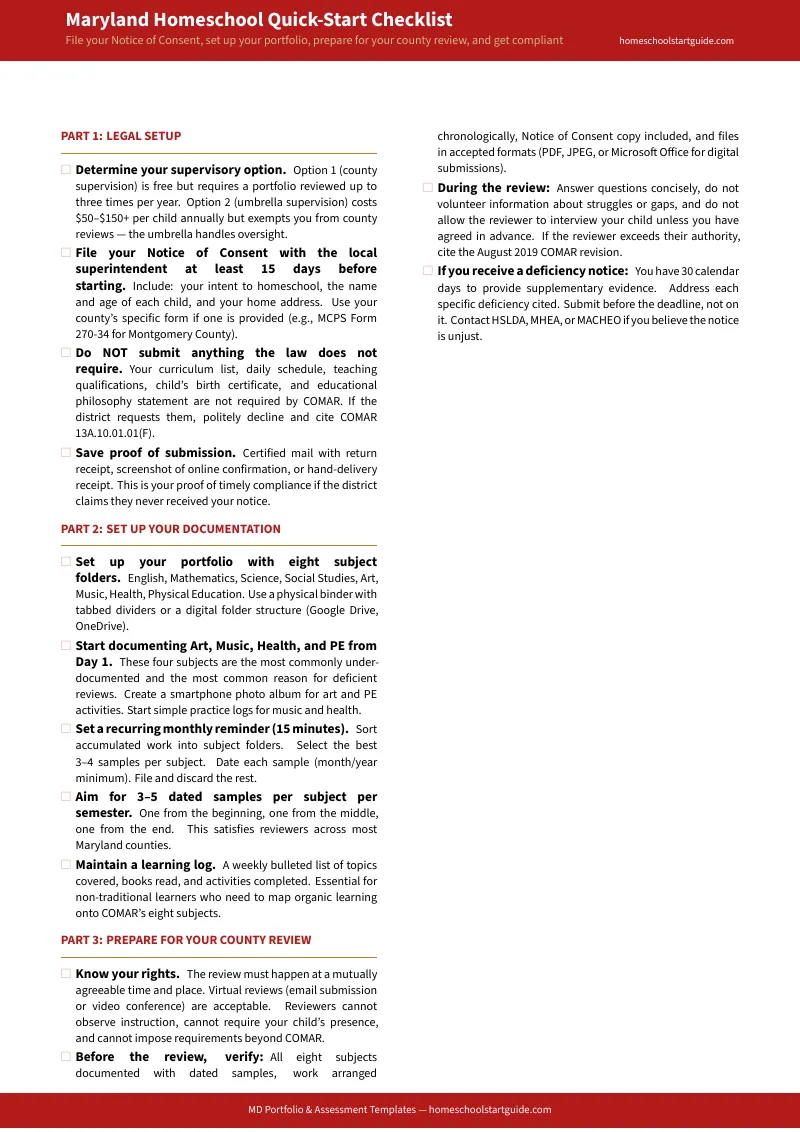
- checklist.pdf — Quick-Start Checklist: a printable action plan from legal setup through portfolio organization, review preparation, and high school essentials.
- grade-banded-frameworks.pdf — What to collect at each level (K–2, 3–5, 6–8, 9–12) with subject-specific evidence lists and volume guidance.
- subjective-four-templates.pdf — Documentation strategies and log templates for Art, Music, Health, and PE — the four subjects that cause the most deficiency notices.
- county-review-guide.pdf — Review procedures, forms, and reviewer expectations for Montgomery, Howard, Baltimore County, Baltimore City, Prince George's, Anne Arundel, and Frederick.
- transcript-template.pdf — Fillable high school transcript formatted for UMD (with notary field), Johns Hopkins, Towson, and UMBC admissions.
- review-preparation-checklist.pdf — Your COMAR rights, pre-review checklist, review conduct guidance, and how to handle reviewer overreach.
- deficiency-response-protocol.pdf — Step-by-step guidance for responding to an unsatisfactory review within the 30-day remediation window.
- compliance-calendar.pdf — Month-by-month tasks from summer setup through spring portfolio review — post it on your fridge.
9 PDFs. Instant download, no account required.
30-day money-back guarantee. If these templates don't give you the structure and confidence to pass your county portfolio review, email us and we'll refund you. No questions asked.
Not ready for the full guide? Download the free Maryland Homeschool Quick-Start Checklist — a printable overview of the legal setup steps, Notice of Consent requirements, eight-subject portfolio basics, review preparation, and high school essentials. It's enough to get oriented, and it's free.
Maryland doesn't require you to prove you're a perfect teacher. It requires the county reviewer to confirm that "regular, thorough instruction" is occurring. These templates make the proof effortless.