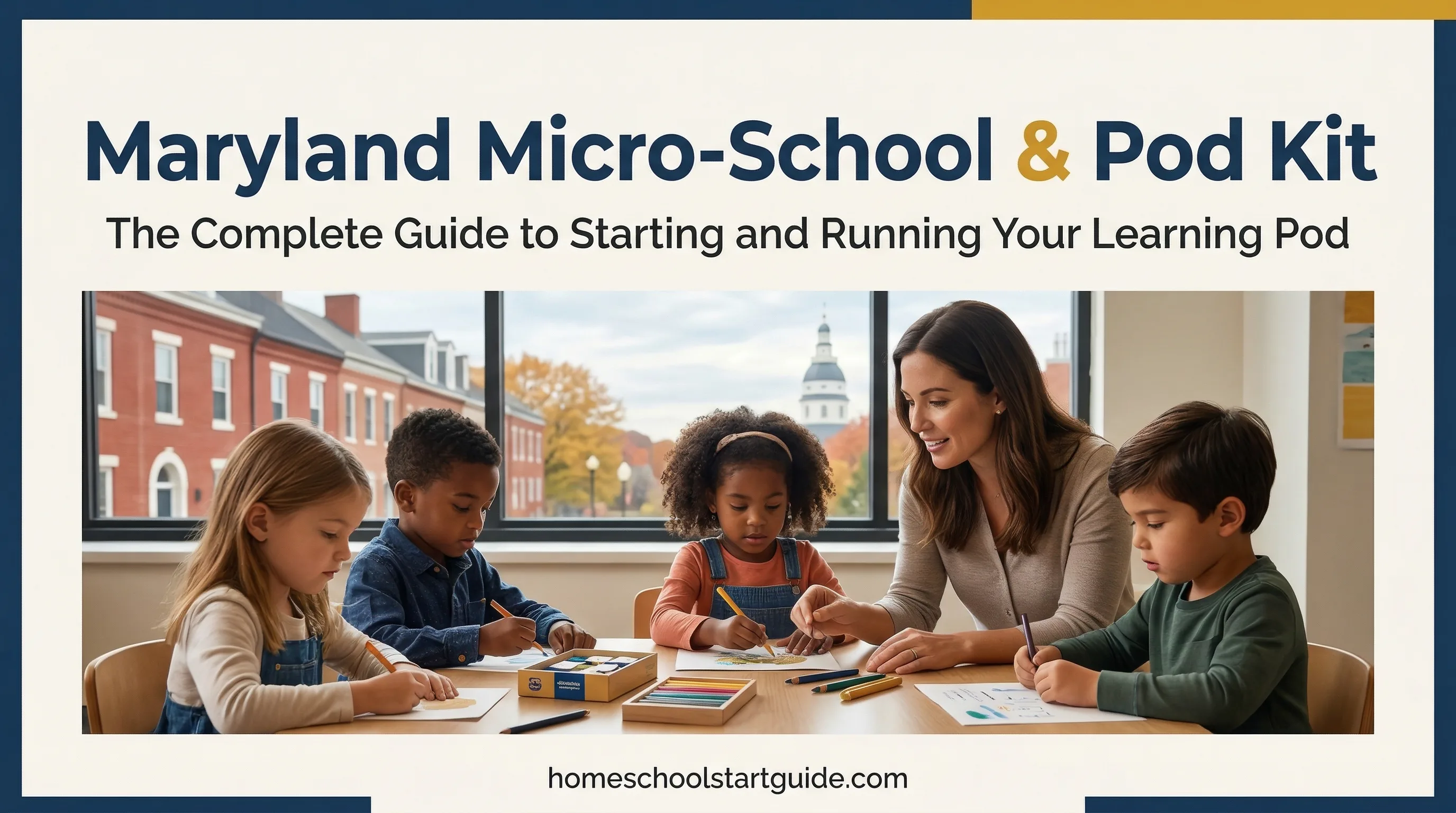
The Maryland Pod Compliance System: Launch Your Learning Pod with Legal Clarity, Portfolio-Ready Documentation, and a Complete Operational Framework.
Maryland is a high-regulation homeschool state. The administrative burden is real: file a Notice of Intent with your local superintendent at least 15 days before instruction begins, provide "regular, thorough instruction" across eight mandated subjects, and submit to portfolio reviews up to three times per year under Option 1 supervision. Over 40,000 Maryland families are already homeschooling — a number that surged post-pandemic and has not come back down. But here is the problem nobody in the Facebook groups or MHEA newsletters will tell you clearly.
You want to gather three to five neighborhood families, share the teaching load, and build something that actually fits your children. Maybe you are a Montgomery County parent who cannot stomach another year of $30,000+ private school tuition when you know three other families who feel the same way. Maybe you are in Howard County and you have been solo homeschooling for two years — your child is thriving academically but starving for peers, and you are burning out at the kitchen table. Maybe you are a military spouse near Fort Meade or Joint Base Andrews and your family has PCS'd twice in four years — every school transition sets your child back months, and you need something portable. Maybe you are in Baltimore County and you have watched the test scores, read the reports, and decided your child deserves better than what the district is providing. Whatever the reason, you have arrived at the same conclusion: I need to build this with other families.
The moment you do, Maryland law gets complicated in ways that single-family homeschooling does not. Each family must file its own Notice of Intent. Each family must choose a supervision option — Option 1 (local school system review with portfolio reviews up to three times per year) or Option 2 (church-exempt umbrella school — bypasses public school reviews but requires religious alignment and umbrella fees). Your micro-school must cover all eight subjects for every student. And when your pod grows past five students, MSDE may view it as an unregistered nonpublic school operating under COMAR 13A.09.09 — which triggers a completely different regulatory pathway requiring a Certificate of Approval, a 170-day school year, and bachelor's degree requirements for teachers of credit-bearing courses. An anonymous complaint to your county superintendent is all it takes for the question to be asked. MHEA warns about regulatory overreach. County-specific Facebook groups give contradictory advice about whether your pod needs formal registration. There are zero affordable resources that explain how to legally structure a Maryland learning pod to navigate both pathways.
The Maryland Micro-School & Pod Kit — the Maryland Pod Compliance System — is that resource.
What's Inside the Maryland Pod Compliance System
The Two-Pathway Legal Framework
Because Maryland has two distinct legal pathways for group learning — and choosing the wrong one means either operating an unregistered private school in your living room or drowning in compliance requirements your pod does not actually need. Pathway 1: Home Education Cooperative — each family files its own Notice of Intent under COMAR 13A.10.01, selects a supervision option (Option 1 or Option 2), maximum flexibility, no teacher certification required for the pod facilitator. Pathway 2: Registered Nonpublic School — the micro-school registers with MSDE under COMAR 13A.09.09, handles all compliance centrally, must operate 170 days per year, teachers of secondary credit-bearing courses need a bachelor's degree. This section walks you through each with a plain-English decision tree — including the critical 5+ student threshold where MSDE may reclassify your cooperative as a nonpublic school — so you choose correctly before your first family meeting.
The Supervision Option Decision Tree
Because the single most confusing decision for Maryland pod parents is whether to use Option 1 (local school system review — portfolio reviews up to three times per year by a county superintendent's designee) or Option 2 (church-exempt umbrella school — bypasses all public school reviews but requires enrollment with a religious umbrella at $50–$400+ per year). This section explains what each option actually requires in practice, how they interact with group instruction, when Option 2 is strategically superior for pods that want minimal government oversight, and the critical fact that different families within the same pod can use different supervision options simultaneously.
Portfolio Review Preparation System
Because Maryland's portfolio reviews are the single greatest source of anxiety for homeschool families — and when you are preparing portfolios for children taught in a group setting, the documentation requirements multiply. This section gives you the exact framework for what county reviewers expect to see: dated work samples across all eight subjects (English, math, science, social studies, art, music, health, and PE), how to individualize documentation for each student even when instruction is shared, what "regular, thorough instruction" actually means in practice versus the legalistic COMAR language, and how to handle reviewers who ask questions that exceed their legal authority.
Family Agreement and Liability Waiver Templates
Because the most common reason pods collapse is not bad curriculum — it is undefined expectations between adults about money, scheduling, and what happens when someone wants to leave mid-year. Customizable templates covering cost-sharing, curriculum authority, health policies, behavioral expectations, dispute resolution with a 30-day mediation period, and withdrawal terms with 30-day written notice. Written without religious language or ideological prerequisites. Each template includes a Maryland-specific compliance clause clarifying that every family retains individual responsibility for their own Notice of Intent, supervision option, and portfolio.
Background Check and Hiring Guide
Because hiring someone to teach other people's children without the correct background checks exposes every family in the pod to catastrophic liability. Maryland requires a Criminal History Records Check (CHRC) through the CJIS Central Repository (DPSCS) — two sets of fingerprints via an authorized LiveScan provider, covering both state and FBI records, approximately $50–$75 per applicant, results in 5–10 business days. This section covers how to run the check, how to classify your facilitator correctly (W-2 vs. 1099 — misclassification carries IRS and Maryland Comptroller penalties), and real Maryland pay benchmarks so you can budget accurately.
Budget Planning with Real Maryland Numbers
Because splitting costs "evenly" between a family with three children and a family with one sounds fair until the first invoice arrives — and financial resentment is the second most common reason pods dissolve. Real Maryland benchmarks for space rental ($300–$800/month for a church classroom in Montgomery County or Howard County, $600–$1,500/month for commercial), CGL insurance ($200–$500/year), curriculum ($200–$600/student/year), and facilitator compensation. Plus cost-sharing formulas for equal-split, per-child, and sliding-scale models — with worked examples showing how a 6-student pod costs a fraction of DC-suburb private school tuition while every family retains full educational control. Includes the 2025 digital goods tax expansion: if you charge a flat tuition that includes digital curriculum access, you need to itemize your invoices.
County-by-County Zoning Guides
Because zoning compliance is hyperlocal and a generic national guide cannot tell you that Montgomery County requires a "Low Impact" home occupation registration for more than 5 client vehicle visits per week, or that Howard County requires a conditional use permit for instructional schools in residential zones, or that Baltimore County is exceptionally restrictive for home-based educational activities. This section covers zoning specifics for the five major Maryland counties where most pods form — Montgomery, Howard, Baltimore, Anne Arundel, and Prince George's — plus the church-space and commercial-space alternatives that sidestep residential zoning entirely.
The Maryland Pod Launch Checklist
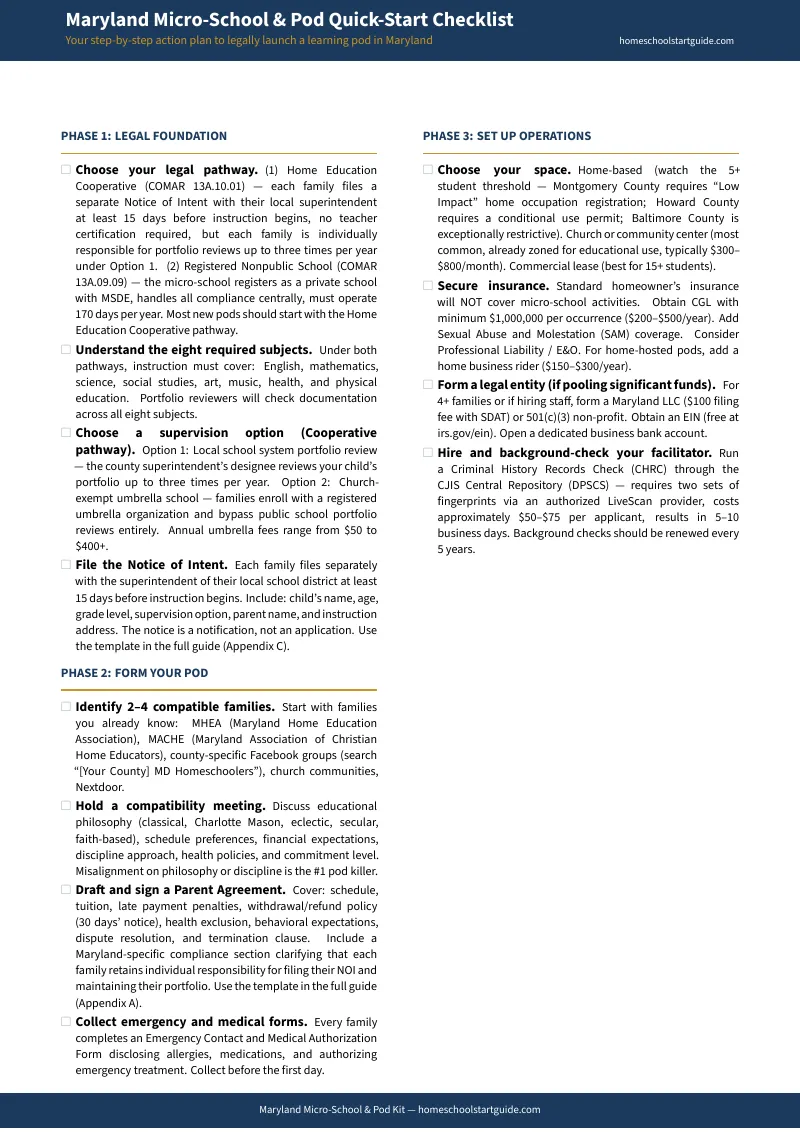
Because most parents spend forty-plus hours stitching together the launch sequence from COMAR regulations, MSDE fact sheets, MHEA newsletters, county-specific Facebook groups, and scattered Reddit threads — and still are not sure they got the order right. A single-page, print-and-pin document covering legal foundation, pod formation, operations setup, curriculum and scheduling, staffing, and launch milestones in the correct sequence — with key legal references (COMAR 13A.10.01, COMAR 13A.09.09, Education Article §2-206) at the bottom.
Who This Kit Is For
- Parents who want to form a small learning community of 3–12 students with two to five families — sharing the teaching load, splitting costs, and building something intentional rather than defaulting to a $2,199/year franchise or a $30,000+/year DC-suburb private school
- Montgomery County and Howard County families priced out of Sidwell, Bullis, Holton-Arms, and the rest of the DC-metro private school circuit who want a rigorous, parent-controlled alternative at a fraction of the cost
- Solo homeschoolers burning out after two or three years of teaching alone who want to share facilitation with other families without losing control of their child's education or navigating Maryland's portfolio review system solo
- Parents choosing between Option 1 (county superintendent portfolio review) and Option 2 (church-exempt umbrella) who want a clear decision framework for which supervision pathway works best in a group setting
- Military families near Fort Meade, Aberdeen Proving Ground, Joint Base Andrews, and the Naval Academy in Annapolis who face frequent PCS moves and need a portable, flexible education model that works regardless of which installation they are assigned to next
- Parents of neurodivergent children (autism, ADHD, dyslexia, twice-exceptional) who need a calmer, self-paced environment with a small group that actually accommodates their child — and cannot find it in the public school system or in traditional co-ops
- Former educators who want to serve their community by running a small paid pod or micro-school — without the overhead, revenue sharing, and loss of autonomy that comes with a Prenda, KaiPod, or Acton franchise
- Prince George's County, Baltimore County, and Anne Arundel County families seeking alternatives to underperforming public schools who want a structured, community-driven option that does not require a private school budget
After Using the Kit, You'll Be Able To
- Choose the right legal pathway for your pod — Home Education Cooperative under COMAR 13A.10.01 or Registered Nonpublic School under COMAR 13A.09.09 — using the two-pathway decision framework and the 5+ student threshold instead of guessing from Facebook advice
- Select the optimal supervision option (Option 1 county review or Option 2 church-exempt umbrella) for your pod's size, philosophy, and tolerance for government oversight — and understand that different families in the same pod can use different options
- Prepare portfolios for group-taught students that satisfy county superintendent reviews — with dated work samples across all eight required subjects, individualized documentation for each child, and clear boundaries for when a reviewer exceeds their legal authority
- Run your first parent meeting using a signed family agreement and liability waiver that accounts for Maryland-specific compliance requirements — without spending $300–$525 per hour on a DC-area education consultant
- Hire a facilitator with the correct Maryland CJIS background check, proper W-2 classification, and competitive pay benchmarks — avoiding the liability and tax issues that sink underprepared pods
- Build a budget that every family agrees on — using real Maryland cost benchmarks for your specific county and a cost-sharing formula that prevents resentment and financial surprises
- Navigate zoning requirements specific to your county — Montgomery, Howard, Baltimore, Anne Arundel, or Prince George's — or sidestep residential zoning entirely with the church-space and commercial-space strategies in the guide
- Access dual enrollment at Maryland community colleges with a mandatory 25–32.5% tuition discount, and build transcripts that satisfy University of Maryland, Towson, UMBC, and other Maryland university admissions requirements
Why Not Just Use the Free Resources?
MSDE publishes home instruction fact sheets. MHEA provides advocacy guidance. Facebook groups share experiences. Here is exactly what you run into when you try to build a pod from those sources alone:
- MSDE's home instruction resources are built for single-family homeschoolers. They explain the Notice of Intent process, the eight-subject requirement, and the portfolio review timeline. They do not explain how five families sharing a facilitator should structure legal responsibility, manage shared finances, draft multi-family agreements, or avoid the 5+ student threshold that triggers nonpublic school classification. MSDE's FAQ explicitly warns that it "may take action against the operator(s)" of cooperatives functioning as unlicensed private schools — a vague threat with zero roadmap for legal compliance.
- MHEA's guidance is adversarial, not operational. MHEA is Maryland's oldest homeschool advocacy organization and they do important legal protection work. But their tone is combative — they warn parents of "creeping regulation" and advise refusing to provide any documentation beyond the legal minimum. Modern parents forming pods want collaborative, streamlined frameworks, not ideological warfare with their county superintendent. And MHEA provides no multi-family business templates, no cost-sharing models, and no zoning guidance.
- Church-exempt umbrellas solve the review problem but nothing else. Option 2 umbrella schools (Frederick Christian Academy, Peaceful Worldschoolers, Freedom Hill Fellowship) eliminate portfolio reviews for $50–$400+ per year. But they require religious alignment that may not fit your pod, they impose their own mid-year and end-of-year reviews, and they provide zero business operational frameworks. Even under an umbrella, you still need parent agreements, liability waivers, facilitator contracts, background check procedures, and financial structuring. The umbrella does not supply any of these.
- Generic Etsy templates are legally dangerous in Maryland. A $3 "Learning Pod Agreement" from Etsy gives you a two-page contract written for a different state — no COMAR-specific legal guidance, no two-pathway distinction, no supervision option analysis, no 5+ student threshold warning, no Maryland CJIS background check procedure, no county-specific zoning guidance. Most Etsy micro-school kits do not know that Montgomery County and Howard County have materially different home occupation rules.
- Franchise networks charge $2,199 to $20,000+ per year. Prenda charges $2,199 per student per year in platform fees. Acton Academy requires a $20,000 startup fee plus ongoing revenue sharing. KaiPod charges $15,000 flat or $249 plus 10% of revenue. They provide the vision and the curriculum platform — but they take a massive cut of your operating budget and restrict your autonomy. Community reviews describe Acton's approach as rigid and dogmatic, with alarming failures to accommodate neurodivergent children.
- Facebook groups are well-meaning but legally unreliable. Parents in Maryland homeschool groups routinely confuse the requirements of the Home Education Cooperative pathway with the Registered Nonpublic School pathway. They share advice that does not distinguish between Option 1 and Option 2 supervision. They recommend filing approaches that differ from county to county without noting the discrepancy. Following crowd-sourced legal guidance in a high-regulation state with portfolio reviews up to three times per year is how pods get flagged, investigated, and forced into compliance pathways they did not choose.
Free resources give you the legal baseline and the inspiration. The Maryland Pod Compliance System gives you the templates, decision frameworks, and county-specific operational playbook to execute this week.
— Less Than One Hour with a DC-Area Education Consultant
A single consultation with a DC-metro education consultant costs $300–$525 per hour. Prenda charges $2,199 per student per year in platform fees. Acton Academy requires a $20,000 startup fee. The Kit costs less than a single consultant session and gives you the legal clarity, operational templates, and county-specific guidance those alternatives are designed to sell piecemeal — or withhold entirely.
Your download includes 8 PDFs: the complete 23-chapter guide with 6 appendices, the Quick-Start Checklist, and 6 standalone printable templates — a Parent Agreement, a Liability Waiver with emergency contact form, a Notice of Intent template, a Facilitator Independent Contractor Agreement, an Annual Compliance Calendar, and a Budget Planning Worksheet. Instant download, no account required.
30-day money-back guarantee. If the Kit does not give you the legal clarity and operational confidence to move forward with your pod, email us and we will refund you. No questions asked.
Not ready for the full Kit? Download the free Maryland Homeschool Quick-Start Checklist — a one-page summary of the two legal pathways, both supervision options, the eight-subject requirement, the 15-day Notice of Intent timeline, and the five-phase launch sequence that applies to your pod from day one. It is enough to understand your rights tonight.
Maryland has a clear legal framework for home instruction. The regulatory complexity is real, but it is navigable. The Maryland Pod Compliance System makes sure you navigate it correctly — the first time.