Maine Has Two Legal Pathways to Homeschool. One Requires Annual Assessment. The Other Doesn't. The State Doesn't Tell You Which One Fits Your Family.
You've made the decision. Your child is struggling — bullied at school in Portland, stuck in an IEP that generates meetings but never results, trapped in a district that just consolidated the neighborhood school and now faces an hour on the bus each way. Maybe the school committee — your neighbors, the parents on the soccer sideline — voted to close the local elementary and you can't stomach the alternative. Maybe you simply looked at the statute and realized you have a legal right to teach your child at home, but within thirty minutes of researching the process, you had four different answers from four different sources.
HOME has decades of advocacy experience and an enormous website — scattered across dozens of pages with no single printable action plan. HSLDA offers attorney-drafted forms behind a $150/year membership. The Maine DOE's NEO Home Instruction Portal walks you through a digital form that asks first-time filers to upload a "Prior Year Assessment" — even though you don't have one yet. And every Maine homeschool Facebook group has a different opinion on whether you should file with the school committee, the Commissioner of Education, or just stop showing up.
Here's the problem most parents don't discover until it's too late: Maine law gives you two completely separate legal pathways — Option 1 (Home Instruction) and Option 2 (Recognized Equivalent Private School, or REPS) — and the oversight, assessment obligations, and local school committee involvement are dramatically different. The Two-Path Decision System inside this Blueprint breaks down the legal, practical, and strategic differences so you choose the right pathway before you file a single piece of paper.
What's Inside the Blueprint
The Option 1 vs Option 2 Decision Matrix
This is the section that prevents the most consequential Maine homeschool mistake. Option 1 requires you to file a Notice of Intent with both the local superintendent and the Commissioner, teach 175 days across ten subjects, and submit an annual assessment. Option 2 lets you organize as (or enroll in) a Recognized Equivalent Private School — bypassing the individual NOI requirement, removing the local superintendent from the equation entirely, and eliminating the annual assessment obligation. The Matrix lays out the filing requirements, oversight level, assessment burden, and strategic implications side by side so you can decide in minutes, not weeks of cross-referencing HOME pages and DOE rules.
The 10-Day NOI Filing Protocol
Maine gives you 10 calendar days from the start of instruction (mid-year withdrawal) or a September 1 deadline (start of year) to file your Notice of Intent. Miss the deadline and you're in truancy territory. The Blueprint includes a fill-in-the-blank NOI letter that contains exactly what Chapter 130 rules require — your name, address, the student's name and age, start date, a statement of subjects and assessment method — and excludes everything it doesn't. No curriculum plans. No textbook lists. No daily schedules. File what the law demands and nothing more.
The School Withdrawal Letter
A separate letter to your child's current school principal, written to establish a clean, documented break. Includes a records request for cumulative files, IEP documents (if applicable), and immunization records. The template tells you what to say, what to exclude, and why you should never sign the school's own withdrawal form — those district-created forms frequently overstep statutory requirements, asking for exit interviews, curriculum details, or waivers that Maine law does not require.
The Annual Assessment Guide
Option 1 families must submit an annual assessment by September 1 of the following year. You have five approved methods: standardized testing, local school assessment, certified Maine teacher portfolio review, support group review, or local advisory board review. The guide explains each method in detail — including how to find a certified teacher evaluator in rural Maine (a genuine challenge when you're in Aroostook or Washington County), what happens if the assessment shows insufficient progress, and how to navigate the remediation and re-assessment process without panic.
The Superintendent Pushback Scripts
In small-town Maine, the school committee members are your neighbors. That makes pushback personal — and harder to resist. When the superintendent demands curriculum plans, requests a meeting to "discuss" your decision, or claims they must "approve" your Notice of Intent, you don't argue and you don't comply. The Scripts provide copy-and-paste responses citing MRSA Title 20-A §5001-A and Chapter 130 rules that politely but firmly establish the boundary between legal requirements and administrative overreach.
The NEO Portal Walkthrough
The Maine DOE's online Home Instruction Portal is the primary filing mechanism — and it's a source of widespread confusion. First-time filers are confronted with a "Prior Year Assessment Type" upload field that doesn't apply to them. The routing logic between digital and paper submissions is convoluted. The Blueprint walks you through the portal step by step so your NOI is filed correctly the first time, without getting trapped in upload fields designed for returning families.
Who This Blueprint Is For
- Parents who need to withdraw their child this week and want the legally correct paperwork ready to file tonight — not after weeks of piecing together information from HOME's sprawling website
- Parents who don't understand the difference between Option 1 and Option 2 and need to know which pathway fits their family before they file anything with the DOE
- Parents whose child has an IEP or 504 Plan and need to understand what happens to special education services after withdrawal — and how to protect their rights without triggering "educational neglect" allegations
- Parents facing their first annual assessment who need to understand the five approved methods and how to find a certified teacher evaluator in their part of the state
- Rural families in towns affected by RSU consolidation who are withdrawing because the local school closed and the alternative is an hour-long bus ride
- Military families at Kittery, Brunswick, or other Maine installations who need Maine-specific compliance procedures before their next PCS cycle
- Franco-American families in the Lewiston-Auburn corridor seeking bilingual or culturally responsive education options outside the public system
- Secular families who need Maine-specific guidance without the religious framing of faith-based organizations or the $150/year commitment of HSLDA
- Parents who've been told by their school committee that they need approval, curriculum plans, or a meeting — and need the exact statutory language to demonstrate otherwise
Why Not Just Use the Free Resources?
You can. HOME has extensive information. The DOE has the NEO portal. HSLDA has legal summaries. Here's what actually happens when you try to assemble a withdrawal strategy from free sources:
- HOME's information is scattered across a labyrinth of web pages with no single, printable blueprint. Their resources are excellent for community, advocacy, and ongoing support — but when you need to file paperwork this week, you're spending hours navigating a dense site map to compile a complete action plan. Their tone is heavily steeped in thirty years of legislative battles and ministry-based framing that actively alienates secular families.
- The Maine DOE NEO Portal tells you what to file but not how to think about it. The portal asks first-time filers to select a "Prior Year Assessment Type" and upload documentation — even though first-year families don't have one. The distinction between first-year and continuation logic is poorly articulated. Paper NOI routing rules are convoluted — mail to the superintendent only, not the DOE. The language is punitive and bureaucratic, emphasising truancy consequences without explaining assessment options or pathway strategy.
- HSLDA gates their attorney-drafted forms behind $150/year. The membership includes real legal representation — valuable for edge cases — but most Maine parents just need the withdrawal paperwork completed correctly. Paying $150 annually for a one-time administrative task is the wrong tool for the job.
- Facebook groups and Reddit give you anecdotes, not law. Well-meaning parents share advice based on how they withdrew their child three years ago — before portal updates changed the upload logic. Following outdated advice could trigger a truancy notice or delay your filing past the 10-day deadline. In small-town Maine, taking legal advice from anonymous internet users about a process that involves your neighbors on the school committee is an unnecessary risk.
— Less Than One Hour With a Tutor
An HSLDA membership runs $150 per year. A single hour with a family attorney costs $250-$400. A truancy investigation triggered by a missed 10-day NOI deadline costs you weeks of anxiety and a potential DHHS visit — in a small town where everyone knows. The Blueprint costs less than a single tutoring session — and you can print your withdrawal letter tonight.
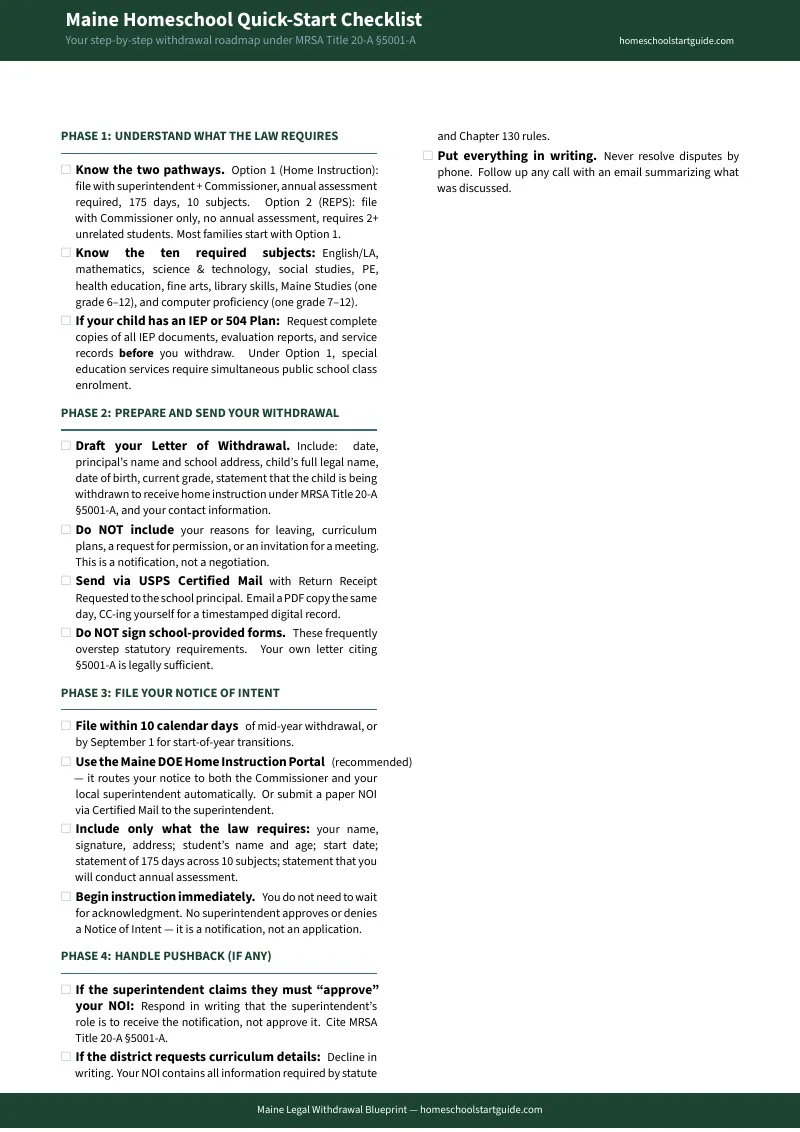
Your download includes the complete Blueprint guide covering all 18 chapters — plus the Quick-Start Checklist you can use immediately. The guide covers the legal framework (MRSA Title 20-A §5001-A and Chapter 130 rules), compulsory education ages, the complete withdrawal process with letter templates, the Notice of Intent filing protocol, Option 1 versus Option 2 decision matrix, the ten required subjects, annual assessment methods, superintendent pushback scripts, truancy law and DHHS procedures, record-keeping, public school access, MPA sports eligibility, special populations (IEP, military, rural, Franco-American), high school transcripts and UMaine admissions, dual enrollment through ExploreC, town tuitioning, support networks, re-enrollment procedures, and a 30-day action plan. Six documents, instant download, no account required: the complete guide, quick-start checklist, withdrawal letter templates, NOI template, pushback scripts, and assessment planning worksheets.
30-day money-back guarantee. If the Blueprint doesn't give you the confidence and legal clarity to execute your withdrawal, email us and we'll refund you. No questions asked.
Not ready for the full Blueprint? Download the free Maine Homeschool Quick-Start Checklist — a one-page overview of the legal requirements, the two pathways, and the filing deadlines. It's enough to get oriented, and it's free.
Your child doesn't have to go back on Monday. Maine law has protected your right to educate at home since MRSA Title 20-A §5001-A was enacted. The Pine Tree State really does recognise home instruction as a lawful alternative — but only if you file the right paperwork through the right pathway within the right deadline. The Blueprint makes sure you do.