Maine Requires 10 Subjects, 175 Days of Instruction, and an Annual Assessment. The State DOE Portal Tells You to File. It Does Not Tell You What Your Portfolio Should Actually Look Like.
You pulled your child out of a Bangor elementary school after the IEP process failed for the third year running. Or you have been homeschooling in Portland for two years and the September 1 assessment deadline is approaching fast — and your documentation lives in a shoebox, three Google Docs, and a stack of library receipts. Or your oldest just started ninth grade and you discovered that the University of Maine wants detailed course descriptions, textbook lists, and competency levels — not the informal learning logs that worked in elementary school. In every case, you have hit the same wall: Maine's homeschool law names 10 required subjects, but nothing tells you how to turn your child's actual learning into a portfolio that a certified teacher will sign off on.
Here is the core problem. MRSA Title 20-A §5001-A requires instruction in 10 subject areas — English language arts, mathematics, science and technology, social studies, physical education, health education, library skills, fine arts, computer proficiency, and Maine Studies. That is more subjects than any other New England state. The DOE's Chapter 130 rules add the 175-day requirement, the Notice of Intent filing, and the annual assessment. But the NEO portal gives you a submission form with zero guidance on portfolio construction. Homeschoolers of Maine sells pre-assembled physical binders for $27.50 per child per year plus shipping — single-use paper forms wrapped in Christian ministry branding. Etsy has beautiful planners built for Texas families that track "Language Arts" and "Social Studies" but have no columns for Maine Studies or Computer Proficiency. The 10-Subject Compliance System inside this toolkit maps every piece of your documentation directly to what §5001-A actually requires, so you never miss a subject, never over-document, and never hand your SAU superintendent a portfolio that leaves gaps.
What's Inside the Toolkit
The §5001-A 10-Subject Matrix
A tracking sheet with ten pre-built columns — one for each subject Maine law mandates. Instead of guessing whether your nature hike counts as "science and technology" or your baking project covers "mathematics," the matrix gives you the exact statutory language and shows how to map any curriculum style — traditional, Charlotte Mason, eclectic, or unschooling — into the ten required buckets. One sheet per child, per year. Fill it in as you go, and your compliance documentation assembles itself.
The Grade-Band Portfolio Frameworks (K–2, 3–5, 6–8, 9–12)
A kindergartner's portfolio should not look like a high schooler's transcript. Each framework specifies exactly what evidence to collect at each developmental stage — the types of work samples, the number to save per subject (the First-Middle-Last Rule: one from September, one from January, one from May), and how to organise them so a certified teacher sees sustained progress without you saving every worksheet your child has ever touched. The K–2 framework is built for play-based and experiential learning. The 9–12 framework is built for UMaine admissions officers.
The High School Transcript Template
Formatted specifically for the University of Maine system — UMaine, USM, UMA, UMFK, UMM, UMF, and UMPI. Maps to a 21–25 credit graduation framework with 4 English, 4 Math through Algebra II, 3 Science, 3 Social Studies, 2 Foreign Language, and electives. Includes course description templates that satisfy UMaine's requirement for detailed textbook lists and competency levels, GPA conversion, grading scale, and parent signature block. Also covers ExplorEC dual enrollment formatting (university system) and OnCourse (community colleges) — including how to generate the 9-digit student ID starting with "9" that the portal requires.
The Assessment Method Decision Guide
Maine offers five legal assessment methods: certified teacher portfolio review, standardised testing (CAT, Stanford, PASS), local school testing, support group review, and advisory board review. Most families default to certified teacher review — but choosing the wrong method for your child's profile wastes time and money, and choosing the right one reduces stress for everyone. The decision guide walks through each method's requirements, timelines, costs, and privacy implications, then matches them to your child's learning style and anxiety profile. For neurodivergent children who cannot tolerate formal testing environments, it explains exactly how to use the portfolio review path to demonstrate progress without a single timed exam.
The Certified Teacher Review Preparation Kit
The certified teacher portfolio review is the most private assessment method — only the evaluator's letter is submitted to the state, not your actual portfolio. But finding an evaluator in rural Maine can be difficult. The kit includes a preparation checklist for what to bring, what to organise, and what to expect during the review. It covers HOME's evaluator network, MaineHEA's referral system, and the digital evaluation option for families in Aroostook County, Washington County, or other areas where in-person evaluators are hours away.
The 175-Day Attendance Log Templates
Monthly tracking grids from September through June with an annual summary page. Maine requires 175 days of instruction — not 175 days of traditional school. Weekend field trips, summer reading, museum visits, and nature exploration all count. The log uses simple daily checkmarks — no hourly tracking required — with space to note non-traditional instruction days so your record stands up to any SAU inquiry.
The SAU Interaction Playbook
Your superintendent does not approve your curriculum, your teaching methods, or your daily schedule. Their role is administrative: receive your Notice of Intent and confirm you submitted an annual assessment. But some SAUs — particularly in small towns where the superintendent knows your family personally — overreach. The playbook scripts exact responses for common overreach scenarios: requests for curriculum samples, demands for home visits, requirements to use specific testing, and pressure to align with Maine Learning Results. Based on §5001-A boundaries, not advocacy group talking points.
The Unschooler's Translation Guide
Your unschooled child spent the morning building a dam in a creek, the afternoon reading about Wabanaki history, and the evening calculating recipe proportions for dinner. That morning covered science and technology and physical education. The afternoon covered social studies and Maine Studies. The evening covered mathematics. The Translation Guide shows how to document child-led, experiential, and project-based learning in the statutory language of §5001-A — including how to capture Maine Studies through Franco-American heritage projects, maritime economy explorations, and Wabanaki cultural studies — without changing how you teach.
Who This Toolkit Is For
- First-year homeschool parents in Maine who need a documentation system mapped to the 10 required subjects — not a generic Etsy planner designed for a different state's laws
- Parents approaching the September 1 assessment deadline who need to assemble a compliant portfolio from a year's worth of scattered work samples, reading logs, and field trip receipts
- Parents of high schoolers who need transcripts that UMaine, USM, UMA, UMFK, UMM, UMF, or UMPI admissions offices will accept — formatted with course descriptions, textbook lists, and competency levels
- Unschooling and eclectic families who need to translate experiential learning into the statutory language of §5001-A without compromising their educational philosophy
- Parents in Portland, Bangor, Lewiston-Auburn, Augusta, or midcoast communities where homeschool enrollment has doubled and SAU documentation expectations have tightened
- Rural families in Aroostook, Washington, or Piscataquis County who need digital evaluation options because the nearest certified teacher evaluator is two hours away
- Franco-American families in Lewiston-Auburn and northern Maine who want to document bilingual French-English instruction as part of their Maine Studies and language arts coverage
- Families relocating to Maine from low-regulation states (Texas, Alaska, Florida) who are shocked by the 10-subject requirement and the annual assessment mandate
- Secular families who need Maine-specific guidance without HOME's Christian ministry framing or HSLDA's $135/year membership requirement
Why Not Just Use HOME's Free Forms?
You can. Homeschoolers of Maine has downloadable PDF packets and pre-assembled physical binders. Here is what actually happens when you try to build a portfolio system from existing resources:
- HOME's free PDFs are bare-minimum forms designed to upsell you into their $49 portfolio review service and $27.50 physical binders. They list what reviewing teachers expect but give you no system for assembling it throughout the year. You end up in a July panic trying to retrofit nine months of learning into their format — and paying $27.50 per child per year for a disposable paper product.
- Etsy and TpT portfolio templates do not track Maine's 10 subjects. They track generic categories like "Language Arts" and "Social Studies." When a certified teacher reviews your portfolio against §5001-A, they are looking for explicit evidence of all 10 mandated subjects — including Maine Studies and Computer Proficiency. A template designed for Texas or California leaves gaps that can trigger a remediation notice.
- The NEO portal is a submission vehicle, not a documentation tool. It tells you where to file your Notice of Intent and upload your assessment. It says nothing about what a compliant portfolio looks like, how many work samples to save, or how to document non-traditional learning. Once you submit, you cannot retrieve or edit your forms without contacting the superintendent.
- Homeschool Tracker, My School Year, and Homeschool Planet charge $60–$70/year for software that micro-schedules daily lesson plans. Maine does not require daily grading rubrics or hour-by-hour tracking — it requires a demonstration of 175 days and an annual portfolio showing progress. You get a scheduling app, not a compliance tool.
— Less Than a Single Physical Binder
HOME's pre-assembled binder costs $27.50 per child per year plus shipping. Homeschool SaaS platforms cost $60–$70 per year. A single hour with an education attorney costs $250–$400. A panicked weekend in July assembling a portfolio from scattered Google Docs, shoebox receipts, and conflicting Facebook advice costs you the weekend — and still leaves gaps a certified teacher might flag.
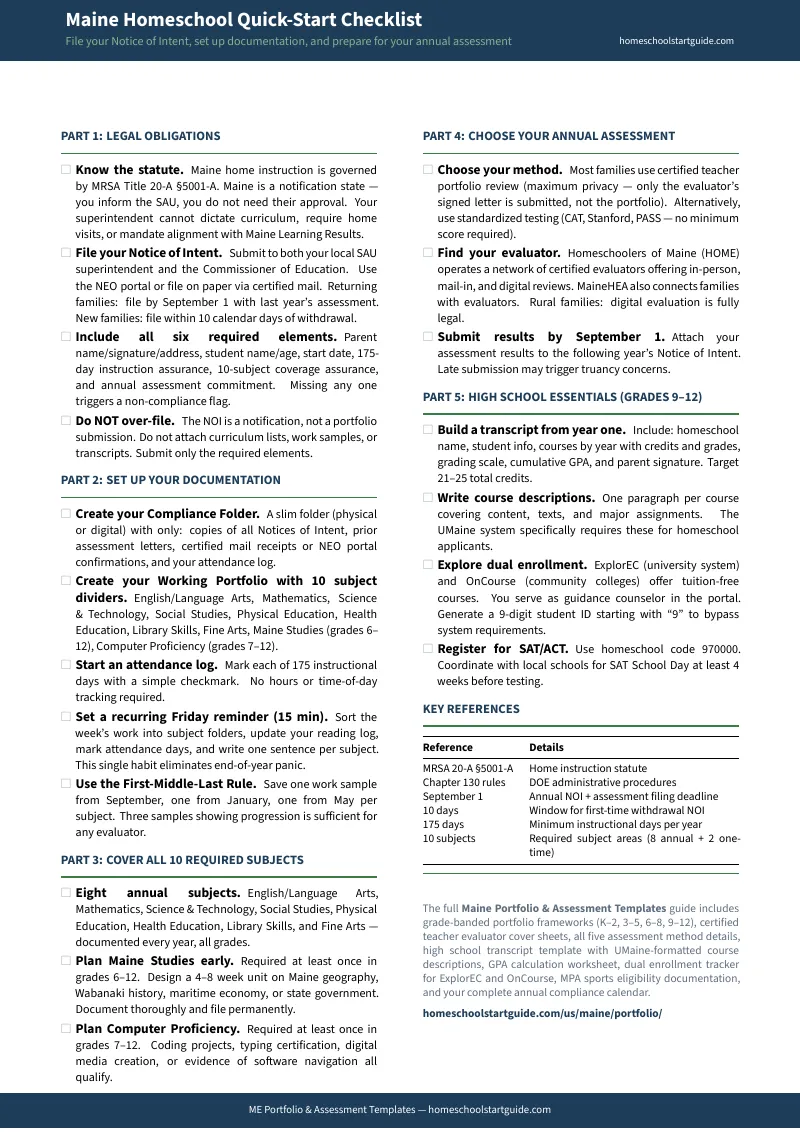
Your download includes the complete 16-chapter guide, the Maine Homeschool Quick-Start Checklist, and standalone printable templates: the §5001-A 10-Subject Matrix, the High School Transcript Template (formatted for the entire UMaine system), the Assessment Method Decision Guide, the Certified Teacher Review Preparation Kit, 175-Day Attendance Log Templates (September through June), the SAU Interaction Playbook, and the Unschooler's Translation Guide. Instant download, no account required.
30-day money-back guarantee. If the toolkit does not give you the documentation system and legal clarity to confidently manage your Maine homeschool portfolio, email us and we will refund you. No questions asked.
Not ready for the full toolkit? Download the free Maine Homeschool Quick-Start Checklist — a one-page guide covering legal setup, the 10 required subjects, documentation basics, the assessment decision, and your first-week action plan. It is enough to get started, and it is free.
Maine law says you can educate your child at home. MRSA Title 20-A §5001-A proves it. Your documentation system should too.