
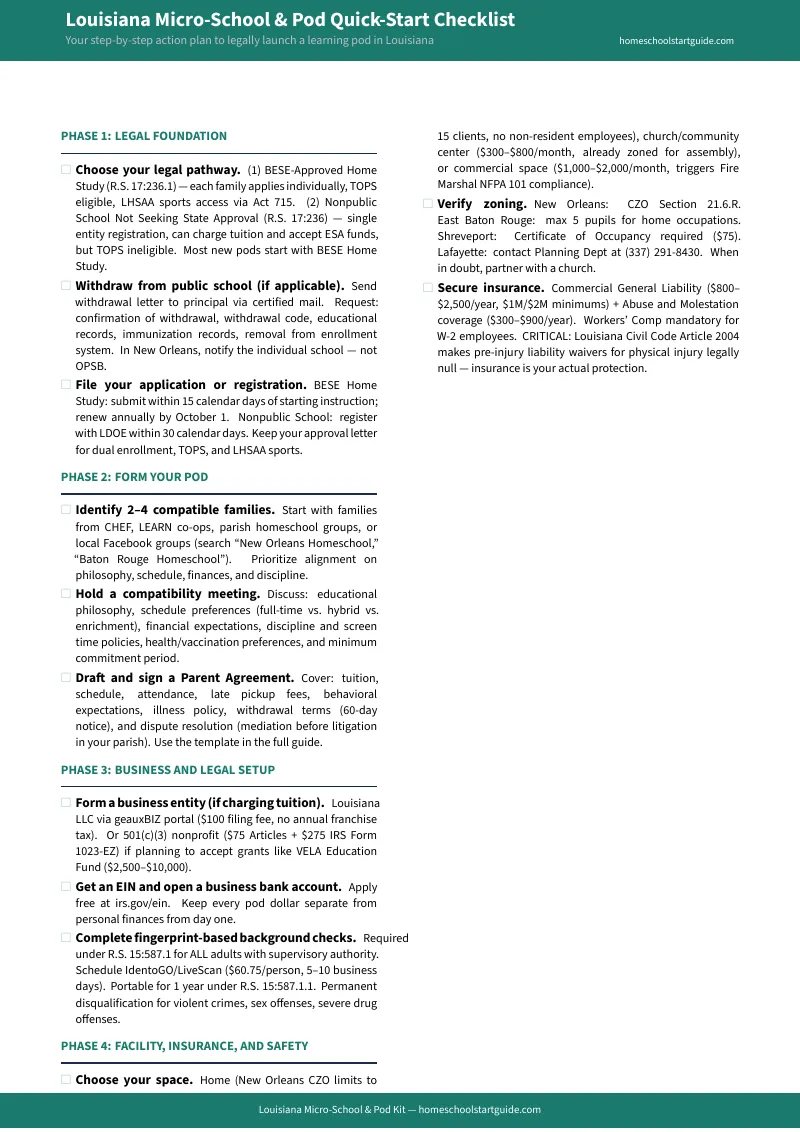
The Louisiana Pod Compliance System: Start Your Micro-School Without Losing TOPS, Triggering DCFS, or Surrendering Your Autonomy to a Franchise.
Louisiana gives you two legal pathways to build a micro-school. One preserves your child's TOPS scholarship eligibility — worth up to $7,048 per year at a public university. The other gives you maximum operational freedom but costs your high schooler that scholarship unless you switch pathways for grades 11 and 12. Nobody explains this trade-off until you have already filed the wrong paperwork. The LA GATOR ESA program is about to send up to $7,626 per student — or $15,253 for special education students — to approved providers. But your pod can only access that money if it registers on the Odyssey Marketplace platform, and the pathway you choose determines whether that registration is even possible.
Meanwhile, you have spent two weeks reading contradictory advice across LDOE bulletins, CHEF resources, HSLDA articles, and parish-specific Facebook groups. The LDOE "Learning Pod Pre-Opening Checklist" requires threat assessment policies and law enforcement coordination — but that form was designed for charter schools opening satellite campuses, not parents forming a neighbourhood learning pod. A parent in the Louisiana Homeschool Moms group says you just file with BESE and you are good to go. Someone on the NOLA Parents subreddit says you need to register as a nonpublic school. An HSLDA article warns about pods being reported as unlicensed daycares — then locks the solution behind a $130 annual membership.
You still do not know which pathway preserves TOPS. You do not know whether hosting eight children in your Lakeview living room triggers DCFS childcare licensing. And you do not know whether the LA GATOR money your family qualifies for can actually flow to your pod.
The Louisiana Micro-School & Pod Kit — the Louisiana Pod Compliance System — is the resource that maps both legal pathways against TOPS and LA GATOR implications, gives you the IdentoGO background check process, explains why Article 2004 makes standard liability waivers useless in Louisiana, and provides every template you need to launch a legally sound micro-school — whether you are in a Metairie subdivision, a church fellowship hall in Lafayette, or a rented space in Baton Rouge.
What's Inside the Louisiana Pod Compliance System
The Two-Pathway Decision Framework
Because Louisiana has two practical legal routes for micro-schools — and the choice between them determines your TOPS eligibility, your LA GATOR access, your testing obligations, and your liability exposure. Pathway 1: BESE-Approved Home Study under R.S. 17:236.1 — each participating family maintains their own individual approval, submits annual curriculum applications, and students take state-mandated tests at grades 3, 5, 7, and 9. Pathway 2: Nonpublic School Not Seeking State Approval under R.S. 17:236 — the micro-school registers as a single private school entity with broad curricular and operational autonomy, no mandatory testing. This section walks you through each with a plain-English diagnostic — including the Home Study paradox that makes your pathway choice the most consequential decision in the entire guide — so you choose correctly before filing a single document.
The Home Study Paradox — TOPS, LA GATOR, and the Choice That Changes Everything
Because picking the wrong pathway can cost your child thousands in college scholarships and you will not know until application season. Under the Home Study pathway, students maintain TOPS eligibility — Louisiana's merit-based aid worth up to $7,048 per year. Under the Nonpublic School pathway, students lose TOPS unless they switch back to Home Study for grades 11 and 12. Meanwhile, LA GATOR ESA eligibility depends on prior public school enrollment and income thresholds during the phase-in period. The Kit maps every combination — pathway choice, TOPS impact, LA GATOR access, testing obligations — so you make an informed decision in Year 1 that does not cost your family in Year 12.
LA GATOR ESA — How to Access Up to $15,253 Per Student
Because the money is rolling out starting 2025–2026 and nobody has consolidated the registration process for grassroots micro-school founders. The Kit walks through the Odyssey Marketplace provider registration, the application timeline (the March window is critical), income verification requirements, approved expense categories, and the strategic implications for different pod structures — so you know whether your pod can accept state funding before you build your budget around it.
Background Checks Under R.S. 15:587.1 — The IdentoGO Process
Because hiring someone to teach other people's children without the correct clearances exposes every family in the pod to catastrophic liability. Louisiana requires criminal background checks through IdentoGO — $60.75 per applicant, specific ORI and service codes for educational personnel, Louisiana State Police clearance letter, and a DCFS child abuse and neglect registry check. The Kit provides the step-by-step process, the exact codes, and a tracking system so nobody falls through the cracks.
Why Article 2004 Makes Standard Waivers Useless — and What Actually Protects You
Because the pre-injury liability waivers that work in most other states are legally null in Louisiana. Article 2004 of the Louisiana Civil Code prohibits advance waiver of liability for physical injury. You cannot have parents sign away their right to sue if their child is injured. The Kit explains what actually works instead: Commercial General Liability insurance ($1,000,000 minimum per occurrence), Sexual Abuse and Molestation coverage, LLC formation via geauxBIZ to separate personal assets from pod liability, and acknowledgment-of-risk documents that are enforceable under Louisiana law.
Parent Agreements That Prevent Pod Implosions
Because the most common reason micro-schools fail is not legal trouble — it is a family who stops paying, a philosophical clash that festers, or a dispute about facilitator authority that splits the group. The Kit includes a comprehensive parent agreement template covering mission, schedule, tuition structure, payment terms, late payment penalties, withdrawal and refund policy, behavioural expectations, health and illness exclusion, dispute resolution, and termination procedures. Have every family sign before the first day — and the interpersonal conflict that dissolves most pods within the first semester never gets the chance to build.
Facilitator Hiring with Regional Pay Benchmarks
Because running a micro-school in New Orleans costs more than running one in Ruston — and misclassifying your facilitator as an independent contractor when they are legally an employee carries IRS and Louisiana Employment Security Law penalties. Real Louisiana compensation benchmarks: New Orleans $25–$40/hour, Baton Rouge $22–$35/hour, Lafayette $20–$30/hour, Shreveport $18–$28/hour, and rural parishes $15–$22/hour. Plus the W-2 vs. 1099 classification framework under the IRS economic reality test that determines your tax and liability obligations.
Zoning and DCFS Checklists for New Orleans, Baton Rouge, Lafayette, and Shreveport
Because zoning compliance is hyperlocal and a generic national guide cannot tell you that Orleans Parish's Comprehensive Zoning Ordinance has historic district overlay restrictions, or that Baton Rouge's Unified Development Code has different home occupation rules than Lafayette's zoning ordinance. This section covers zoning specifics for the four major Louisiana metro areas where most pods form — plus the church-space and commercial-space alternatives that sidestep residential zoning and DCFS childcare licensing triggers entirely.
Budget Models with Real Louisiana Numbers
Because splitting costs "evenly" between a family with three children and a family with one sounds fair until the first invoice arrives. Three models with real numbers: home-based co-op (5 students, parent-led, $600–$1,200/student/year), church-based pod (8–10 students, part-time facilitator, $2,000–$4,000/student), and commercial-space micro-school (10–15 students, full-time facilitator, $4,000–$7,000/student). Each includes facilitator compensation, space costs, curriculum, insurance, and a reserve fund — with regional adjustments for New Orleans Metro, Baton Rouge, Lafayette, Shreveport, and rural parishes. Compare that to $15,000+ per year at Newman, Country Day, or Metairie Park Country Day.
TOPS Preparation, Dual Enrollment, and LHSAA Sports Access
Because your micro-school students need a path to college, college credits, and extracurriculars. The TOPS chapter maps exact requirements — 19 ACT for Opportunity, 23 for Performance, 27 for Honors — against each legal pathway. The LCTCS dual enrollment chapter covers eligibility, the application process, and credit transferability to LSU, ULL, UNO, and other state institutions. The LHSAA Act 715 chapter covers sports access requirements, enrollment timing restrictions, and alternatives through community recreational leagues and homeschool athletic organisations.
Who This Kit Is For
- New Orleans parents done with the OneApp charter lottery — your child was assigned across the city, your charter closed mid-year, or your neurodivergent child was locked out of selective-admissions schools — who want to build an alternative without surrendering to a $2,199/student/year franchise or a $15,000/year private school
- Solo homeschoolers burning out across Louisiana — you have been the only teacher, social coordinator, and record keeper for too long, and you want to share the load with other families without accidentally voiding anyone's BESE Home Study compliance
- Parents seeking LA GATOR ESA funding for their pod — you want to know whether the money can flow to your micro-school, how to register on the Odyssey Marketplace, and which legal pathway preserves that access
- Parents priced out of Louisiana private schools — Lusher, Newman, Country Day, Teurlings Catholic, Loyola College Prep — who want small-group instruction at a fraction of the cost while retaining full curriculum control
- Neurodivergent families who need a calmer, self-paced environment with a small group that actually accommodates their child — sensory-friendly spaces, therapeutic integration, flexible pacing — because the IEP process has been a years-long battle
- Acadiana families who want to integrate CODOFIL's Cajun French and Louisiana Creole programming into their children's daily education — something no standardised public school curriculum prioritises
- Rural parish families fighting geographic isolation — the nearest private school is an hour away, your local public school has been consolidated twice, and a micro-school brings the options to your community instead of requiring your family to leave it
- Former educators who want to run a small paid pod or micro-school — without the overhead, revenue sharing, and loss of autonomy that comes with a Prenda, KaiPod, or Acton franchise
After Using the Kit, You'll Be Able To
- Choose the right legal pathway for your pod — BESE-Approved Home Study or Nonpublic School Not Seeking Approval — using the diagnostic framework that maps your TOPS considerations, LA GATOR eligibility, and growth plans to the correct Louisiana pathway
- Avoid the Home Study paradox — understanding exactly how the pathway choice affects TOPS scholarship eligibility and LA GATOR ESA access, so you do not make an irreversible decision in Year 1 that costs your child thousands in Year 12
- Navigate LA GATOR ESA registration — the Odyssey Marketplace provider process, application windows, and the strategic trade-offs between pathways
- Run your first parent meeting using a signed parent agreement and liability waiver that accounts for Louisiana Civil Code Article 2004 — without spending $200–$400 on an education attorney consultation
- Hire a facilitator with the correct IdentoGO background checks under R.S. 15:587.1, proper W-2 classification, and competitive regional pay benchmarks
- Build a budget that every family agrees on — using real Louisiana cost benchmarks for your specific metro area and a cost-sharing formula that prevents resentment
- Navigate zoning in your municipality — with specific guidance for New Orleans CZO, Baton Rouge UDC, Lafayette, and Shreveport zoning codes
- Avoid DCFS childcare licensing triggers — knowing exactly when your pod's structure crosses the line from homeschool co-op to regulated Type III Early Learning Centre
- Prepare students for TOPS, set up LCTCS dual enrollment, and access LHSAA sports — with the requirements mapped to your specific legal pathway
Why Not Just Use the Free Resources?
- LDOE's "Learning Pod Pre-Opening Checklist" is designed for charter schools, not parents. It requires institutional threat assessment policies, law enforcement coordination, and commercial insurance frameworks — because it was written for public charter schools opening satellite pod campuses under their LEA umbrella. A parent reading this official state form would believe they need to draft institutional security protocols to teach five children in a living room. The actual filing process for independent micro-schools is completely different.
- CHEF requires a Statement of Faith and demands parents stay on-site. CHEF is Louisiana's most prominent homeschool organisation — and it requires all members to sign a strict evangelical Statement of Faith, excluding secular, moderate, or non-evangelical families. CHEF co-ops are parent-led and require every parent to remain on-site and volunteer. If you want a secular, drop-off micro-school with a paid facilitator, CHEF's resources are the starting point — not the answer.
- HSLDA paywalls the actual legal forms. Their free Louisiana overview correctly identifies the state as "moderate regulation." They warn about pods being reported as unlicensed daycares. But the usable withdrawal templates, notification letters, and compliance forms cost $130/year in membership fees. They highlight the problem and lock the solution behind a paywall.
- Generic Etsy templates are legally dangerous in Louisiana. A $12 "Learning Pod Agreement" from Etsy contains zero Louisiana-specific legal frameworks. No R.S. 17:236.1 analysis. No IdentoGO background check process. No TOPS scholarship mapping. No explanation of why Article 2004 makes their included liability waiver legally null in Louisiana. A generic contract will not protect you when your pod's structure inadvertently costs your child their college scholarship.
- Franchise networks charge $2,199 to $20,000+ per year. Prenda charges $2,199 per student per year in platform fees. Acton Academy requires $20,000+ upfront plus revenue sharing. KaiPod's Catalyst programme costs $249 plus 10% revenue share or $15,000 flat. They handle the administration — but they take a massive cut of your operating budget, dictate your curriculum, and restrict your autonomy. With LA GATOR ESA funds potentially covering student costs, every dollar you surrender to a franchise fee is a dollar that could stay in your families' pockets.
- Facebook groups are well-meaning but legally unreliable. Parents in Louisiana homeschool groups routinely confuse the two legal pathways, give incorrect advice about TOPS eligibility under different structures, and cannot explain the LA GATOR ESA registration process. Following crowd-sourced legal guidance on the Home Study paradox is how families lose thousands in college scholarships they did not know they were forfeiting.
Free resources give you scattered pieces of a solo homeschooling puzzle. The Louisiana Pod Compliance System gives you both legal pathways mapped against TOPS and LA GATOR implications, the Home Study paradox analysis, the IdentoGO background check process, the Article 2004 liability framework, the parent agreements, the facilitator hiring system, the budget models, the metro-specific zoning and DCFS checklists, and every template you need to execute this week.
— Less Than One Hour with an Education Attorney
A single consultation with a New Orleans or Baton Rouge education attorney costs $200–$400 per hour. Prenda charges $2,199 per student per year in platform fees. Acton Academy requires $20,000 upfront. The Kit costs less than a single attorney consultation and gives you the legal clarity, operational templates, and metro-specific guidance those alternatives are designed to sell piecemeal — or withhold entirely.
Your download includes the complete 26-chapter guide, the Quick-Start Checklist, and standalone printable templates: a Parent Agreement, a Liability Waiver and Emergency Contact Form, a BESE Application Cover Letter, and a Public School Withdrawal Letter. Instant download, no account required.
30-day money-back guarantee. If the Kit doesn't give you the legal clarity and operational confidence to move forward with your pod, email us and we'll refund you. No questions asked.
Not ready for the full Kit? Download the free Louisiana Homeschool Quick-Start Checklist — a one-page summary of the two legal pathways, the Home Study paradox, the key R.S. references, and the launch sequence that applies to your pod from day one. It's enough to understand your rights tonight.
Louisiana law gives you extraordinary educational freedom. The LA GATOR program is about to make it affordable. The Louisiana Pod Compliance System makes sure you use both correctly.