Kentucky Doesn't Ask for Your Records. But Colleges, Scholarships, and Your Child's Future Will.
Kentucky homeschool law is simple: submit a letter of intent, teach eight subjects, log 1,062 hours, and update a "scholarship report" every six to nine weeks. No testing. No portfolio reviews. No state approval. Parents exhale — and then stop keeping records entirely.
Then the KEES scholarship application arrives. Or the University of Kentucky asks for an official transcript with the Pre-College Curriculum. Or KCTCS needs dual enrollment documentation. And the parent who spent four years teaching a brilliant curriculum discovers they can't prove any of it happened.
The Kentucky Portfolio & Assessment Templates is the complete documentation system — scholarship report templates built around KRS 159.040's nine-week cycle, professional transcript frameworks that UK and UofL actually accept, KEES ACT bonus tracking, and subject-by-subject documentation guides for all eight required subjects. Not a generic planner with attendance logs from states that aren't yours. A system built entirely around Kentucky's specific legal framework and what Kentucky institutions actually expect.
What's Inside
The KRS 159.040 Compliance Framework
Chapter 1 explains why documentation still matters when the state rarely checks — and why the parents who stopped keeping records are the ones panicking at college application time. Chapter 2 maps exactly what Kentucky law requires (letter of intent, 1,062 hours, scholarship reports in eight subjects) and what it explicitly does not require (standardised testing, curriculum approval, teacher certification, portfolio submission). You'll know exactly what to document and what to skip.
The Scholarship Report System
KRS 159.040 requires homeschools to maintain "scholarship reports" on the same schedule as local public schools — typically every six to nine weeks. Most parents have never seen what a compliant scholarship report actually looks like because the Kentucky Department of Education refuses to provide a template. Chapter 2 gives you the specific format with all eight required subjects mapped, progress indicators, and the statutory reference printed at the bottom. Fill it in every grading period and you're covered if a Director of Pupil Personnel ever requests records.
Standardised Testing Strategy (Grades 3, 6, and 8)
Kentucky doesn't legally require testing, but thousands of homeschool parents voluntarily test at grades 3, 6, and 8 — the same milestones where public school students take the Kentucky Summative Assessment. Chapter 3 compares every option: CAT, Iowa, Stanford-10, Woodcock-Johnson, and online alternatives. It covers where to find test administrators (including rural Eastern KY), what the scores actually tell you, and how to use results for your own peace of mind without inviting state oversight.
Grade-Level Documentation Strategies (K-12)
What counts as good documentation for a first grader looks nothing like what UK admissions expects from a junior. Chapter 5 provides grade-level strategies: reading logs and milestone photos for K-2, essay drafts and curriculum logs for grades 3-8, and full course documentation with graded assignments for high school. Each level includes specific examples of what to save, what to photograph, and what to skip.
Subject-by-Subject Documentation Guide
Kentucky requires instruction in eight subjects: reading, writing, spelling, grammar, history, mathematics, science, and civics. Chapter 6 shows you exactly what to document for each one — not generic advice, but Kentucky-specific examples tied to the subjects the state actually mandates. Whether you use Charlotte Mason, unschooling, or a textbook curriculum, the documentation examples adapt to your approach.
Documenting Non-Traditional Learning
Chapter 7 is for the unschooling family, the project-based learner, and the nature-study household. It shows you how to translate interest-led exploration into documentation that meets KRS 159.040's subject requirements — without forcing your child into a textbook box. A creek exploration becomes a science sample. A baking project becomes mathematics and reading. The system honours your teaching style while satisfying the legal framework.
Professional Transcript Creation
Chapter 8 is the transcript chapter — the one that prevents your child's homeschool record from looking like an arts-and-crafts project. It covers course naming conventions (use "Algebra I" not "Math Stuff"), credit assignment (1.0 for full year, 0.5 for semester), weighted and unweighted GPA calculation, the course description supplement that competitive universities expect, and formatting standards that make your transcript look institutional. Morehead State requires notarisation. UK wants the Pre-College Curriculum mapped. This chapter handles both.
KCTCS Dual Enrollment Guide
Kentucky's community college system lets homeschool students earn college credits in high school — often tuition-free. But you need specific documentation to enrol, and the credits must be recorded correctly on your transcript to count toward KEES eligibility. Chapter 9 walks through every step: finding participating colleges, meeting admission requirements, documenting the coursework, and integrating dual-credit grades into your transcript and GPA.
University-Specific Admissions Requirements
The University of Kentucky wants something different from the University of Louisville, and both want something different from Western Kentucky University. Chapter 10 provides institution-specific documentation requirements for UK, UofL, WKU, EKU, NKU, and Morehead State — what each admissions office expects from homeschooled applicants, how to format course descriptions, and when to submit supplemental materials.
The KEES Scholarship — What Homeschoolers Need to Know
Public school students build a KEES base award automatically through their GPA — up to $2,000 for a 4.0. Homeschoolers cannot use their parent-generated GPA for the base award. They qualify only for the ACT/SAT bonus award (up to $500/year for an ACT of 28+). Chapter 11 explains this critical financial nuance, provides ACT score tracking templates, and shows how dual-credit coursework at KCTCS can create weighted GPA entries that strengthen your child's academic profile.
Sports, Extracurriculars, and Special Programmes
Your homeschooler can play public school varsity sports under KHSAA's HB 290 provisions. They can pursue the Kentucky Seal of Biliteracy. They can document extracurriculars for college applications. Chapter 12 covers the eligibility rules, enrollment requirements, and documentation needed for each programme — so you're not scrambling when the athletic director asks for paperwork.
Who This Is For
- Parents setting up their first year's scholarship report and unsure what it's supposed to look like — because the KDE and CHEK don't provide a usable template
- Parents approaching a testing year (grade 3, 6, or 8) who want to voluntarily assess for peace of mind without triggering state involvement
- Parents whose child is entering high school and who suddenly realise they need formal transcripts, not a box of worksheets
- Parents preparing for UK, UofL, or WKU admissions who need institution-specific documentation guidance
- Parents who want to maximise their child's KEES scholarship eligibility through documented ACT scores and dual-credit coursework
- Parents using the Kentucky withdrawal product who now need the ongoing documentation system — the withdrawal guide gets you out of school, this gets you organised for the years ahead
- Louisville, Lexington, Northern Kentucky, and Bowling Green families whose districts handle compliance differently
- Unschooling and project-based families who need to translate non-traditional learning into documentation that institutions recognise
- Secular families who want legally accurate templates without the religious framing of CHEK resources
Why Not Just Use the Free Resources?
You can. Here's what you'll find:
- The Kentucky Department of Education provides the law — and nothing else. Their homeschool information packet tells you that KRS 159.040 requires "scholarship reports" but gives you zero visual examples of what one looks like. The tone is legalistic and intimidating. It tells you what to do but never how.
- CHEK provides a 1997 "Best Practices" document and free intent letter samples. Invaluable for advocacy and religious liberty protection. But their forms are outdated in appearance, lack modern portfolio templates, and don't address KEES scholarship strategy, dual-credit documentation, or secular college admissions guidance.
- Etsy and TPT sell generic $5-15 planners built for every state. They include mandatory attendance trackers and portfolio submission forms designed for high-regulation states like Pennsylvania and New York. They don't know that Kentucky requires eight subjects (not six). They don't mention scholarship reports, KEES, KCTCS dual enrollment, or KHSAA eligibility. They solve the "pretty binder" problem while creating the "wrong state" problem.
- Homeschool Tracker charges $65/year for software that requires daily data entry and a steep learning curve. Kentucky's requirements can be met with a simple system updated every six to nine weeks — not an app designed for states that demand hourly tracking.
- Blog posts and YouTube videos cost you time, not money. To build a compliant, Kentucky-specific portfolio from free sources, you'll spend dozens of hours cross-referencing KDE statutes, watching 20-minute walkthroughs, and formatting your own Word documents. And you'll still wonder whether you got it right.
Free resources tell you what Kentucky law requires. This guide gives you the exact system to execute it — subject by subject, grade by grade, deadline by deadline.
— Less Than One ACT Registration Fee
A single ACT registration costs $68. Homeschool Tracker charges $65 every year. PACHEK membership runs $60/year. A weak transcript that costs your child KEES scholarship money? That's thousands of dollars in lost college funding. This guide costs less than one standardised test session.
Your download includes the complete guide, 7 standalone printable tools, and the Quick-Start Checklist — 9 PDFs:
- guide.pdf — The full Kentucky Portfolio & Assessment Templates: 17 chapters covering the KRS 159.040 compliance framework, scholarship report templates, standardised testing strategy for grades 3/6/8, grade-level documentation (K-12), subject-by-subject guides for all eight required subjects, non-traditional learning documentation, professional transcript creation with GPA calculation, KCTCS dual enrollment, university-specific admissions (UK, UofL, WKU, EKU, NKU, Morehead State), KEES scholarship strategy, KHSAA sports eligibility, the Kentucky homeschool diploma, district variations, special populations guidance, and a year-round documentation calendar.
- scholarship-report-template.pdf — Fillable nine-week scholarship report with all eight required subjects mapped, grading period fields, and the KRS 159.040 statutory reference. Print one per grading period.
- transcript-template.pdf — Professional transcript builder with course naming conventions, credit assignment guide, GPA calculation (weighted and unweighted), UK Pre-College Curriculum mapping, and course description supplement template.
- kees-act-tracker.pdf — KEES ACT bonus award scale, score tracking worksheet, and scholarship maximisation strategy. The one page that shows exactly how much college money each ACT point is worth.
- university-requirements.pdf — Institution-specific admissions reference for UK, UofL, WKU, Morehead State, EKU, and NKU — what each school expects from homeschool applicants on a single printable card.
- testing-comparison.pdf — Side-by-side comparison of CAT, Iowa, Stanford-10, PIAT, and Woodcock-Johnson with administrator requirements and Kentucky-specific access strategies.
- documentation-calendar.pdf — Year-round month-by-month task calendar with Kentucky deadlines for letter of intent, scholarship reports, KCTCS dual enrolment, ACT registration, and portfolio compilation.
- krs-compliance-reference.pdf — What Kentucky law requires and what it does not, the eight required subjects, and exactly what your Director of Pupil Personnel can and cannot inspect. Pin it above your desk.
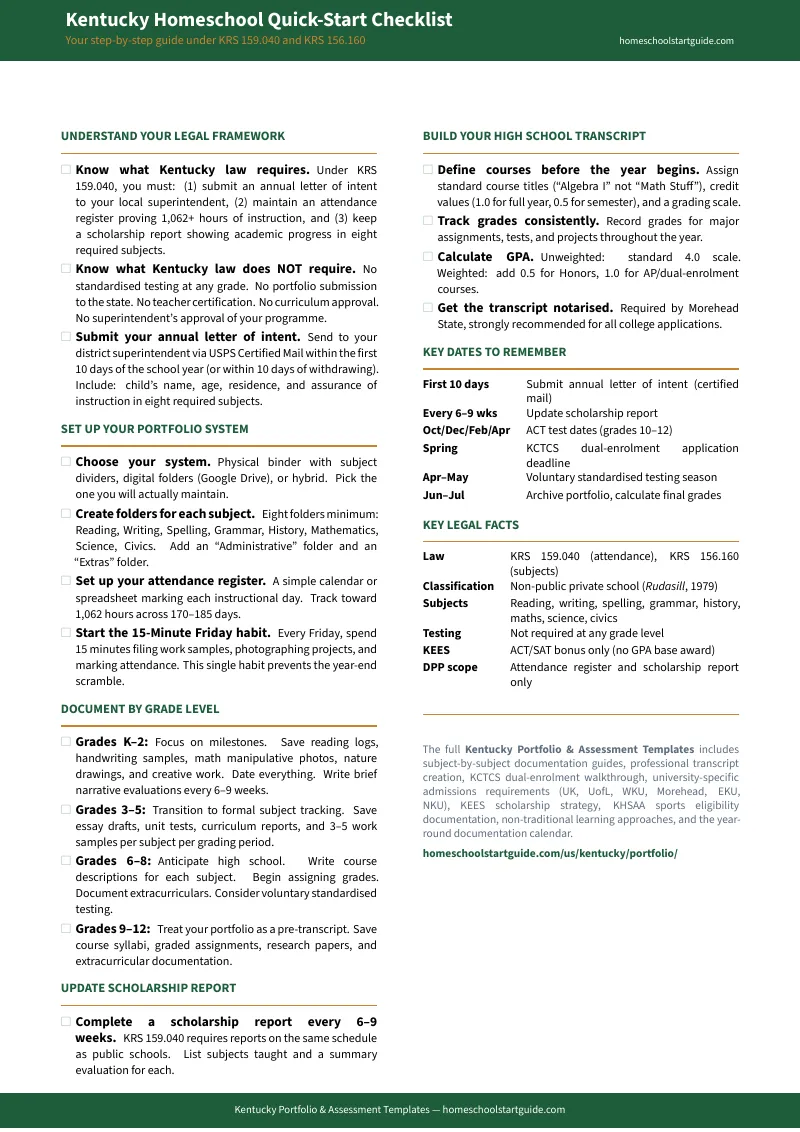
- checklist.pdf — The Kentucky Homeschool Portfolio Quick-Start Checklist: a printable action plan covering legal requirements, portfolio setup, grade-level documentation, scholarship report scheduling, transcript basics, and key Kentucky deadlines.
9 PDFs. Instant download, no account required.
30-day money-back guarantee. If the guide doesn't give you the documentation system and transcript framework you need, email us and we'll refund you. No questions asked.
Not ready for the full guide? Download the free Kentucky Homeschool Portfolio Quick-Start Checklist — a printable overview of Kentucky's legal requirements, portfolio setup steps, scholarship report scheduling, transcript basics, and key compliance deadlines. It's enough to get oriented, and it's free.
Kentucky gave you the freedom to educate your child without state interference. This guide makes sure you have the documentation to prove it was worth every minute.