
The Kentucky Pod Compliance System: Launch Your Learning Pod with Legal Clarity and a Complete Operational Framework.
Kentucky is one of the most homeschool-friendly states in the country. The 1979 Rudasill decision stripped the state of authority to dictate curriculum, require teacher certification, or mandate testing for non-public schools. The administrative burden is minimal: file one Notice of Intent per year and keep attendance records. Forty-one thousand Kentucky students are already being homeschooled — a 56 percent increase in six years. But here is the problem nobody tells you about until it is too late.
You want to gather three or four neighborhood families, share the teaching load, and build something that actually fits your children. Maybe you're a Louisville parent whose child has been stranded by JCPS bus cancellations one too many times. Maybe you're in Lexington and you've been priced out of every private school worth considering — tuition routinely exceeds $10,000 per year, and Kentucky voters defeated the voucher amendment in 2024, so no state subsidies are coming. Maybe you're in Northern Kentucky or Bowling Green and the nearest co-op is parent-led and demands you stay on-site all day — impossible when you work full-time. Maybe you've been solo homeschooling for two years and your child is thriving academically but starving for peers. Whatever the reason, you've arrived at the same conclusion: I need to build this with other families.
The moment you do, Kentucky law gets complicated. A parent teaching their own children at home is classified as a private school under KRS 159.030 — fully protected by the Rudasill decision, virtually no regulation. But when multiple families' children gather regularly in one home for instruction, the Kentucky Department of Education explicitly classifies that operation differently. They call it a "home-based school" — and that triggers a cascade of commercial regulations: State Fire Marshal inspections under NFPA 101, potential classification as a Type II Day Care Center with child-to-caregiver ratios and square-footage minimums, and local zoning compliance that can require a Conditional Use Permit and public hearings. An angry neighbor's phone call to code enforcement is all it takes. HSLDA warns about this. CHEK's Best Practices Document doesn't cover it. There are zero affordable resources that explain how to legally structure a Kentucky learning pod to avoid this trap.
The Kentucky Micro-School & Pod Kit — the Kentucky Pod Compliance System — is that resource.
What's Inside the Kentucky Pod Compliance System
The Three-Pathway Decision Framework
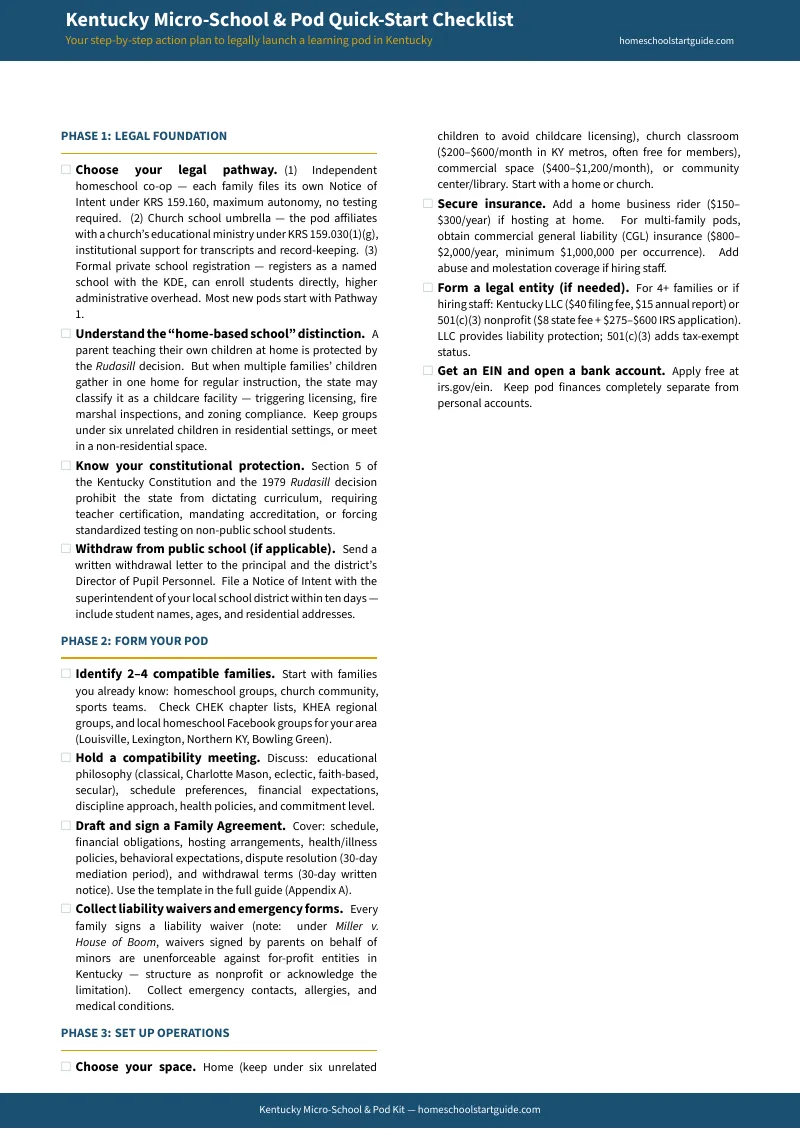
Because Kentucky has three distinct legal pathways for group learning — and choosing the wrong one means filing paperwork you don't need, triggering regulations you can avoid, or operating illegally without knowing it. Pathway 1: Independent homeschool co-op — each family files its own Notice of Intent under KRS 159.160, maximum autonomy, no testing required, no teacher certification needed. Pathway 2: Church school umbrella — the pod affiliates with a church's educational ministry under KRS 159.030(1)(g), institutional support for transcripts and record-keeping. Pathway 3: Formal private school registration — the pod registers as a named school with the KDE, can enroll students directly, higher administrative overhead. This section walks you through each with a plain-English decision tree — including the critical "home-based school" distinction that determines whether your pod triggers childcare licensing — so you choose correctly before your first family meeting.
The "Home-Based School" Legal Firewall
Because the single biggest legal risk for Kentucky pods is not what you teach — it's how many children from how many families gather in one location. The KDE explicitly distinguishes between a parent teaching their own children (protected homeschool) and multiple families' children receiving instruction in a third-party home (home-based school — subject to commercial regulation). This section gives you the exact structural rules to keep your pod on the protected side of the line: group size thresholds, residential vs. non-residential space strategies, how each family maintains primary legal responsibility for their own children's education, and what to do if a neighbor or school official files a complaint.
Family Agreement and Liability Waiver Templates
Because the most common reason pods collapse isn't bad curriculum — it's undefined expectations between adults about money, scheduling, and what happens when someone wants to leave mid-year. Customizable templates covering cost-sharing, curriculum authority, health policies, behavioral expectations, dispute resolution with a 30-day mediation period, and withdrawal terms with 30-day written notice. Written without religious language or ideological prerequisites. And a critical Kentucky-specific detail: under the 2018 Miller v. House of Boom decision, liability waivers signed by parents on behalf of minors are unenforceable against for-profit entities. The guide explains how to structure your pod to navigate this — including the nonprofit formation option that strengthens waiver enforceability.
Background Check and Hiring Guide
Because hiring someone to teach other people's children without the correct background checks exposes every family in the pod to catastrophic liability. Kentucky requires three separate clearances under KRS 160.151: an FBI fingerprint-based national criminal history check, a Kentucky State Police records check, and a Cabinet for Health and Family Services Central Abuse and Neglect (CA/N) Registry clearance. Cost: $40–$55 per applicant, 2–4 weeks processing. This section covers how to run each check, how to classify your instructor correctly under Kentucky's "Right to Control" test (W-2 vs. 1099 — misclassification carries IRS and Kentucky Revenue penalties), and real Kentucky pay benchmarks so you can budget accurately.
Budget Planning with Real Kentucky Numbers
Because splitting costs "evenly" between a family with three children and a family with one sounds fair until the first invoice arrives — and financial resentment is the second most common reason pods dissolve. Real Kentucky benchmarks for space rental ($200–$600/month for a church classroom in Louisville or Lexington, $400–$1,200/month for commercial), CGL insurance ($800–$2,000/year), curriculum ($200–$600/student/year), and facilitator compensation ($28,000–$45,000/year depending on region and qualifications). Plus cost-sharing formulas for equal-split, per-child, and sliding-scale models — with worked examples showing how a 6-student pod costs a fraction of private school tuition while every family retains full educational control.
Zoning and Space Guides for Louisville, Lexington, Bowling Green, and Northern KY
Because zoning compliance is hyperlocal and a generic national guide cannot tell you that Louisville Metro's Land Development Code requires a Conditional Use Permit for a private school in a residential zone, or that Lexington-Fayette County's Urban County Government has different home occupation rules than Bowling Green's ADU ordinances. This section covers zoning specifics for the four major Kentucky metro areas where most pods form — plus the church-space and commercial-space alternatives that sidestep residential zoning entirely.
The Kentucky Pod Launch Checklist
Because most parents spend forty-plus hours stitching together the launch sequence from KRS statutes, KDE regulations, CHEK guides, HSLDA articles, and scattered Facebook threads — and still aren't sure they got the order right. A single-page, print-and-pin document covering legal foundation, pod formation, operations setup, curriculum and scheduling, staffing, and launch week in the correct sequence — with key legal references (KRS 159.040, KRS 159.160, KRS 158.070, the Rudasill decision) at the bottom.
Who This Kit Is For
- Parents who want to form a small learning community of 3–8 students with two to four families — sharing the teaching load, splitting costs, and building something intentional rather than defaulting to a $20,000 franchise or a $10,000+/year private school
- Louisville and Jefferson County families fed up with JCPS transportation failures, chronic absenteeism, and classroom overcrowding who want a reliable, parent-controlled alternative without the private school price tag
- Lexington-Fayette County parents who want a secular, drop-off pod model — not the parent-led, stay-on-site co-ops that dominate the local homeschool scene — because they work full-time and need structured hours
- Northern Kentucky families (Boone, Kenton, Campbell counties) who want to pool resources with neighbors without accidentally triggering Ohio childcare regulations that don't apply across the river
- Current homeschoolers burning out after two or three years of solo teaching who want to share facilitation with other families without losing control of their child's education or giving up the freedoms the Rudasill decision guarantees
- Parents of neurodivergent children (autism, ADHD, dyslexia, twice-exceptional) who need a calmer, self-paced environment with a small group that actually accommodates their child — and can't find it in the public school system or in traditional co-ops
- Faith-based families who want to build a Christ-centered pod using the church school pathway — with full curriculum autonomy and institutional support for transcripts
- Military families near Fort Campbell and Fort Knox/Fort Moore who face frequent PCS moves and need a portable, flexible education model that works regardless of which installation they're assigned to next
- Former educators who want to serve their community by running a small paid pod or micro-school — without the overhead, revenue sharing, and loss of autonomy that comes with a Prenda, KaiPod, or Acton franchise
After Using the Kit, You'll Be Able To
- Choose the right legal pathway for your pod — independent homeschool co-op, church school umbrella, or formal private school — using the three-pathway decision framework and the "home-based school" distinction instead of guessing and hoping you got it right
- Structure your pod to stay on the protected side of Kentucky's homeschool classification — avoiding childcare licensing, Fire Marshal inspections, and zoning violations — even if you hire a shared facilitator
- Run your first parent meeting using a signed family agreement and liability waiver that accounts for Kentucky's Miller v. House of Boom precedent — without spending $200+ on an education attorney consultation
- Hire a teacher or tutor with the correct Kentucky background checks (FBI fingerprint, KSP records, CA/N registry), proper W-2 classification, and competitive pay benchmarks — avoiding the liability and IRS issues that sink underprepared pods
- Build a budget that every family agrees on — using real Kentucky cost benchmarks for your specific metro area and a cost-sharing formula that prevents resentment and financial surprises
- Navigate zoning requirements specific to your city — Louisville, Lexington, Bowling Green, or Northern KY — or sidestep residential zoning entirely with the church-space and commercial-space strategies in the guide
- Access KHSAA sports eligibility for your pod's students, set up KCTCS dual enrollment for high school students, and build transcripts that satisfy UK, UofL, WKU, EKU, and NKU admissions requirements
Why Not Just Use the Free Resources?
CHEK publishes a Best Practices Document. HSLDA provides a Kentucky overview. Facebook groups share experiences. Here is exactly what you run into when you try to build a pod from those sources alone:
- CHEK's Best Practices Document is built for single-family homeschoolers. It covers the Notice of Intent, the 1,062-hour requirement, and the mandated subjects. It does not explain how five families sharing a facilitator in a living room should structure legal responsibility, manage shared finances, draft multi-family agreements, or avoid the "home-based school" classification that triggers commercial regulation. For the working parent seeking a secular, drop-off pod, CHEK's resources are misaligned in both scope and format.
- HSLDA paywalls the actual legal forms. Their free Kentucky overview correctly identifies the state as "low regulation" and outlines the basic requirements under KRS 159.030. But the usable legal forms — withdrawal letters, attendance templates, the private school notice — cost $130/year in membership fees. Their articles warn about pods being reported as "illegal daycares" but don't provide the structural blueprints to prevent it.
- Generic Etsy templates are legally dangerous in Kentucky. A $12 "Learning Pod Agreement" from Etsy gives you a three-page contract written for a different state — no Kentucky-specific legal guidance, no three-pathway distinction, no "home-based school" firewall explanation, no Miller v. House of Boom waiver limitations. Most Etsy micro-school kits don't know that Kentucky's liability waiver rules for minors changed in 2018.
- Franchise networks charge $2,199 to $20,000+ per year. Prenda charges $2,199 per student per year in platform fees. Acton Academy requires a $20,000 startup fee plus 3% of annual revenue. KaiPod charges $15,000 flat or $249 plus 10% of revenue for two years. They provide the vision and the curriculum platform — but they take a massive cut of your operating budget and restrict your autonomy. And without Kentucky's defeated voucher amendment, every dollar comes directly out of families' pockets.
- Facebook groups are well-meaning but legally unreliable. Parents in Kentucky homeschool groups routinely confuse the minimal requirements of a standard homeschool with the drastically different requirements triggered when multiple families gather for regular instruction. They share advice that doesn't distinguish between the protected homeschool classification and the regulated "home-based school" classification. Following crowd-sourced legal guidance in a state with this specific regulatory trap is how pods get reported, investigated, and shut down.
Free resources give you the legal baseline and the inspiration. The Kentucky Pod Compliance System gives you the templates, decision frameworks, and metro-specific operational playbook to execute this week.
— Less Than One Hour with an Education Attorney
A single consultation with a Kentucky education attorney costs $150–$300 per hour. Prenda charges $2,199 per student per year in platform fees. Acton Academy requires a $20,000 startup fee. The Kit costs less than a single attorney consultation and gives you the legal clarity, operational templates, and metro-specific guidance those alternatives are designed to sell piecemeal — or withhold entirely.
Your download includes the complete 24-chapter guide, the Quick-Start Checklist, and standalone printable templates: a Family Participation Agreement, a Liability Waiver with emergency contact form, and a Public School Withdrawal Letter. Instant download, no account required.
30-day money-back guarantee. If the Kit doesn't give you the legal clarity and operational confidence to move forward with your pod, email us and we'll refund you. No questions asked.
Not ready for the full Kit? Download the free Kentucky Homeschool Quick-Start Checklist — a one-page summary of the three legal pathways, the "home-based school" distinction, the key KRS references, and the six-phase launch sequence that applies to your pod from day one. It's enough to understand your rights tonight.
Kentucky parents have extraordinary constitutional protection for non-public education. The Rudasill decision guarantees your freedom. The Kentucky Pod Compliance System makes sure you use it correctly.