The Classification & Funding System: Start Your Indiana Learning Pod with Legal Protection, Choice Scholarship Access, and a Complete Operational Framework.
Indiana is one of the easiest states in America to homeschool. No registration. No notification. No curriculum approval. No standardised testing. No teacher certification. No annual reports. No home visits. Just "instruction equivalent to that given in the public schools" under IC §20-33-2-28, a 180-day attendance log, and the Mazanec v. North Judson-San Pierre (1985) federal court ruling permanently stripping local school districts of any authority over your private education. Simple, right?
Except here is what the Facebook groups are not telling you: homeschooling your own children and running a micro-school for other families' children are two completely different legal and operational realities.
The moment you invite other families' children into your home, charge tuition, or hire a facilitator, you step out of the "non-accredited non-public school" umbrella and into questions that Indiana's lax homeschool law does not answer: Does your pod need to register with the IDOE as a private school? Does it trigger childcare licensing requirements? Does a hired facilitator need a state background check? Does hosting eight students in your Carmel living room violate your township's zoning ordinance? Can your pod accept Choice Scholarship vouchers — and should it, given the accreditation and testing strings attached? Is your personal homeowners insurance policy void the moment another family's child gets injured during a pod session?
You have been thinking about this. Maybe you are a Hamilton County parent who spent two years homeschooling alone and your child is thriving academically but asking why they never see other kids — and the burnout is crushing you. Maybe you are a Fort Wayne parent who heard about Jill Haskins's Kainos Microschool and the 130+ schools in the Indiana Microschool Network and thought: "I could do that." Maybe you are an Indianapolis family that looked at $15,000 private school tuition in Carmel and thought: "There has to be a better way." Maybe you have a neurodivergent child and the INESA Education Savings Account would give you $20,000/year — if you knew how to structure your pod to qualify. Whatever brought you here, you have reached the same conclusion: I need to build this myself, and I need to build it correctly.
The problem is that Indiana has two distinct legal classifications for micro-schools — and the internet gives you fragments. IAHE provides legislative advocacy and a co-op directory, but it is built for single-family homeschoolers, not multi-family pods where money changes hands. The IDOE website has a Homeschool FAQ that does not mention micro-schools, pods, or multi-family arrangements at all. Prenda charges $2,199 per student per year in platform fees. KaiPod takes a 10% revenue share for two years. Acton franchise costs run $150,000–$500,000. Generic Etsy templates sell $8 "Pod Agreements" that contain zero Indiana-specific language and know nothing about the Choice Scholarship application timeline, the INESA provider structure, or why hosting ten children in an Indianapolis home and a Bloomington home trigger different zoning considerations.
The Indiana Micro-School & Pod Kit — the Classification & Funding System — is that operational framework.
What's Inside the Classification & Funding System
The Two-Classification Legal Framework
Because choosing the wrong legal classification means either leaving thousands of dollars in funding on the table or triggering compliance obligations you did not expect. Indiana has two distinct legal pathways for group instruction — Classification 1 (Non-Accredited Non-Public School, operating under IC §20-33-2-28, each family retains individual homeschool status, maximum autonomy, no state testing, eligible for the $1,000 per-child tax deduction) and Classification 2 (Registered Private School, IDOE registration, accreditation pathway through SBOE or recognised agency, enabling participation in the Choice Scholarship voucher programme). This section walks you through each with a plain-English decision tree — including the critical thresholds of pod size, compensation, and accreditation intent — so you choose the right classification before your first meeting.
The Funding Pathway Matrix
Because Indiana offers some of the most generous school choice funding in America — but the pathways are labyrinthine. The universal Choice Scholarship eliminates all income caps from 2026-27, averaging $6,264 per student at participating private schools. The INESA Education Savings Account provides up to $20,000 for students with disabilities and $8,000 for siblings. Scholarship Granting Organisations have distributed over $10 million to more than 11,000 students. And the $1,000 per-child state tax deduction under IC §6-3-2-22 applies to every homeschool family with zero compliance strings. The Kit consolidates all five funding sources into a single matrix — eligibility requirements, dollar amounts, application windows (Choice Scholarship first period: March 1 – September 1; second period: November 1 – January 15), and step-by-step instructions — so you know exactly which pathways your pod can access and what each one costs in regulatory independence.
Family Agreement and Liability Waiver Templates
Because the most common reason pods collapse is not bad curriculum — it is undefined expectations between adults about money, scheduling, and what happens when someone wants to leave mid-year. Customisable templates covering cost-sharing, curriculum authority, health policies, behavioural expectations, dispute resolution, and withdrawal terms. Written without religious language or ideological prerequisites. Every participating family signs before the first day — and Indiana's LLC liability protections mean your personal assets stay separate from the pod's obligations.
Facilitator Hiring and ISP Background Check Guide
Because hiring someone to teach other people's children without running the correct background checks is not just risky — it destroys the trust that holds your pod together. Indiana requires ISP Limited Criminal History Checks for education workers. This section covers the Fieldprint/IdentoGO fingerprinting process, Indiana State Police submission, and the National Criminal History Record Check requirement. Plus W-2 vs. 1099 classification rules — because misclassifying a facilitator whose schedule, location, and methods you control as a 1099 contractor carries IRS penalties.
The IHSAA Sports Access Navigator
Because sports access is a deal-breaker for Indiana families and the rules are poorly understood. The IHSAA allows homeschooled students to compete on public school athletic teams — but with severe restrictions: three consecutive years of homeschooling prior, enrollment in at least one full-credit course at the member school, and the school's participation is voluntary (many refuse). This section gives you the exact eligibility rules, the practical timeline, which districts participate, and alternative athletic pathways — homeschool sports associations, YMCA leagues, community recreation programmes, and private club sports — so families make informed decisions before switching, not devastating discoveries afterward.
Budget Planning with Real Indiana Numbers
Because splitting costs "evenly" between a family with three children and a family with one sounds fair until the first invoice arrives — and financial resentment is the second most common reason pods dissolve. Real Indiana benchmarks for space rental ($200–$800/month for a church classroom, $10–$18/sq ft annually for commercial), liability insurance ($57–$79/month average), curriculum ($200–$600/student/year), and facilitator compensation ($28,000–$42,000/year depending on region and hours). Plus cost-sharing formulas for equal-split, per-child, and sliding-scale models — with worked examples showing how a 6-student pod costs a fraction of $9,500–$13,000/year private school tuition while families retain the $1,000 per-child tax deduction.
Zoning and Space Guide
Because Indiana's educational freedom does not override your municipality's zoning ordinance — and the rules vary by jurisdiction. This section covers home-based pods (when hosting crosses the threshold from "home activity" to "educational assembly" for zoning purposes), church partnerships (already zoned for educational use, typically $200–$800/month), and commercial leases — with guidance for Indianapolis, Fort Wayne, Bloomington, South Bend, and rural counties where zoning enforcement is minimal but childcare licensing questions can still arise.
The Indiana Pod Launch Checklist
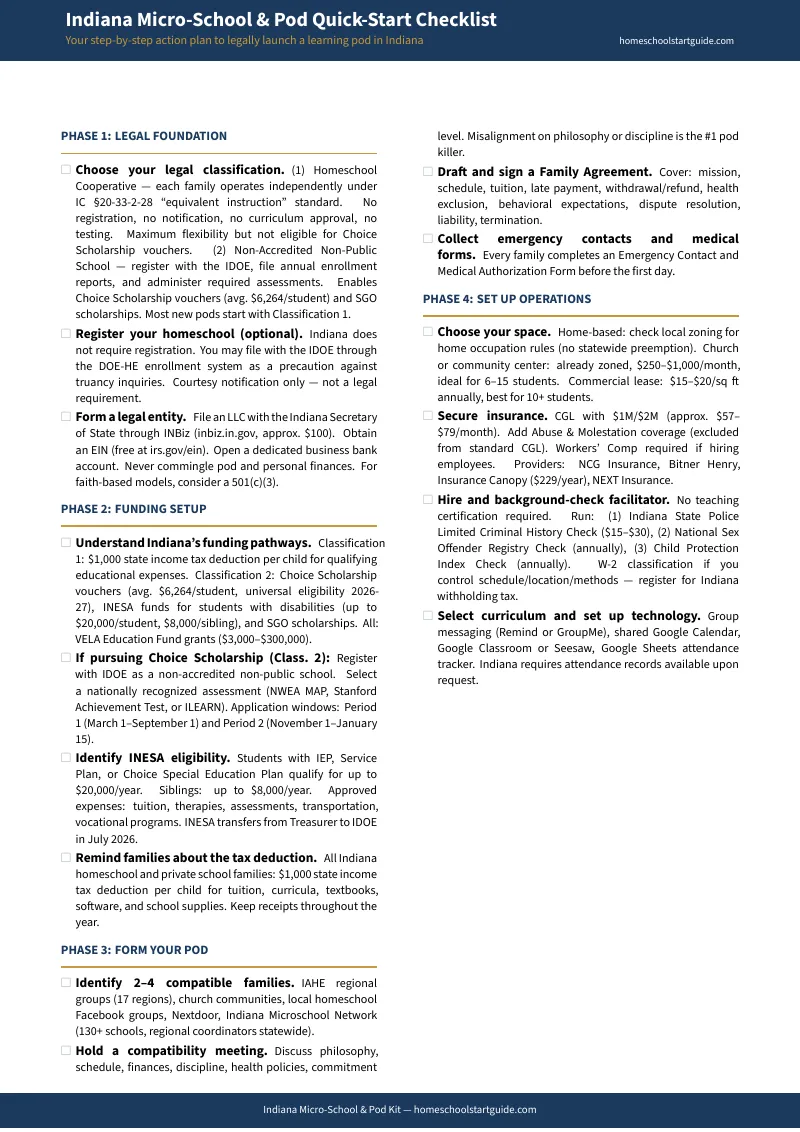
Because most parents spend forty-plus hours stitching together the launch sequence from scattered IAHE resources, IDOE FAQs, Indiana Microschool Network connections, and contradictory Facebook posts — and still are not sure they got the order right. A single-page, print-and-pin document that walks you from "I have an idea" to "the first day of pod school" — covering legal classification, funding setup, pod formation, operations, curriculum, staffing, and launch week in the correct sequence.
Who This Kit Is For
- Parents who want to form a small learning community of 3–8 students with two to four families — sharing the teaching load, splitting costs, and building something intentional rather than defaulting to institutions that extract franchise fees or public school compliance obligations
- Hamilton County families (Carmel, Fishers, Noblesville, Westfield, Zionsville) who want a high-quality small-group learning environment without surrendering $2,199/student/year to Prenda's platform fees or paying $15,000+ private school tuition
- Fort Wayne parents inspired by the Indiana Microschool Network's growth from 4 to 130+ schools in three years and ready to launch their own — but needing the legal and operational playbook that the network's community connections do not provide
- Current homeschoolers who find solo teaching unsustainable after two or three years and want to share facilitation with other families without losing control of their child's education or autonomy
- Parents of neurodivergent children (autism, ADHD, dyslexia, twice-exceptional) who need a calmer, self-paced environment with a small group that actually accommodates their child — and want to use INESA funding ($8,000–$20,000/student) to pay for it
- Indianapolis and suburban families who have been priced out of premium private schools or are frustrated by declining public school enrolment and want to pool resources with compatible families for a learning environment they actually control
- Parents whose children need sports access and are weighing the private school classification as a pathway to IHSAA eligibility — and need the full picture of eligibility rules, timelines, and alternative athletic options before making a structural decision about their pod
- Faith-based families who want to build a Christ-centred pod with a like-minded community — using the same legal and operational templates as secular pods, with full curriculum autonomy protected by IC §20-33-2-12
- Rural Indiana parents who lack nearby private school options and want to create a community-based micro-school centred around a church, community centre, or home — even if the nearest co-op is an hour away
- Former educators who want to serve their community by running a small pod or micro-school — without the overhead and control of a Prenda, KaiPod, or Acton franchise
After Using the Kit, You'll Be Able To
- Choose the right legal classification for your pod — Non-Accredited Non-Public School for maximum autonomy or Registered Private School for Choice Scholarship access — using the two-classification decision framework instead of guessing based on contradictory Facebook advice
- Map every available funding pathway — Choice Scholarship (no income cap starting 2026-27), INESA ($8,000–$20,000/student), SGOs, and the $1,000 tax deduction — and know exactly which ones your pod qualifies for based on your chosen classification
- Run your first parent meeting using a signed family agreement and liability waiver that protects every family in the pod — without spending $200+ on an education attorney consultation
- Hire a facilitator with the correct ISP background check, proper W-2 classification, and competitive pay benchmarks — avoiding the liability and IRS issues that sink underprepared pods
- Understand the IHSAA sports access rules clearly enough to advise every family in your pod — the three-year eligibility rule, the single-course requirement, which districts participate, and alternative athletic pathways — so no family makes a structural decision based on incomplete information
- Build a budget that every family agrees on — using real Indiana cost benchmarks for your specific region and a cost-sharing formula that prevents resentment and financial surprises
- Navigate your municipality's zoning requirements — whether you are in Indianapolis, Carmel, Fort Wayne, Bloomington, or a rural county — so your pod does not get shut down by a single neighbour complaint
Why Not Just Use the Free Resources?
The IDOE provides a Homeschool FAQ. IAHE explains homeschool rights. The Indiana Microschool Network connects founders. Facebook groups share experiences. Here is exactly what you run into when you try to build a pod from those sources alone:
- The IDOE website is written for individual homeschoolers, not pod founders. It tells you that Indiana requires 180 instructional days, attendance records, and "equivalent instruction." It does not tell you how to form an LLC, structure tuition for Choice Scholarship compliance, hire a facilitator through the ISP background check process, or navigate your township's zoning ordinance for a home-based educational assembly. The tone is bureaucratic, minimal, and offers zero operational tools for multi-family arrangements.
- IAHE is excellent — but it is built for single-family homeschoolers. The Indiana Association of Home Educators provides legislative advocacy, convention support, a co-op directory, and a wealth of podcasts and resources. Their "What About Sports?" page addresses IHSAA eligibility directly. But IAHE does not cover multi-family legal structures, liability insurance for hosting other people's children, cost-sharing models, facilitator contracts, or the operational complexities that emerge the moment your pod goes from "I teach my kids" to "I accept tuition from other families." The gap between those two realities is where parents need the most help — and IAHE does not cover it.
- The Indiana Microschool Network is community, not documentation. Jill Haskins and the regional coordinators have built something remarkable — 130+ microschools in three years. But the network provides personal connection and peer mentorship, not downloadable operational guides, legal checklists, or template libraries. The support is person-to-person and relationship-based — invaluable during business hours but inaccessible at 11 PM on a Tuesday night when you need to understand whether your pod triggers childcare licensing requirements.
- Generic Etsy templates are legally dangerous in Indiana. An $8 "Learning Pod Agreement" from Etsy gives you a three-page contract written for a different state — no Indiana-specific legal guidance, no two-classification distinction, no Choice Scholarship application timeline, no INESA provider structure explanation. Most Etsy micro-school kits do not know the difference between IC §20-33-2-28 and IDOE private school registration, the IHSAA three-year rule, or the ISP background check process for education workers.
- Franchise networks withhold the operational details deliberately. Prenda, KaiPod, and Acton webinars give you the vision. The granular how — the legal structuring, budget templates, scheduling frameworks — is what they sell for $2,199–$14,760/student/year in platform fees and tuition. And they keep a cut of every dollar that flows through your pod.
- Facebook groups are well-meaning but legally unreliable. Parents in Indiana homeschool groups routinely confuse the ease of individual homeschooling with the operational requirements of running a compensated multi-family pod. They share advice that predates the universal Choice Scholarship expansion, does not mention the INESA administration transfer to IDOE in July 2026, and treats all of Indiana as having the same zoning rules. Following crowd-sourced legal guidance that does not distinguish between state educational law and municipal operational law is how parents end up with a zoning violation or a family suing them personally after an accident.
Free resources give you the legal baseline and the community connections. The Classification & Funding System gives you the templates, decision trees, and step-by-step playbooks to execute this week.
— Less Than One Hour with an Education Attorney
A single consultation with an Indiana education attorney costs $200–$400 per hour. Prenda charges $2,199 per student per year in platform fees. The average Indiana private school tuition runs $9,500–$13,000/year. The Kit costs less than a single attorney consultation and gives you the legal clarity, operational templates, and funding pathway navigation those alternatives are designed to sell piecemeal.
Your download includes the complete 17-chapter guide, the Quick-Start Checklist, and four standalone printable templates: a Family Participation Agreement, a Liability Waiver with emergency contact form, a Facilitator Employment Contract, and an Annual Budget Planner. Instant download, no account required.
30-day money-back guarantee. If the Kit does not give you the legal clarity and operational confidence to move forward with your pod, email us and we will refund you. No questions asked.
Not ready for the full Kit? Download the free Indiana Homeschool Quick-Start Checklist — a one-page summary of the two legal classifications, the key funding pathways, and the five-phase launch sequence that applies to your pod from day one. It is enough to understand your rights tonight.
Indiana parents have the constitutional freedom to build this. The Choice Scholarship and INESA fund it. The Classification & Funding System makes sure you build it correctly.