Launch Your Illinois Micro-School Without Triggering a DCFS Investigation or a Zoning Complaint.
Illinois is one of the most permissive states in the country for home education. The 1950 People v. Levisen ruling means your pod is legally a private school — no registration, no notification, no testing, no curricular review. But that legal freedom has a trap built into it: the moment you gather other families' children in your home and accept payment, you risk being reclassified as an unlicensed daycare under the Illinois Child Care Act. DCFS oversight. Staff-to-child ratios. Commercial zoning violations. The line between "private school" and "illegal daycare" is real, and no free resource online tells you exactly where it is.
You want to build a small learning community — three or four Chicagoland families sharing the teaching load, or a downstate homeschooler formalizing a co-op that's been running informally for years. Maybe you're a CPS parent who's watched 100,000 students leave the district since 2000 and decided your family is next. Maybe you're a Naperville parent who wants rigorous academics without screens and without $30,000 private school tuition. Maybe you're a veteran homeschooler burning out on doing it alone, and you've realized the curriculum you built has real value to other families.
Whatever brought you here, you've hit the same wall: Illinois has no micro-school statute. No state agency will tell you how to structure a multi-family learning arrangement. ILHSA explains how to keep your own child home legally. ICHE connects you with co-ops — but only Christian ones. Prenda charges $2,199 per student per year in platform fees. KaiPod takes 10% of your revenue for two years. You need the legal and operational framework without the franchise overhead.
The Illinois Micro-School & Pod Kit is a complete execution manual built specifically for Illinois law — the Levisen doctrine, DCFS thresholds, Chicago zoning codes, collar county regulations, CANTS background check requirements, and ISBE voluntary registration. Every chapter is written for Illinois families operating under Illinois rules.
What's Inside the Kit
The Private School Compliance Framework
The core of the Kit. Illinois doesn't have a "micro-school" category — your pod either qualifies as a private school under People v. Levisen or it doesn't. This section gives you the exact three-prong test (competent teacher, required subjects, equivalent education) and the documentation practices that prove compliance if anyone ever asks. More critically, it shows you how to structure your operations so you never cross the threshold into DCFS daycare jurisdiction under 225 ILCS 10/2.05 — the trap that catches unprepared founders who don't know the difference between educating children and caring for them.
Chicago and Collar County Zoning Guide
Chicago's zoning code explicitly prohibits tutoring and children-related home occupations. That doesn't mean you can't run a pod — it means you need to understand the distinction between a home occupation and a private school operating from a residence, and you need to know when a church classroom or community center partnership is the smarter path. This section covers Chicago, Cook County, DuPage, Lake, Kane, Will, and McHenry — with the specific regulatory differences that matter for each.
Family Agreement and Liability Waiver Templates
Customizable templates for every participating family — covering schedule, financial obligations, curriculum authority, health policies, behavioral expectations, dispute resolution, and withdrawal terms. Written without religious language or ideological prerequisites. These are the documents that prevent the most common reason pods collapse: undefined expectations between adults who assumed they agreed on everything.
DCFS Background Check and Hiring Guide
If you're hiring an instructor, Illinois requires a CANTS (Child Abuse and Neglect Tracking System) check plus an FBI fingerprint-based criminal history check through an approved vendor like Accurate Biometrics. This section covers the full process, processing timelines (2–4 weeks), interstate check requirements, and the critical employee-vs-contractor classification under IDES rules — because getting the W-2/1099 distinction wrong triggers state employment penalties.
Budget Planning with Real Illinois Benchmarks
Actual cost data: church classroom rental ($200–$800/month), commercial general liability insurance ($500–$1,500/year), curriculum ($200–$600/student/year), and instructor compensation ($20–$40/hour in Chicagoland, $15–$30 downstate). Plus cost-sharing formulas for equal-split, per-child, and sliding-scale models — with a worked example showing how a 6-student pod splits $10,000–$14,000 in annual expenses.
The Quick-Start Checklist
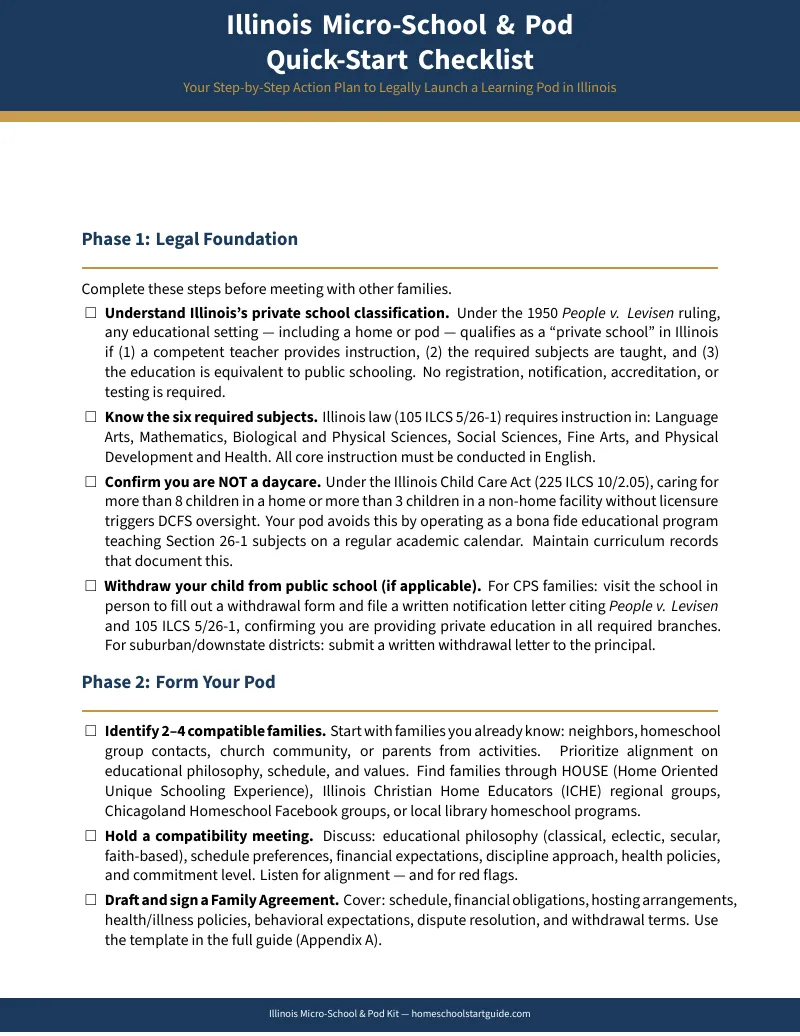
A single-page, print-and-pin reference that walks you from "I have an idea" to "the first day of pod school" — covering legal foundation, pod formation, operations setup, curriculum selection, staffing, and launch week in the correct order. Most parents spend forty or more hours assembling this sequence from scattered blog posts, Facebook groups, and ISBE pages. The checklist condenses it to one reference with the key legal citations you'll need.
Who This Kit Is For
- Parents who want to form a small learning community of 3–8 students with two to four families — sharing the teaching load, splitting costs, and building an intentional educational environment instead of defaulting to institutions that don't fit
- CPS families who've decided to withdraw and want a structured group alternative to solo homeschooling — with the exact withdrawal process, legal citations, and pushback scripts for when the attendance office resists
- Suburban parents in Naperville, Schaumburg, Evanston, Lake Forest, or Oak Park who want rigorous, low-tech academics at a fraction of the $25,000–$40,000 annual tuition at elite Chicago-area private schools
- Current homeschoolers who find solo teaching unsustainable and want to share facilitation with other families without losing control of their child's education
- Secular or inclusive families who've been turned away from ICHE-affiliated co-ops that require a statement of faith, and who need a legally sound framework for building a non-denominational pod
- Parents of neurodivergent children (autism, ADHD, dyslexia) who are exhausted by IEP advocacy and want a calmer, self-paced micro-school environment with access to Chicago-area specialized resources
- Experienced educators who want to formalize their co-op into a revenue-generating micro-school — without surrendering 10% of tuition to a franchise network
After Using the Kit, You'll Be Able To
- Explain exactly how your pod qualifies as a "private school" under People v. Levisen — the three-prong test, the six required subjects, and why no registration or notification is needed — to any truancy officer, school administrator, or concerned neighbor
- Structure your pod's operations to stay firmly within the private school classification and avoid triggering DCFS daycare licensing under 225 ILCS 10/2.05 — the single most dangerous regulatory trap for Illinois micro-school founders
- Navigate Chicago's zoning restrictions on home occupations, understand when a church partnership or leased space is necessary, and know the different rules in Cook County versus collar counties
- Run your first parent meeting with a signed family agreement and liability waiver that protects every family in the pod — without spending $250+ per hour on an education attorney
- Hire an instructor with completed CANTS and FBI background checks, correctly classify them as W-2 or 1099 under IDES rules, and set up payroll without surprises
- Build a budget that every family agrees on — using real Illinois cost benchmarks and a cost-sharing formula that prevents resentment and financial surprises
- Create high school transcripts, access dual enrollment at Illinois community colleges, navigate driver's education requirements, and understand IHSA sports eligibility for your micro-school students
Why Not Just Use the Free Resources?
ILHSA summarizes Illinois homeschool law. ICHE connects you with co-ops. ISBE has a nonpublic school page. Here is exactly what you run into when you try to build a pod from those sources alone:
- ILHSA is built for solo homeschool families defending their rights. They explain how to legally keep your own child home from public school. They do not address what happens when you bring other people's children into your home, accept payment, and effectively operate a multi-family educational business. No liability waivers, no budget templates, no family agreements, no DCFS compliance guidance.
- ICHE requires a Christian statement of faith. Their mission statement explicitly targets families "dedicated to bringing up their children 'in the nurture and admonition of the Lord.'" If you're secular, interfaith, or simply want an inclusive pod, their resources and network are not designed for you.
- Generic Etsy templates are legally hazardous in Illinois. A $5 "Homeschool Pod Agreement" from Etsy provides generic language with no Illinois-specific guidance. Worse, daycare starter kits sold as pod resources can trigger DCFS oversight — in Illinois, using childcare frameworks for an educational program risks reclassification as an unlicensed facility.
- Franchise networks withhold the operational details deliberately. Prenda, KaiPod, and Acton Academy webinars are marketing funnels. The granular how — legal structuring, DCFS thresholds, zoning navigation, background check procedures — is what they charge $2,199/student/year or 10% of revenue to access.
Free resources explain your rights as a solo homeschooler. The Kit gives you the legal and operational framework to bring other families' children into your program, protect your assets, and charge tuition — legally and confidently.
— Less Than One Hour with an Education Attorney
A single consultation with an Illinois education attorney costs $250–$400 per hour. Prenda charges $2,199 per student per year in platform fees — for a pod of eight students, that's $17,592 extracted from your top-line revenue. KaiPod takes $249–$499 upfront plus 10% of gross revenue for two years. The Kit costs less than a single attorney consultation and gives you the legal clarity, operational templates, and Illinois-specific guidance those alternatives are designed to sell piecemeal.
Your download includes 6 PDFs: the complete 26-chapter guide with 4 appendices, the Quick-Start Checklist, plus 4 standalone printables — the Parent Agreement template, Liability Waiver and Medical Release, Public School Withdrawal Letter, and the DCFS Compliance Quick Reference card. The guide covers the Levisen doctrine, DCFS compliance, Chicago zoning, CANTS background checks, budget planning, scheduling models, high school operations, neurodivergent accommodations, bilingual pods, faith-based models, and scaling from a pod to a micro-school. Instant download, no account required.
30-day money-back guarantee. If the Kit doesn't give you the legal clarity and operational confidence to move forward with your pod, email us and we'll refund you. No questions asked.
Not ready for the full Kit? Download the free Illinois Homeschool Quick-Start Checklist — a one-page summary of the Levisen three-prong test, the DCFS daycare thresholds, the six required subjects, and the six-phase launch sequence. It's enough to understand your legal standing tonight.
Illinois law already protects your right to educate children as a private school. The Kit makes sure you exercise that right without stepping into the daycare trap, the zoning trap, or the handshake-agreement trap that collapses pods before Thanksgiving.