
Build Your Idaho Micro-School Legally, Affordably, and Without a Franchise.
Idaho Code §33-202 gives you the right to educate your child outside the public system — no registration, no testing, no curriculum mandates, no state approval. That freedom is real, and it is why Idaho has become one of the most attractive states in America for micro-schools and learning pods. But the moment you invite other families' children into your home, charge tuition, or host a recurring learning group, you step into a different legal landscape: municipal zoning restrictions, childcare licensing thresholds, and the homeschool-to-private-school line that nobody on Facebook can agree on.
You want to pull together three or four Treasure Valley families, share the teaching load, and build something that actually fits your child. Maybe you are burned out on solo homeschooling and need a shared-responsibility model. Maybe you are stuck on a charter school waitlist while the West Ada School District adds another portable classroom. Maybe you looked at Prenda's $219-per-month platform fee and decided you would rather keep the money and the autonomy. Maybe you are an LDS family in Idaho Falls or an evangelical family in Nampa looking for a faith-aligned pod that matches your values without the rigidity of a formal school. Whatever the reason, you have arrived at the same conclusion: I need to build this myself.
The problem is that the internet gives you fragments. The Idaho State Department of Education tells you Idaho "does not regulate homeschools" — full stop. Homeschool Idaho runs the annual convention but gives you no operational templates. Facebook groups in the Treasure Valley Homeschool Moms group confidently declare that pods don't need insurance, that zoning doesn't apply if it's "just education," and that you can teach twelve kids in your living room without any legal risk. You need an Idaho Pod Founder's Playbook — the complete operational framework without the dangerous legal guesswork, the franchise costs, or the ideological prerequisites.
The Idaho Micro-School & Pod Kit is that Pod Founder's Playbook.
What's Inside the Pod Founder's Playbook
The Idaho Legal Framework and Private School Threshold
Because the single most confusing question for every new pod founder is whether a tuition-charging micro-school crosses the line from homeschooling into private school territory — and what that actually means in Idaho. Unlike most states, Idaho does not require private schools to register, obtain licensing, or meet teacher certification requirements. This framework walks you through the exact criteria — number of families, who is teaching, whether you are charging tuition, and whether accreditation matters — so you choose the right legal structure before your first family meeting, not after a neighbor files a complaint with planning and zoning.
The Parental Choice Tax Credit Playbook (HB 93)
Because Idaho families paying tuition to your micro-school can claim up to $5,000 per student — or $7,500 for students with disabilities — as a refundable tax credit. This makes your micro-school effectively free for most families after the credit. The guide explains exactly how families claim it, what documentation your micro-school needs to provide, and how to structure your invoicing so every family qualifies. This is the single strongest recruitment tool for your pod: tuition that costs parents nothing out of pocket after tax season.
The Advanced Opportunities Funding Guide (§33-4602)
Because your secondary students can access up to $4,625 each in state funding for dual credit courses, AP exams, and workforce training certificates through Idaho's Advanced Opportunities program — but only if they dual-enroll through a public school district under IC §33-203. This section walks you through the exact dual-enrollment process, the SDE portal submission, and how to partner with your local district to unlock funding without surrendering your micro-school's autonomy. Most micro-school families in Idaho leave thousands of dollars on the table because they do not know this pathway exists.
The Zoning and Childcare Licensing Matrix
Because Idaho has no rules for learning, but your city has aggressive rules for operating a business. Boise allows 1–6 children by right in a home setting, but 7–12 requires a Zoning Compliance Review. Meridian limits in-home instruction to 12 persons for less than three hours with an accessory use permit. Idaho Falls is highly restrictive, prohibiting home occupations in some residential zones entirely. This matrix maps the exact thresholds for Boise, Meridian, Idaho Falls, Nampa, Eagle, Coeur d'Alene, and Pocatello — so you know your limits before the city planning department tells you.
The Parent Agreement and Liability Waiver Templates
Because a child breaking an arm in your living room should not end the pod — and it will not, if you are prepared. Customizable parent agreements covering educational philosophy, schedule, tuition, attendance, behavior, conflict resolution, withdrawal, and media privacy. Plus a liability waiver with indemnification, medical consent, and emergency contact forms. Every family signs these before day one. These are not copy-pasted Etsy templates — they are written for the specific legal context of Idaho home education and private school operations.
The Facilitator Hiring and Background Check Guide
Because hiring your first facilitator triggers employment classification decisions, payroll tax obligations, and non-negotiable background check requirements. Idaho DHW background checks (BCI, FBI fingerprint-based criminal history, sex offender registry) must be completed before any student contact — allow 2–4 weeks and approximately $40–$60 per applicant. This section covers the W-2 vs. 1099 classification decision, Idaho facilitator pay rates ($19–$25/hr rural, $23–$35/hr Boise metro), contract templates, and scope of duties.
The Idaho Regional Budget Planner
Because running a pod in Boise costs nothing like running one in Pocatello. Region-specific budget templates covering facilitator compensation, space rental, curriculum materials, insurance, and field trips — with real numbers for the Treasure Valley (high-cost), Idaho Falls (moderate), Coeur d'Alene (moderate), and rural Idaho (low-cost). Includes cost-sharing models for 3-family, 5-family, and 8-family pods, and a tuition calculator that factors in the Parental Choice Tax Credit offset.
The Idaho Pod Launch Checklist
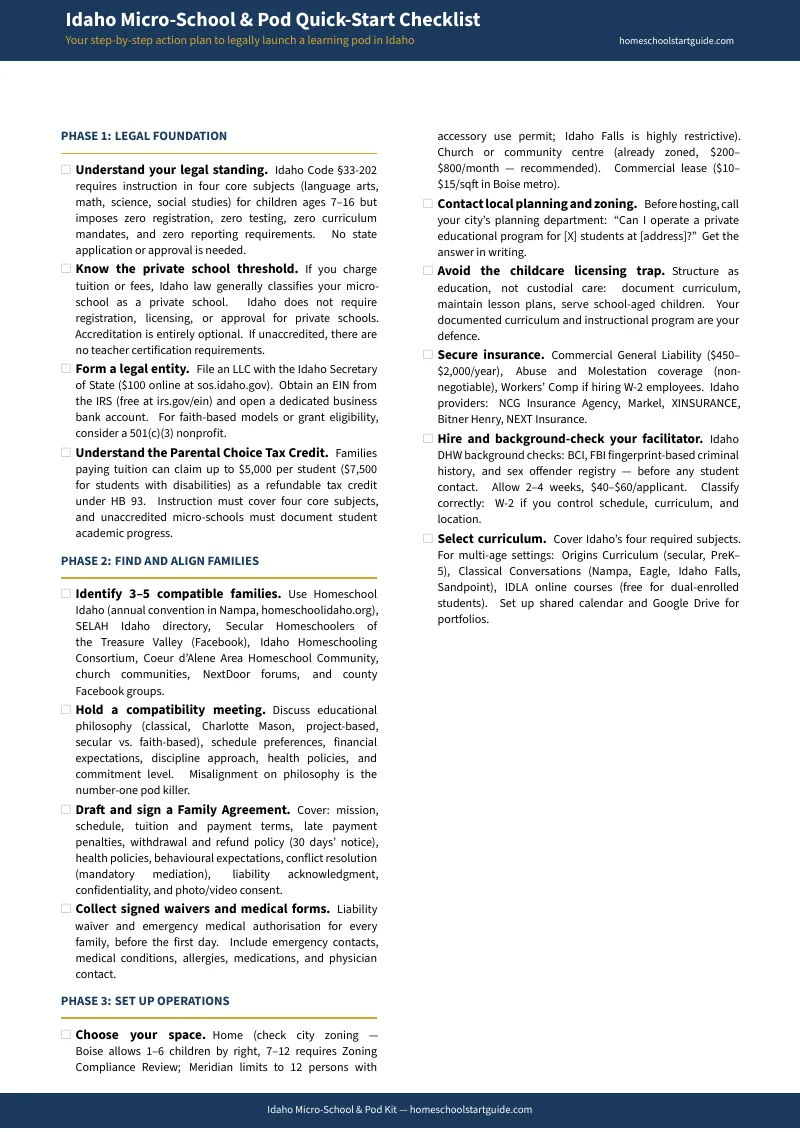
Because most parents spend forty-plus hours assembling the launch sequence from blog posts, Facebook groups, and SDE pages. A single-page, print-and-pin document that walks you from "I have an idea" to "the first day of pod school" — covering the legal, operational, financial, and community formation steps in the correct order.
Who This Kit Is For
- Parents who have decided the public school system is not working for their child — whether because of overcrowded classrooms in the Treasure Valley, rigid curriculum, or the safety anxiety that keeps you checking your phone every afternoon — and want to build a small, intentional alternative with a handful of like-minded families
- Solo homeschoolers who have reached the burnout threshold and need a shared-responsibility model where the instructional and social burden is distributed among trusted families — without losing control of their child's education
- Families stuck on charter school waitlists or priced out of private school tuition who need an affordable alternative that provides structure, community, and academic rigor for a fraction of the cost
- LDS families in Idaho Falls or Pocatello, evangelical families in Nampa or Eagle, and secular families in Boise who need a pod model that matches their values without the ideological gatekeeping of existing co-op networks
- Parents of neurodivergent children (autism, ADHD, dyslexia, giftedness) who are exhausted by IEP battles and need an ultra-low-ratio, self-paced learning environment that public schools structurally cannot provide
- Rural families in Eastern Idaho, the Magic Valley, or North Idaho where geographic isolation makes traditional schooling impractical and the nearest co-op is an hour away
- Former educators who have left the public school system and want to serve their community by running a small paid micro-school — without the overhead, the revenue share, or the rigid pedagogy of a franchise network
After Using the Kit, You'll Be Able To
- Understand your legal standing under IC §33-202 and know exactly when a micro-school crosses the private school threshold — and why that distinction barely matters in Idaho, where private schools need no registration, no licensing, and no teacher certification
- Help every family in your pod claim the $5,000 Parental Choice Tax Credit (or $7,500 for students with disabilities) by structuring your invoicing and documentation correctly from day one
- Unlock up to $4,625 per secondary student through the Advanced Opportunities program by navigating dual enrollment with your local school district
- Run your first parent intake meeting using a signed Family Agreement and liability waiver that protects every family in the pod — without spending $300 on a Boise education attorney
- Choose the right space for your pod based on your city's zoning rules — home, church, or commercial — and know the exact student count thresholds that trigger additional requirements in your municipality
- Hire and background-check a facilitator legally, classify them correctly for Idaho tax purposes, and pay them competitively using real local wage benchmarks
- Build a sustainable budget with region-specific cost data, set tuition that families can afford (especially after the tax credit), and split costs equitably across participating households
Why Not Just Use the Free Resources?
The Idaho State Department of Education confirms that Idaho does not regulate homeschools. Homeschool Idaho runs the annual convention and maintains a co-op directory. Facebook groups in the Treasure Valley and North Idaho have thousands of homeschool parents trading advice. Here is exactly what you run into when you try to build a pod from those sources alone:
- The SDE gives you one sentence and walks away. The Idaho Department of Education's homeschool page states that Idaho "does not regulate, approve, or accredit homeschool programs" and provides no further guidance. For a solo homeschooler, that is all you need to know. For a micro-school founder hosting ten children and charging tuition, it tells you nothing about zoning, insurance, employment law, or the private school classification.
- Homeschool Idaho gives you community but not operations. The annual convention in Nampa is excellent for networking and curriculum shopping. But Homeschool Idaho provides no templates, no legal frameworks, and no guidance on the operational mechanics of running a multi-family pod — scheduling, liability, cost-sharing, facilitator hiring, or zoning compliance.
- Facebook groups are an echo chamber of dangerous legal advice. Parents confidently claim that pods don't need insurance, that zoning doesn't apply to education, and that you can teach as many kids as you want in your home without any legal risk. These statements ignore municipal code entirely. A Meridian parent who hosts 15 children based on Facebook advice will discover the city's in-home instruction limits when code enforcement shows up, not before.
- Etsy templates are generic daily planners with a micro-school label. Canva templates, minimalist worksheets, and generic enrollment forms priced at $4–$12. Not one references IC §33-202, the Parental Choice Tax Credit, the Advanced Opportunities program, Idaho's childcare licensing thresholds, or municipal zoning restrictions in Boise, Meridian, or Idaho Falls. They help you organize a schedule. They do not help you form a legally protected pod.
- Prenda and KaiPod solve the problem — and take your autonomy and revenue. Prenda charges $219/month per student in platform fees. KaiPod charges enterprise-level tuition. Both require you to recruit the families, find the space, and build the community yourself. If you are doing the hard work of building local trust, you should keep 100% of the revenue and 100% of the curriculum control.
Free resources give you the inspiration and the legal baseline. The Pod Founder's Playbook gives you the templates, checklists, and frameworks to execute this week.
— Less Than One Hour With a Boise Education Consultant
A single consultation with an Idaho education attorney costs $200 to $350 per hour. Prenda charges $219 per student per month in platform fees. KaiPod charges enterprise-level tuition. The Kit costs less than one hour of professional advice and gives you the operational independence those platforms are designed to prevent — plus the $5,000 tax credit playbook and the $4,625 Advanced Opportunities blueprint that can fund your entire operation.
Your download includes the complete guide (19 chapters covering Idaho law, the Parental Choice Tax Credit, Advanced Opportunities funding, pod formation, zoning, insurance, facilitator hiring, budgeting, curriculum, IDLA integration, dual enrollment, transcripts, and scaling), the Idaho Pod Launch Checklist (print-and-pin), and four standalone printable templates — the Family Partnership Agreement, Liability Waiver, Facilitator Contract, and Idaho Regional Budget Planner. Instant download, no account required.
30-day money-back guarantee. If the Kit does not give you the legal clarity and operational confidence to move forward with your pod, email us and we will refund you. No questions asked.
Not ready for the full Kit? Download the free Idaho Homeschool Quick-Start Checklist — a one-page summary of the legal framework under IC §33-202, the private school threshold, the Parental Choice Tax Credit basics, and the key zoning considerations for Treasure Valley, Idaho Falls, and Coeur d'Alene. It is enough to understand your rights tonight.
Idaho gave you the freedom. The Pod Founder's Playbook makes sure you use it correctly.