Hawaii Has Seven Legal Ways to Homeschool. The State Makes It Feel Like There Are Zero.
You've made the decision. Your child is coming home — maybe because the bullying has gone too far and the school's "monitoring the situation," maybe because your family just PCS'd to Schofield Barracks and you refuse to enroll your kids in a third school this year, maybe because your bright, curious child is drowning in a system that won't bend. Whatever brought you here, you started researching and hit a wall of confusion.
The Hawaii DOE website gave you Form 4140 — a document titled "Exceptions to Compulsory Education" that lumps your constitutional right to homeschool alongside disability exemptions and employment waivers. The form asks the principal to check a box: "Approval Recommended," "Approval Not Recommended," or "Acknowledged with Reservations." You read those words and your stomach dropped. Because it sure looks like you need someone's permission to educate your own child.
You don't. Under HRS §302A-1132 and HAR Chapter 12, you are notifying the principal — not requesting approval. That "Acknowledged with Reservations" checkbox? Legally meaningless. But no one at the DOE will tell you that, and no one at the school office will explain it. The Hawaii Legal Withdrawal Blueprint is a Form 4140 Defense System — the complete legal extraction guide that walks you through every field on the form, every conversation with the principal, and every annual compliance requirement so you never operate without legal certainty again.
What's Inside the Blueprint
The Form 4140 Field-by-Field Walkthrough
Form 4140 is the single most confusing document in Hawaii homeschooling. Section B lists seven different "instructional approaches" — parent teaches, certified tutor, approved private school, alternative education program, private school curriculum, licensed vocational school, or other DOE-approved program — and most parents have no idea which one to check. The Blueprint breaks down each approach with selection criteria, legal implications, and oversight differences. You'll know exactly which box to check and exactly why before you walk into the school office.
The "Acknowledged with Reservations" Action Plan
When a principal checks the "acknowledged with reservations" box, most parents panic. They think they've been denied. They consider re-enrolling their child. They call HSLDA in a panic and sign up for a $150/year membership they may not need. The Blueprint includes the exact legal analysis of what that checkbox means (nothing), a response letter template you can send to the principal, and the specific HAR citations that confirm your absolute right to proceed regardless of what any administrator writes on that form.
The Principal Pushback Scripts
Hawaii principals routinely demand documents that aren't legally required — birth certificates, immunization records, proof of residency, curriculum plans for review. The HIDOE's own FAQ confirms that none of these are required for withdrawal. But when the person behind the desk is telling you they "can't process your Form 4140" without a meeting, an in-person conference, or documents you don't legally owe them, you need more than knowledge of the law. You need the exact words to say. The Blueprint includes copy-and-paste scripts for the five most common illegal demands, so you never have to compose a response while your hands are shaking.
The Seven Progress Report Methods
After you withdraw, Hawaii requires an annual progress report demonstrating "adequate progress." But the state gives you four distinct methods to satisfy this — standardized testing (like the Iowa Test), a Hawaii-certified teacher evaluation, a private assessment, or a parent-written narrative evaluation. No existing resource compares these methods side by side. The Blueprint gives you the pros, cons, and cost of each method, plus a fill-in-the-blank template for the parent-written narrative — the most popular option but the most daunting for first-year families who've never written one before.
The Military PCS Transition Guide
If you're PCSing to JBPHH, Schofield Barracks, MCBH Kaneohe Bay, Fort Shafter, or Camp Smith, you already know the drill: arrive, get stuck in TLF for weeks, enroll in the zoned school for your temporary address, then withdraw and re-enroll when you find permanent housing. Homeschooling eliminates that entire cycle. But military families from low-regulation states like Texas, Oklahoma, or Idaho are blindsided by Hawaii's notification requirements and annual progress reports. The Blueprint includes the specific timeline for filing Form 4140 with a TLF address, what happens when you move to permanent housing mid-year, and how to coordinate with your School Liaison Officer so your records stay clean.
The Withdrawal Letter Templates
Fill-in-the-blank templates for every scenario — start of year, mid-year, private school transfer, military PCS arrival. Each template cites the correct HRS and HAR provisions, includes only what the law requires, and comes with delivery instructions (certified mail with return receipt requested — always). Nothing extra that invites scrutiny from a school office that has no legal authority to review your educational plans.
The Curriculum Record System
HAR §8-12-15 requires you to maintain a "record of the planned curriculum" — but never defines what that record must look like. The Blueprint provides a practical record-keeping framework: what to track, how often to update it, and what format to use. This is not a curriculum recommendation guide. It's the organizational system that keeps you in legal compliance without consuming your evenings.
Who This Blueprint Is For
- Parents whose child is being bullied, having daily anxiety episodes, or physically refusing to attend school — and who need to execute a legal withdrawal this week, not after months of Facebook research
- Military families PCSing to any Hawaii installation who want to bypass the TLF-to-zoned-school-to-permanent-housing enrollment shuffle entirely
- Parents who received a Form 4140 back with "acknowledged with reservations" checked and don't know what it means or what to do next
- Parents of neurodivergent children whose IEPs aren't being implemented and who are leaving the public system to take control of their child's learning environment
- Parents on the Big Island, Maui, or Kauai who can't find Hawaii-specific guidance that accounts for neighbor island realities and limited local resources
- Families who want a clean, secular, non-ideological guide without joining HSLDA for $150/year or navigating CHEA's faith-based membership requirements
Why Not Just Use the Free Resources?
You can. The HIDOE website publishes Form 4140. CHEA of Hawaii offers community support with their membership. Facebook groups have hundreds of threads from Hawaii parents who've been through it. Here's what actually happens when you try to assemble a withdrawal strategy from free sources:
- The HIDOE website gives you the form — not the translation. Form 4140 is designed to protect the school district's administrative process, not to empower you. It doesn't explain which of the seven instructional approaches fits your family. It doesn't tell you that "acknowledged with reservations" is legally meaningless. It doesn't warn you that certain principals will demand documents they have no right to request. And it definitely doesn't provide a fill-in-the-blank progress report template for the end of the year.
- HSLDA summarizes the law but doesn't execute it. Their Hawaii page outlines the statutes accurately. But for $150/year, you get legal summaries written in dense legalese and the promise of representation if you end up in court. You don't get the tactical "here's exactly what to say when the principal refuses to sign your form" scripts. You don't get the seven progress report methods compared side by side. You don't get the military PCS timeline.
- CHEA of Hawaii requires a statement of faith. If you're a secular family, a Buddhist family, a family of no particular religious persuasion — CHEA's membership barrier excludes you from the state's largest homeschool support network. Their withdrawal guidance is fragmented across blog posts that require hours to piece together, and it's filtered through a faith-based lens that may not fit your family.
- Facebook advice is anecdotal and often wrong. When you post "how do I fill out Form 4140?" in a local group, you'll get twenty conflicting answers from well-meaning parents. One says the principal must sign it. Another says mail it without meeting anyone. A third quotes a version of the law from 2019. In Hawaii, where the coconut wireless moves faster than the legal code, relying on group hearsay for truancy-adjacent compliance is genuinely risky.
- Etsy templates don't know Hawaii exists. A $3 "homeschool withdrawal letter" template is a generic fill-in-the-blank document that doesn't reference HRS §302A-1132, doesn't address Form 4140, and doesn't prepare you for the annual progress report requirement. Your school district will either reject it or use it as evidence that you don't understand the state's process.
Free resources tell you that Hawaii allows homeschooling. The Blueprint tells you exactly how to file Form 4140, handle the principal who pushes back, and write the progress report that keeps you legally compliant all year.
— Less Than Ten Minutes of an Education Attorney
An education attorney consultation runs $250-$500 per hour. HSLDA membership costs $150 per year. A compulsory attendance violation in Hawaii can trigger truancy proceedings and a CWS investigation that follows your family for years. The Blueprint costs less than the certified mail postage you'll use to send your Form 4140.
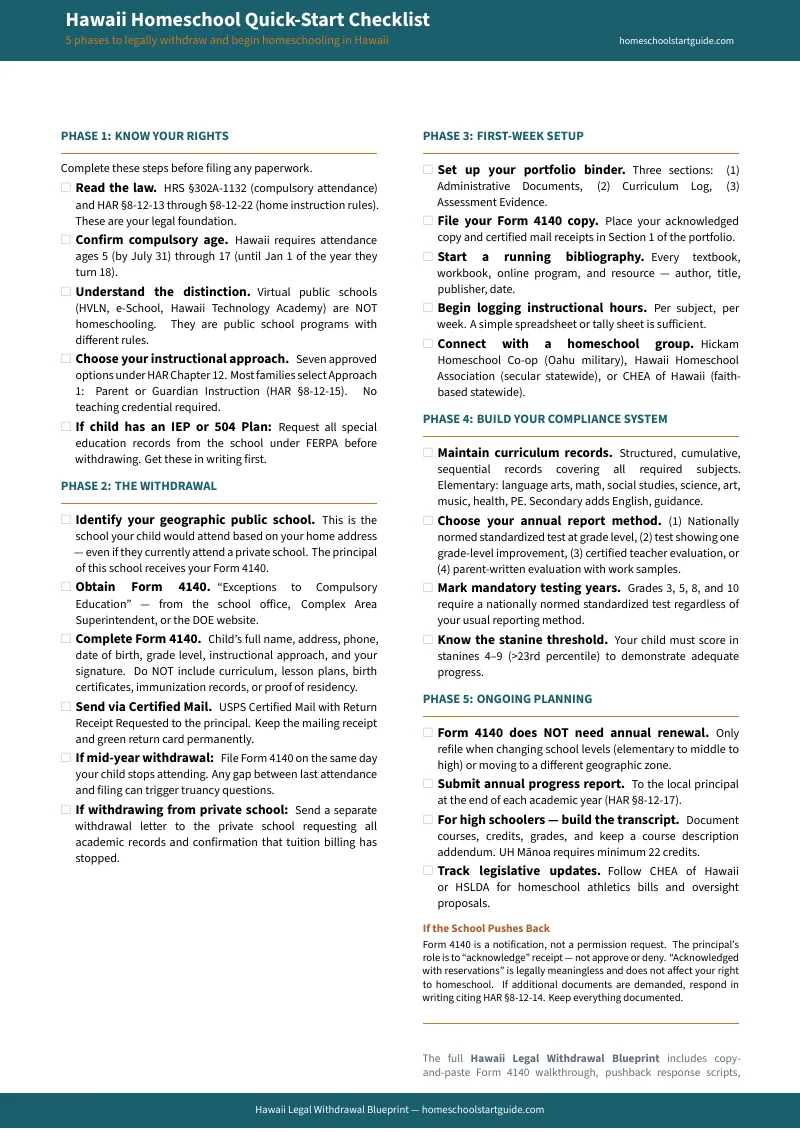
Your download includes 10 documents: the complete Blueprint guide (17 chapters covering Hawaii's legal framework, all seven instructional approaches compared, Form 4140 walkthrough, withdrawal process, truancy protections, curriculum records, progress reports, military PCS, special education, dual enrollment, transcripts, athletics, and Hawaiian cultural education), plus 8 standalone printable tools — the Withdrawal Letter Templates (6 ready-to-send letters for every scenario), the Principal Pushback Scripts (copy-paste responses for illegal demands), the Form 4140 Field-by-Field Walkthrough (print and reference while filling out the form), the Seven Approaches Comparison (side-by-side decision matrix), the Annual Progress Report Template (fill-in-the-blank parent narrative with all four methods compared), the Military PCS Quick-Start (JBPHH, Schofield, MCBH timeline), the IEP/504 Exit Checklist (records to get before you withdraw), and the Record-Keeping Reference (three-section portfolio system for HAR §8-12-15 compliance). Plus the Hawaii Homeschool Quick-Start Checklist — a one-page summary of the statutory requirements, key deadlines, and the single most important thing to know about Form 4140 before you walk into the school office. Instant download, no account required.
30-day money-back guarantee. If the Blueprint doesn't give you the confidence and legal clarity to execute your withdrawal and secure your family's compliance, email us and we'll refund you. No questions asked.
Not ready for the full Blueprint? Download the free Hawaii Homeschool Quick-Start Checklist — a one-page overview of the statutory requirements, the seven instructional approaches at a glance, and the single fact about Form 4140 that most parents don't discover until it's too late. It's enough to get oriented, and it's free.
Your child doesn't have to go back tomorrow. Hawaii law gives you the right to educate at home — the DOE just hasn't made it easy. The Blueprint makes it simple.