Hawaii Requires an Annual Progress Report. Nobody Shows You What One Actually Looks Like.
You filed Form 4140. You chose your instructional approach. You've been teaching your child at home for months, and it's going well — better than you expected, honestly. Then May arrives and reality hits: you need to submit an annual progress report to the principal demonstrating "adequate progress," and the state has never once defined what "adequate" actually means.
You check the HIDOE website. It tells you to provide "a description of the child's progress in each subject area taught, together with representative samples of the child's work." Helpful, right? So you open a blank Word document and stare at it. How long should this be? What counts as a "representative sample"? What if the principal thinks your unschooling field journals don't look like real schoolwork? What if your child's work is scattered across three notebooks, a Google account, and a stack of art projects you swore you'd organize in January?
You search Facebook groups. One parent says she writes two paragraphs per subject and that's plenty. Another says she submits a 40-page binder with color-coded tabs. A third says her principal rejected her report last year because it "lacked detail." You're more confused than when you started, and the deadline is six weeks away.
The Hawaii Portfolio & Assessment Templates are a Chapter 12 Documentation System — the complete set of fillable, Hawaii-specific templates that translate every legal requirement in HAR §8-12-15 and §8-12-18 into a structured format you can fill in, attach your work samples to, and hand to the principal with confidence. No guessing what "adequate" means. No formatting fights. No panicked late-night binder assembly.
What's Inside the Documentation System
The Chapter 12 Compliance Matrix
A one-page reference that maps every legal requirement from HAR §8-12-15 (Record of Curriculum) and §8-12-18 (Annual Progress Report) to the exact template in this kit that satisfies it. This is the document you tape inside your portfolio binder — when you're unsure whether you've covered a requirement, you check the matrix instead of re-reading the statute.
The 4-Part Parent Evaluation Template
Hawaii's parent-written evaluation — the most popular reporting method and the most daunting for first-year families — requires four distinct elements: subject progress descriptions, representative work samples, representative tests and assignments, and grades. Most parents don't realize this until they're staring at a blank document in May. The template gives you fillable sections for each element, with example phrasing for every core subject area so you're never writing from scratch. Strong, measurable language that principals accept: "Student independently solves multi-step word problems involving fractions" — not vague descriptions that invite follow-up questions.
Seven Instructional Approach Documentation Guides
Form 4140 lists seven legal approaches to homeschooling — parent-taught, certified tutor, approved private school curriculum, alternative education program, private school, licensed vocational school, and other DOE-approved programs. What nobody tells you is that each approach creates different documentation expectations. A parent using an accredited online program has transcripts generated automatically but still needs to integrate them into a unified progress report. A parent using a Charlotte Mason method needs to translate nature journals and living books into the subject-based structure the principal expects. The templates include approach-specific phrasing guides so your documentation matches your actual teaching style.
Grade-Level Portfolio Frameworks
What you collect for a kindergartener looks nothing like what you collect for a 10th grader. The guide provides age-appropriate documentation structures from K through 12th grade — what to keep, what to skip, how many work samples per subject is enough (the answer is fewer than you think), and how to show progression across the year without daily logging. Elementary parents get simple weekly collection routines. High school parents get subject-specific portfolio strategies aligned to transcript-building.
The High School Transcript Builder
Hawaii does not issue diplomas to homeschooled students. If your teenager wants to attend college, trade school, or enlist in the military, you — the parent — must produce a professional transcript that stands alongside institutional documents. The transcript builder includes a course-by-course template, GPA calculator, Carnegie unit tracker, and specific admissions guidance for the University of Hawaii system: Manoa's core requirements, Hilo's flexible admissions, West Oahu's pathways, and community college dual enrollment through Running Start. Plus guidance for mainland university applications — what SAT/ACT scores to include, how to document extracurriculars, and how to write a school profile that explains your homeschool program to admissions officers who've never seen one.
The Record of Curriculum Worksheets
HAR §8-12-15 requires you to maintain a "record of the planned curriculum" with five specific elements: start/end dates, instructional hours per week, subject areas, assessment methods, and a bibliography with author, title, publisher, and date. You keep this at home — it's not submitted annually — but if a principal ever requests it, you need to produce it. The worksheets give you a structured place to record all five elements as you go, so you're never retroactively reconstructing months of teaching from memory.
Standardized Testing Integration
Hawaii mandates nationally-normed standardized testing in grades 3, 5, 8, and 10. But the public schools administer high school tests in 11th grade — creating a scheduling conflict for 10th graders who need to satisfy the statute. The guide covers free testing options at your local public school, private testing alternatives through co-ops and test administrators, how test scores interact with your annual progress report (they can replace it in testing years), and how to handle the 10th-grade gap.
Hawaiian Studies & Cultural Integration
If your family practices ʻāina-based education, Hawaiian language immersion, or culturally integrated learning, you know the documentation challenge: how do you translate a lo'i kalo restoration project or a huaka'i field study into the subject-based categories the state expects? The guide includes specific examples of mapping cultural learning to state reporting categories — language arts, social studies, science, health, and Hawaiian studies — so culturally grounded education gets the documentation it deserves.
Who This Is For
- First-year homeschool parents approaching their first annual progress report who have no idea what the principal expects or what "adequate progress" looks like in practice
- Military families who PCS'd to Hawaii from low-regulation states and are blindsided by the annual reporting requirement — you've never had to write a progress report before and the deadline is approaching
- Parents of high schoolers who need to build a transcript that gets their teenager into UH Manoa, a mainland university, or a military branch — and who refuse to let a "homemade" document hold their child back
- Unschoolers, Charlotte Mason families, and eclectic homeschoolers whose teaching doesn't fit neatly into subject-based boxes and who need help translating child-led learning into state-approved language
- Big Island, Maui, and Kauai families with limited access to evaluators, testing centers, and local support — where a principal who processes one homeschool file a year scrutinizes every line
- Second- or third-year families who've been winging it with handwritten notes and a prayer, and realize they need a real system before high school makes the stakes permanent
Why Not Just Use the Free Resources?
You can. The HIDOE website lists the requirements. CHOH provides detailed walkthroughs of the law. Facebook groups have hundreds of threads from Hawaii parents sharing what they submitted. Here's what actually happens when you try to build a portfolio system from free sources:
- The HIDOE tells you what to submit — not how to write it. "A description of the child's progress in each subject area taught, together with representative samples" is the complete instruction. No examples. No templates. No indication of how long, how detailed, or how formal the principal expects it to be. Every parent interprets that sentence differently, which is exactly why Facebook groups are full of contradictory advice.
- CHOH has deep legal knowledge — buried in walls of text. The Christian Homeschoolers of Hawaii website is the best free legal resource in the state. It's also organized like an encyclopedia from 2004. To extract actionable templates, you need to read dozens of articles, copy text into your own documents, and format everything yourself. And the tone is explicitly religious — perfectly fine for their audience, but it means secular families, military families, and diverse families are left without a culturally neutral option.
- Etsy templates are designed for Pinterest, not principals. A $5 "homeschool portfolio template" gives you a watercolor cover page, a generic attendance tracker, and a reading log. None of these satisfy Hawaii's four-part evaluation structure. None include the Record of Curriculum fields required by HAR §8-12-15. You'll spend hours modifying a pretty template to actually meet your state's requirements — or worse, you'll submit it thinking it's compliant and discover it's not when the principal asks for revisions.
- Homeschool tracking apps are overkill for Hawaii. Homeschool Tracker and Homeschool Planet charge $60-80 per year for daily assignment logging, automated grading, and attendance tracking. Hawaii doesn't require daily attendance logs submitted to the state. It requires one annual progress report. Paying a monthly subscription and entering daily data creates exactly the kind of administrative burnout that makes parents quit homeschooling — for a reporting requirement that could be satisfied in an afternoon with the right templates.
Free resources tell you that Hawaii requires a progress report. The Documentation System gives you the fillable templates, the approach-specific phrasing, and the compliance matrix that turn a blank document into a finished report the principal accepts without question.
— Less Than One Hour of a Tutor
A certified teacher evaluation runs $75-150 per child per year. Homeschool tracking apps charge $60-80 annually. An education attorney consultation costs $250-500 per hour. The Documentation System costs less than a single tutoring session and covers every child in your family, every year, with no recurring fees.
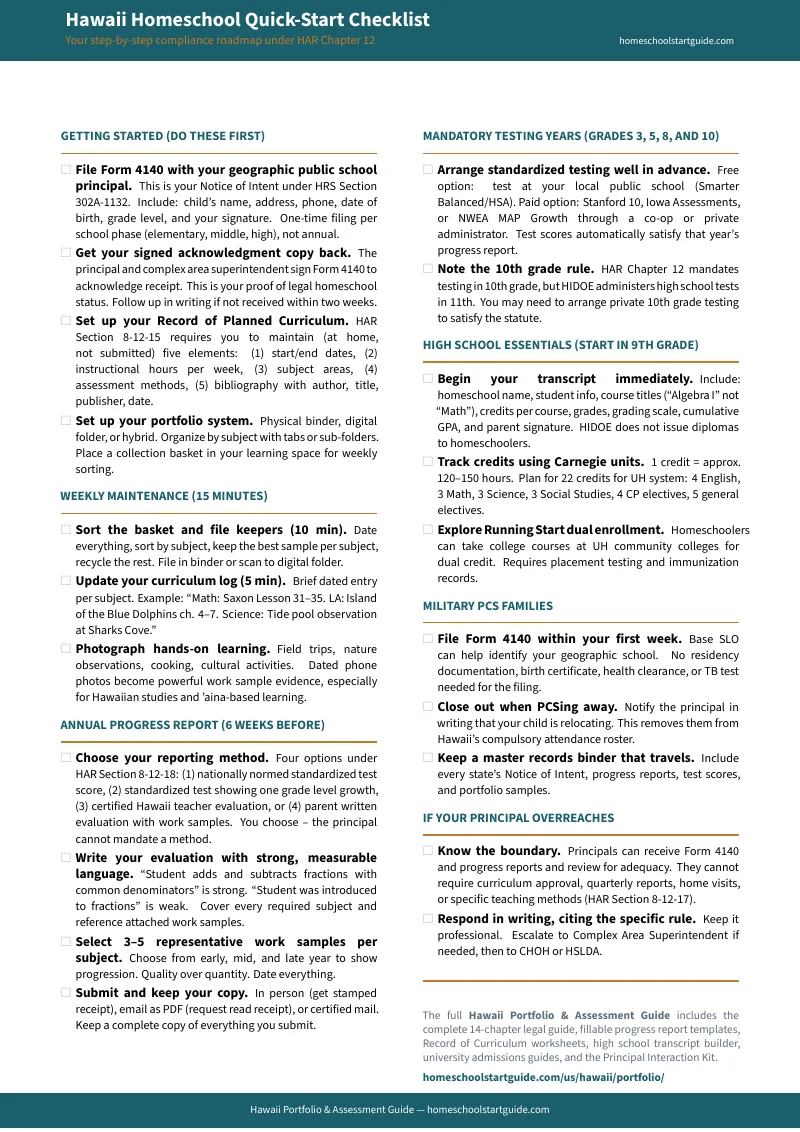
Your download includes the complete 14-chapter guide plus 6 standalone printable worksheets — the Chapter 12 Compliance Matrix (1 page — tape it inside your binder), fillable 4-Part Parent Evaluation Template (8 pages), Record of Curriculum Worksheets (3 pages — all five required elements), High School Transcript Builder (5 pages — GPA calculator + UH admissions formatting), Military PCS Documentation Bridge (2 pages), and End-of-Year Compilation Guide (4 pages). The main guide covers all seven instructional approaches, grade-level portfolio frameworks from K-12, subject documentation examples, standardized testing integration, Hawaiian studies, and principal interaction strategies. Plus the Hawaii Homeschool Quick-Start Checklist — a one-page compliance roadmap with the essential deadlines, filing requirements, and weekly maintenance routine. 8 PDFs total. Instant download, no account required.
30-day money-back guarantee. If the templates don't give you the confidence and structure to submit your annual progress report without anxiety, email us and we'll refund you. No questions asked.
Not ready for the full system? Download the free Hawaii Homeschool Quick-Start Checklist — a step-by-step compliance roadmap covering Form 4140 filing, weekly portfolio maintenance, annual progress report preparation, mandatory testing years, and high school essentials. It's enough to get organized, and it's free.
Your child is learning. The state just needs to see it on paper. The Documentation System makes sure they do.