Build Your Hawaii Micro-School Legally, Affordably, and Without a Franchise.
Hawaii's HRS §302A-1132 gives parents the right to homeschool by filing a simple notification with their local school principal — no curriculum approval, no teacher credentials, just a completed Form 4140 and a choice among seven approved instructional approaches. That framework is why learning pods and micro-schools are surging across Oahu, Maui, the Big Island, and Kauai. But the moment your pod starts looking like childcare instead of education — serving children under five without parents on-site, operating during traditional work hours, or accepting compensation for watching other families' kids — the Hawaii Department of Human Services may classify it as an unlicensed childcare facility. A Waldorf-inspired co-op on the Big Island learned this the devastating way: a $55,500 fine and immediate forced closure. The HIDOE website never mentions "micro-school" or "learning pod." The free Facebook groups confidently declare that pods need no insurance, that zoning doesn't matter, and that Form 4140 covers everything — until the DHS investigation letter arrives.
You want to pull together three or four families in your area, share the teaching load, and build something that works for your keiki. Maybe you're a solo homeschooler who filed your Form 4140 two years ago and you're burned out — the isolation of island life makes teaching alone even harder than on the mainland, and your relationship with your child is fraying over daily math battles. Maybe you're a military spouse who just PCS'd to Pearl Harbor-Hickam or Schofield and need a learning community that survives the next set of orders. Maybe you live on Maui or Kauai where private school options barely exist and the nearest co-op meets twice a month in someone's garage. Maybe you researched Punahou ($31,150/year), 'Iolani ($31,150), and Mid-Pacific ($28,140) and realized those numbers are fantasy for your dual-income household in a state where a modest Kapolei townhouse costs $650,000. Whatever the reason, you've arrived at the same conclusion: I need to build this myself.
The problem is that the internet gives you fragments. HIDOE talks about Form 4140 and seven instructional approaches — it does not explain how three families can share a living room without triggering a DHS investigation. CHEA of Hawaii provides networks and curriculum fairs but operates explicitly from a "Christ-centered perspective" that excludes secular, progressive, and Native Hawaiian cultural advocates. Facebook groups in Oahu Homeschool Moms and Maui Homeschoolers confidently declare that pods need no insurance, that GET doesn't apply, and that zoning is irrelevant — advice that crumbles under scrutiny. You need a Pod Founder's Playbook — the complete operational framework without the dangerous legal guesswork, the franchise costs, or the mainland assumptions.
The Hawaii Micro-School & Pod Kit is that Pod Founder's Playbook.
What's Inside the Pod Founder's Playbook
The Legal Framework — Homeschool Notification vs. Private School Registration
Because the single most dangerous assumption in Hawaii micro-schooling is that the state's simple Form 4140 notification covers group learning. Under HRS §302A-1132, each family notifies their local school principal and selects one of seven approved instructional approaches — a certified teacher, an approved program, a properly qualified parent, or others. As long as each parent in your pod retains individual instructional authority over their own children and files their own Form 4140, the pod operates as cooperating homeschool families. But once one guide or facilitator accepts primary instructional responsibility for children from multiple families on an ongoing basis, you may need to register as a private school through the Hawaii Council of Private Schools — triggering accreditation requirements, facility standards, and teacher qualifications. The guide walks you through the exact criteria that separate a legal cooperative from an unregistered private school, so you choose the right structure before your first family meeting.
The DHS Childcare Licensing Trap — How to Avoid the $55,500 Fine
Because a well-intentioned Big Island co-op discovered that Hawaii strictly regulates commercial childcare facilities — and their Waldorf-inspired micro-school was classified as an unlicensed one. If your pod serves primarily children under age five, operates during traditional work hours, or lacks consistent parent-on-site participation, the Department of Human Services can classify it as a Family Child Care Home (3–6 children) or Group Child Care Home (7–12 children) requiring state licensing. The guide provides the exact operational structures — parent-share rotation models, school-age-only enrollment, documented educational instruction rather than custodial care — that maintain your pod's educational exemption and keep DHS out of your living room.
The County Zoning and General Excise Tax Guide
Because operating a learning pod from your home in Honolulu has different rules than operating one in Hilo, Kahului, or Līhu'e — and ignoring the General Excise Tax can cost you more than the pod earns. The guide maps zoning considerations for all four Hawaii counties: Honolulu's "Group Instruction" home occupation classification, Hawaii County's rural and agricultural zone restrictions, Maui County's Special Use Permit requirement for home businesses with outside visitors, and Kauai County's strict limits on home-based operations with employees. Plus the GET reality — Hawaii's 4.712% General Excise Tax applies to tutoring and educational services unless you form a 501(c)(3) nonprofit and secure Form G-6 exemption.
The 'Āina-Based Curriculum Integration Framework
Because Hawaii families don't want a generic mainland curriculum dropped into a tropical setting — they want education rooted in the land. The guide provides a framework for weaving Hawaiian culture, 'ōlelo Hawai'i (Hawaiian language), ahupua'a ecology, and ocean stewardship into your pod's curriculum. It maps existing cultural education resources — Waipā Foundation's taro cultivation programs, Kōkua Hawai'i Foundation's environmental education, Pacific American Foundation's place-based learning — and shows how to integrate them into your weekly schedule. This chapter is why national micro-school guides feel hollow in Hawaii and why this kit exists.
The Family Agreement and Liability Templates
Because a child getting hurt during a field trip to Hanauma Bay should not end the pod — and it won't, if you're prepared. Customizable parent agreements covering educational philosophy, schedule, tuition, attendance, behavior, conflict resolution, withdrawal, and media privacy. Plus a liability waiver with indemnification, medical consent, and emergency contact forms. A facilitator contract for W-2 or 1099 educators with Hawaii-specific employment terms and background check requirements. Every family signs these before day one. These are not generic Etsy templates — they are written for the specific legal context of Hawaii home education under HRS §302A-1132.
The Hawaii Budget Planner and Cost-Sharing Models
Because running a pod with hired help in Honolulu costs nothing like running one in Captain Cook or Hāna. Budget templates covering facilitator compensation ($26,000–$43,000/year, adjusted for Hawaii's cost of living — not mainland benchmarks), space rental, curriculum materials, insurance ($1,200–$1,800/year), field trips, and GET obligations — with real Hawaii cost data by island. Includes cost-sharing models for 3-family, 5-family, and 8-family pods, and a tuition calculator that shows families the per-student cost compared to private school tuition.
The Hawaii Pod Launch Checklist
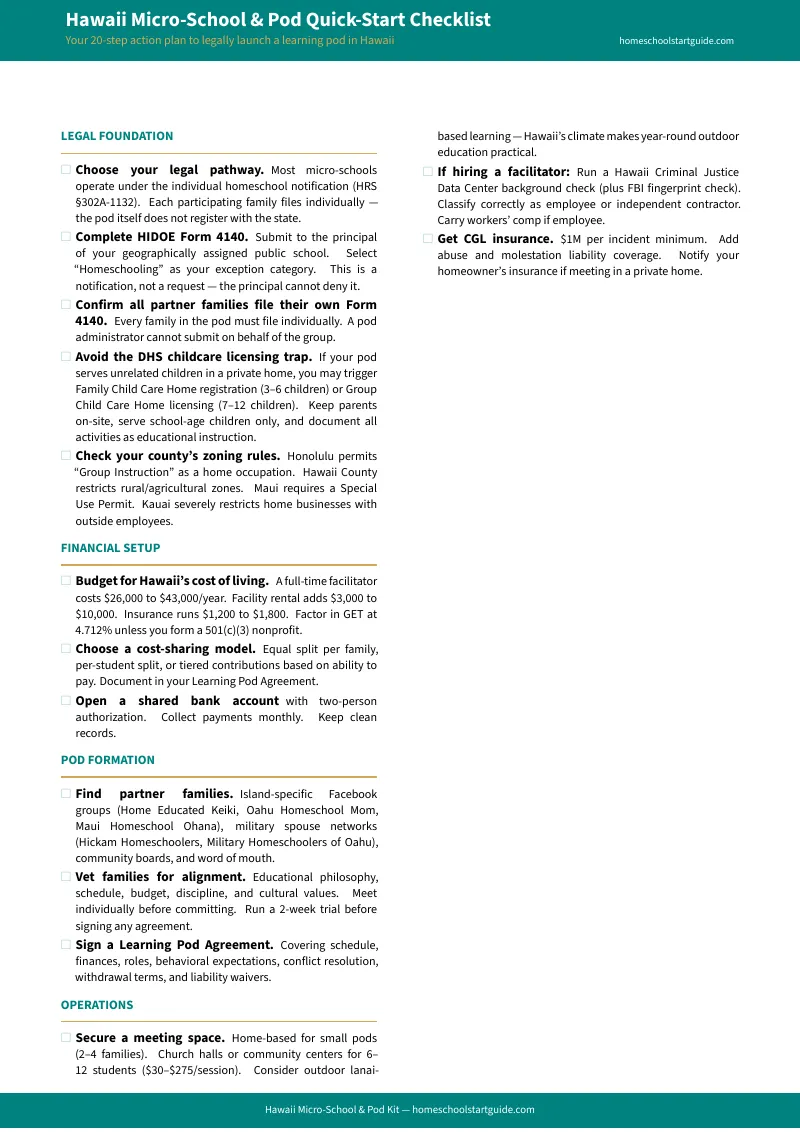
Because most parents spend forty-plus hours assembling the launch sequence from HIDOE forms, CHEA resources, county zoning codes, and contradictory Facebook posts. A single-page, print-and-pin document that walks you from "I have an idea" to "the first day of pod school" — covering the legal, financial, operational, and community formation steps in the correct order, with Hawaii-specific thresholds and legal references at every step.
Who This Kit Is For
- Solo homeschoolers who have reached the burnout threshold and need a shared-responsibility model where the instructional and social burden is distributed among trusted families — without losing control of your child's education or accidentally triggering DHS childcare licensing
- Oahu families priced out of Punahou, 'Iolani, Mid-Pacific, and the other private schools that charge $28,000–$31,000 per year — who want small-group instruction and real community at a fraction of institutional tuition
- Military families at Pearl Harbor-Hickam, Schofield Barracks, and MCBH Kaneohe Bay who need a learning community that survives PCS rotations — with transient membership structures, mid-year entry protocols, and portable documentation that transfers cleanly to the next duty station
- Neighbor island families on Maui, the Big Island, Kauai, Molokai, or Lanai where private school options are scarce and geographic isolation makes solo homeschooling lonely for both children and parents — a pod of even three families transforms the educational experience
- Hawaiian and Pacific Islander families who want education rooted in the 'āina — ahupua'a ecology, ocean stewardship, Hawaiian language and cultural practices — delivered through a small-group learning environment, not a mainland-designed curriculum
- Secular, progressive, or minority-religion families who want structured community without navigating the conservative Christian organizational culture that dominates Hawaii's existing homeschool networks
- Parents of neurodivergent children (autism, ADHD, dyslexia, giftedness, 2e) who are exhausted by inadequate public school services and want a small-group environment designed around their child's actual needs
- Former educators who want to serve their community by running a small paid micro-school — without Prenda's $2,199 per-student platform fee, Acton Academy's $20,000 licensing fee, or KaiPod's revenue share
After Using the Kit, You'll Be Able To
- Understand Hawaii's legal framework under HRS §302A-1132 and know exactly when a multi-family pod crosses the threshold from cooperating homeschool families into private school territory requiring Hawaii Council of Private Schools registration
- Structure your pod to maintain every family's individual homeschool notification compliance — including the seven approved instructional approaches, annual progress reports, and standardized testing at grades 3, 5, 8, and 10
- Avoid the DHS childcare licensing trap that cost the Big Island Waldorf co-op $55,500 — with specific operational structures that keep your pod classified as educational instruction, not unlicensed childcare
- Navigate county zoning rules for all four Hawaii counties and understand the General Excise Tax obligations — including the 501(c)(3) exemption pathway that eliminates GET entirely
- Run your first parent intake meeting using a signed Family Agreement and liability waiver that protects every family in the pod — without spending $300+ on a Hawaii education attorney
- Hire and background-check a facilitator legally under Hawaii statutes, classify them correctly for employment taxes, and pay them competitively using real Hawaii wage data
- Integrate 'āina-based learning, Hawaiian culture, and place-based education into your pod's curriculum using existing local resources and cultural organizations
Why Not Just Use the Free Resources?
HIDOE is the regulatory authority. CHEA of Hawaii has decades of community building. Facebook groups have thousands of Hawaii parents trading advice. Here is exactly what you run into when you try to build a pod from those sources alone:
- HIDOE gives you Form 4140 and nothing else. The Hawaii Department of Education website explains how to file your homeschool notification, lists the seven approved instructional approaches, and outlines testing requirements at grades 3, 5, 8, and 10. It has never used the words "micro-school" or "learning pod." A parent searching HIDOE for instructions on starting a multi-family pod finds compliance mandates for individual homeschoolers. No guidance on group structures, no DHS childcare licensing warnings, no county zoning considerations.
- CHEA of Hawaii gives you community — if you share their worldview. Christian Homeschoolers of Hawaii is the state's most organized network. They run curriculum fairs, island-specific Facebook groups, and military spouse support channels. But CHEA operates explicitly from a "Christ-centered perspective." For secular families, Native Hawaiian cultural advocates, progressive educators, and families of minority or no religious background, this network is culturally and ideologically inaccessible. The pod structures, the community advice, and the curriculum recommendations are filtered through a specific religious lens.
- Facebook groups are an echo chamber of dangerous legal assumptions. Parents in Oahu Homeschool Moms, Maui Homeschoolers, and Hawaii Homeschooling Families confidently declare that pods need no insurance (they do if a child gets hurt on your property), that General Excise Tax doesn't apply to educational co-ops (it does unless you have a 501(c)(3) exemption), and that DHS childcare licensing only applies to daycares (it applies to any facility caring for unrelated children under conditions the state classifies as custodial). A parent who follows Facebook advice discovers the gaps when DHS contacts them.
- Etsy templates are generic planners with a Hawaiian aesthetic. Plumeria-themed attendance trackers, keiki flashcards, and Honolulu travel planners priced at $5–$15 on Etsy and TPT. Not one references HRS §302A-1132, the DHS childcare licensing thresholds, the four-county zoning matrix, General Excise Tax obligations, or how to structure a multi-family financial agreement. They help you decorate a schedule. They do not help you form a legally protected pod in Hawaii.
- Prenda and Acton solve the problem — and take your autonomy and your money. Prenda charges $2,199 per student per year in platform fees and locks you into their screen-heavy curriculum — which contradicts the outdoor, 'āina-based learning that Hawaii families actually want. Acton Academy charges a $20,000 licensing fee plus ongoing revenue share and currently operates only on Maui. KaiPod requires premium tuition that works in states with ESA vouchers — Hawaii has none. If you're doing the hard work of building local trust on your island, you should keep 100% of the revenue and 100% of the curriculum control.
Free resources give you the legal baseline and the community connections. The Pod Founder's Playbook gives you the templates, checklists, and frameworks to execute this week.
— Less Than a Single Day of Private School Tuition
One day of private school tuition in Hawaii costs $115–$175. Prenda charges $2,199 per student per year. Acton Academy charges a $20,000 licensing fee. A consultation with a Hawaii education attorney costs $200–$400 per hour. The Kit costs a fraction of any of these and gives you the operational independence those platforms are designed to prevent.
Your download includes the complete guide (18 chapters covering Hawaii's legal framework under HRS §302A-1132, the seven approved instructional approaches, the DHS childcare licensing trap and how to avoid the $55,500 fine, General Excise Tax and 501(c)(3) exemption, county zoning for Honolulu/Hawaii County/Maui/Kauai, space solutions from living rooms to lānais, finding families and vetting for values alignment, hiring facilitators with Hawaii background checks and cost-of-living-adjusted pay, HIDOE compliance and annual reporting, 'āina-based curriculum integration with Hawaiian culture and language, budget planning with real Hawaii cost data, national micro-school networks in Hawaii, field trips and experiential learning, high school pods with transcripts and University of Hawaii dual enrollment, special populations including neurodivergent learners and military families and neighbor island challenges, daily operations and scaling, conversations and conflict resolution, and templates and tools), plus the Hawaii Pod Launch Checklist and standalone printable tools: the Learning Pod Agreement, the Liability Waiver and Emergency Contact Form, the Facilitator Contract, and the Hawaii Regional Budget Planner. Instant download, no account required.
30-day money-back guarantee. If the Kit does not give you the legal clarity and operational confidence to move forward with your pod, email us and we will refund you. No questions asked.
Not ready for the full Kit? Download the free Hawaii Homeschool Quick-Start Checklist — a 20-step roadmap covering the legal foundation under HRS §302A-1132, the DHS childcare licensing avoidance checklist, county zoning checks, financial setup, finding families, operations, and launch day. It's enough to understand your rights tonight.
Hawaii gave you the legal freedom. The Pod Founder's Playbook makes sure you use it without accidentally creating an unlicensed childcare facility.