
Georgia Doesn't Collect Your Records — Until Everyone Else Demands Them
You filed your Declaration of Intent. You are teaching the five core subjects. You are logging 180 days at 4.5 hours. Georgia law says you keep your records at home and the state never asks to see them.
Then a DFCS caseworker arrives and asks for three years of progress reports. Your tenth-grader wants to dual-enroll through Move On When Ready and the coordinator asks for a transcript you never built. Your twelfth-grader applies for the HOPE Scholarship through GAfutures and discovers that her parent-assigned GPA cannot be used because she graduated from an unaccredited program — she needed a 1160 SAT or four rigor credits, and nobody told her until April of senior year.
Georgia's leniency is the trap. The state does not check your records until colleges, scholarships, DFCS, or a PCS transition suddenly does. And if you cannot produce comprehensive, organized documentation on short notice, the consequences are immediate.
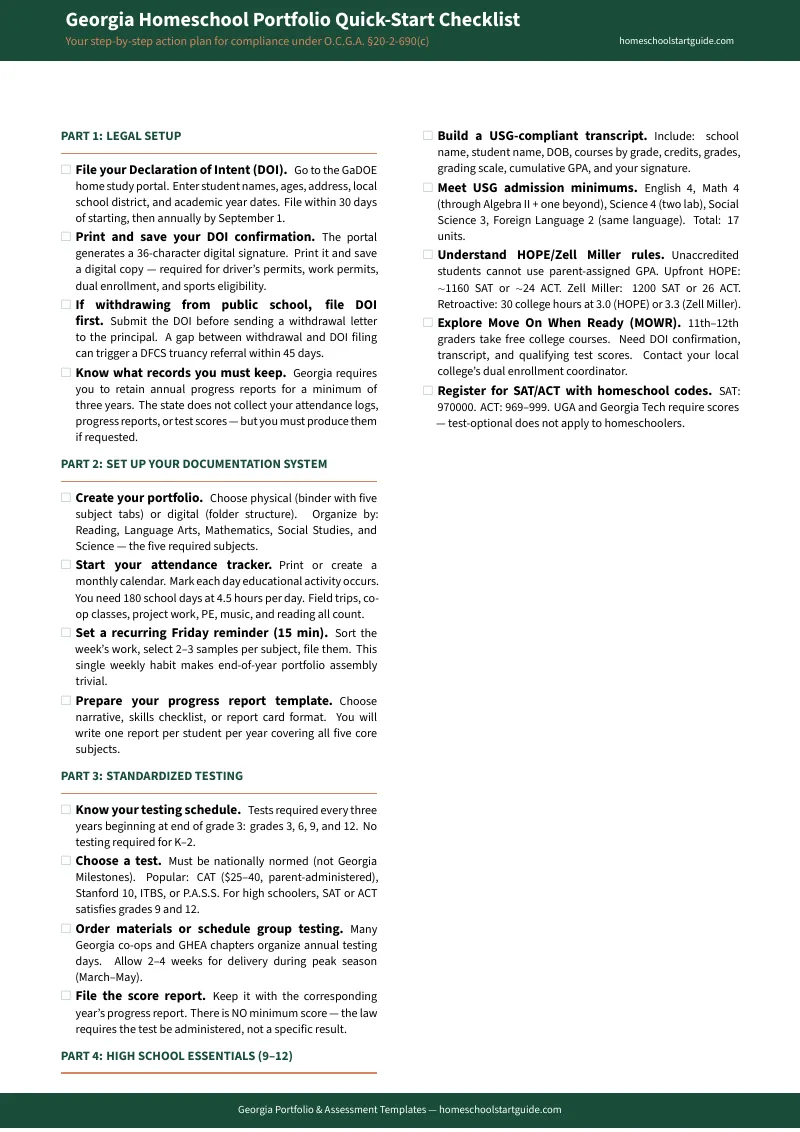
The Georgia Portfolio & Assessment Templates is a complete compliance system built around O.C.G.A. § 20-2-690(c) — the one statute that defines every requirement for Georgia home study programs. It gives you the exact templates, tracking systems, and pre-built language you need to stay legally compliant in 15 minutes a week, and to be fully prepared for the high-stakes moments that arrive without warning.
— less than a single month of an umbrella school that charges $300 a year to hold your records in a filing cabinet.
What's Inside
Compliance Foundation
- 180-Day / 4.5-Hour Attendance Tracker — A monthly calendar system mapped to Georgia's exact statutory requirement. Designed so field trips, co-op days, PE, music lessons, and project work all count naturally toward the 4.5-hour total — because the law says they do, and your tracker should reflect that without making you log every minute.
- Annual Progress Report Templates — Three format options (narrative, skills checklist, report card) with pre-built language covering all five mandated subjects. Written to satisfy the statutory requirement without volunteering more information than the law demands — because a progress report that over-reports is a liability, not a strength.
- DOI Filing & Renewal Guide — Step-by-step walkthrough of the GaDOE portal, the 36-character confirmation code, the September 1 annual deadline, and the 45-day withdrawal rule that triggers DFCS referrals when missed.
Five-Subject Portfolio System
- Work Sample Filing System — Organized by Georgia's five legally required subjects (reading, language arts, mathematics, social studies, science) with grade-banded guidelines showing how many samples to keep per subject and what types of evidence work for different homeschool styles.
- Standardized Testing Guide — Which tests qualify (CAT, Stanford 10, ITBS, P.A.S.S., SAT, ACT), where to find Georgia test administrators, how to schedule around the grade 3/6/9/12 triennial cycle, and what to do with the score reports afterward.
High School & Scholarships
- USG-Compliant Transcript Builder — Pre-formatted for the University System of Georgia with fields for course descriptions, credits, grades, grading scale, and cumulative GPA. Built to match what UGA, Georgia Tech, and the GAfutures portal expect from an unaccredited home study program.
- HOPE & Zell Miller Scholarship Eligibility Tracker — The exact requirements for unaccredited homeschool graduates: upfront path (1160 SAT for HOPE, 1200 SAT for Zell Miller) vs. retroactive path (30 college credits at 3.0/3.3 GPA). Includes an Academic Rigor Course List checklist so your student does not discover missing rigor credits in April of senior year.
- MOWR Dual Enrollment Tracker — For Move On When Ready participants: what documentation the college coordinator needs, how dual enrollment credits map to your transcript, and how to track Georgia Virtual School (GAVS) courses alongside traditional coursework.
Who This Is For
The First-Year Parent
You filed the DOI and now you are staring at a blank binder wondering what a progress report is supposed to look like. Georgia law says you must write one every year covering all five core subjects — but the GaDOE does not provide a template, GHEA tells you what to include but not how to format it, and every blog post you find says something different. This guide gives you three ready-to-use formats with filled examples so you can pick one and be done in an evening.
The HOPE Strategist
Your student is in ninth or tenth grade and you are already thinking about the HOPE Scholarship. You know that unaccredited homeschool graduates cannot use a parent-assigned GPA — but the GAfutures website is dense, the rigor course requirements are buried in PDF documents, and nobody has given you a clear, year-by-year tracking system. The transcript builder and scholarship tracker in this guide are built specifically for the GSFC evaluation process, not adapted from a generic template.
The Military Family
You are at Fort Moore, Fort Stewart, Robins AFB, or Kings Bay, and you know a PCS is coming. South Carolina, North Carolina, and Alabama all have different homeschool requirements, and the receiving school district will ask for documentation from Georgia. The special situations chapter covers exactly what records to organize before you move and how MIC3 protections apply to your homeschooled children.
After You Have This System
- You will know exactly which records O.C.G.A. § 20-2-690(c) requires you to keep — and which ones forums and Facebook groups tell you to keep that exceed the legal minimum
- You will have a progress report template with pre-built language for all five subjects that satisfies the statute without over-reporting
- Your attendance tracker will map directly to the 180-day/4.5-hour requirement without requiring minute-by-minute logging
- If a DFCS caseworker or superintendent requests records, you will have three years of organized documentation ready to produce
- If your high schooler applies to a Georgia university, you will have a transcript formatted for the system that processes it — not a generic spreadsheet that gets flagged
- If your student qualifies for HOPE or Zell Miller, you will have the documentation trail that proves it from year one — not a panicked reconstruction in April
Why Not Just Use GHEA's Free Resources?
GHEA is excellent at explaining what the law requires. They will tell you that you need a progress report, that it must cover five subjects, and that you must retain it for three years. What they do not provide is the template. They will tell you that a high school transcript should be "a one-page summary of your student's coursework, grades, and credits earned" — but they will not hand you a fillable document formatted for the GAfutures portal.
The GaDOE explicitly states that its authority extends only to collecting the Declaration of Intent. They provide no templates, no examples, and no guidance on what a compliant progress report looks like. The $2 planners on Etsy are beautifully designed and legally irrelevant — they do not reference Georgia's five required subjects, they do not align with the 180-day/4.5-hour statute, and they will not help your student when the GSFC evaluates an unaccredited transcript.
This guide fills the gap between "here is what the law says" and "here is exactly how to do it, in a format that holds up when it matters."
Instant Digital Download — 11 PDFs
The complete guide (63 pages) plus 9 standalone printable tools: attendance tracker, progress report templates (3 formats), standardized testing reference, grade-banded portfolio frameworks, USG-compliant transcript template, HOPE & Zell Miller scholarship tracker, MOWR dual enrollment tracker, military PCS checklist, and annual compliance calendar. Download immediately after purchase. No shipping, no waiting, no account required.