Start Your Florida Micro-School Legally, Fund It With ESA Money, and Keep 100% of Your Tuition.
Florida passed HB 1285 to unlock thousands of new locations for your micro-school. Churches, museums, community centers, and commercial spaces are now explicitly available without fighting local zoning boards or applying for special use permits. The Personalized Education Program (PEP) puts up to $8,000 per student into Education Savings Accounts your families can use to pay your tuition. But nobody has packaged Florida's regulatory maze into a usable, step-by-step guide that tells you exactly how to build a compliant, fundable micro-school from scratch — until now.
You want to pull together a handful of neighborhood families, create something small and intentional, and give your children the learning environment the public school system refuses to provide. Maybe your child has ADHD and the IEP battles have exhausted you. Maybe you're a former teacher who left the system and wants to serve your community without surrendering control to a franchise network. Maybe you're secular, and every quality co-op in your area requires a statement of faith. Whatever the reason, you've arrived at the same conclusion: I need to build this myself.
The problem is that the internet gives you fragments. The Florida Department of Education tells you the legal baseline — in 100-page PDFs scattered across sub-domains that read like bureaucratic obstacle courses. The Step Up For Students handbook dictates the rules for accepting ESA funds, but it doesn't tell you how to structure your micro-school to actually qualify. The franchise networks (Prenda, KaiPod, Primer) will walk you through launch — for $2,200 per student per year in platform fees, or a long-term revenue share that strips away the financial independence that drew you to micro-schooling in the first place. You need the operational playbook without the ideological prerequisites and without surrendering your tuition to a network.
The Florida Micro-School & Pod Kit is that playbook.
What's Inside the Kit
The HB 1285 Facility & Compliance Checklist
A plain-English breakdown of House Bill 1285 — the law that preempts local zoning ordinances and allows you to open a private school in churches, museums, theaters, and community centers without a special use permit. This checklist tells you exactly what HB 1285 protects you from, what it does not exempt you from (Fire Marshal, Environmental Health, and Building Code inspections are still required), and how to document your compliance so a single letter ends any dispute before it starts. This is the first resource that separates the zoning preemption from the safety code requirements into a parent-ready action document.
The FLDOE Registration Roadmap
The exact chronological sequence for registering your micro-school as a Florida private school: form your LLC on Sunbiz.org, obtain your EIN, complete the mandatory FDLE Level 2 fingerprinting and background check, request a school code from the Florida Department of Education, submit the notarized Annual Private School Survey, and secure your general liability insurance policy. This is not a general overview — it is the specific 2026 checklist that prevents the administrative errors causing families to lose months of operational time before they can legally accept their first student.
The PEP & ESA Funding Playbook
Florida's Personalized Education Program provides up to $8,000 per student annually through Education Savings Accounts managed by Step Up For Students. The Family Empowerment Scholarship for Unique Abilities (FES-UA) provides even more for qualifying students. This section gives you the exact steps to register as a provider in the Step Up EMA portal, manage ClassWallet transactions, avoid the 60-day reimbursement delays that are devastating new providers, and set accurate financial expectations. It also explains why the $8,000 PEP figure differs from the $11,950 FES-UA allocation — and which one your families actually qualify for.
The Secular & Inclusive Community Charter Templates
Customizable parent agreements, liability waivers, and group operating guidelines — written from scratch without any religious language, political affiliations, or mandatory statements of faith. These documents establish clear expectations around attendance, cost-sharing, scheduling, curriculum authority, and liability before the first child walks through your door. No attorney required, and no ideological gatekeeping required to access them.
The Pod Liability Protection Framework
Liability paranoia is the most common reason parents abandon pod formation after the first planning meeting. This section walks you through securing a micro-school liability insurance policy (Florida private schools carrying ESA students typically need $1 million in general liability coverage), provides the framework for a bulletproof participant agreement that every parent signs before enrollment, and explains what your homeowner's or renter's policy does and does not cover. A child gets hurt. You are prepared. The pod continues.
The Multi-Age Pod Scheduling Framework
The single biggest operational fear for new pod founders is managing children of different ages and grade levels simultaneously without burning out by week three. This section provides weekly scheduling frameworks for mixed-age pods using self-paced curriculum models, transitions between independent work and group sessions, and the facilitation shift from "teacher" to "learning guide." It draws on the same pedagogical principles used by Prenda and KaiPod — without their platform fees or proprietary software requirements.
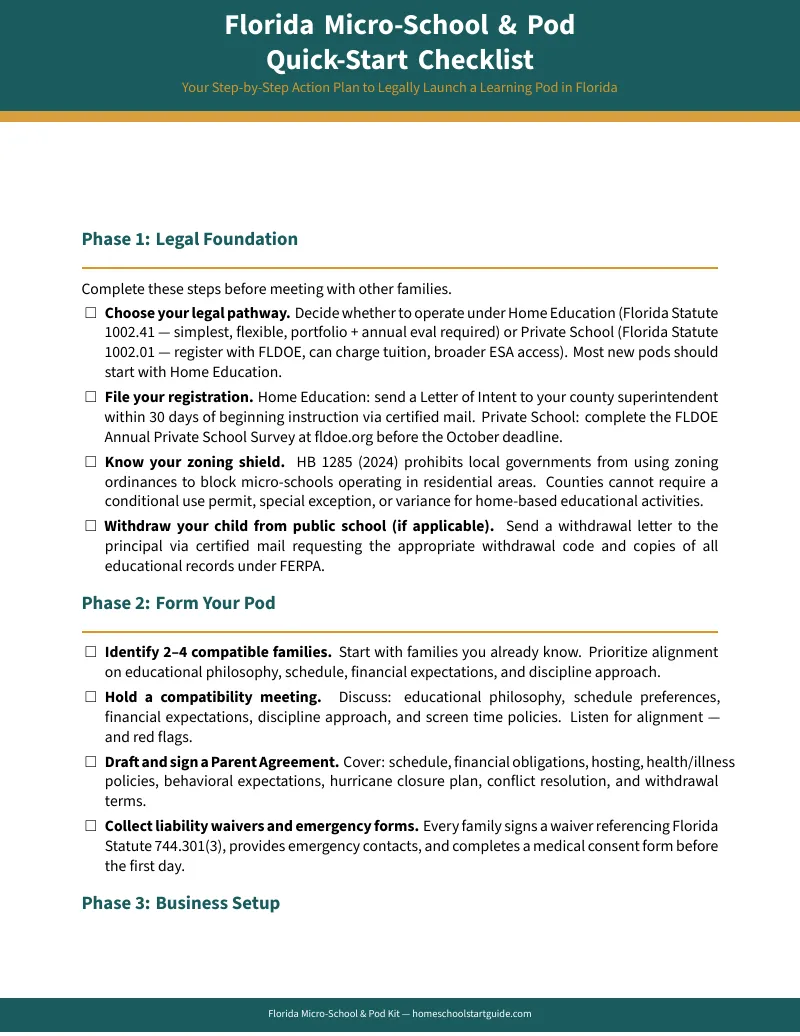
The Florida Pod Launch Checklist
A single-page, print-and-pin sequencing document that walks you from "I have an idea" to "the first day of pod school" — covering the legal, operational, financial, and community formation steps in the correct order. Most parents spend forty or more hours assembling this sequence from FLDOE pages, Step Up handbooks, Facebook groups, and policy documents. This checklist condenses it to a single reference document.
Who This Kit Is For
- Parents who've decided the public school system isn't working for their child — whether because of overcrowding, standardized testing mandates, curriculum concerns, or rigid special education placements — and want to build a small, intentional alternative with a handful of like-minded families
- Parents of neurodivergent children (autism, ADHD, dyslexia) who are exhausted by IEP advocacy and need a calmer, self-paced learning environment without the overstimulating structure of a 25-to-30-student classroom
- Secular or progressive parents who've been excluded from established co-ops that require statements of faith or ideological conformity, and who need a legally sound charter for an inclusive pod
- Former educators who've left the Florida public school system and want to serve their community by running a small micro-school — without the overhead, revenue share, and curricular control of a franchise network
- Families who are aware of the PEP scholarship and want to structure their micro-school correctly from the start to accept ESA funds through the Step Up For Students portal
- Parents who are currently homeschooling alone and are exhausted — and who want to share the facilitation load with two or three other families without losing control of their child's education
After Using the Kit, You'll Be Able To
- Hand any local zoning official, HOA representative, or county inspector the HB 1285 compliance document that legally ends their authority to block your micro-school from operating in a church, community center, or eligible commercial space — before the conversation escalates
- Complete the FLDOE registration sequence — LLC, EIN, FDLE fingerprinting, school code request, Annual Private School Survey — in the correct order, without the administrative errors that delay founders for months
- Register as a Step Up For Students provider and manage ClassWallet transactions to accept PEP and FES-UA scholarship funds without triggering the 60-day reimbursement delays that are devastating new providers
- Facilitate a mixed-age pod of four to eight children across multiple grade levels without chaos — using a scheduling framework that keeps independent learners on task while you work with a small group
- Run your first parent intake meeting using a signed participant agreement and liability waiver that protects every family in the pod — without spending money on an attorney
- Build a secular, inclusive learning community that explicitly does not require any statement of faith, political affiliation, or religious curriculum — and document that inclusivity in your community charter
Why Not Just Use the Free Resources?
The FPEA offers a free starting guide. The FLDOE publishes the private school requirements. Step Up For Students provides dense handbooks. Prenda and KaiPod run free webinars. Here is exactly what you run into when you try to build a micro-school from those sources alone:
- The FPEA caters to traditional homeschoolers, not edupreneurs. Their resources are designed for parents running informal co-ops — not founders launching a tuition-charging micro-school that needs an LLC, liability insurance, and SUFS provider registration. The business mechanics are entirely absent.
- The FLDOE gives you the raw law but zero operational templates. You learn that you need an Annual Private School Survey and FDLE fingerprinting. You do not receive the chronological checklist, the parent agreement framework, or the liability waiver to operationalize that knowledge. The information is scattered across multiple sub-domains and deep-linked PDFs.
- Step Up handbooks are 100+ pages of bureaucratic compliance language. They dictate what is and isn't eligible for ESA reimbursement, but they don't tell you how to structure your micro-school's invoicing, manage ClassWallet transactions, or avoid the specific clerical errors that trigger 60-day reimbursement delays.
- The franchise networks withhold the operational details deliberately. Prenda's blog, KaiPod's webinars, and Primer's social content are top-of-funnel marketing designed to route you into their paid platforms. The granular how — the provider registration steps, the facility inspection checklists, the multi-age scheduling frameworks — is the product they sell for thousands of dollars per year.
- Generic Etsy templates don't know Florida law. A $12 "Pod Agreement" from Etsy doesn't address HB 1285 zoning preemption, FDLE fingerprinting requirements, FLDOE Annual Private School Survey filing, or Step Up provider onboarding. It's a blank contract with no state-specific legal context.
Free resources give you the inspiration and the legal baseline. The Kit gives you the templates, checklists, and frameworks to execute this week.
— Less Than One Month of a Franchise Platform Fee
Prenda charges approximately $2,200 per student per year in platform fees. The KaiPod Catalyst accelerator starts at $249 upfront plus ongoing costs. Launch Your Kind charges $4,000 for their founder program. A single consultation with a Florida education attorney about your pod's legal standing costs $200-$400 for one hour. The Kit costs less than a week of that franchise subscription and gives you the operational independence those platforms are designed to prevent.
Your download includes 7 PDFs: the complete guide, the HB 1285 facility compliance reference (print and hand to officials), the FLDOE registration roadmap, a printable parent agreement template, a liability waiver template, a template withdrawal letter for unenrolling from public school, and the Florida Homeschool Quick-Start Checklist — a one-page overview of Florida homeschool law requirements, the three registration options (home education, umbrella school, private school), and the HB 1285 protections that apply to your micro-school from day one. Instant download, no account required.
30-day money-back guarantee. If the Kit doesn't give you the legal clarity and operational confidence to move forward with your micro-school, email us and we'll refund you. No questions asked.
Not ready for the full Kit? Download the free Florida Homeschool Quick-Start Checklist — a one-page summary of the legal requirements, the ESA funding basics, and the HB 1285 protections that apply to your pod from day one. It's enough to understand your rights tonight.
Florida passed HB 1285 specifically to open doors for schools like yours. You have the legal right to build this. The Kit makes sure you build it correctly.