OSSE Could Email You Tomorrow. Is Your Portfolio Ready?
You've been homeschooling in DC for months. Your child is learning — reading more, asking better questions, building things you never expected. But you've never formally documented Art. Music is "he plays piano every day" with no log to prove it. Physical Education is karate twice a week, but there's nothing in writing. Health is cooking dinner together, which sounds reasonable until you imagine explaining it to an OSSE reviewer with a checklist and thirty days to fix whatever they flag.
Because that's how it works in the District. OSSE doesn't schedule annual reviews like Maryland. They don't require standardized tests like Virginia. Instead, they select families at random for portfolio reviews — and when the email arrives, you have thirty days to present dated evidence across all eight mandatory subjects. If three of those subject folders are empty, you receive a Corrective Action Plan. If you fail the CAP, OSSE can refer your family to truancy enforcement. And right now, your "portfolio" is a stack of math worksheets on the kitchen counter and a vague intention to organize everything before summer.
The District of Columbia Portfolio & Assessment Templates is an OSSE Compliance Documentation System — 17 chapters covering every subject requirement, every grade band from kindergarten through high school, and every template you need to satisfy DC's "thorough and regular instruction" standard. It is built exclusively for DCMR Title 5, Chapter 52. Not adapted from Maryland. Not borrowed from Virginia. Not a generic Etsy planner with floral borders and no legal scaffolding.
What's Inside
DC's Legal Framework Decoded
The District operates a notification system, not an approval system. You don't need OSSE's permission to homeschool — you notify them and they acknowledge receipt. But "simple" doesn't mean "safe." Chapter 2 translates DCMR Title 5, Chapter 52 into plain language: the Notification of Intent timeline, the August 15 continuation deadline, parent eligibility requirements, the eight mandatory subjects, the "regular and thorough" standard, portfolio retention rules, and the single most common compliance failure — forgetting to deliver your OSSE verification letter to the school, which leaves your child accruing unexcused absences that trigger truancy protocols after ten days.
The Eight-Subject Evidence Matrix
DC requires instruction in Language Arts, Mathematics, Science, Social Studies, Art, Music, Health, and Physical Education. Generic planners use four-subject layouts. Maryland templates are built for semester reviews you don't have. Chapter 4 maps exactly what OSSE reviewers look for in each subject — including the four subjects families consistently fail to document: Art, Music, Health, and PE. Because your child taking karate and drawing constantly is not self-evident to a reviewer examining a binder. It must be documented with the same intentionality as mathematics.
Grade-Banded Portfolio Frameworks
A kindergartener's portfolio looks nothing like a tenth-grader's. Chapter 6 provides grade-banded frameworks — K-2, 3-5, 6-8, and 9-12 — with specific guidance on what to collect, how many dated samples per subject per term, what "growth over time" looks like at each developmental stage, and a weekly 20-minute filing routine so you never face a last-minute portfolio assembly panic.
Documenting Museum and Experiential Learning
You live in the only jurisdiction in the country where a morning at the Smithsonian can generate evidence for four subjects simultaneously. Chapter 8 shows how to document visits to the National Museum of Natural History (Science + Social Studies), the National Gallery of Art (Art + Language Arts), the Kennedy Center (Music + Social Studies), the National Zoo (Science + Health), and the Library of Congress (Language Arts + Social Studies). The field trip documentation template captures date, institution, exhibits visited, subjects covered, and student reflections — turning what feels like a fun outing into legally compliant curriculum evidence.
OSSE Audit Preparation
Chapter 9 walks through the entire review process: what triggers a review, what the thirty-day notice looks like, what to bring, how the reviewer evaluates your portfolio against the eight-subject matrix, what happens if deficiencies are found, the Corrective Action Plan process, and the remediation timeline. The monthly self-audit checklist catches gaps before OSSE does — verify that every subject has at least one new dated entry each month.
High School Transcript Templates
DC does not issue official diplomas for homeschooled students. You are the sole authority generating your child's academic record. Chapter 11 provides a transcript template formatted for DC-area university admissions — with fields for course titles, detailed descriptions, credits, letter grades, grading scale, and cumulative GPA on a 4.0 scale. Plus: how to calculate weighted and unweighted GPAs, how to document AP and honours coursework, and what Georgetown, GWU, American University, Howard, and Catholic University specifically require from homeschool applicants — because GWU and Georgetown require SAT/ACT scores from homeschoolers even when test-optional for everyone else.
Non-Traditional Learning Documentation
Chapter 7 covers the documentation gap that trips up eclectic, unschooling, and project-based families. How to map cooking to Math + Health + Science. Minecraft to Math + Language Arts + Social Studies + Art. Nature walks at Rock Creek Park to Science + PE. Community service to Social Studies + Health. Each mapping includes suggested documentation formats — photos with parent narratives, activity logs, project summaries — so organic learning translates into eight-subject evidence without forcing your family into a textbook framework the law doesn't require.
Special Situations
Chapter 14 covers neurodivergent learners (accommodation documentation, IEP transition records, Child Find rights), diplomatic and international families (dual compliance, overseas documentation, embassy school transitions), military families (cross-jurisdiction record transfer), mid-year DCPS or charter school re-entry (portfolio-to-transcript conversion), and documentation considerations for DC's growing population of remote-worker families who split time between jurisdictions.
Who This Is For
- First-year DC homeschool parents who submitted their Notification of Intent but have no system for documenting the eight required subjects — and August 15 is approaching
- Parents who have been homeschooling for years but never formally documented Art, Music, Health, or PE — the four subjects that trigger Corrective Action Plans during OSSE reviews
- Eclectic, unschooling, and museum-based families who need to translate rich experiential learning into legally compliant eight-subject evidence without adopting a textbook curriculum
- High school parents who suddenly realize they need a professional transcript for Georgetown, GWU, Howard, American, or Catholic University admissions — and have no template formatted for what these institutions actually require
- Parents currently using Maryland or Virginia templates who are over-documenting in areas DC doesn't require and under-documenting in areas it does
- Families who just moved to DC from another state and need to convert their existing records into a portfolio that satisfies DCMR Title 5, Chapter 52
- Parents of neurodivergent learners who need documentation that captures non-linear progress across all eight subjects without forcing standardised benchmarks
Why Not Just Use the Free Resources?
You can. OSSE has FAQ documents. HSLDA has legal summaries. The DC Home Educators Association has a WordPress blog. Here's what actually happens when you try to assemble a documentation system from free sources:
- OSSE tells you what's required but gives you nothing to build it with. Their handout lists the eight mandatory subjects, the portfolio retention rule, and the Corrective Action Plan process. It does not provide a single fillable template, cover sheet, or organisational framework. You read the requirements and then open a blank Word document.
- HSLDA translates the law brilliantly but locks the tools behind membership. Their DC summary is excellent. Their downloadable forms are generic nationwide templates reserved for paying legal members. Even as a member, you get abstract legal documents — not grade-banded portfolio frameworks mapped to DCMR 5200.
- Etsy planners are a compliance liability in DC. Generic homeschool planners use four-subject layouts designed for states with different requirements. They include daily attendance logs DC doesn't mandate and omit subject divisions for Art, Music, Health, and PE that DC does. Using the wrong template means over-documenting in irrelevant areas and leaving gaps in the subjects OSSE actually reviews.
- Maryland and Virginia resources are the most dangerous shortcut. Living in the DMV makes it tempting to borrow from neighbours. But Maryland templates are built for twice-yearly face-to-face reviews with county officials. Virginia templates are structured around standardised test score submission. DC requires neither. Adopting an out-of-state framework forces you into a rigid, labour-intensive structure the law doesn't demand — while potentially missing the specific documentation DC does require.
- Facebook group advice is a game of telephone across state lines. Parents routinely share portfolio tips from Maryland, recommend attendance templates Virginia requires but DC doesn't, and offer interpretations of the "regular and thorough" standard that predate recent regulatory changes. The District's homeschool community is small, which means less locally verified information and more regional proxy advice.
The free resources explain what DC law says. These templates are engineered to do exactly what DC law requires — and nothing more.
— Less Than a Single Curriculum Textbook
Homeschool tracking software runs $65-$120 per year. HSLDA membership is $12-$15 per month. A Corrective Action Plan costs weeks of stress and retroactive documentation work. These templates cost less than a single workbook from the Smithsonian gift shop.
Your download includes the complete guide, the Quick-Start Checklist, and 6 standalone printable templates — 8 PDFs:
- guide.pdf — The full District of Columbia Portfolio & Assessment Templates guide: 17 chapters covering DC's legal framework (DCMR Title 5, Chapter 52), the eight required subjects, grade-banded portfolio frameworks, museum documentation, OSSE audit preparation, high school transcript creation, college admissions guidance, and your annual compliance calendar.
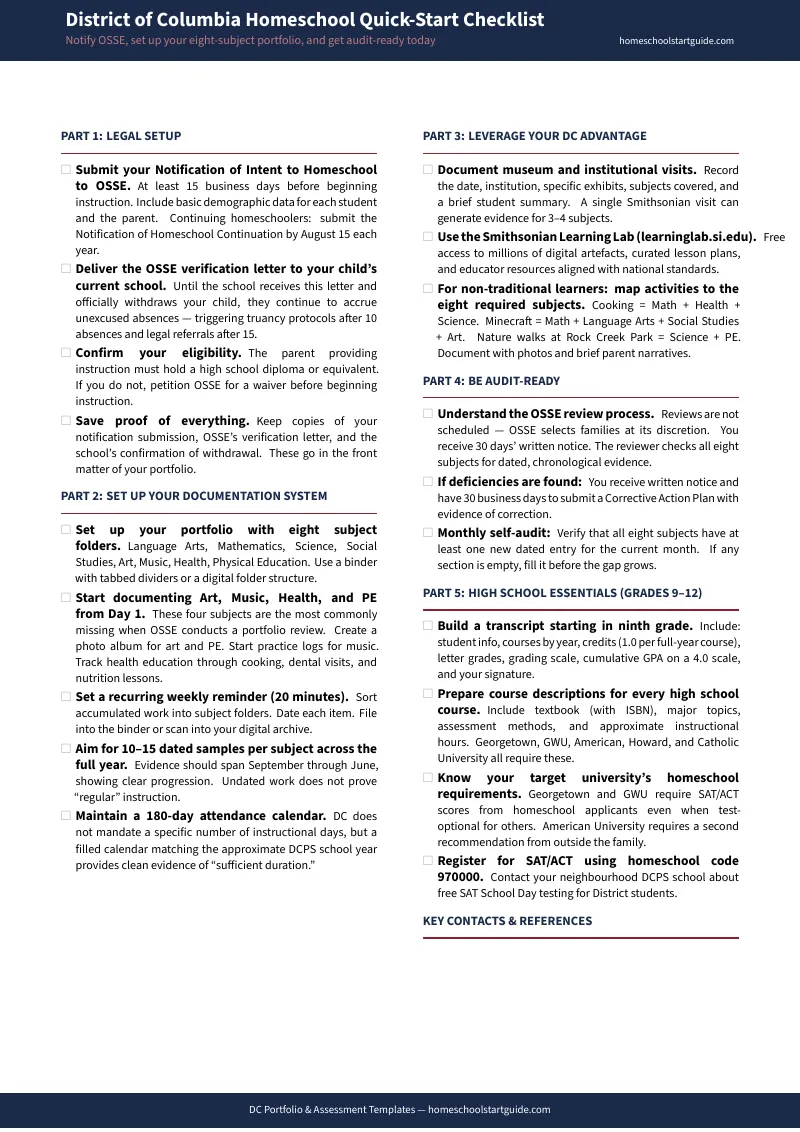
- checklist.pdf — The District of Columbia Homeschool Quick-Start Checklist: a printable action plan covering legal setup, documentation system setup, leveraging DC institutions, audit readiness, and high school essentials.
- transcript-template.pdf — Fillable high school transcript formatted for Georgetown, GWU, Howard, American, and Catholic University admissions with GPA calculator and grading scale.
- compliance-calendar.pdf — Month-by-month compliance calendar with every deadline from the August 15 continuation through end-of-year portfolio assembly. Print and post.
- law-quick-reference.pdf — One-page summary of DCMR Title 5, Chapter 52 requirements, the deficiency process, and key contacts including OSSE, DCSAA, and HSLDA.
- field-trip-log.pdf — Fillable museum and field trip documentation template with subject checkboxes and a DC institutions-to-subjects mapping reference. Print multiple copies.
- subject-coverage-tracker.pdf — Monthly eight-subject evidence tracker. Verify every subject has dated entries each month — catches gaps before OSSE does.
- audit-preparation-checklist.pdf — Step-by-step OSSE portfolio review preparation checklist with the review timeline, what reviewers examine, and deficiency response guidance.
8 PDFs. Instant download, no account required.
30-day money-back guarantee. If these templates don't give you the structure and confidence to pass an OSSE portfolio review, email us and we'll refund you. No questions asked.
Not ready for the full guide? Download the free District of Columbia Homeschool Quick-Start Checklist — a printable overview of the legal setup steps, eight-subject documentation basics, DC institution resources, audit preparation essentials, and high school planning milestones. It's enough to get oriented, and it's free.
DC doesn't require you to mimic public school. It requires you to prove your child is receiving thorough, regular instruction. These templates make the proof effortless.