The MySchoolDC Lottery Failed You. Sidwell Wants $59,000. Solo Homeschooling Is Burning You Out. There's a Fourth Option Nobody Explains Clearly.
You filed every preference in the MySchoolDC lottery. You toured the charter schools, ranked your choices carefully, and waited through March and April hoping for good news. What you got was a waitlist number in the hundreds at LAMB, E.W. Stokes, or Oyster-Adams. Your in-boundary school has 30 kids per classroom and a first-year teacher. The private schools you can stomach start at $30,000 and climb past $55,000 at Sidwell, Maret, and St. Albans. Your homeschool experiment worked for a semester, but you're teaching all day, working all night, and your child misses other children.
A micro-school fixes all three problems. Five families pool $8,000 each, hire a dedicated facilitator for $40,000, and their children learn in a 5:1 ratio that Sidwell can't match at ten times the price. They use the Smithsonian, Library of Congress, and National Archives as their classroom — for free. The structure of a school, the freedom of homeschooling, and the community of a neighborhood.
But here's what stops most DC parents from actually starting one: DC's legal framework creates a regulatory maze that generic guides don't touch. Each family must individually notify OSSE under DC Code §38-202, but the parent-instruction restriction under 5-E DCMR means parents cannot teach other parents' children — you must hire a third-party facilitator. Running a pod from a home triggers Child Development Home zoning rules (9-child cap, prohibited in apartment buildings with 3+ units). Cross 10 children or accept tuition from non-participating families and you're operating an unregistered private school. Get the structure wrong, and a single zoning complaint or CFSA referral shuts the entire pod down.
The Dual-Pathway Compliance System inside this Kit maps both legal routes — the Homeschool Cooperative pathway (each family files individually with OSSE, the micro-school coordinates but doesn't register as an institution) and the Private School/CDC pathway (the micro-school registers centrally and handles all compliance) — because no free resource explains where one pathway ends and the other becomes legally required, and most DC parents don't realize there's a choice until they've already committed to the wrong one.
What's Inside the Kit
The DC Legal Framework — Both Pathways Explained
The chapter that answers the question every DC parent asks and no free resource addresses clearly: should your pod operate as a homeschool cooperative or register as a private school? The guide walks through DC Code §38-202, the parent-instruction restriction under 5-E DCMR, the OSSE notification sequence, and the exact thresholds (student count, tuition structure, non-participating families) that push a cooperative into private school territory. You'll know which pathway fits your pod before you file a single form.
The OSSE Filing Guide
Step-by-step instructions for each family's Notification of Intent to Homeschool — OSSE portal account creation, documentation requirements (high school diploma or GED), the 15-business-day waiting period, and the Verification Letter. A standalone printable appendix walks each family through the process, so you can hand it to new families joining the pod without re-explaining the entire system.
Zoning, Fire Code, and Insurance
DC's zoning rules for home-based micro-schools are specific and unforgiving. The guide covers Child Development Home regulations (9-child cap, single-family and townhouse only, Home Occupation Permit from DOB), apartment building prohibitions, church and community center alternatives (already zoned for educational use, $300–$800/month), commercial lease options by ward ($25–$58/sq ft), fire code minimums (35 sq ft per child, hardwired smoke detectors, quarterly drill logs, 20% wall coverage limit), and insurance requirements (CGL minimum $1,000,000 per occurrence, SAM coverage, Workers' Comp for W-2 staff). Every requirement includes the specific DC regulation number so your facilitator can verify compliance independently.
Facilitator Hiring — From Background Checks to Contracts
DC requires a third-party facilitator because parents cannot instruct other parents' children. The guide covers MPD/FBI fingerprint background checks (10-year lookback), CFSA Child Protection Register clearance, National Sex Offender Registry checks, TB screening, competitive DC salary ranges ($55,000–$75,000 full-time, $25,000–$40,000 part-time), the 1099 vs. W-2 classification decision that most pods get wrong, and DC's $17.50/hour minimum wage. The facilitator contract template in Appendix F is ready to print and sign.
Budget Planning and Cost-Sharing Models
Three tested budget models for DC micro-schools: the Equal Share model (identical contributions from all families), the Sliding Scale model (income-adjusted for mixed-income pods), and the Hybrid model (base share plus usage-based fees for materials and field trips). Realistic budget ranges: $11,000–$17,000 per student per year for a 6-student pod, dropping to $8,000–$12,000 for 8–10 students. The budget worksheet template in Appendix E handles all the math — enter your family count, facilitator salary, space rental, and materials budget, and it calculates per-family cost automatically.
Parent Agreement and Liability Waiver Templates
The two documents that protect your pod from the dispute that kills most informal arrangements. The Parent Agreement template covers tuition schedule, late payment penalties, 60-day withdrawal notice (DC's high cost of living makes mid-year departures financially devastating), behavioral expectations, health and illness exclusion policies, dispute resolution, and OSSE compliance responsibilities. The Liability Waiver template covers premises liability, participant assumption of risk, field trip consent, photo/media release, and DC-specific waiver language. Both are ready to print and customize.
Curriculum Integration with DC's Free Institutions
No city in America matches DC's free educational resources. The guide shows how to build core curriculum around the Smithsonian Learning Lab (19 museums plus the National Zoo), Library of Congress primary sources, National Archives DocsTeach platform, Kennedy Center arts education, National Gallery of Art, and U.S. Botanic Garden — turning weekly field trips into portfolio-ready learning documentation that satisfies OSSE's eight required subjects.
International and Diplomatic Micro-School Models
Dedicated guidance for DC's international community: bilingual and immersion pod frameworks (Spanish, French, Amharic, Mandarin), integrating CNED French curriculum, embassy family enrollment considerations, diplomatic visa implications, and creating a micro-school that reflects the multilingual reality of a city where 15% of residents speak a language other than English at home.
High School Transcripts and College Admissions
How to create parent-issued transcripts that Georgetown, Howard, American University, and George Washington University will accept. Dual enrollment pathways at DC-area institutions (with the UDC exclusion workaround). AP exam registration as a homeschool student. DCSAA athletic eligibility waivers. The transcript creation guide covers GPA calculation, course descriptions, and the specific documentation each DC-area university expects from homeschooled and micro-schooled applicants.
Who This Kit Is For
- Parents who lost the MySchoolDC lottery or are sitting on a waitlist hundreds deep at LAMB, Stokes, or Oyster-Adams — and refuse to accept an overcrowded, underperforming in-boundary school as the default
- DC professionals earning good incomes who still can't justify $50,000+ per child at Sidwell, Maret, or Georgetown Day — and want a 5:1 ratio at a fraction of the cost
- Solo homeschoolers who've been doing this alone since 2020 and need the structure, socialization, and shared responsibility of a micro-school without giving up curricular freedom
- International and diplomatic families who want a multilingual, culturally rich education that isn't available at any DC school — public, charter, or private
- Parents of neurodivergent children (ADHD, dyslexia, twice-exceptional) who need a 5:1 environment that no 30-student public classroom or overpriced private school provides
- Former teachers, tutors, or education professionals who want to turn their expertise into a micro-school business — with the legal structure, contracts, and business formation guidance to do it properly in DC
- Parents who've been in pandemic pods since 2020 and are ready to formalize: hire a real facilitator, establish legal protections, and build something that lasts beyond next semester
Why Not Just Use the Free Resources?
You can. OSSE has a website. HSLDA has a legal summary. Sankofa and Capitol Hill Learning Group offer community support. DC Urban Moms has ten years of forum threads. Here's what actually happens when you try to assemble a micro-school strategy from free sources:
- OSSE's guidance covers individual homeschooling, not group models. It tells each family how to file the Notification of Intent, maintain a portfolio, and submit the August 15 continuation notice — but provides zero guidance on how multiple families can legally share a facilitator, what happens when a cooperative crosses the threshold into a private school, or how the parent-instruction restriction applies to co-teaching arrangements. The gap between "how to homeschool" and "how to run a micro-school" is exactly where legal trouble starts.
- DMV Facebook groups blend DC, Maryland, and Virginia into one jurisdiction. Maryland uses umbrella schools. Virginia has religious exemptions and state-approved curricula. Neither applies in the District. A parent who follows Virginia co-op advice in DC may be operating an unlicensed educational institution. For every accurate comment about OSSE's process, there are three that confuse DC law with a neighboring state's framework.
- Prenda charges $2,199 per student per year for a platform fee — before the facilitator gets a dollar. DC has no Education Savings Account or public subsidy to offset Prenda's cost, so every penny comes out of pocket. Acton Academy's only DC campus (Foggy Bottom) closed in 2023. KaiPod's nearest centers are in the Virginia and Maryland suburbs. The franchise model is either unavailable, unaffordable, or requires a daily commute outside the District.
- Generic Etsy and Gumroad "micro-school starter kits" don't know DC exists. They don't address the parent-instruction restriction, the Child Development Home 9-child cap, the BZA special exception process, the OSSE notification sequence, or the difference between DC's homeschool cooperative pathway and its private school registration pathway. They're written for a state that doesn't have DC's regulatory quirks — and DC isn't a state.
- HSLDA costs $150/year and covers individual homeschooling, not group micro-school formation. Their legal hotline is excellent for withdrawal questions and OSSE compliance disputes — but structuring an LLC, drafting facilitator contracts, and navigating commercial zoning for a multi-family educational entity is outside their standard scope.
— Less Than One Family's Share of a Single Field Trip
Sidwell Friends charges $59,920 per year. Maret charges $53,545. A Prenda micro-school costs $2,199 per student annually before you pay the guide. A single hour with a DC education attorney runs $400–$500. A zoning violation investigation costs months of anxiety and potentially shuts down a pod that six families depend on. This Kit costs less than your family's Metro fare for one week of commuting to a school that isn't working.
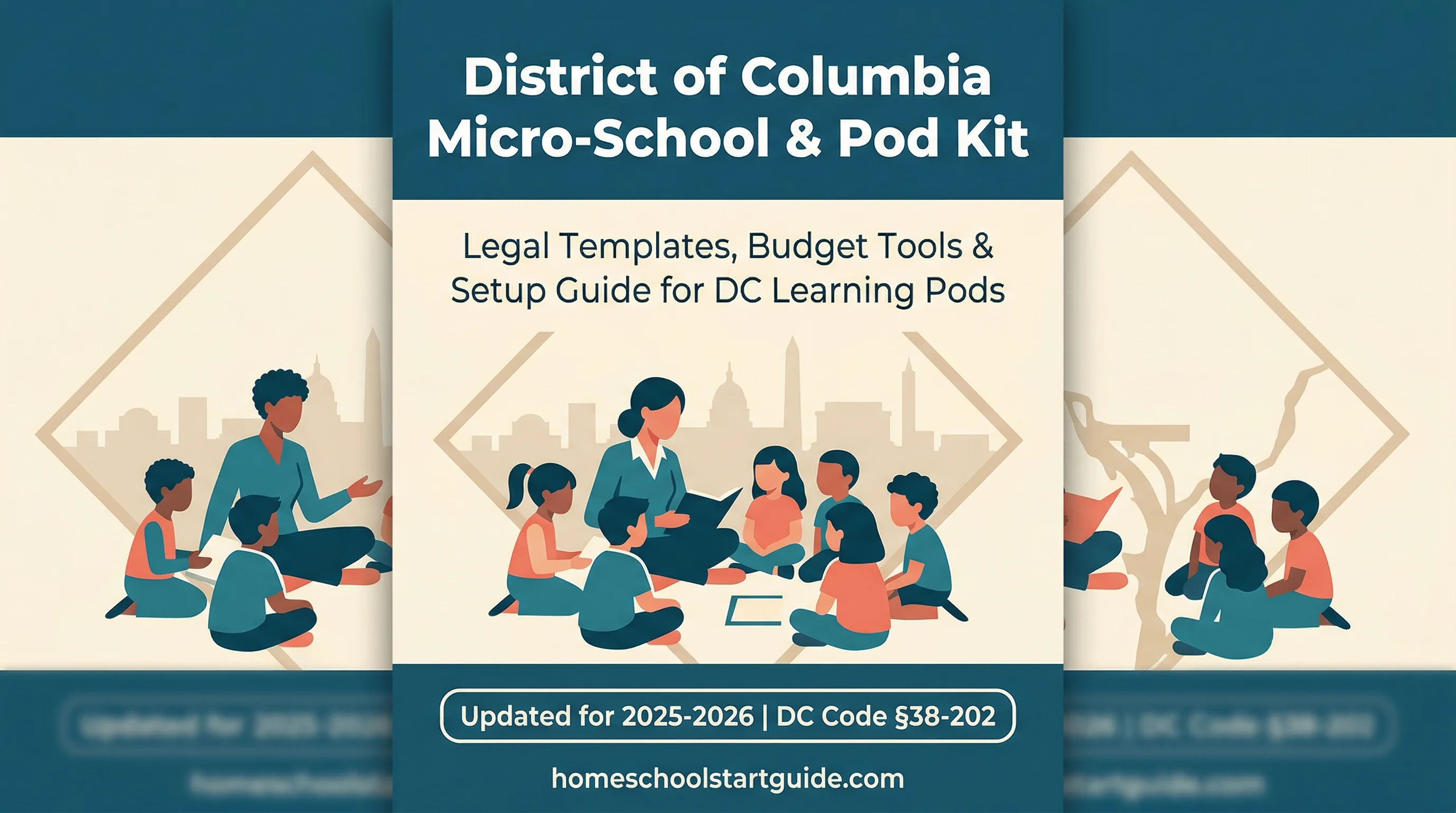
Your download includes the complete 22-chapter guide with 6 appendices, the Quick-Start Checklist, and standalone printable templates — parent agreement, liability waiver, OSSE filing guide, emergency contact and medical authorization form, budget worksheet, and facilitator contract. Covering DC's dual legal pathways (homeschool cooperative vs. private school/CDC), the parent-instruction restriction, OSSE notification and compliance, zoning and fire code, insurance, corporate structure (LLC vs. 501(c)(3)), facilitator hiring and background checks, budget planning and cost-sharing, curriculum integration with DC's free institutions, international and diplomatic family models, military family guidance (JBAB), neurodivergent learner accommodations, high school transcripts and college admissions, micro-school network comparisons (Prenda, KaiPod, Acton), marketing and enrollment, urban logistics, and DC's 2026 regulatory horizon. Everything you need to legally launch a micro-school in the District of Columbia. Instant download, no account required.
30-day money-back guarantee. If the Kit doesn't give you the legal clarity and operational framework to launch your micro-school, email us and we'll refund you. No questions asked.
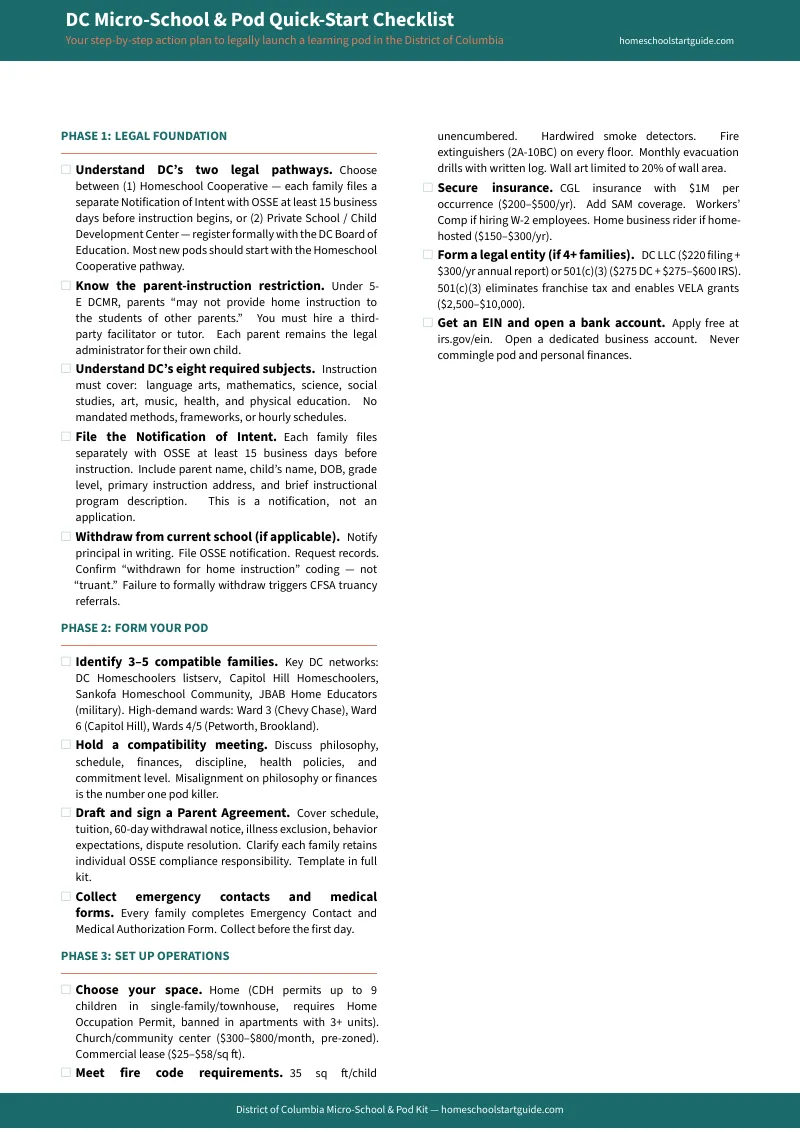
Not ready for the full Kit? Download the free District of Columbia Homeschool Quick-Start Checklist — a printable action plan covering the five phases of micro-school setup, from legal foundation through launch day. It's enough to understand whether a micro-school is right for your family, and it's free.
DC Code §38-202 protects your right to educate at home. The Kit shows you how to do it together — legally, affordably, and without paying franchise fees to a corporation that takes your money and hands your child an iPad.