Build Your Delaware Micro-School Legally, Affordably, and Without a Franchise.
Delaware's 14 Del. Code §2703A gives you explicit legal authority to form a multi-family homeschool — the legal vehicle for micro-schools and learning pods. No standardized testing, no curriculum approval, no teacher credentials required. One designated liaison handles all state reporting for every family in the pod. That framework is why Delaware's homeschool enrollment surged 29% in a single year. But the moment you invite other families' children, charge tuition, or operate a regular learning schedule, you step into a minefield the DDOE website never mentions: OCCL child care licensing thresholds, municipal zoning restrictions in Wilmington, Newark, and Dover, and the HB 47 background check requirements effective September 2026.
You want to pull together four or five families in New Castle County, share the teaching load, and build something that actually fits your child. Maybe you are burned out on solo homeschooling and need a shared-responsibility model. Maybe your child was waitlisted in the Red Clay school choice lottery — again — alongside 2,400 other families. Maybe you are a Dover AFB military family who needs educational continuity that survives the next PCS move. Maybe you looked at KaiPod's 10% revenue share and Prenda's $2,100-per-student platform fee and decided you would rather keep the money and the autonomy. Whatever the reason, you have arrived at the same conclusion: I need to build this myself.
The problem is that the internet gives you fragments. The DDOE website talks about "nonpublic schools" and "multi-family homeschools" — it does not use the words "micro-school" or "learning pod." The Delaware Home Education Association was instrumental in the 1990s but provides no operational templates for collaborative, multi-family pods. Facebook groups in "Homeschool Delaware" (4,000+ members) confidently declare that pods do not need insurance, that zoning does not apply, and that you can host a dozen children in your living room without any legal risk. You need a Delaware Pod Founder's Playbook — the complete operational framework without the dangerous legal guesswork, the franchise costs, or the ideological prerequisites.
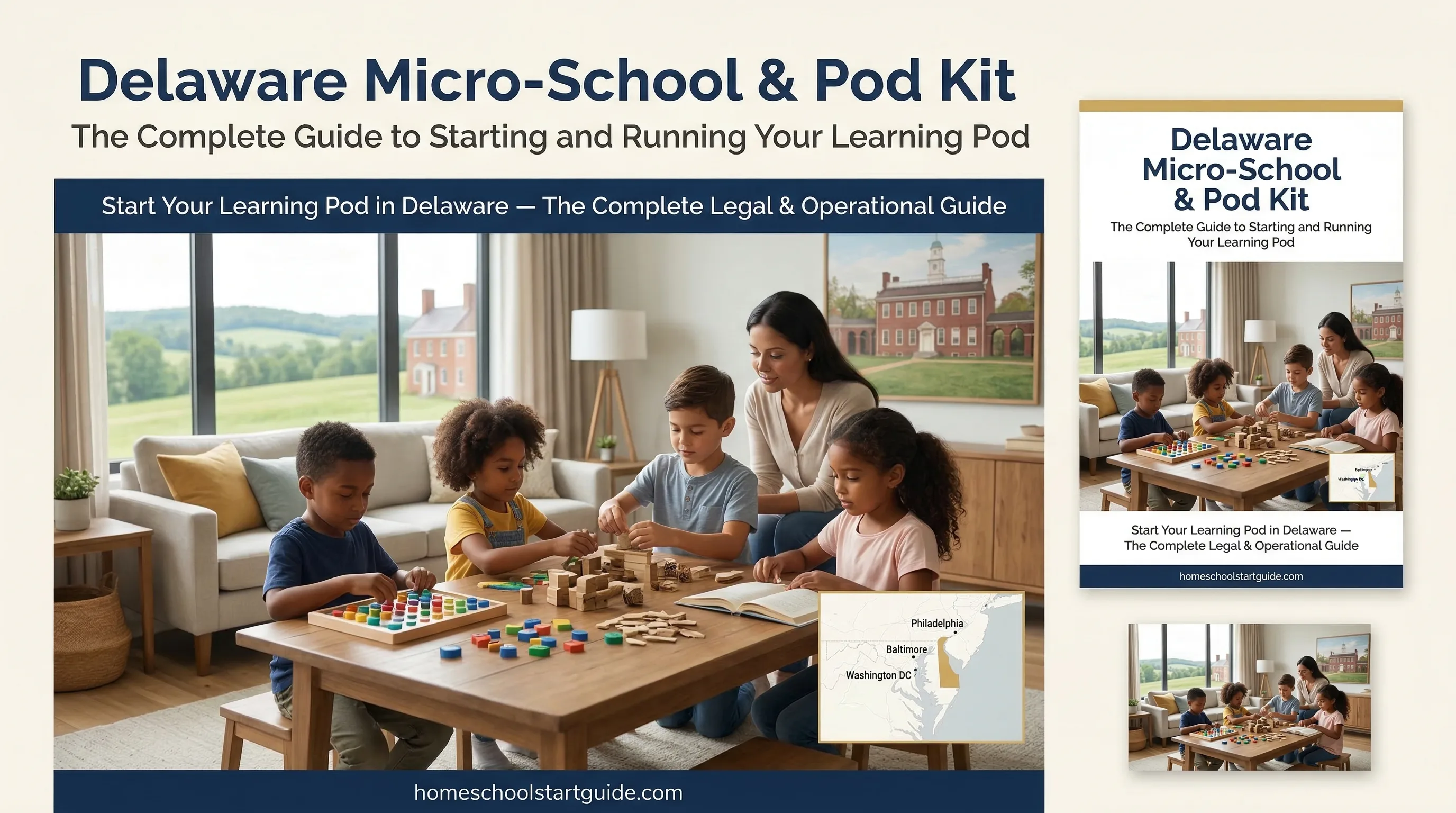
The Delaware Micro-School & Pod Kit is that Pod Founder's Playbook.
What's Inside the Pod Founder's Playbook
The Multi-Family Homeschool Legal Framework
Because the single most confusing question for every new Delaware pod founder is how a "micro-school" maps to the DDOE's legal categories — and what happens if you get it wrong. Delaware classifies every nonpublic educational entity as a single-family homeschool, a multi-family homeschool, or a private school. The guide walks you through the exact criteria — number of families, liaison designation, EdAccess reporting requirements, and the private school threshold under Admin Code 255.2 (board + faculty + dedicated facility) — so you choose the right legal structure before your first family meeting, not after the DDOE contacts you about missing enrollment reports.
The EdAccess Portal Masterclass
Because the DDOE's EdAccess system is the gatekeeper for your legal status — and it has blackout windows, strict deadlines, and a truancy trap that catches families every year. The guide provides a visual, step-by-step walkthrough: creating your nonpublic school account, designating the multi-family liaison, generating Acknowledgment Letters before any child withdraws from public school (skip this and the student is legally truant under 14 Del. C. §2729), enrollment reporting between August 12 and September 30, and year-end attendance filing between June 3 and July 31. Missing the September 30 deadline means the DDOE can close your school's nonpublic status.
The Child Care Licensing Shield
Because Delaware's Child Care Act (14 Del. C. §3001A) defines "child care" broadly enough to cover a drop-off educational program that charges fees — and the Office of Child Care Licensing (OCCL) can shut you down if your pod looks more like an unlicensed daycare than an educational program. The guide details three proven strategies to stay classified as education, not child care: keeping parents on premises, structuring tuition as cost-sharing rather than salary payments, and serving only K–12 students. Plus how to request a formal License Exemption letter from OCCL for documented protection.
The Zoning Matrix — Wilmington, Newark, and Dover
Because Delaware is small, but zoning rules vary sharply by municipality. Wilmington R-1 zones allow up to six school children (including the family's own). Newark RS zones historically require a Special Use Permit for educational facilities. Dover R-15 needs planning commission conditional approval. The guide maps the exact thresholds and permit requirements for each city — so you know your limits before code enforcement tells you.
The HB 47 Background Check Requirements
Because effective September 1, 2026, every adult with unsupervised student access in a child-serving entity needs fingerprint-based background checks: Delaware SBI state criminal, FBI national criminal, and DSCYF Child Protection Registry. The guide covers who needs checks, the application process, processing times (2–4 weeks), costs ($50–$85 per person), and the exemption analysis for informal pods versus structured micro-schools.
The Parent Agreement and Liability Waiver Templates
Because a child breaking an arm in your living room should not end the pod — and it will not, if you are prepared. Customizable parent agreements covering educational philosophy, schedule, tuition, attendance, behavior, conflict resolution, withdrawal, and media privacy. Plus a liability waiver with indemnification, medical consent, and emergency contact forms. Every family signs these before day one. These are not generic Etsy templates — they are written for the specific legal context of Delaware home education and the multi-family homeschool framework.
The Delaware Budget Planner
Because running a pod with a facilitator and rented space costs nothing like running one from your kitchen table. Budget templates covering facilitator compensation ($20–$30/hour in Delaware), space rental, curriculum materials, insurance, and field trips — with real Delaware cost benchmarks. Includes cost-sharing models for 4-family, 6-family, and 10-family pods, and a tuition calculator that accounts for Delaware's zero-state-funding reality.
The Delaware Pod Launch Checklist
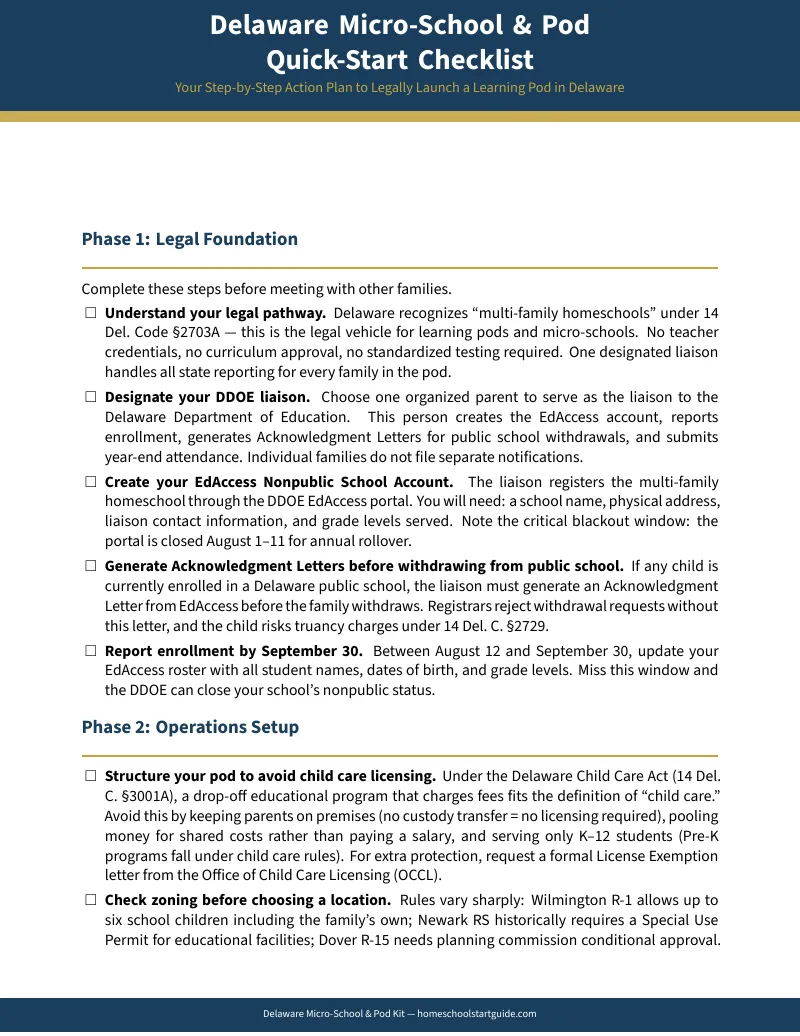
Because most parents spend forty-plus hours assembling the launch sequence from DDOE pages, Facebook groups, and outdated DHEA resources. A single-page, print-and-pin document that walks you from "I have an idea" to "the first day of pod school" — covering the legal, operational, financial, and community formation steps in the correct order, with Delaware-specific deadlines and thresholds at every step.
Who This Kit Is For
- Parents whose children were waitlisted in the Red Clay, Christina, or Colonial school choice lottery — you need an immediate, high-quality alternative that replicates the small-classroom feel without depending on a randomized system that rejects thousands of families every year
- Solo homeschoolers who have reached the burnout threshold and need a shared-responsibility model where the instructional and social burden is distributed among trusted families — without losing control of your child's education
- Parents of neurodivergent children (autism, ADHD, dyslexia, giftedness) who are exhausted by IEP battles and want to build a specialized pod while keeping access to public school therapies under Senate Bill 106
- Dover AFB military families who need educational continuity that survives PCS moves — a pod framework that travels with your philosophy even when the zip code changes
- Families priced out of Wilmington's private schools ($12,000–$25,000/year) who want structure, community, and academic rigor for a fraction of the cost
- Former educators who have left the public school system and want to serve their community by running a small paid micro-school — without the overhead, revenue share, or rigid pedagogy of a franchise network
- Secular families seeking inclusive, non-religious educational community in a state where the largest homeschool network (Tri-State) is explicitly Christian
After Using the Kit, You'll Be Able To
- Understand your legal standing under 14 Del. Code §2703A and know exactly when a multi-family pod crosses the threshold into private school territory — and what that means for your DDOE reporting obligations
- Navigate the EdAccess portal confidently — from creating your nonpublic school account to generating Acknowledgment Letters, reporting enrollment by September 30, and filing year-end attendance — without triggering truancy flags or missing deadlines
- Structure your pod to avoid OCCL child care licensing using three proven exemption strategies — so you operate as a recognized educational entity, not an unlicensed daycare
- Choose the right space for your pod based on your city's zoning rules — home, church, or commercial — and know the exact student count thresholds in Wilmington, Newark, and Dover
- Run your first parent intake meeting using a signed Family Agreement and liability waiver that protects every family in the pod — without spending $300 on a Delaware education attorney
- Hire and background-check a facilitator legally under HB 47, classify them correctly for Delaware tax purposes, and pay them competitively using real local wage benchmarks
- Build a sustainable budget with Delaware cost data, set tuition that families can afford, and split costs equitably across participating households
Why Not Just Use the Free Resources?
The DDOE website is the legal authority. DHEA has advocated for homeschool rights since the 1990s. Facebook groups have thousands of Delaware parents trading advice. Here is exactly what you run into when you try to build a pod from those sources alone:
- The DDOE speaks bureaucratic, not parent. The DDOE website uses "multi-family homeschool" and "nonpublic school" — it has never used the words "micro-school" or "learning pod." A parent searching the state portal for instructions on starting a pod finds truancy warnings and EdAccess login screens, not step-by-step guidance on forming a collaborative learning community. The tone is compliance-first, punitive-second, and helpful-never.
- DHEA gives you advocacy history but not operations. The Delaware Home Education Association helped establish the 1997 homeschool laws and continues important legislative work. But DHEA provides no templates, no multi-family formation guides, and no operational frameworks for the collaborative pod model that defines the post-2020 homeschool landscape.
- Facebook groups are an echo chamber of dangerous legal advice. Parents in "Homeschool Delaware" confidently claim that pods do not need insurance, that OCCL rules do not apply to educational programs, and that you can host a dozen children without zoning concerns. These statements ignore the Delaware Child Care Act (14 Del. C. §3001A) entirely. A Wilmington parent who hosts ten children based on Facebook advice will discover the OCCL and municipal zoning limits when enforcement contacts them, not before.
- Etsy templates are generic daily planners with a micro-school label. Canva templates and enrollment forms priced at $5–$24 on Etsy and TPT. Not one references 14 Del. Code §2703A, the EdAccess portal, OCCL child care licensing thresholds, HB 47 background check requirements, or municipal zoning restrictions in Wilmington, Newark, or Dover. They help you organize a schedule. They do not help you form a legally protected pod.
- KaiPod and Prenda solve the problem — and take your autonomy and revenue. KaiPod charges a $249 upfront fee plus 10% of gross tuition revenue for the first two years. Prenda charges over $2,100 per student per year in platform fees. Both require you to recruit the families, find the space, and build the community yourself. If you are doing the hard work of building local trust, you should keep 100% of the revenue and 100% of the curriculum control.
Free resources give you the inspiration and the legal baseline. The Pod Founder's Playbook gives you the templates, checklists, and frameworks to execute this week.
— Less Than One Hour With a Wilmington Education Attorney
A single consultation with a Delaware education attorney costs $250 to $400 per hour. KaiPod charges a $249 upfront fee plus 10% of your gross revenue. Prenda charges over $2,100 per student per year. The Kit costs less than one hour of professional advice and gives you the operational independence those platforms are designed to prevent.
Your download includes the complete guide (24 chapters covering Delaware law, EdAccess portal navigation, child care licensing exemptions, zoning by city, HB 47 background checks, insurance, facilitator hiring, budgeting, curriculum, dual enrollment at DTCC, transcripts, University of Delaware and Delaware State admissions, military family pods, neurodivergent learners, and scaling), plus 7 standalone printable tools: the Delaware Pod Launch Checklist, the Parent Participation Agreement, the Liability Waiver and Emergency Contact Form, the Facilitator Contract, the Delaware Regional Budget Planner, the 180-Day Instructional Tracking Log, and the EdAccess Portal Quick Reference. Instant download, no account required.
30-day money-back guarantee. If the Kit does not give you the legal clarity and operational confidence to move forward with your pod, email us and we will refund you. No questions asked.
Not ready for the full Kit? Download the free Delaware Homeschool Quick-Start Checklist — a one-page summary of the legal framework under 14 Del. Code §2703A, the EdAccess timeline, OCCL child care licensing basics, and key zoning considerations for Wilmington, Newark, and Dover. It is enough to understand your rights tonight.
Delaware gave you the legal framework. The Pod Founder's Playbook makes sure you use it correctly.