Your Superintendent Doesn't Get to Approve Your Decision to Homeschool. Connecticut Law Is Clear — But 169 Districts Pretend Otherwise.
You've made the decision. Your child is struggling — bullied, anxious, bored, or trapped in an IEP process that's gone nowhere for two years. Maybe the school keeps "losing" your accommodation requests. Maybe the CREC magnet school lottery didn't work out and you're stuck in a district that doesn't fit. Maybe you watched the HB 5468 hearings and decided your family needs out before the legislature finds another way to involve DCF. You sat down to research how to legally withdraw your child in Connecticut, and within thirty minutes you had four different answers.
The Connecticut Homeschool Network says the Notice of Intent is optional and tells you to never appear in person. TEACH-CT says to file the NOI but wraps every instruction in Christian homeschool framing. HSLDA provides a withdrawal letter — but Connecticut legal experts have publicly warned that HSLDA's letter forces you to promise compliance with State Department of Education procedures that don't exist in statute. And the CSDE website itself lists "file a Notice of Intent" and "maintain a portfolio" under "suggested best practices" — which your superintendent then treats as mandatory requirements.
Here's the problem: Connecticut has 169 separate municipalities, each with its own superintendent, and their interpretations of CGS §10-184 vary wildly. A family in Glastonbury submits a letter and never hears back. A family in Waterbury gets demands for portfolio reviews, home visits, and standardised testing that have no basis in law. The Superintendent Boundary System inside this Blueprint tells you exactly what the law requires, what your district can request, and — critically — what you are legally entitled to refuse.
What's Inside the Blueprint
The "Required vs. Suggested" Decoder
This is the single page that prevents the most common Connecticut homeschool mistake. The CSDE's Circular Letter C-14 suggests parents file a Notice of Intent and participate in annual portfolio reviews. CGS §10-184 — the actual law — requires instruction in eight named subjects and nothing more. No NOI. No portfolio review. No testing. No home visits. No curriculum approval. The Decoder separates every CSDE "best practice" from every statutory requirement so you know exactly what's mandatory and what's theatre — before you sign anything the district hands you.
The Withdrawal Letter Templates
Fill-in-the-blank templates for every withdrawal scenario: standard public school withdrawal, private school withdrawal, magnet school dual-notification (you need two separate letters — one to the magnet school principal, one to your home district superintendent), mid-year withdrawal, and IEP/504 withdrawal. Each template includes exactly what to say, what to exclude (your reasons, your curriculum, a request for permission), and a records request. Print, fill in, send via certified mail — done.
The Notice of Intent Strategy Guide
Filing the NOI is legally optional for children over age 7. But some families choose to file strategically to maintain an amicable relationship with a cooperative superintendent. The Blueprint walks through when filing makes sense, when it creates unnecessary liability, what the NOI must include, and the one field you should always leave blank or cross out — the portfolio review checkbox. Signing up for a review legally invites the district to scrutinise your curriculum. The guide shows you how to file without opening that door.
The Superintendent Pushback Scripts
When the superintendent emails back demanding a portfolio review, requesting a home visit, asking for your curriculum plan, or insisting the NOI is mandatory — you don't panic and you don't call a lawyer. The Scripts provide copy-and-paste email responses citing CGS §10-184, the C-14 guidelines' advisory-only status, and the specific legal language that makes each demand unenforceable. Connecticut law is explicit: no superintendent gets to approve or deny your decision to educate at home. The scripts make sure they know it.
The Magnet School Dual-Notification Guide
If your child attends a CREC inter-district magnet school or a state charter school, a single withdrawal letter is not enough. You must notify both the magnet/charter school principal and the superintendent of your home school district — separately, in writing. Failing to notify both creates a gap where one entity marks your child as transferred while the other marks them as truant. The guide walks through the exact coordination procedure, the timeline, and the specific districts where this dual-notification trap catches the most families.
The 17-Year-Old Withdrawal Protocol
A 17-year-old cannot simply be withdrawn via a mailed letter. Connecticut law requires the parent to personally appear at the district office, sign a formal withdrawal form, and attest that the child will be enrolled in an adult education programme. Generic templates from Etsy, HSLDA, or decade-old Facebook posts completely miss this nuance. The Blueprint includes the exact procedure, the attestation language, and what happens if the district tries to add conditions that aren't in statute.
Who This Blueprint Is For
- Parents who need to withdraw their child this week — not after months of forum-scrolling — and want the legally correct paperwork ready to file tonight
- Parents who can't tell whether the NOI, portfolio review, and home visits are legal requirements or district bluffs — and need a clear, statutory answer before they sign anything
- Parents withdrawing from a CREC magnet school who need the dual-notification procedure that generic templates don't cover
- Parents whose superintendent has demanded curriculum plans, home visits, or portfolio reviews — and who need the exact statutory language to politely decline
- Military families at the Groton Naval Submarine Base or Coast Guard Academy in New London who need Connecticut-specific compliance procedures before the next PCS cycle
- Parents whose child has an IEP or 504 Plan and who need to understand what happens to special education services after withdrawal
- Secular families who need Connecticut-specific guidance without the religious framing of TEACH-CT or the political advocacy of HSLDA
- Parents of a 17-year-old who've discovered the in-person appearance requirement and need the exact procedure
Why Not Just Use the Free Resources?
You can. CHN has sample letters. TEACH-CT has a withdrawal overview. HSLDA has a legal summary. Here's what actually happens when you try to assemble a withdrawal strategy from free sources:
- CHN's information is scattered across 80-page PowerPoints, multiple Facebook groups, and a labyrinthine website. There is no single, consolidated, step-by-step checklist. Their tone is intensely political — effective for lobbying at the State Capitol, overwhelming for a parent who just wants a quiet, smooth exit from their local school.
- TEACH-CT intertwines legal guidance with religious framing. Their resources are technically accurate, but every page carries a Christian homeschool identity ("By God's Grace, For God's Glory!"). Secular families, interfaith families, and families who just want the legal mechanics feel alienated.
- HSLDA gates their templates behind $135/year — and their Connecticut letter has a documented legal error. Attorney Deborah G. Stevenson publicly warned that HSLDA's withdrawal letter historically forced parents to promise compliance with "procedures established by the State Department of Education" — procedures that have no basis in CGS §10-184. You're paying $135 for a letter that creates unnecessary liability.
- The CSDE website is deliberately ambiguous. The state lists "file a Notice of Intent" and "maintain a portfolio" as "best practices" — not law. Superintendents read the same page and treat these as mandates. The site doesn't clarify the distinction because ambiguity serves the state's interest in maximum oversight. You get the rules of the game but no one telling you which rules are actually enforceable.
— Less Than Your Last School Supply Run
An HSLDA membership runs $135 per year. A single hour with a family attorney costs $250-$400. A truancy investigation triggered by a missing magnet school notification costs you weeks of anxiety and a potential DCF visit. The Blueprint costs less than the gas to drive to the superintendent's office — which, by the way, you should not do in person.
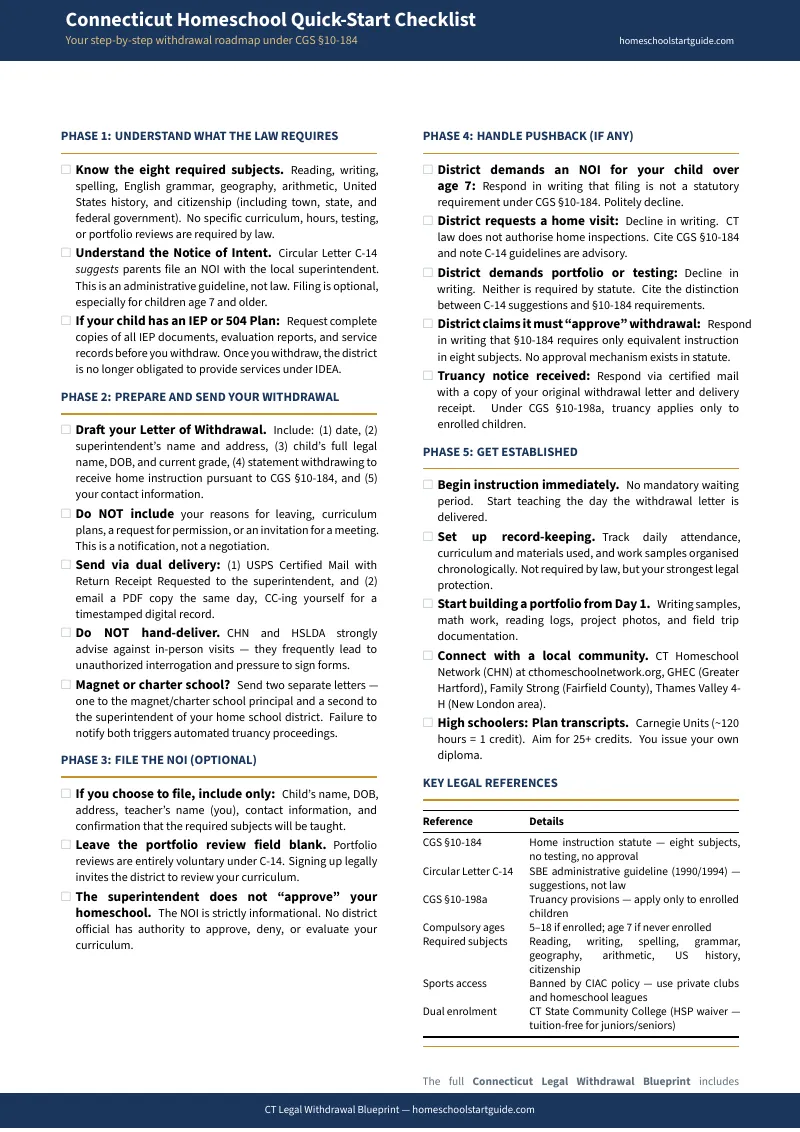
Your download includes the complete Blueprint guide covering all 17 chapters — plus five standalone printables you can use immediately: the "Required vs. Suggested" Decoder (one page separating law from C-14 suggestion), fill-in-the-blank Withdrawal Letter Templates for every scenario, the Notice of Intent Template with strategic include/exclude guidance, Superintendent Pushback Scripts (copy-paste email responses citing CGS §10-184), and Truancy & DCF Response Templates. Plus the Quick-Start Checklist. Seven documents total, instant download, no account required.
30-day money-back guarantee. If the Blueprint doesn't give you the confidence and legal clarity to execute your withdrawal, email us and we'll refund you. No questions asked.
Not ready for the full Blueprint? Download the free Connecticut Homeschool Quick-Start Checklist — a one-page overview of the five phases of withdrawal, the NOI trap, and the single most important thing to exclude from any form the district hands you. It's enough to get started, and it's free.
Your child doesn't have to go back on Monday. Connecticut law has protected your right to educate at home since 1650. Your superintendent just hasn't told you how straightforward it actually is. The Blueprint makes sure they can't pretend otherwise.