Connecticut Law Says "Equivalent Instruction in Nine Subjects." Your Superintendent Says "Submit a Detailed Portfolio for Review." One of Them Is Making Things Up.
You pulled your child out of a Bridgeport elementary school after a year of unaddressed bullying. Or you've been unschooling in Litchfield County for three years and it's been quiet — until now. Or your daughter is entering tenth grade and you just discovered that UConn requires detailed syllabi, learning logs, and a self-reported transcript through the STARS system. In every case, you've hit the same wall: Connecticut's homeschool law is one paragraph long, but the paperwork everyone says you need fills a filing cabinet.
Here's the core problem. CGS §10-184 requires instruction in nine subjects — reading, writing, spelling, English grammar, geography, arithmetic, US history, citizenship, and composition. That's the entire legal standard. No testing. No portfolio reviews. No curriculum approval. No attendance mandates. But the State Department of Education's Circular Letter C-14 lists "suggested best practices" that include annual portfolio reviews, detailed attendance logs, and NOI filings — and 169 separate superintendents treat those suggestions as enforceable law. The Compliance Documentation System inside this toolkit maps every piece of your documentation directly to what the statute actually requires, so you never overshare, never underprepare, and never hand a sceptical superintendent ammunition he shouldn't have.
What's Inside the Toolkit
The CGS §10-184 Subject Matrix
A tracking sheet with nine pre-built columns — one for each subject the statute names. Instead of guessing whether your nature walks count as "geography" or your baking project covers "arithmetic," the matrix gives you the exact statutory language and shows how to map any curriculum style — traditional, eclectic, Charlotte Mason, or unschooling — into the nine required buckets. One sheet per child, per year. Fill it in as you go, and your compliance documentation is done before you realise you've been doing it.
The Grade-Band Portfolio Frameworks (K–2, 3–5, 6–8, 9–12)
A kindergartner's portfolio should not look like a high schooler's transcript. Each framework specifies exactly what evidence to collect at each developmental stage — the types of work samples, the number to save per subject (3–5 per year is enough), and how to organise them so a superintendent sees sustained progress without you saving every worksheet your child has ever touched. The K–2 framework is built for play-based and experiential learning. The 9–12 framework is built for college admissions officers.
The High School Transcript Template
Formatted specifically for UConn's STARS self-reporting system and the Connecticut State University system (CCSU, ECSU, SCSU, WCSU). Maps to Connecticut's 25-credit graduation standard — 9 credits STEM, 9 credits humanities, 1 PE, 1 health, 1 world language, 1 mastery assessment, and 3 electives. Includes Carnegie Unit calculation (120 hours = 1 credit), GPA conversion, and course description templates. Most Etsy transcript templates are designed for states with different credit structures. This one is designed for Connecticut admissions offices.
The Superintendent Interaction Checklist
A one-page tactical reference for what to bring, what to say, and what to firmly withhold during any superintendent interaction. Bring one brief sample per required subject. Do not bring your child. Do not drop the portfolio off in advance. Do not allow copies. Do not bring medical records, immunisation logs, or detailed lesson plans — the superintendent has no legal right to any of it. Based on the boundary-setting practices used by experienced Connecticut homeschool families, stripped of the religious framing that makes TEACH-CT's version unusable for secular families.
The Attendance Log Templates
Connecticut does not mandate 180 days of instruction. The attendance tracker supports hours-based tracking, mastery-based checkoffs, and simple daily marks — so you can document your year without replicating a public school schedule. Most families accumulate 170–180 days naturally. The log exists to demonstrate consistent instruction if anyone asks, not to constrain how you teach.
The Unschooler's Translation Guide
Connecticut's statute requires nine specific academic subjects. Your unschooled child spent the morning building a dam in the creek, the afternoon reading a graphic novel about the American Revolution, and the evening helping calculate grocery costs. That morning covered geography and composition (the field journal). The afternoon covered US history and reading. The evening covered arithmetic. The Translation Guide shows how to document child-led, experiential, and project-based learning in the statutory language of CGS §10-184 — without changing how you teach.
Who This Toolkit Is For
- First-year homeschool parents in Connecticut who need a documentation system that maps directly to the nine required subjects — not a generic Etsy planner designed for a different state's laws
- Parents whose superintendent has requested a portfolio review, attendance records, or testing — and who need to know which parts of that request are legally enforceable and which are C-14 theatre
- Parents of high schoolers who need a transcript that UConn, CCSU, ECSU, SCSU, or WCSU admissions offices will accept — formatted to Connecticut's 25-credit standard, not a national template
- Unschooling and eclectic families who need to translate experiential learning into the statutory language of CGS §10-184 without compromising their educational philosophy
- Parents in Hartford, New Haven, Stamford, Bridgeport, or Danbury — districts where superintendent expectations vary significantly and documentation demands run high
- Military families at the Groton Naval Submarine Base or Coast Guard Academy who need Connecticut-specific compliance before the next PCS cycle
- Parents preparing for the possibility that HB 5468 or a similar bill makes portfolio reviews mandatory — building documentation now so the transition is painless
- Secular families who need Connecticut-specific guidance without the religious worldview of TEACH-CT or the $135/year gatekeeping of HSLDA
Why Not Just Use CHN's Free Resources?
You can. The Connecticut Homeschool Network has sample NOI templates, subject lists, and legal advocacy resources. Here's what actually happens when you try to build a portfolio system from free sources:
- CHN's resources are scattered across an enormous website, multiple Facebook groups, and 80-page PowerPoint decks. There is no single, consolidated, ready-to-use portfolio system. Their tone is political and advocacy-driven — essential for fighting HB 5468 at the State Capitol, overwhelming for a parent who just needs to organise work samples by subject.
- Etsy and TpT portfolio templates don't map to Connecticut's nine required subjects. They map to generic categories like "language arts" and "social studies." When a superintendent reviews your portfolio against CGS §10-184, they're looking for explicit evidence of reading, writing, spelling, English grammar, geography, arithmetic, US history, citizenship, and composition — nine distinct categories. A template designed for Texas or California leaves gaps.
- TEACH-CT has excellent boundary-setting advice but wraps it in Christian homeschool framing. Their portfolio review tips are tactically sound — don't bring your child, don't allow copies, bring one sample per subject. But every page carries a patriarchal religious identity that alienates secular, interfaith, and single-parent families.
- Homeschool Tracker, My School Year, and Homeschool Planet charge $60–$70/year for software that micro-schedules daily lesson plans. None of them auto-generate a Connecticut-compliant portfolio, map to the nine statutory subjects, or format a transcript for UConn's STARS system. You get a scheduling app, not a compliance tool.
— Less Than a Single School Supply Run
Homeschool Tracker costs $65/year. My School Year costs $60/year. A single hour with an education attorney costs $250–$400. A panicked weekend assembling a portfolio from scattered CHN resources, Pinterest printables, and Facebook advice costs you the weekend — and still leaves gaps a superintendent could question.
Your download includes the complete 14-chapter guide, the Connecticut Homeschool Quick-Start Checklist, and five standalone printable templates: the CGS §10-184 Subject Matrix, the High School Transcript Template (formatted for UConn STARS and the CSU system), the Superintendent Interaction Checklist, Attendance Log Templates (September through June), and the Unschooler's Translation Guide. Seven documents total. Instant download, no account required.
30-day money-back guarantee. If the toolkit doesn't give you the documentation system and legal clarity to confidently manage your Connecticut homeschool portfolio, email us and we'll refund you. No questions asked.
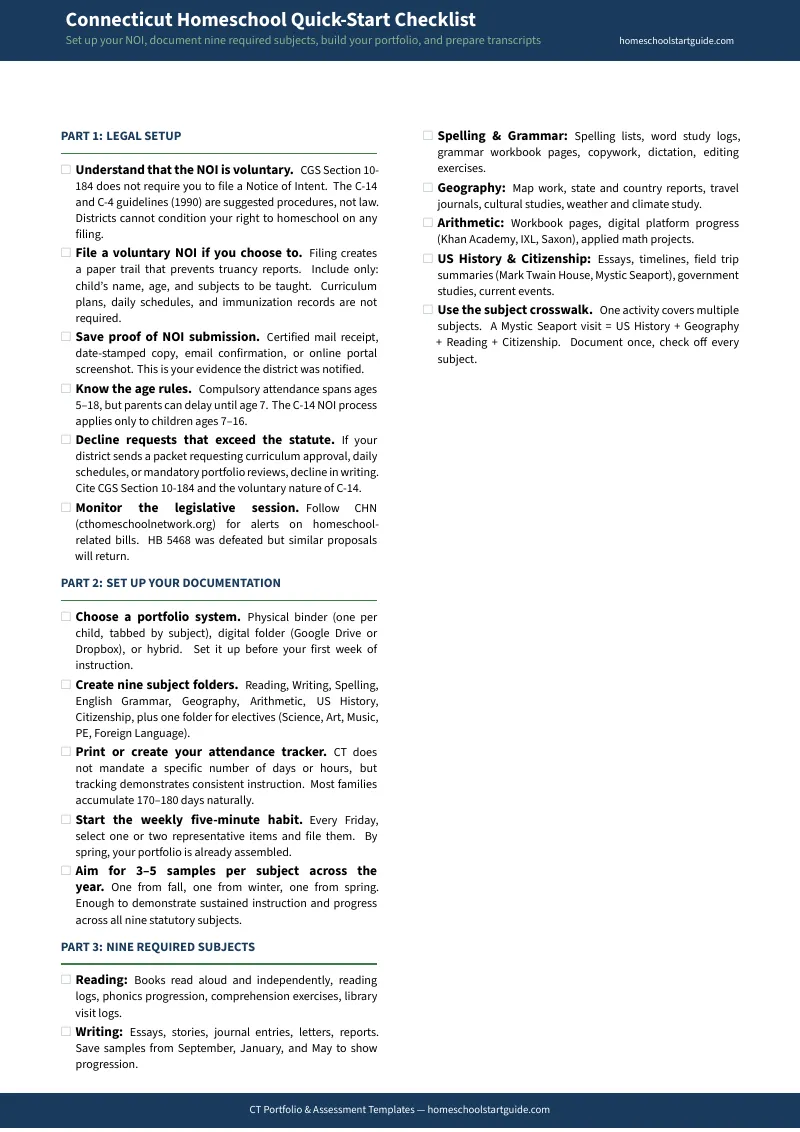
Not ready for the full toolkit? Download the free Connecticut Homeschool Quick-Start Checklist — a one-page guide covering legal setup, the nine required subjects, documentation basics, and your first-week action plan. It's enough to get started, and it's free.
Connecticut has protected your right to educate at home since 1650. The law is on your side. Your documentation system should be too.