
Build Your Connecticut Micro-School Legally, Affordably, and Without a Franchise.
Connecticut's CGS §10-184 gives parents the legal authority to provide "equivalent instruction" in eight required subjects — with no standardized testing, no curriculum approval, no teacher credentials, and no mandatory registration. That framework is why CT is one of the most deregulated homeschool states in the Northeast, and why micro-schools and learning pods are surging in Hartford, New Haven, Fairfield County, and Stamford. But the moment you invite other families' children, charge tuition, or operate a regular learning schedule from your home, you step into a minefield the state website never mentions: the private school threshold under CGS §10-188, municipal zoning restrictions in Greenwich, Westport, West Hartford, and New Haven, daycare licensing triggers for children under five, and the background check requirements under Public Acts 16-67 and 17-68.
You want to pull together four or five families in your area, share the teaching load, and build something that actually fits your child. Maybe you are burned out on solo homeschooling and need a shared-responsibility model. Maybe you are a Fairfield County parent paying $26,000 to $51,000 a year in private school tuition and wondering whether a micro-school could deliver the same personalization at a fraction of the cost. Maybe the September 1 kindergarten age cutoff displaced your child and you need a bridge year that is more than expensive daycare. Maybe you are a former COVID-era pod parent whose informal arrangement needs legal structure before someone in the group gets nervous. Maybe you looked at Prenda's $2,100-per-student platform fee and KaiPod's 10% revenue share and decided you would rather keep the money and the autonomy. Whatever the reason, you have arrived at the same conclusion: I need to build this myself.
The problem is that the internet gives you fragments. The state Department of Education talks about "equivalent instruction" and "nonpublic schools" — it does not use the words "micro-school" or "learning pod." The Connecticut Homeschool Network (CHN) fiercely advocates for parental rights but explicitly separates "true co-ops" from tuition-based pods and provides zero guidance on the business side. Facebook groups in Shoreline Homeschoolers and Fairfield County CT Homeschoolers confidently declare that pods need no insurance, that zoning does not apply, and that the Notice of Intent is "definitely required" or "definitely optional" depending on which post you read. You need a CT Pod Founder's Playbook — the complete operational framework without the dangerous legal guesswork, the franchise costs, or the ideological prerequisites.
The Connecticut Micro-School & Pod Kit is that Pod Founder's Playbook.
What's Inside the Pod Founder's Playbook
The Homeschool Co-op vs. Private School Legal Framework
Because the single most confusing question for every new Connecticut pod founder is whether your group is a "homeschool cooperative" or an "unregistered private school" — and what happens if you get it wrong. Connecticut classifies educational entities under two distinct statutes: CGS §10-184 (home instruction — each parent retains legal responsibility) and CGS §10-188 (private school — requires attendance reporting, is subject to fire/health inspections). The guide walks you through the exact criteria that push a pod from one classification to the other — number of families, who controls curriculum, whether you hire employees, and whether the structure looks more like a "school" than a "group of homeschoolers cooperating." You choose the right legal structure before your first family meeting, not after the superintendent contacts you.
The Notice of Intent Strategy
Because the NOI is the single most argued-about document in Connecticut homeschooling — and the confusion can paralyze pod formation for months. The 1990 C-14 Guidelines established the NOI as a "suggested procedure," not a legal requirement. CHN and NHELD advise against filing because it invites voluntary oversight. Some families file for peace of mind. The guide explains exactly what the law says, what the Guidelines suggest, what the major advocacy groups recommend, and when filing or not filing makes strategic sense for your specific situation — so every family in your pod makes an informed decision instead of blindly following Facebook advice.
The Zoning Matrix — Hartford, New Haven, Fairfield County, and Beyond
Because HB 1050, which would have protected residential learning pods from zoning enforcement, failed to pass — and your home-based pod is vulnerable to neighbor complaints. The guide maps zoning considerations for Connecticut's major municipalities: how many children trigger commercial use classification, when you need a Special Use Permit, and which institutional alternatives (churches, community centers, commercial space) sidestep residential zoning entirely. The difference between running a four-family pod from your West Hartford living room and running one from a church fellowship hall is the difference between legal vulnerability and legal clarity.
The Background Check Requirements
Because Public Acts 16-67 and 17-68 require any educational entity hiring employees with student contact to conduct DCF abuse and neglect registry checks before hire, state and national criminal history records checks with fingerprinting within 30 days, and employment history verification with former educational employers. The guide covers who needs checks, the application process through the Connecticut State Police, processing times, costs, and the critical distinction between a parent-led co-op (where parents teach their own children) and a structured micro-school with hired facilitators (where background checks are non-negotiable).
The Parent Agreement and Liability Waiver Templates
Because a child breaking an arm in your living room should not end the pod — and it will not, if you are prepared. Customizable parent agreements covering educational philosophy, schedule, tuition, attendance, behavior, conflict resolution, withdrawal, and media privacy. Plus a liability waiver with indemnification, medical consent, and emergency contact forms. Every family signs these before day one. These are not generic Etsy templates — they are written for the specific legal context of Connecticut home education under CGS §10-184.
The Connecticut Budget Planner
Because running a pod with a facilitator and rented space in Fairfield County costs nothing like running one from your kitchen table in Windham County. Budget templates covering facilitator compensation ($22–$35/hour in Connecticut), space rental, curriculum materials, insurance, and field trips — with real CT cost benchmarks by region. Includes cost-sharing models for 3-family, 5-family, and 8-family pods, and a tuition calculator that accounts for Connecticut's high cost of living.
The Connecticut Pod Launch Checklist
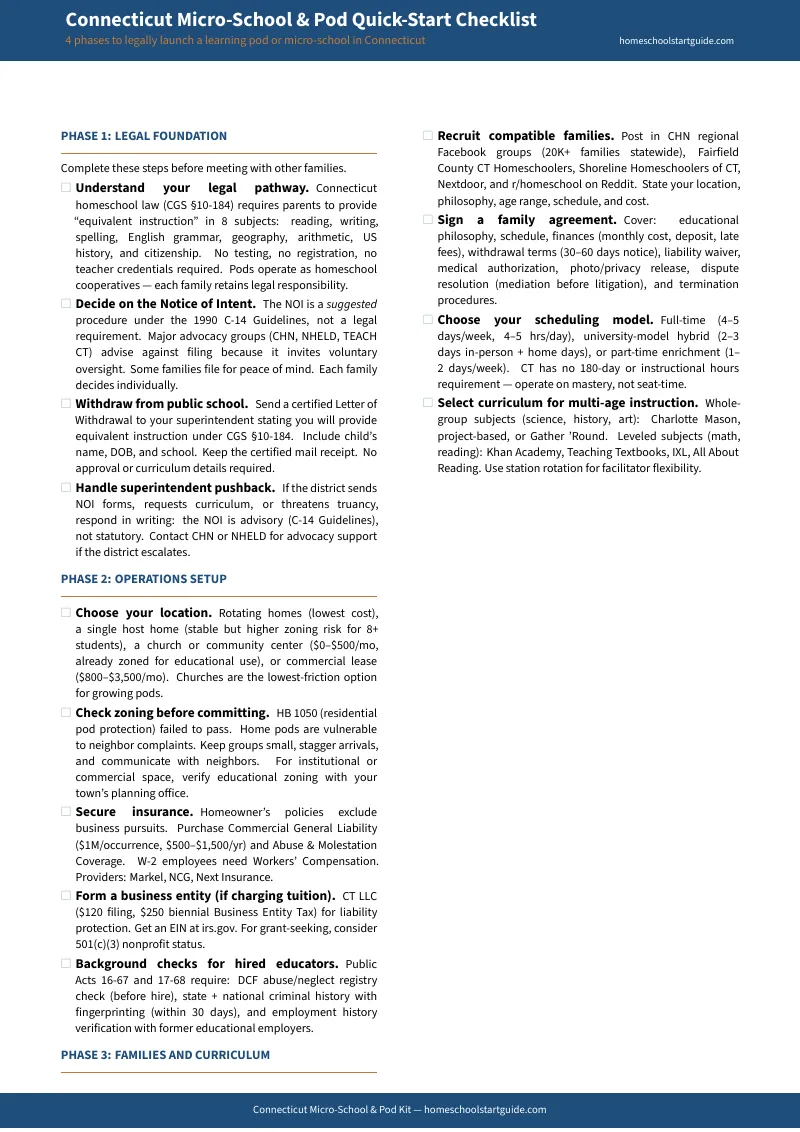
Because most parents spend forty-plus hours assembling the launch sequence from state websites, CHN resources, NHELD advisories, and contradictory Facebook posts. A single-page, print-and-pin document that walks you from "I have an idea" to "the first day of pod school" — covering the legal, operational, financial, and community formation steps in the correct order, with Connecticut-specific thresholds and legal references at every step.
Who This Kit Is For
- Solo homeschoolers who have reached the burnout threshold and need a shared-responsibility model where the instructional and social burden is distributed among trusted families — without losing control of your child's education or triggering state oversight you never signed up for
- Fairfield County parents paying $26,000 to $51,000 a year in private school tuition who want personalized, small-group education for a fraction of the cost — without the admissions gatekeeping, rigid schedules, and ideological constraints of traditional prep schools
- Parents of age-cutoff children displaced by the September 1 kindergarten deadline — you need a structured learning community for your four- or five-year-old that costs less than Connecticut's $18,000 average annual childcare while delivering real educational rigor
- Former COVID-era pod parents whose informal living-room arrangement has been running for years but never had insurance, a family agreement, or a clear legal classification — and someone in the group is getting nervous
- Parents of neurodivergent children (autism, ADHD, dyslexia, giftedness, 2e) who are exhausted by IEP battles and want a small-group learning environment designed around their child's actual needs
- Former educators who have left the public school system and want to serve their community by running a small paid micro-school — without the $20,000 Acton Academy licensing fee, Prenda's $2,100 per-student extraction, or KaiPod's 10% revenue share
- Secular families seeking inclusive, non-religious educational community in a state where some of the largest co-op networks require specific faith commitments
- Hartford, New Haven, and Stamford families who want the safety, personalization, and community of a micro-school but cannot afford or access the private school options that dominate Fairfield County
After Using the Kit, You'll Be Able To
- Understand your legal standing under CGS §10-184 and know exactly when a multi-family pod crosses the threshold into private school territory under CGS §10-188 — and what that means for your reporting obligations, zoning exposure, and state oversight
- Make an informed decision about the Notice of Intent — whether to file, when not to, how to respond if the superintendent pushes back, and what the major advocacy groups actually recommend — instead of following contradictory Facebook advice
- Structure your pod to avoid the private school classification and daycare licensing triggers that catch founders operating informally — so you remain a group of cooperating homeschool families, not an unregistered school
- Choose the right space for your pod based on your municipality's zoning rules — home, church, or commercial — and know the thresholds that separate a permitted home gathering from a prohibited commercial operation
- Run your first parent intake meeting using a signed Family Agreement and liability waiver that protects every family in the pod — without spending $200 on a Connecticut education attorney
- Hire and background-check a facilitator legally under Public Acts 16-67 and 17-68, classify them correctly for Connecticut tax purposes, and pay them competitively using real local wage benchmarks
- Build a sustainable budget with Connecticut cost data, set tuition that families can afford, and split costs equitably across participating households
Why Not Just Use the Free Resources?
The Connecticut Department of Education is the legal authority. CHN has 20,000+ member families. NHELD provides legal advocacy. Facebook groups have thousands of CT parents trading advice. Here is exactly what you run into when you try to build a pod from those sources alone:
- The state speaks bureaucratic, not parent. The Connecticut Department of Education website talks about "equivalent instruction" and "nonpublic schools" — it has never used the words "micro-school" or "learning pod." A parent searching the state portal for instructions on starting a pod finds truancy statutes and compulsory attendance language, not step-by-step guidance on forming a collaborative learning community.
- CHN gives you advocacy but not operations. The Connecticut Homeschool Network is the state's most important grassroots voice for homeschool rights. But CHN explicitly categorizes tuition-based pods as "private schools" rather than co-ops — and provides no templates, no multi-family formation guides, and no operational frameworks for the collaborative pod model that defines the post-2020 homeschool landscape.
- Facebook groups are an echo chamber of contradictory legal advice. Parents in Fairfield County CT Homeschoolers and Shoreline Homeschoolers confidently claim that the Notice of Intent is mandatory (it is not — it is a suggested procedure under the C-14 Guidelines), that pods do not need insurance (they do if charging tuition or hosting other families' children), and that zoning does not apply (HB 1050 failed — residential pods remain zoning-vulnerable). A parent who follows Facebook advice discovers the gaps when the superintendent calls, not before.
- Etsy templates are generic daily planners with a micro-school label. Canva templates and enrollment forms priced at $5–$24 on Etsy and TPT. Not one references CGS §10-184, the C-14 Guidelines, Public Acts 16-67 and 17-68 background check requirements, or municipal zoning restrictions in Hartford, New Haven, Greenwich, or Stamford. They help you organize a schedule. They do not help you form a legally protected pod.
- Prenda and KaiPod solve the problem — and take your autonomy and revenue. Prenda charges over $2,100 per student per year in platform fees. KaiPod charges a $249 upfront fee plus 10% of gross tuition revenue for the first two years. Acton Academy charges a $20,000 licensing fee plus 3% annual revenue. All three require you to recruit the families, find the space, and build the community yourself. If you are doing the hard work of building local trust, you should keep 100% of the revenue and 100% of the curriculum control.
Free resources give you the inspiration and the legal baseline. The Pod Founder's Playbook gives you the templates, checklists, and frameworks to execute this week.
— Less Than One Hour With a Connecticut Education Attorney
A single consultation with a Connecticut education attorney costs $100 to $300 per hour. Acton Academy charges a $20,000 licensing fee. Prenda charges over $2,100 per student per year. The Kit costs less than one hour of professional advice and gives you the operational independence those platforms are designed to prevent.
Your download includes the complete guide (25 chapters covering Connecticut law, the Notice of Intent strategy, the co-op vs. private school distinction, zoning by municipality, background checks under PA 16-67 and PA 17-68, insurance, hiring, budgeting, curriculum for multi-age groups, scheduling models, family agreements, corporate structure, assessment, sports access, field trips, high school operations with dual enrollment, neurodivergent learner pods, bilingual and unschooling pods, franchise alternatives, finding families, the kindergarten age-cutoff opportunity, Fairfield County market considerations, conversation scripts, scaling, and tax implications), plus the Connecticut Pod Launch Checklist and standalone printable tools: the Parent Participation Agreement, the Liability Waiver and Emergency Contact Form, the Facilitator Contract, the Connecticut Regional Budget Planner, and the Instructional Tracking Log. Instant download, no account required.
30-day money-back guarantee. If the Kit does not give you the legal clarity and operational confidence to move forward with your pod, email us and we will refund you. No questions asked.
Not ready for the full Kit? Download the free Connecticut Homeschool Quick-Start Checklist — a one-page summary of the legal framework under CGS §10-184, the Notice of Intent decision, background check basics, zoning considerations, and the four-phase launch sequence. It is enough to understand your rights tonight.
Connecticut gave you the legal framework. The Pod Founder's Playbook makes sure you use it correctly.