The Assessment-Ready System for Colorado Homeschool Families
Every Colorado homeschool family hits the same wall: a testing grade is coming and you're not sure your records are ready. Your third grader's first standardized test is in the spring. Your fifth grader needs a qualified person evaluation and you've never prepared a portfolio for one. Your ninth grader wants Concurrent Enrollment at Front Range Community College and the advisor is asking for a parent-issued transcript you've never built.
Colorado's homeschool law gives you real freedom — and zero structure for the paperwork. The CDE website lists what's required but provides no tools. CHEC tells you what subjects to teach but doesn't give you tracking forms. Umbrella schools handle the filing but charge annual fees for documentation you can own yourself. And generic Etsy planners don't account for Colorado's unique grade 3-5-7-9-11 testing schedule, the 172-day/688-hour requirement, or the constitutional studies mandate that no other state shares.
The Colorado Portfolio & Assessment Templates is an Assessment-Ready System — not a stack of blank forms, but an integrated workflow that translates C.R.S. 22-33-104.5 into year-round documentation, built for the grade-specific testing schedule, and formatted to satisfy a qualified person evaluator, a school district superintendent, or a CU Boulder admissions officer.
— less than what a single qualified person evaluation costs.
What's Inside
172-Day Compliance Foundation
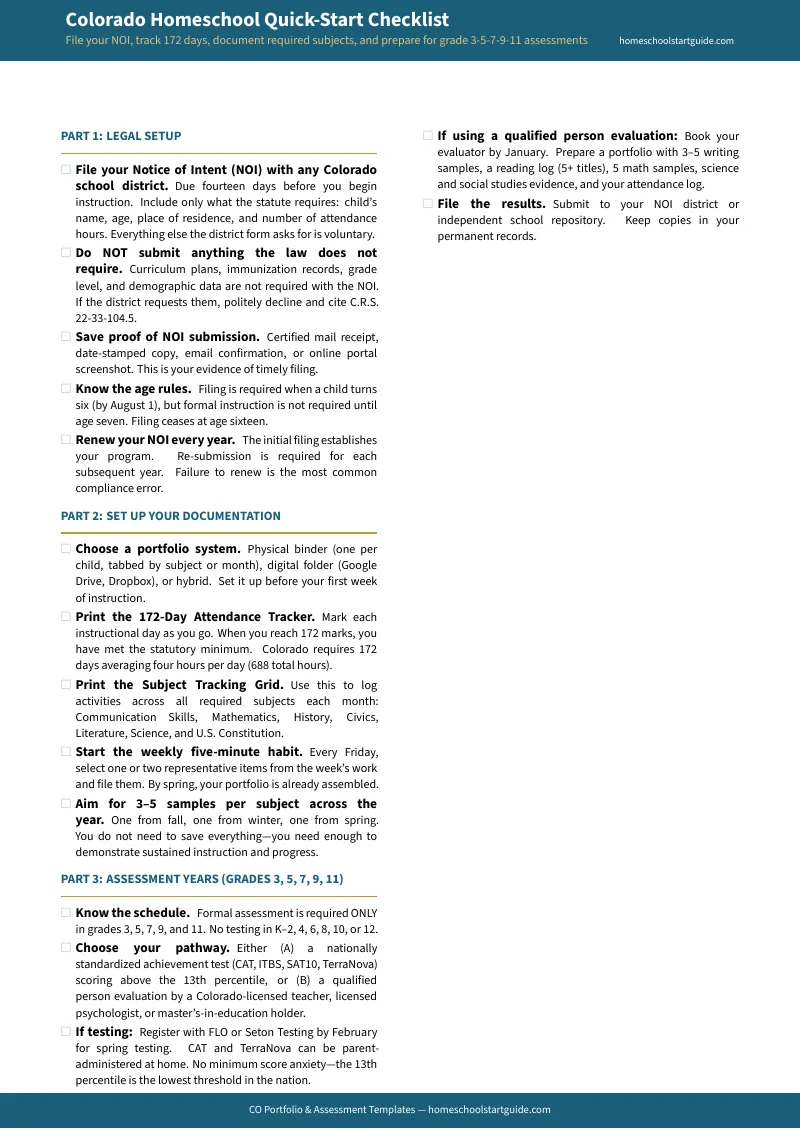
- 172-Day Attendance Tracker — because "I think we did enough days" isn't a compliance strategy. A fill-as-you-go calendar that marks each instructional day and calculates your running total toward the 688-hour statutory minimum — so you never have to retroactively count days from memory in March.
- Subject Tracking Grid — because Colorado requires instruction in six named subjects plus the U.S. Constitution, and a box of undated notebooks doesn't prove you covered them all. A monthly grid that maps activities to Communication Skills, Mathematics, History, Civics, Literature, Science, and Constitutional Studies — with a crosswalk showing how one field trip or project covers multiple subjects simultaneously.
- Weekly Planning Sheets — because documenting as you go takes five minutes on Friday. Retrofitting a year of records takes a panicked weekend in April.
Assessment Year Preparation
- Testing vs. Evaluation Decision Guide — because most families don't realize they have two options until their testing year arrives. A clear breakdown of standardized testing (CAT, ITBS, SAT10, TerraNova — the 13th percentile is the lowest threshold in the nation) versus qualified person evaluation (Colorado-certified teacher, licensed psychologist, or master's holder) — with the specific scenarios where each pathway is the better choice.
- Assessment Preparation Checklist — because the most common evaluation mistakes are over-preparing (submitting more than the statute requires) and under-preparing (missing the one item your evaluator needs). Exactly what to assemble for each pathway, in the order evaluators look for it.
- Remediation Plan Template — because if a score falls at or below the 13th percentile, the statute requires a specific response. A ready-to-use template so the remediation process is administrative, not adversarial.
High School & University
- Colorado High School Transcript Template — because "mom grades" in a Google Doc won't satisfy a CU Boulder admissions officer. Pre-formatted with standard course titles, credit calculations, GPA formula, and the constitutional studies notation that Colorado uniquely requires. Built to match what CU Boulder, Colorado State, Colorado School of Mines, and University of Denver expect from homeschool applicants. Transcript services charge $60–$120 for what this template lets you produce yourself.
- Concurrent Enrollment Documentation Kit — because homeschoolers can take free college courses at Front Range, Pikes Peak, or Arapahoe community colleges, but the enrollment process requires a current NOI, a parent-issued transcript, a Concurrent Enrollment Agreement, and an Individual Career and Academic Plan. This kit gives you every document in the correct format.
- Course Description Templates — because dual enrollment and university applications require course descriptions, and "we used Saxon Math" isn't one. The exact format Colorado colleges expect.
Year-Round System
- NOI Filing Reference Guide — because Colorado requires only four pieces of information on the Notice of Intent, and most district forms ask for far more than the law requires. Know exactly what to submit, what to decline, and which districts have the smoothest filing processes.
- Annual Compliance Calendar — because Colorado's obligations are spread across the year: NOI renewal, testing windows, evaluator booking deadlines, and Concurrent Enrollment application periods. One calendar with every deadline marked so nothing sneaks up on you.
- District Filing Profiles — because Denver, JeffCo, Douglas County, El Paso County, and Poudre all handle homeschool filings differently. Know your district's quirks before you file.
Who This Is For
The Testing-Year Family
Your child is approaching grade 3, 5, 7, 9, or 11 — the mandatory assessment years — and you've been homeschooling without a formal documentation system. You need to assemble a portfolio or prepare for a standardized test, and you're not sure what Colorado actually requires versus what the internet says it requires. The Assessment-Ready System gives you exactly the templates the statute demands, organized in the order your evaluator will look for them.
The Military Family
You PCS'd to Fort Carson, Peterson SFB, Buckley, or USAFA from a state with different (or no) homeschool requirements. Your child may be entering a testing grade in Colorado for the first time. You need to file a Colorado NOI, start tracking 172 days, and potentially prepare for an assessment — all within weeks of unpacking. The guide's military transition chapter covers exactly this scenario.
The High School Strategist
Your teenager wants Concurrent Enrollment at a Colorado community college, or is applying to CU Boulder, CSU, or Mines. You need a transcript that signals "serious academic program" to an admissions office that sees hundreds of homeschool applications. The transcript template and course description formats are built to match what Colorado universities specifically request from homeschool applicants.
Why Free Tools Fall Short
CDE website provides the statute text and NOI forms, but zero tools for the ongoing documentation it requires. It tells you to track 172 days without giving you a tracker. It tells you to cover six subjects without giving you a way to prove it.
CHEC (Christian Home Educators of Colorado) is excellent on advocacy and evaluator referrals. But their resources funnel toward umbrella school enrollment ($50–$200/year) or conference attendance, not standalone documentation systems the independent filer owns year-round.
Umbrella schools (CHEC Independent School, Statheros Academy, Poudre River School) simplify filing and sometimes handle testing logistics. But they charge annual fees, may require specific curriculum alignment, and the records they maintain belong to the school — not to you. If you leave, your documentation doesn't follow.
Generic Etsy and TpT planners are designed for national audiences. They don't account for Colorado's unique testing schedule (grades 3, 5, 7, 9, 11 only), the 172-day/4-hour requirement, the constitutional studies mandate, or the Concurrent Enrollment documentation that Colorado community colleges require. A "homeschool planner" from Iowa won't produce a transcript formatted for CU Boulder.
The Assessment-Ready System fills these gaps in one place — built around what C.R.S. 22-33-104.5 actually requires, formatted for what Colorado evaluators and universities actually expect.
After You Have This System
- You'll know exactly which documents Colorado law requires — and which ones district forms ask for that exceed the legal minimum
- You'll have a 172-day tracker running from day one so the hours question is never a source of anxiety
- When a testing year arrives, you'll have an assessment-ready portfolio that any evaluator can review in 15 minutes
- If a district superintendent requests records with probable cause, you'll have organized documentation and a clear understanding of what they can and cannot legally demand
- If your high schooler needs a transcript for CU Boulder, CSU, Mines, or Concurrent Enrollment, you'll have a Colorado-formatted document ready to submit
Instant Digital Download — 11 PDFs
The complete guide plus 9 standalone printable templates — attendance tracker, subject tracking grid, weekly planning sheet, testing vs. evaluation decision guide, assessment preparation checklist, high school transcript template, concurrent enrollment kit, annual compliance calendar, and district filing profiles. Download immediately after purchase. No shipping, no waiting, no account required.