Build Your Colorado Micro-School Legally, Confidently, and Without Paying a Franchise.
Colorado passed SB22-071 to explicitly legalize learning pods and cooperatives under home-based education law. Your district cannot demand curriculum approval. Your HOA cannot shut you down for teaching. You do not need a teaching license. But nobody has packaged that protection — along with the NOI filing process, the umbrella school decision, the 172-day tracking requirement, the odd-year testing schedule, and the four-child licensing threshold — into a single, usable operational guide. Until now.
You want to pull together three or four Front Range families, share the teaching load, and build something that actually fits your child. Maybe you're burned out on solo homeschooling and need a shared-responsibility model. Maybe you're secular in a state where the largest homeschool network requires a Christ-centered focus. Maybe you're a military family at Fort Carson or Peterson SFB and need a pod that survives a PCS move. Maybe you looked at Prenda's $2,200-per-student platform fee or Acton's $20,000 franchise cost and decided you'd rather keep the money and the autonomy. Whatever the reason, you've arrived at the same conclusion: I need to build this myself.
The problem is that the internet gives you fragments. CHEC tells you the legal baseline — but their resources are written for evangelical families. The Colorado Department of Education tells you to "review and interpret homeschool statute" on your own. Poudre River School explains when your pod might need private school registration — but their solution is to enroll in their umbrella school. Facebook groups offer fiercely contradictory legal advice that could trigger a truancy investigation. You need a Colorado Pod Founder's Playbook — the complete operational framework without the ideological prerequisites, the franchise costs, or the dangerous legal guesswork.
The Colorado Micro-School & Pod Kit is that Pod Founder's Playbook.
What's Inside the Pod Founder's Playbook
The Colorado Legal Pathway Decision Framework
Because the single most confusing question for every new pod founder is whether to file individual Notices of Intent under C.R.S. 22-33-104.5 or register as an independent private school with the Department of Education. This framework walks you through the exact criteria — number of families, who's teaching, whether you're charging tuition, and whether you're teaching other people's children — so you choose the right legal structure before your first family meeting, not after a school district letter forces the question.
The NOI Filing Checklist and 14-Day Countdown
Because every participating family must file a Notice of Intent with their local school district 14 days before instruction begins — and getting the paperwork wrong, or missing the timeline, is the fastest path to a truancy letter. A step-by-step checklist for each family's NOI submission: what to include, what the district cannot legally require, and what to do if the district pushes back with requests for curriculum approval or in-person meetings.
The Umbrella School Decision Guide
Because paying $105 per year for CHEC or enrolling through Poudre River School solves the reporting problem — but not the operational one. An unbiased directory of Colorado umbrella schools comparing annual fees, secular versus religious affiliation, transcript services, and reporting requirements. Explains exactly what umbrella schools handle (state reporting, record keeping) and what they don't (liability, scheduling, parent agreements, zoning, facilitator hiring).
The Secular & Inclusive Community Charter Templates
Because the co-ops you've found require a statement of faith your family can't sign. Customizable parent agreements, liability waivers, and operating guidelines written from scratch — no religious language, no political affiliations, no mandatory statements of belief. Clear expectations around attendance, cost-sharing, scheduling, curriculum authority, and liability before the first child walks through your door.
The Pod Liability Protection Framework
Because a child breaking an arm in your living room shouldn't end the pod — and it won't, if you're prepared. Colorado's liability waiver statute (C.R.S. 13-22-107) allows enforceable assumption-of-risk waivers. This section walks you through securing micro-school liability insurance, provides the framework for a participant agreement every parent signs before enrollment, and explains what your homeowner's policy does and does not cover. Liability paranoia is the most common reason parents abandon pod formation after the first planning meeting. This removes it.
The 172-Day Tracking System
Because Colorado requires 172 days of instruction averaging at least 4 hours per day — and in a multi-family pod, every family needs their own compliant records. Printable tracking logs that each family uses to document instructional hours, required subject coverage (communication skills, mathematics, history, civics, literature, science, and the U.S. Constitution), and attendance. Designed for pods where families share instruction but maintain individual compliance.
The Colorado Regional Budget Planner
Because running a pod in Denver costs nothing like running one in Pueblo. Region-specific budget templates covering facilitator compensation, space rental, curriculum materials, insurance, and field trips — with real numbers for Denver/Boulder (high-cost), Colorado Springs (moderate), Fort Collins (moderate), mountain resort communities (variable), and rural Colorado (low-cost). Includes cost-sharing models for 3-family, 5-family, and 8-family pods.
The Colorado Pod Launch Checklist
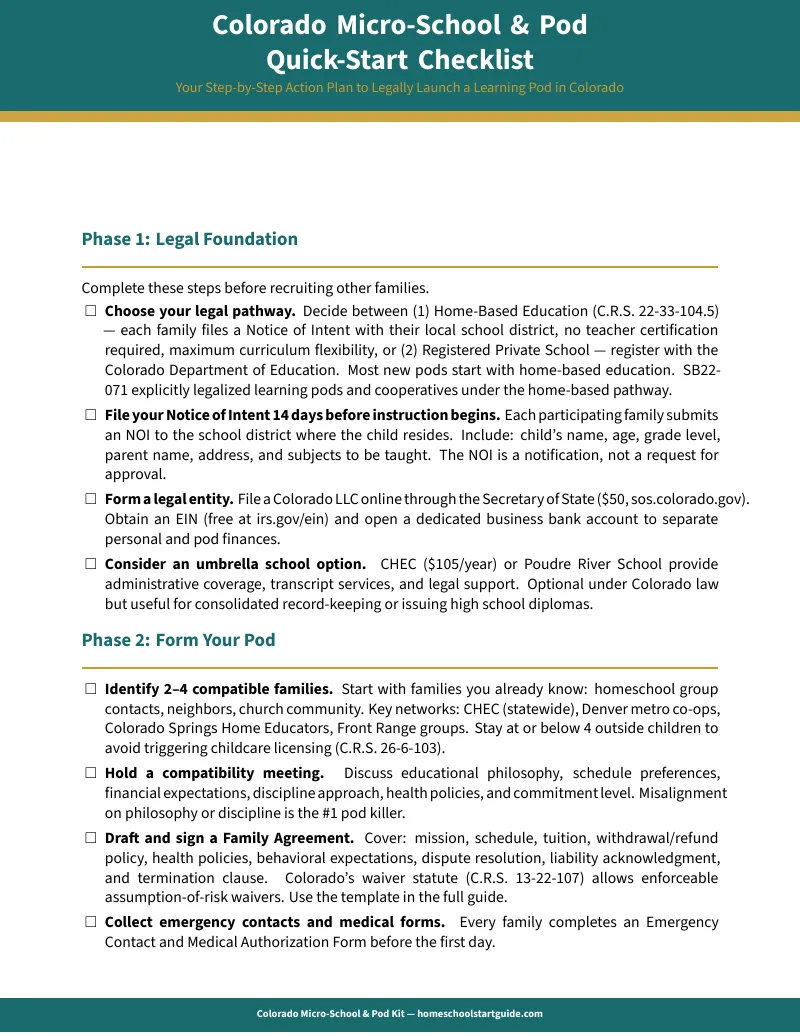
Because most parents spend forty-plus hours assembling the launch sequence from blog posts, Facebook groups, and CDE statute pages. A single-page, print-and-pin document that walks you from "I have an idea" to "the first day of pod school" — covering the legal, operational, financial, and community formation steps in the correct order.
Who This Kit Is For
- Parents who've decided the public school system isn't working for their child — whether because of large class sizes, over-testing, curriculum frustrations, or the safety anxiety that keeps you checking your phone every afternoon — and want to build a small, intentional alternative with a handful of like-minded families
- Solo homeschoolers who've reached the burnout threshold and need a shared-responsibility model where the instructional and social burden is distributed among trusted families — without losing control of their child's education
- Secular or progressive parents in Denver, Boulder, or Colorado Springs who've been locked out of the state's largest homeschool networks by religious litmus tests and need a legally sound charter for an inclusive pod
- Military families stationed at Fort Carson, Peterson SFB, Schriever SFB, or USAFA who need a pod model that adapts to PCS cycles without disrupting their child's learning continuity
- Parents of neurodivergent children (autism, ADHD, dyslexia, giftedness) who are exhausted by IEP battles and need an ultra-low-ratio, self-paced learning environment that public schools structurally cannot provide
- Mountain and rural families in Summit, Eagle, Garfield, or Eastern Plains communities where geographic isolation and extreme weather make traditional schooling impractical — and the outdoor environment is the strongest classroom asset
- Former educators who've left the public school system and want to serve their community by running a small paid pod — without the overhead, the revenue share, or the rigid pedagogy of a franchise network
After Using the Kit, You'll Be Able To
- Choose the correct legal pathway — home-based education NOIs versus private school registration — based on your pod's size, structure, and whether you're teaching other families' children, before a district letter forces the decision
- File each family's Notice of Intent correctly, on time, and with the exact information the district is entitled to receive — nothing more — and know what to say if the district requests a meeting, curriculum approval, or in-person inspection
- Run your first parent intake meeting using a signed Family Agreement and liability waiver that protects every family in the pod — without spending $300 on a Denver education attorney
- Facilitate a mixed-age pod of four to eight children across multiple grade levels without chaos — using a scheduling framework that keeps independent learners on task while you work with a small group
- Track your 172 instructional days and required subject coverage with logs that satisfy C.R.S. 22-33-104.5 for every participating family — without duplicating effort or losing records
- Prepare for odd-year standardized testing (grades 3, 5, 7, 9, 11) with the correct timeline, approved test options, and the 13th-percentile threshold families actually need to clear
- Build a secular, inclusive learning community with no statement of faith required — and document that inclusivity in your community charter from day one
Why Not Just Use the Free Resources?
CHEC hosts the Rocky Mountain Homeschool Conference and runs a statewide co-op directory. The CDE publishes the statute text. Poudre River School explains when pods need private school registration. Facebook groups have thousands of Colorado homeschool parents trading advice. Here is exactly what you run into when you try to build a pod from those sources alone:
- CHEC gives you the legal baseline — and requires a Christ-centered focus. Their co-op directory, umbrella school, and conference resources are built explicitly for evangelical families. The large and growing secular demographic in Boulder, Denver, and increasingly Colorado Springs is either ignored or actively filtered out. If you don't share their theological framework, you are not their audience.
- The CDE tells you to figure it out yourself. The Colorado Department of Education homepage states: "CDE is not able to advise on homeschool matters" and "Families are responsible for reviewing and interpreting homeschool statute." Parents reading the dense legalese about 172 instructional days, 4-hour contact time, relative-only teaching restrictions, and odd-year testing mandates are left panicked and confused about how to actually prove compliance in a group setting.
- Poudre River School warns you about the legal landmines — and sells their umbrella school as the fix. They provide one of the best free breakdowns of NOI versus private school registration and correctly warn that teaching non-relatives under an NOI carries legal risk. But their prescribed solution is to pay to enroll in their organization. The operational questions — scheduling, liability, parent agreements, budget — go unanswered.
- Facebook groups are an echo chamber of contradictory legal advice. Parents confidently claim umbrella schools eliminate all testing requirements, that NOIs don't require attendance records, and that pods under four kids need no documentation at all — statements that directly violate Colorado statute. The emotional support is real. The legal guidance is dangerous.
- The Etsy "micro-school starter kits" are generic daily planners with a micro-school label. Canva templates, minimalist worksheets, and daycare enrollment forms priced at $5–$28. Not one references C.R.S. 22-33-104.5, the 172-day requirement, the four-child licensing threshold, or Colorado's specific liability waiver statute. They help you organize a schedule. They don't help you form a legally compliant pod.
Free resources give you the inspiration and the legal baseline. The Pod Founder's Playbook gives you the templates, checklists, and frameworks to execute this week.
— Less Than One Hour With a Denver Education Consultant
A single consultation with a Colorado education expert costs $150 to $300 per hour. The KaiPod Catalyst accelerator starts at $249 upfront. An Acton Academy franchise requires $20,000 plus 4% of annual revenue. Prenda charges approximately $2,200 per student per year in platform fees. The Kit costs less than one hour of expert advice and gives you the operational independence those platforms are designed to prevent.
Your download includes 8 PDFs: the complete guide (18 chapters, 81 pages covering legal pathways, pod formation, operations, curriculum, outdoor education, testing compliance, and scaling), the Colorado Pod Launch Checklist (print-and-pin), plus six standalone printable templates — the Parent Participation Agreement, the Liability Waiver (C.R.S. 13-22-107 compliant), the Facilitator Contract, the Colorado Regional Budget Planner, the 172-Day Instructional Hours Tracking Log, and the NOI Filing Checklist with 14-Day Countdown. Instant download, no account required.
30-day money-back guarantee. If the Kit doesn't give you the legal clarity and operational confidence to move forward with your pod, email us and we'll refund you. No questions asked.
Not ready for the full Kit? Download the free Colorado Homeschool Quick-Start Checklist — a one-page summary of the legal requirements, NOI filing basics, the 172-day rule, and the SB22-071 protections that apply to your pod from day one. It's enough to understand your rights tonight.
Colorado legalized learning pods by name. You have the legal right to build this. The Pod Founder's Playbook makes sure you build it correctly.