California Tells You to Keep Records. It Never Tells You What That Actually Looks Like.
You filed your PSA. You chose your curriculum. Your kids are learning. But somewhere in the back of your mind, a question keeps nagging: Am I documenting this correctly?
Education Code §48222 says you must maintain an attendance register. §33190 says you need a course of study covering "the several branches of study required to be taught in the public schools." §51210 and §51220 list the required subjects. But the California Department of Education explicitly states that it does not provide guidance on how to homeschool — or how to format a single one of those records. You're running a private school, and the state gave you a legal obligation with zero templates.
The California Compliance Portfolio System is the bridge between what the Education Code demands and what you can actually put in a binder. Ready-to-use templates for all five California homeschool pathways — PSA, PSP, Charter IS, Credentialed Tutor, and District ISP — organized by grade band from kindergarten through 12th grade, with every document mapped directly to the statute it satisfies.
What's Inside the Portfolio System
Pathway-Specific Documentation for All Five Legal Routes
California doesn't have a single "homeschool" framework — it has five distinct legal pathways, each with different documentation requirements. A PSA filer needs an attendance register tracking half-day absences under §48222. A charter IS family needs monthly engagement logs and work sample collections for ADA funding. A PSP family submits records to their satellite program's format. The Portfolio System provides separate template sets for each pathway so you document exactly what your legal structure requires — not more, not less.
The Attendance Register That Actually Satisfies §48222
California law requires you to track "every absence of the pupil from school for a half day or more." A generic Etsy planner with daily checkboxes doesn't meet this standard. The Portfolio System's attendance register uses the exact statutory language, tracks half-day absences specifically, and provides formatting that would satisfy a district inquiry — the same format PSPs use for their enrolled families, adapted for independent PSA filers.
Course of Study Templates Mapped to Required Subjects
Ed Code §51210 (grades 1-6) and §51220 (grades 7-12) list the branches of study every California private school must teach. Most homeschool parents have never read these sections. The Portfolio System provides pre-formatted course of study templates that map your actual curriculum — whether textbook-based, eclectic, or unschooling — to the exact subject categories the Education Code requires. You fill in what you're already doing. The template handles the legal translation.
The Unschooler's Translation Matrix
California has one of the largest unschooling and self-directed learning communities in the country. But interest-led learning doesn't produce neat subject labels — and the Education Code demands them. The Portfolio System provides specific frameworks for translating experiential, project-based, and interest-led learning into formal academic taxonomy. Your child's year-long cooking obsession becomes "Home Economics" and "Applied Mathematics." Their Minecraft world-building documents as "Engineering and Design" and "Digital Literacy." The state gets its categories. Your child keeps their freedom.
Grade-Banded Portfolio Structures (K-2, 3-5, 6-8, 9-12)
What counts as meaningful documentation for a six-year-old looks nothing like what a high school junior needs. The Portfolio System provides age-appropriate structures: art samples and reading logs for early elementary, research projects and lab reports for middle school, and detailed course descriptions with credit hours for high school. Each grade band tells you exactly what to collect, how often, and in what format.
UC/CSU-Ready Transcripts with A-G Mapping
The UC and CSU systems are permanently test-blind. The SAT and ACT are gone from the admissions equation. For PSA-filed homeschoolers applying through "Admission by Exception," the parent-generated transcript is now the single most consequential document in the application. The Portfolio System includes transcript templates that align with UC a-g subject requirements, community college concurrent enrollment credit tracking under Ed Code §48800, GPA calculation worksheets that match UC's weighted/unweighted methodology, and detailed course description templates that demonstrate rigor to admissions reviewers who have never seen your child's work.
Assessment Without State Testing
PSA filers are not required to administer state standardized tests. But you still need a credible way to document academic progress — for your own records, for portfolio reviews, and for college applications. The Portfolio System includes narrative evaluation frameworks, custom rubric templates, and portfolio-based assessment guides so you can demonstrate growth without defaulting to bubble sheets.
The Annual Assembly Process
At the end of each year, everything needs to come together into a cohesive cumulative file. The Portfolio System includes a step-by-step assembly checklist — legal foundations, attendance, course of study, work samples, reading logs, assessment records, extracurriculars, and archiving — so the annual compilation takes 60-90 minutes instead of an entire weekend of panic.
Who This Portfolio System Is For
- PSA filers who need to know exactly what "attendance register" and "course of study" mean in practice — not another vague blog post telling you to "keep good records"
- Charter IS families who want to maintain their own permanent, portable portfolio alongside the program's proprietary digital system — because if you leave the charter, you lose access to their portal and every record in it
- Unschoolers and eclectic homeschoolers who need a way to translate interest-led, project-based learning into the formal academic language that California law and university admissions require
- Parents of high schoolers facing UC/CSU applications in the test-blind era, where the parent-generated transcript is now the make-or-break document for Admission by Exception
- New homeschoolers who just filed their PSA and are staring at a completely blank record-keeping system with no idea where to start
- Families who switch between pathways — PSA to charter, charter to PSP, PSP back to PSA — and need a centralized documentation framework that moves with them
Why Not Just Use the Free Resources?
You absolutely can. CHEA publishes free downloadable PDF forms. HSC has excellent getting-started guides. The CDE website outlines what the law requires. Here's what happens when you try to assemble a compliant portfolio from free sources:
- CHEA's forms are rigidly traditional. Their transcript template uses a "1st period, 2nd period" scheduling layout designed for classroom-based instruction. If your homeschool doesn't follow a bell schedule — and most don't — you'll spend hours reformatting. And CHEA's materials carry explicit religious framing that many secular California families find alienating.
- HSC's record-keeping bundle is $23 for Word documents. Twelve Microsoft Word templates that require manual formatting, header adjustment, and print-layout troubleshooting on every computer they touch. For a $23 price tag, you're paying for legal accuracy wrapped in a 2009 user experience.
- The CDE tells you what to keep but gives you nothing to keep it in. Their website says "maintain an attendance register" and "instruction in the several branches of study." It provides zero templates, zero examples, and zero structural guidance. One parent summarized it perfectly: "CA: 'You must keep these records.' Also CA: 'We won't give you any guidance or input on exactly what needs to be kept or in any particular format.'"
- Etsy planners are beautiful and legally meaningless. A $6-$10 watercolor homeschool planner tracks daily assignments with pretty checkboxes. It does not include a statutory attendance register formatted for half-day absence tracking, a course of study mapped to Ed Code §51210/§51220, or faculty qualifications documentation. It organizes your day. It does not protect your legal status.
The free resources give you scattered legal requirements. The Portfolio System gives you the formatted, ready-to-fill documents that turn those requirements into a completed binder.
— Less Than One Hour of a PSP's Annual Fee
Private School Satellite Programs charge $200-$800 per year to hold your cumulative file, file the aggregate PSA, and issue a diploma. Educational consultants charge $65-$115 per hour to help draft transcripts. HSLDA charges $16 just for their basic transcript service — or $130/year for full legal access. The Portfolio System costs less than the registration fee for a single homeschool convention.
Your download includes the complete 15-chapter guide, the California Homeschool Quick-Start Checklist, and 7 standalone printable templates you can grab and fill in immediately:
- Annual Attendance Register — printable monthly grid with half-day absence tracking per Ed Code §48222
- Course of Study Template — pre-mapped to Ed Code §51210 (grades 1-6) and §51220 (grades 7-12), with a non-traditional learning translation guide for unschoolers
- High School Transcript Template — UC/CSU a-g subject mapping, credit tracking, concurrent enrollment section, and course description template
- GPA Calculation Worksheet — unweighted and weighted GPA with UC-specific weighting notes
- Five-Pathway Comparison — documentation requirements for PSA, PSP, Charter IS, Credentialed Tutor, and District ISP at a glance
- Annual Assembly Checklist — 9-step end-of-year portfolio compilation in 60-90 minutes
- Ed Code Quick Reference — every relevant California statute explained in plain English on one page
Instant download, no account required.
30-day money-back guarantee. If the Portfolio System doesn't give you the clarity and confidence to document your California homeschool, email us and we'll refund you. No questions asked.
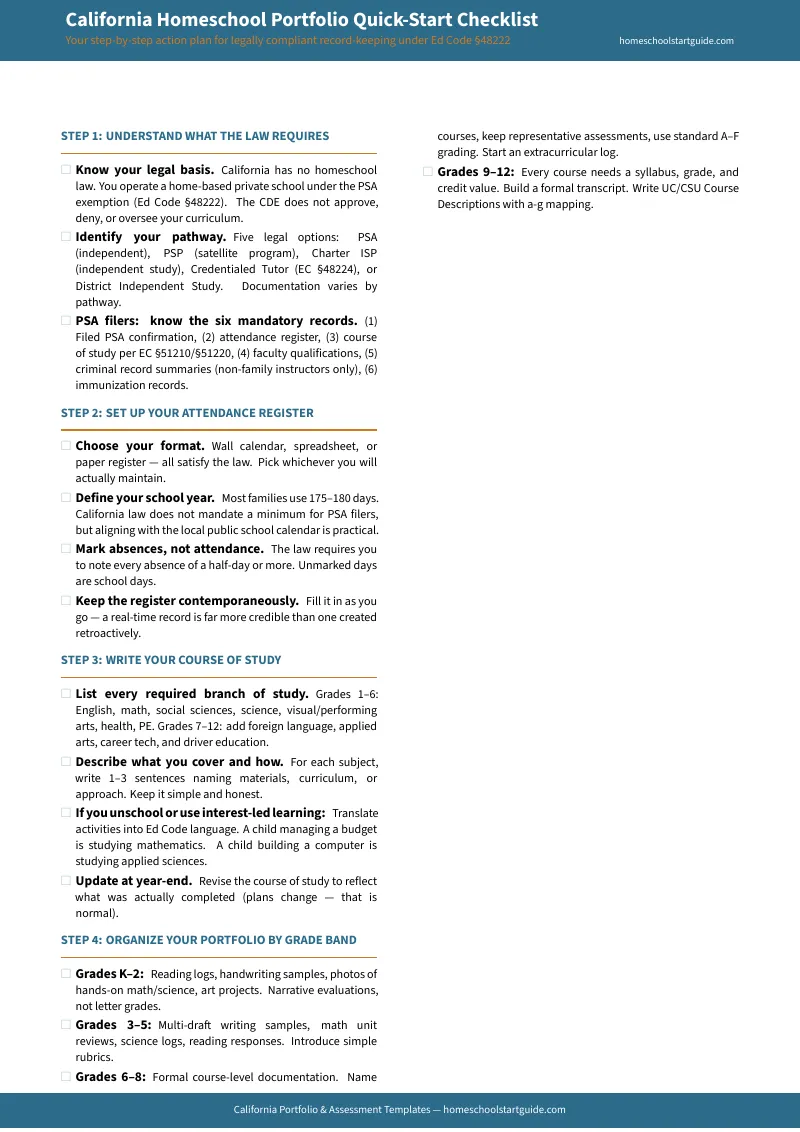
Not ready for the full system? Download the free California Homeschool Quick-Start Checklist — a step-by-step action plan covering the six legal requirements, how to set up your attendance register, how to write your course of study, and what you do NOT need to waste time on. It's enough to get oriented, and it's free.
Your homeschool is legal. Your documentation should prove it — to the state, to universities, and to yourself. The Portfolio System makes that straightforward.