Launch Your California Micro-School Without Triggering AB5 Fines, Truancy Violations, or Zoning Enforcement.
California is the best state in the country for micro-school formation — and the most dangerous to get wrong. No teacher credential requirement. No state testing. No curriculum approval. The PSA filing is a notification, not a permission request. But California also has AB5 employment law, which means hiring a tutor for your pod without proper classification can cost you $5,000 to $25,000 in state penalties. It has LiveScan background check mandates for every adult with unsupervised access to children. It has metro-specific zoning ordinances in LA, SF, San Diego, Sacramento, and San Jose that can shut down a home-based school with a single complaint. And it has SB 277 vaccination requirements that apply to multi-student PSA filings but not single-family ones — a distinction most parents discover too late.
You want to gather three or four families, share the teaching load, and build something that fits your children — whether you're a Bay Area tech parent who sees education as a system to optimize, an LA parent priced out of $30,000–$50,000-per-year private schools, or a San Diego family formalizing the pandemic pod that's been running since 2020. Whatever the reason, you've arrived at the same conclusion: I need to build this myself.
The problem is that California's regulatory landscape is a patchwork of state education codes, aggressive labor laws, and local municipal ordinances — and the internet gives you fragments. The CDE tells you how to file a PSA but provides zero guidance on running a school. HSC explains the difference between a PSA and a PSP but is geared toward single-family homeschoolers, not multi-family pods. CHEA focuses on faith-based families. Prenda charges $219.90 per student per month. Acton Academy demands $15,000–$20,000 upfront plus 3% of your gross revenue in perpetuity. You need the operational playbook without the institutional overhead and without surrendering your tuition to a network.
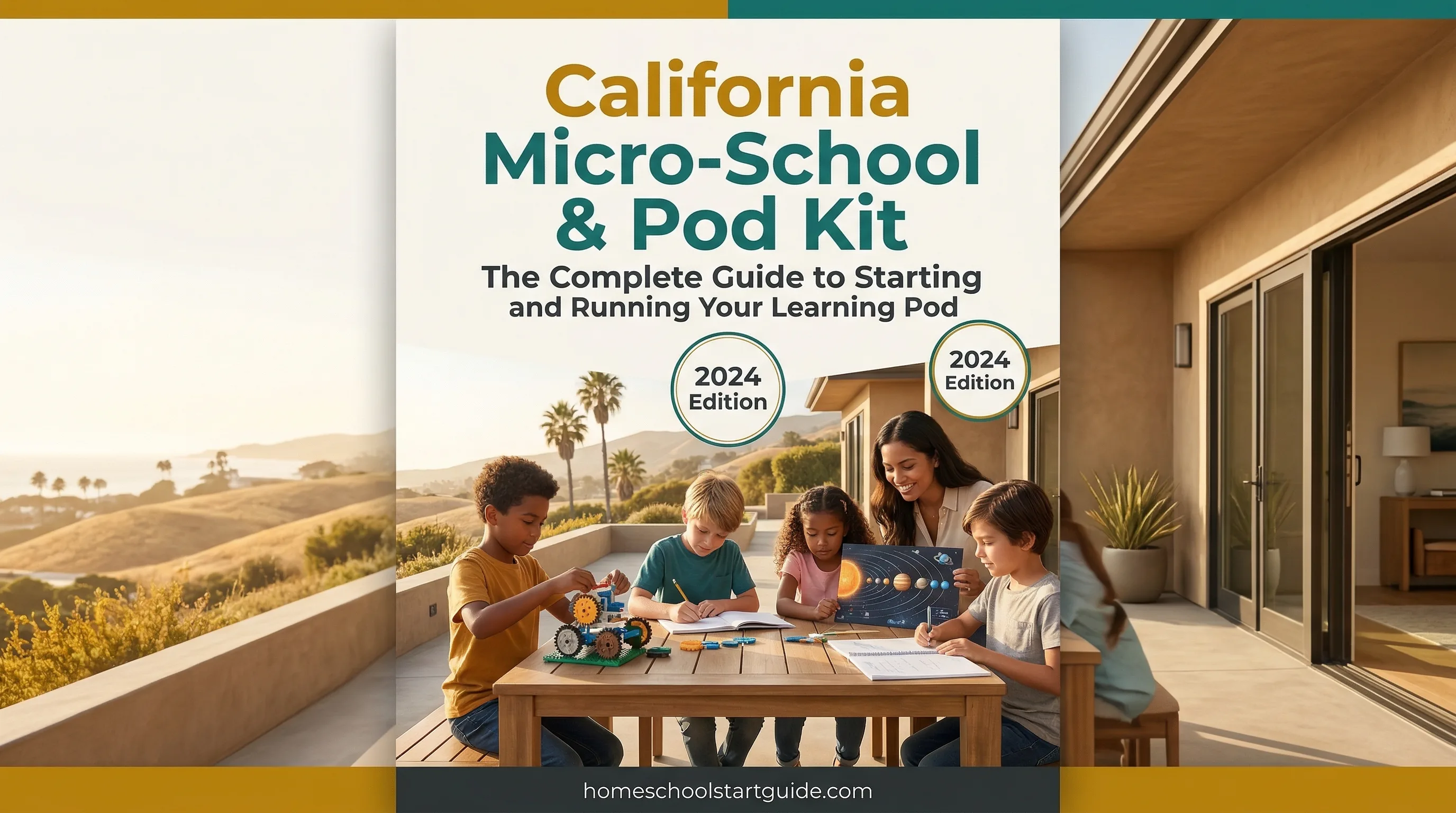
The California Micro-School & Pod Kit is that playbook — the California Compliance Blueprint that translates AB5, PSA filing, zoning law, and LiveScan requirements into step-by-step action plans with templates you can execute this week.
What's Inside the Kit
The Five-Pathway Legal Framework
California doesn't have a "micro-school" category. Your pod operates under one of five existing legal pathways: single-family PSA (maximum privacy, SB 277 vaccine exemption), multi-student PSA (required when charging tuition), Private School Satellite Program (PSP umbrella for families who want administrative support), charter school independent study (state-funded but politically vulnerable), or the credentialed tutor pathway under EC §48224. This section walks you through each option with a plain-English decision tree so you choose the right structure — and understand what each choice means for tuition, taxation, vaccinations, and your exposure to state oversight.
The AB5 Employment Law Compliance Guide
This is the section no other micro-school resource covers — because no other resource is California-specific. When four families pool money to hire a teacher, that teacher is an employee under AB5's ABC test unless very specific conditions are met. The referral agency exemption under Labor Code Section 2777 provides a narrow path to lawful independent contractor status — but only if the tutor sets their own rates, holds their own business license, develops their own curriculum, and operates through a formalized referral contract. This chapter explains the ABC test, the exemption requirements, and gives you a compliance checklist so you structure the relationship correctly from day one — instead of discovering the rules during a $25,000 audit.
Metro Zoning Guides for LA, SF, San Diego, Sacramento, and San Jose
Zoning is the most common way micro-schools get shut down in California's major metros. A neighbor complaint triggers an inspection, the city discovers an unpermitted educational use, and the pod closes overnight. This section covers the specific zoning classifications, conditional use permit requirements, and home occupation permit rules in each of the five major metro areas — plus the critical threshold: home-based pods under six students generally avoid zoning scrutiny, while larger operations in commercial or church spaces need explicit educational-use zoning. Knowing your zone before you sign a lease prevents the single most common operational failure.
LiveScan, Insurance, and SB 277 Compliance
Every adult with unsupervised access to children who are not their own must complete DOJ LiveScan fingerprinting ($20–$75 per person). This chapter walks you through the LiveScan process, provider selection, timeline expectations, and the connection between background checks and abuse/molestation insurance coverage. It covers the four insurance types your pod needs (commercial general liability, abuse and molestation, workers' compensation if hiring staff, and why your homeowner's policy will not protect you). And it explains SB 277 vaccination requirements — specifically, the exemption that applies to home-based private schools filing individual PSAs but not to multi-student PSA schools.
Family Agreements, Liability Waivers, and Enrollment Forms
Customizable templates covering schedule, tuition and cost-sharing, curriculum authority, health and illness policies, behavioral expectations, dispute resolution (mediation before litigation), and withdrawal terms. Written from scratch without religious language or ideological prerequisites. These are the documents that prevent the most common reason pods collapse — undefined expectations between adults. Every participating family signs before the first day.
Budget Planning for California's High-Cost Environment
Real California benchmarks: space rental ($500–$1,500/month for a church classroom or community center), liability insurance ($57–$150/month), curriculum ($200–$800/student/year), and teacher compensation ($25–$60/hour depending on credentials and metro area). Plus cost-sharing formulas for equal-split, per-child, and sliding-scale models — with worked examples showing how a 6-student pod in the Bay Area splits $18,000–$24,000 in annual expenses to achieve a 6:1 student-teacher ratio at a fraction of private school tuition.
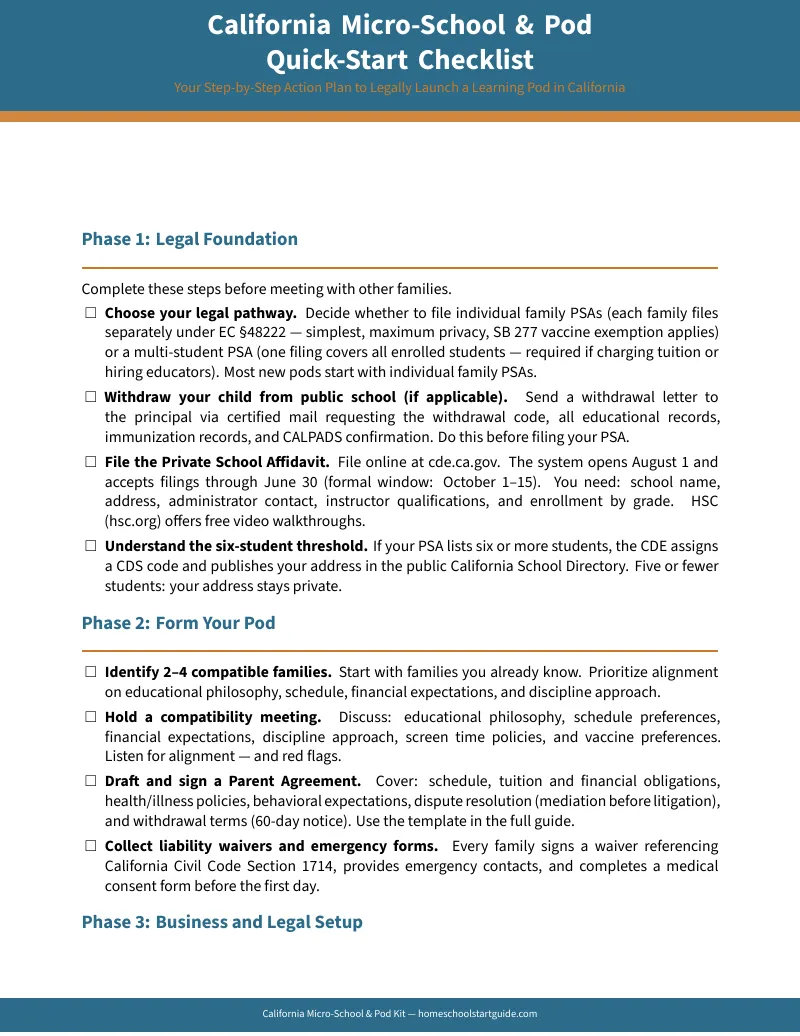
The California Micro-School Quick-Start Checklist
A single-page, print-and-pin sequencing document that walks you from "I have an idea" to "the first day of pod school" — covering legal foundation, pod formation, business and legal setup, facility and safety, curriculum and schedule, and launch week in the correct order. Most parents spend forty or more hours assembling this sequence from scattered CDE pages, HSC guides, and Facebook groups. This checklist condenses it to a single reference.
Who This Kit Is For
- Parents who want to form a small learning community of 3–8 students with two to four families — sharing the teaching load, splitting costs, and building something intentional rather than defaulting to institutions that don't fit
- Bay Area and Los Angeles families priced out of elite private schools who want a high-quality 6:1 student-teacher ratio at a fraction of the $30,000–$50,000 annual tuition those institutions charge
- Post-COVID pod families who've been running an informal arrangement since 2020 and need legal structure, proper insurance, and a real agreement between families before something goes wrong
- Charter school families threatened by AB 84 and SB 414 funding cuts who need the PSA pathway as an escape hatch from politically volatile NCB charter programs
- Parents of neurodivergent children (autism, ADHD, dyslexia, gifted) who are exhausted by IEP advocacy and want a calmer, self-paced environment designed around their child's needs
- Bilingual families building Spanish-English or Mandarin-English dual-immersion micro-schools — leveraging California's Prop 58 flexibility and English Learner Roadmap outside the public system
- Tech-industry parents applying startup thinking to education — building the school they wish existed, with project-based learning, maker-space integration, and outdoor education in California's year-round climate
- Military families near Camp Pendleton, Edwards AFB, or Travis AFB who need educational continuity that survives a PCS move
- Former educators leaving the public system who want to serve their community by running a small pod or micro-school — without the overhead and control of a franchise network
Why Not Just Use the Free Resources?
The California Department of Education tells you how to file a PSA. HSC explains the difference between a PSA and a PSP. CHEA serves faith-based families. Here is exactly what you run into when you try to build a multi-family pod from those sources alone:
- The CDE is an administrative portal, not an operational guide. It lists the 11-step PSA filing process and explicitly warns that filing does not mean the state "approves" or "endorses" your school. It provides zero templates for attendance tracking, immunization records, background checks, or the record-keeping mandated by Education Code Sections 51210 and 51220. The state requires compliance but abandons you on implementation.
- HSC is built for single-family homeschoolers. Their PSA filing walkthroughs are excellent, but their resources, language, and support structures are geared toward one family in one home. They don't offer family agreements, cost-sharing frameworks, AB5 compliance guidance, or liability waiver templates — all of which are essential when multiple families share space, money, and children.
- Generic Etsy planners are legally dangerous in California. A $7 "Homeschool Planner" from Etsy tracks daily rhythms and curriculum schedules. It provides zero guidance on AB5 worker classification, LiveScan requirements, metro zoning ordinances, or the SB 277 vaccination distinction between single-family and multi-student PSAs. Using one gives you the aesthetic of organization without the substance of compliance.
- Franchise networks withhold the operational details deliberately. Prenda, Acton Academy, and Wildflower webinars are top-of-funnel marketing. The granular how — the legal structuring, AB5 compliance, budget templates, zoning navigation — is the product they sell for thousands per year plus a perpetual share of your revenue.
Free resources give you the legal baseline and the inspiration. The Kit gives you the templates, checklists, and compliance frameworks to execute this week.
— Less Than One Hour with a California Business Attorney
A single consultation with a California small business attorney costs $150–$600 per hour. A single AB5 worker misclassification penalty starts at $5,000 per violation and can reach $25,000. Prenda charges $219.90 per student per month in platform fees. Acton Academy franchise startup fees range from $15,000 to $20,000 — plus 3% of your gross revenue, forever. The Kit costs less than a single attorney consultation and gives you the AB5 compliance framework, PSA filing guide, zoning references, family agreements, and liability waivers those alternatives are designed to sell piecemeal.
Your download includes the complete 24-chapter guide with 4 appendices, the Quick-Start Checklist, and standalone printable templates — the Family Agreement, Liability Waiver, and Withdrawal Letter. Instant download, no account required.
30-day money-back guarantee. If the Kit doesn't give you the legal clarity and operational confidence to move forward with your pod, email us and we'll refund you. No questions asked.
Not ready for the full Kit? Download the free California Homeschool Quick-Start Checklist — a one-page summary of the five legal pathways, PSA filing requirements, and the key California-specific regulations that affect your pod from day one. It's enough to understand your rights tonight.
California doesn't require teacher credentials, state testing, or curriculum approval for private schools. The law is on your side. The Kit makes sure you use it correctly.