
The EFA Compliance Blueprint: Launch Your Arkansas Learning Pod with Legal Confidence and a Complete Operational Framework.
Arkansas eliminated virtually every barrier to alternative education. The LEARNS Act made every K–12 student universally eligible for an Education Freedom Account — roughly $6,800 per student per year deposited into a ClassWallet digital account. The only formal homeschool requirement is filing an annual Notice of Intent with your local superintendent by August 15. No curriculum approval. No mandatory testing. No portfolio submissions. Arkansas is now one of the simplest states in the country to form a micro-school. But then the legislature passed Act 920 (Senate Bill 625), capping extracurricular and transportation spending at 25% of EFA funds — and nobody has explained what that means for your pod's budget. Until now.
You want to gather three or four neighborhood families, share the teaching load, and build something that actually fits your children. Maybe you're a NW Arkansas parent working remotely for one of the corridor's major employers and you're craving community for a child who's been learning alone at the kitchen table. Maybe you're in Little Rock and you've been priced out of every private school worth considering. Maybe you're in a rural county where the nearest alternative school is an hour's drive. Maybe the LEARNS Act lit a fire under you — $6,800 per child is real money, and you want to pool it with other families instead of handing it to Prenda for $2,199 per student per year. Whatever the reason, you've arrived at the same conclusion: I need to build this myself.
The problem is that Arkansas has two distinct legal pathways — and the internet gives you fragments. The Arkansas Department of Education defines home instruction and private schools in dense statutory language but doesn't explain how five parents sharing a facilitator in a living room fits into the framework. AHEM and the Education Alliance provide excellent homeschool rights information but are built for single-family homeschoolers, not multi-family pods. Prenda charges $2,199 per student per year in platform fees. Generic Etsy templates sell $12 "Pod Agreements" that contain zero Arkansas-specific language and know nothing about Act 920, the 75/25 spending rule, or the "majority of instruction" threshold that determines whether your pod is a homeschool co-op or an unaccredited private school.
The Arkansas Micro-School & Pod Kit — the EFA Compliance Blueprint — is that operational framework.
What's Inside the EFA Compliance Blueprint
The Two-Pathway Decision Framework
Because choosing the wrong legal pathway means filing paperwork you don't need, hiring credentialed staff you can avoid, or accidentally operating an unaccredited private school when a simpler option exists. Arkansas has two distinct legal pathways for group instruction — Home Instruction (ACA §6-15-501 through §6-15-507, each family files an NOI independently, maximum flexibility, no teacher certification required) and Unaccredited Private School (triggered when a hired facilitator delivers the majority of instruction across core subjects, requiring separate registration and compliance). This section walks you through each with a plain-English decision tree — including the critical "majority of instruction" test that determines which side of the line your pod falls on — so you choose the right structure before your first meeting.
The Act 920 EFA Budget Compliance Guide
Because spending 30% of your pooled EFA funds on transportation and field trips triggers a state audit — and no blog post, Facebook group, or Etsy template explains the new 75/25 rule. Act 920 (Senate Bill 625, passed 2025) caps extracurricular, transportation, PE, and field trip spending at 25% of each student's EFA funds. The remaining 75% must go to core academics: curriculum, tuition, direct instruction, tutoring, and testing. This section gives you a per-student budget tracking framework so you stay compliant without a spreadsheet meltdown — plus the exact ClassWallet expense categories that count toward each side of the split.
Family Agreement and Liability Waiver Templates
Because the most common reason pods collapse isn't bad curriculum — it's undefined expectations between adults about money, scheduling, and what happens when someone wants to leave mid-year. Customizable templates covering cost-sharing, curriculum authority, health policies, behavioral expectations, dispute resolution, and withdrawal terms. Written without religious language or ideological prerequisites. Every participating family signs before the first day — and Arkansas's LLC liability protections mean your personal assets stay separate from the pod's obligations.
EFA Vendor Application Walkthrough
Because the ADE's 40-page Family Handbook is written in dense legalese that tells you what to submit but never how a grassroots group of parents should actually organize a business entity, run background checks, or structure a non-discrimination enrollment policy. This section translates the vendor application into a plain-English checklist: business registration, employee fingerprinting, educator qualification documentation, norm-referenced testing plan, and the non-discrimination enrollment statement — with the exact sequence and the common mistakes that delay approval.
Facilitator Hiring and Background Check Guide
Because hiring someone to teach other people's children without running the correct background checks isn't just risky — it disqualifies your pod from EFA participation entirely. Arkansas requires three separate checks before a facilitator has any student contact: Arkansas State Police criminal records (~$25), Child Maltreatment Central Registry through DHS (~$10), and FBI fingerprint-based national check through Fieldprint (~$40, mandatory for EFA providers). This section covers exactly how to run the checks, how to classify facilitators correctly (W-2 vs. 1099 — misclassification carries IRS penalties), and real Arkansas pay benchmarks so you can budget accurately.
Budget Planning with Real Arkansas Numbers
Because splitting costs "evenly" between a family with three children and a family with one sounds fair until the first invoice arrives — and financial resentment is the second most common reason pods dissolve. Real Arkansas benchmarks for space rental ($250–$800/month for a church classroom, $8–$18/sq ft annually for commercial), liability insurance ($1,000,000 CGL at $1,500–$3,500/year), curriculum ($200–$600/student/year), and facilitator compensation ($30,000–$42,000/year depending on region). Plus cost-sharing formulas for equal-split, per-child, and sliding-scale models — with worked examples showing how a 6-student pod costs a fraction of private school tuition while each family retains 100% of their EFA funds.
The Arkansas Pod Launch Checklist
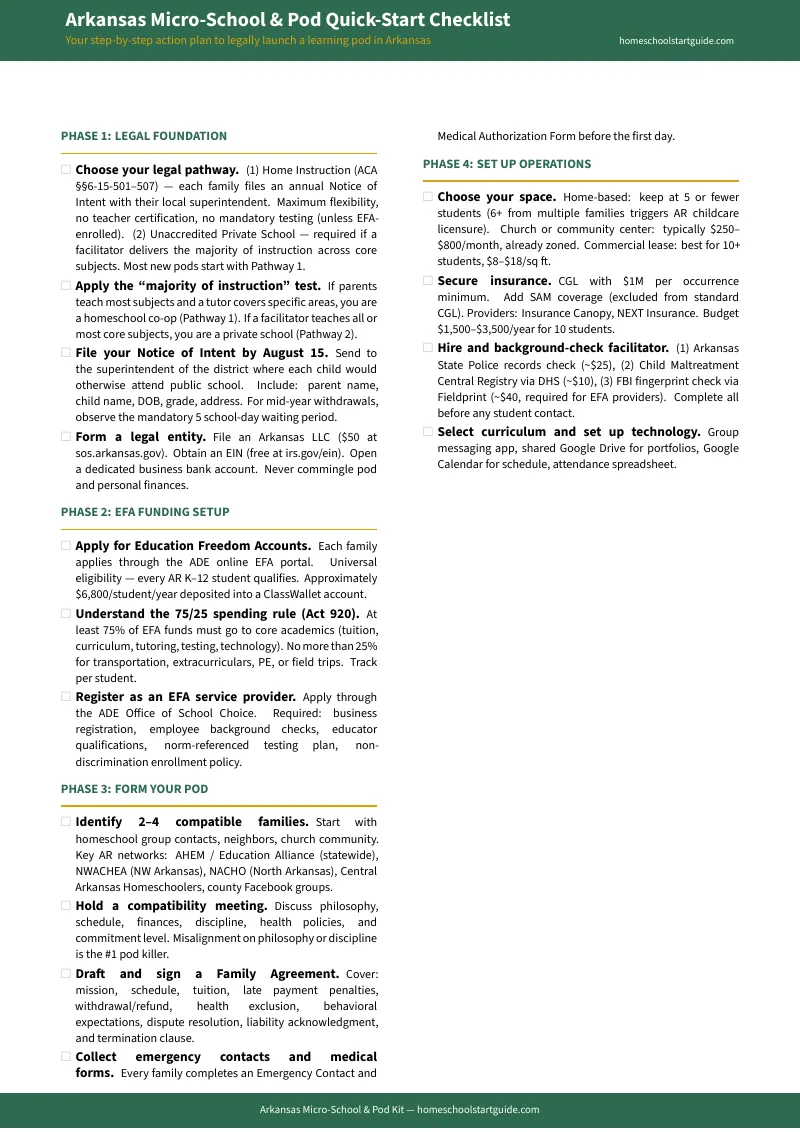
Because most parents spend forty-plus hours stitching together the launch sequence from ACA statutes, ADE portal instructions, AHEM guides, and scattered Facebook threads — and still aren't sure they got the order right. A single-page, print-and-pin document that walks you from "I have an idea" to "the first day of pod school" — covering legal foundation, EFA funding setup, pod formation, operations, curriculum, staffing, and launch week in the correct sequence.
Who This Kit Is For
- Parents who want to form a small learning community of 3–8 students with two to four families — sharing the teaching load, splitting costs, and building something intentional rather than defaulting to institutions that take a cut of your EFA funds
- NW Arkansas families (Fayetteville, Bentonville, Rogers, Springdale) who want a high-quality small-group learning environment without surrendering $2,199/student/year to Prenda's platform fees or paying private school tuition that EFA funds can't fully cover
- Current homeschoolers who find solo teaching unsustainable after two or three semesters and want to share facilitation with other families without losing control of their child's education
- Little Rock, Fort Smith, and Jonesboro parents who've been priced out of private school or underwhelmed by public school options and want to pool EFA funds with compatible families for a shared learning environment
- Parents of neurodivergent children (autism, ADHD, dyslexia, twice-exceptional) who need a calmer, self-paced environment with a small group that actually accommodates their child — and want to use EFA funds to pay for it
- Faith-based families who want to build a Christ-centered pod with a like-minded community — using the same legal and operational templates as secular pods, with full curriculum autonomy
- Rural Arkansas parents in the Ozarks, Delta, or Ouachita regions who lack nearby private school options and want to create a pod that brings quality education to their community — even if the nearest co-op is an hour away
- Former educators who want to serve their community by running a small pod or micro-school — without the overhead and control of a Prenda, KaiPod, or Acton franchise
After Using the Kit, You'll Be Able To
- Choose the right legal pathway for your pod — Home Instruction for maximum flexibility or Unaccredited Private School for formalized group instruction — using the two-pathway decision framework and the "majority of instruction" test instead of guessing
- Track every dollar of your EFA spending against the Act 920 75/25 rule with a per-student budget framework that keeps you compliant and audit-proof — without hiring an accountant
- Run your first parent meeting using a signed family agreement and liability waiver that protects every family in the pod — without spending $200+ on an education attorney consultation
- Navigate the EFA vendor application with the exact documents, sequence, and common mistakes — so you can access state funding without the bureaucratic paralysis that stops most parents before they start
- Hire a facilitator with the correct Arkansas background checks (State Police, DHS Child Maltreatment Registry, FBI Fieldprint), proper W-2 classification, and competitive pay benchmarks — avoiding the liability and IRS issues that sink underprepared pods
- Access public school sports and extracurriculars for your pod's students through the Tim Tebow Law (Act 303) — including the 365-day enrollment rule and the exact notification process for your local school district
- Build a budget that every family agrees on — using real Arkansas cost benchmarks for your specific region and a cost-sharing formula that prevents resentment and financial surprises
Why Not Just Use the Free Resources?
The ADE provides EFA documentation. AHEM explains homeschool rights. Facebook groups share experiences. Here is exactly what you run into when you try to build a pod from those sources alone:
- The ADE's 40-page Family Handbook is written for administrators, not parents. It tells you that EFA providers must pass background checks, maintain non-discrimination policies, and administer norm-referenced testing. It does not tell you how to form an LLC, open a business bank account, run three separate background checks on a facilitator, or structure a multi-family tuition agreement. The tone is regulatory and punitive — designed to audit compliance, not guide pod formation.
- AHEM and the Education Alliance are built for single-family homeschoolers. Their NOI guidance, testing exemptions, and Tim Tebow Law resources are excellent for traditional homeschooling. They offer virtually zero guidance on multi-family legal structures, EFA vendor applications, cost-sharing models, facilitator contracts, or the zoning complexities of running a group learning environment in a residential home. The operational gap between "one family files an NOI" and "five families pool EFA funds and hire a facilitator" is where parents need the most help — and neither organization covers it.
- Generic Etsy templates are legally dangerous in Arkansas. A $12 "Learning Pod Agreement" from Etsy gives you a three-page contract written for a different state — no Arkansas-specific legal guidance, no two-pathway distinction, no Act 920 budget framework, no "majority of instruction" threshold explanation. Most Etsy micro-school kits don't even know the LEARNS Act exists, let alone the 2025 spending restrictions that changed how every Arkansas pod must manage its EFA funds.
- Franchise networks withhold the operational details deliberately. Prenda, KaiPod, and Acton Academy webinars give you the vision. The granular how — the legal structuring, budget templates, scheduling frameworks — is what they sell for $2,199–$11,000+ per student per year in platform fees and tuition. And they take a cut of your EFA funds in the process.
- Facebook groups are well-meaning but legally unreliable. Parents in Arkansas homeschool groups routinely confuse the minimal requirements of a standard NOI with the rigorous requirements of an EFA-funded service provider. They share advice that predates Act 920 and the universal EFA expansion. Following crowd-sourced legal guidance that doesn't distinguish between a homeschool co-op and an unaccredited private school is how parents end up on the wrong side of a state audit.
Free resources give you the legal baseline and the inspiration. The EFA Compliance Blueprint gives you the templates, checklists, and decision frameworks to execute this week.
— Less Than One Hour with an Education Attorney
A single consultation with an Arkansas education attorney costs $150–$300 per hour. Prenda charges $2,199 per student per year in platform fees. The Kit costs less than a single attorney consultation and gives you the legal clarity, operational templates, and EFA compliance guidance those alternatives are designed to sell piecemeal.
Your download includes the complete 18-chapter guide, the Quick-Start Checklist, and standalone printable templates: a Family Participation Agreement, a Liability Waiver with emergency contact form, and a Facilitator Employment Contract. Instant download, no account required.
30-day money-back guarantee. If the Kit doesn't give you the legal clarity and operational confidence to move forward with your pod, email us and we'll refund you. No questions asked.
Not ready for the full Kit? Download the free Arkansas Homeschool Quick-Start Checklist — a one-page summary of the two legal pathways, the Act 920 EFA spending rules, and the key legal references that apply to your pod from day one. It's enough to understand your rights tonight.
Arkansas parents have the legal right to build this. The LEARNS Act funds it. The EFA Compliance Blueprint makes sure you build it correctly.