
Launch Your Arizona Micro-School Without Losing Your ESA Contract, Triggering Zoning Enforcement, or Surrendering Your Funds to a Network.
Arizona gave you universal ESA eligibility. You have $7,000 or more per child sitting in your ClassWallet account. You know exactly what kind of education your child deserves — a small pod of four or five kids, a real curriculum you chose, a trusted facilitator in a neighbor's living room instead of a 35-kid classroom with a Chromebook. You've been dreaming about this for months.
But every time you sit down to actually start, the questions bury you. Can you file a homeschool affidavit if you're using ESA funds? (No — A.R.S. § 15-802 explicitly prohibits it, and getting this wrong can terminate your contract and force repayment of thousands in funds.) Will your city's zoning board shut you down if a neighbor files a complaint? What does ClassWallet actually need on an invoice before it stops sitting "in limbo" for eight weeks? Do you need an LLC? What kind of insurance? Does your facilitator need a fingerprint clearance card?
You've scrolled through Arizona ESA Facebook groups. You've gotten conflicting advice from traditional homeschoolers who resent ESA families. You've looked at Prenda and realized they'd consume your entire $8,000 allocation for a proprietary curriculum you didn't choose. You've considered KaiPod and discovered it costs $5,000–$10,000 per child per year — most of your ESA award — for a commercial storefront and a daily commute.
The Arizona Micro-School & Pod Kit is the ESA Compliance Blueprint that resolves every one of these problems in a single, sequential framework — the correct affidavit pathway, ClassWallet vendor setup, zoning defense scripts, and ready-to-use templates. No franchise fees. No corporate lock-in. No 60 hours of research across ADE handbooks, Facebook groups, and Reddit threads.
What's Inside the Kit
The ESA-Affidavit Paradox Resolver
This is the single most dangerous trap in Arizona micro-schooling — and almost no free resource addresses it correctly. A.R.S. § 15-802 explicitly prohibits families from filing a traditional Homeschool Affidavit while receiving ESA funds. If your families follow generic "file a homeschool affidavit" advice from a blog post or Facebook group, their ESA contracts can be terminated immediately. The kit explains the two legal pathways (Homeschool Cooperative vs. Private School Affidavit), tells you exactly which one to use based on whether your families have ESA accounts, and walks you through filing the correct affidavit with your county superintendent — step by step, in plain English.
The ClassWallet Vendor Blueprint
Parents describe ClassWallet as a "bureaucratic nightmare." Curriculum orders sit in limbo for six to eight weeks. Invoice rejections arrive without explanation. Direct-pay approvals stall indefinitely. The kit includes the exact invoice format that ClassWallet's reviewers approve — business name and address, invoice date and number, student's full name, itemized services with dates, and total charge. You also get the complete vendor registration walkthrough: LLC documentation, Facility Accreditation Attestation Form, W-9, and bank account setup — so your pod receives ESA payments directly without the delays that cripple underprepared founders.
Municipal Zoning Defense Scripts for Phoenix, Tucson, Mesa, and Pinal County
Arizona state law is friendly to micro-schools. Your city's zoning board probably is not. Phoenix Home Occupation Standards (Section 608.C.9) restrict non-resident employees and exterior signage. Tucson's Unified Development Code limits home occupations to 25% of building area. Mesa requires a General Business License. And Pinal County has attempted to enforce commercial acreage minimums on home-based pods — one founder lost a $5,000 property deposit before the enforcement was challenged. The kit includes pre-written defense scripts and template letters for addressing municipal zoning boards, HOA complaints, and neighbor concerns — because knowing what to say and what legal precedent to cite before anyone questions your right to operate is the difference between a pod that launches and one that dies in the planning stage.
Parent Agreements, Liability Waivers, and Facilitator Contracts
The most common reason parents never start a pod is fear of liability. A child gets hurt. A parent disagrees on curriculum. Without formal agreements, you are exposed. The kit provides customizable templates for family enrollment agreements, liability waivers (Arizona courts generally uphold parent-signed waivers on behalf of minors), emergency contact and medical disclosure forms, and facilitator contracts with correct W-2 vs. 1099 classification guidance. You also get practical guidance on commercial general liability insurance — policies typically run $400–$1,200 per year — so you open your doors with genuine legal protection, not a hope and a prayer.
The Complete 10-Step Launch Sequence
Not a vague "things to think about" list. A chronological execution plan: choose your legal pathway, form your LLC ($50 Arizona filing fee), get your EIN, file the correct affidavit, register as a ClassWallet ESA vendor, recruit compatible families through AFHE networks and Facebook groups, secure your space, clear municipal zoning and get insurance, select multi-age curriculum, and hire a facilitator (IVP Fingerprint Clearance Card, $67 + ~$29 LiveScan fee, 6–8 weeks processing). Each step includes the specific forms, websites, fees, and timelines you need — not just what to do, but when and in what order.
Budget Planning with ESA Revenue Modeling
Real Arizona benchmarks, not hypothetical numbers. Micro-schools typically charge $5,000–$8,000 per student annually — within the standard ESA award — so families pay nothing out of pocket. The kit includes a budget planning framework showing how to model revenue based on pod size, tuition structure, and ClassWallet payment cycles. Covers cost-sharing cooperatives vs. tuition-based business models and the tax implications of each — so you know your pod's financial model is sustainable before you recruit a single family.
Prenda vs. KaiPod vs. Independent: The Honest Comparison
Prenda consumes roughly $8,000 per child in ESA funds and locks you into their proprietary curriculum — parents complain about the math program forcing overly complex multi-step processes while neglecting foundational memorization, and the reading curriculum relying on sight-word methods rather than phonics. KaiPod charges $5,000–$10,000 annually and requires a daily commute to a commercial storefront. The kit gives you the honest breakdown so you can decide: join a network and trade autonomy for convenience, or build your own pod and keep 100% of your ESA funds for the curriculum, therapies, and enrichment your child actually needs.
Beyond Launch: Dual Enrollment, University Admissions, and Scaling
Dual enrollment at Maricopa and Pima community colleges for free or ESA-funded college credit. Transcripts, diplomas, and admissions pathways to ASU, University of Arizona, and NAU. Neurodivergent learner integration for students with higher ESA tiers averaging $17,800+. Bilingual English/Spanish models for Arizona's large bilingual community. Faith-based micro-school frameworks. And a scaling roadmap from a 3-family pod to a 15-student academy — because the best pods grow, and you should know how to grow yours without breaking the legal structure you built.
Who This Kit Is For
- Parents with ESA funds who want to deploy them on their own terms — not surrender $8,000 per child to Prenda's proprietary curriculum or $5,000–$10,000 per child to KaiPod's commercial storefronts, but keep 100% of the allocation for the specific materials, therapies, and enrichment their children actually need
- Solo homeschoolers who've hit the wall — the kitchen table was supposed to be liberating, but it became isolating, exhausting, and unsustainable alongside work and family. You want the shared responsibility of a pod without surrendering autonomy to a franchise network
- Parents paralyzed by the legal complexity — conflicting advice about affidavits, ESA compliance, and zoning from Facebook groups and traditional homeschoolers who resent ESA families. You need someone to lay out the exact steps in the correct order so you stop researching and start building
- Parents of neurodivergent children whose IEP process failed — your child's ESA award is higher (potentially $17,800+) and you know a small, self-paced, sensory-friendly environment would transform their educational experience. You need the operational framework to create it
- Former educators ready to build something better — you left the classroom because you know what good teaching looks like. You want to open a micro-school professionally, with proper ESA vendor status, insurance, and legal structure — not as a side project held together by Facebook advice
- Phoenix metro and Tucson families (Scottsdale, Gilbert, Chandler, Mesa, Tempe, Surprise, Peoria, Goodyear) who are priced out of private school but refuse to settle for overcrowded public classrooms — and now have ESA funds to build the alternative themselves
Why Not Just Use the Free Resources?
The Arizona Department of Education publishes the ESA Parent Handbook. AFHE runs support group directories. Facebook groups share advice. Here is exactly what you run into when you try to build a multi-family pod from those sources alone:
- The ADE ESA Handbook is a compliance document, not an operational guide. It lists approved spending categories and prohibitions but provides zero templates for ClassWallet invoicing, vendor registration, parent agreements, or the record-keeping that prevents audit flags. The state requires compliance but abandons you on implementation.
- AFHE is built for traditional, autonomous homeschoolers. Their support group directories are excellent, but they explicitly state that co-ops should supplement home teaching, not replace it. They provide zero guidance on hiring facilitators, ESA vendor registration, cost-sharing frameworks, or liability protection — all essential when multiple families share space, money, and children. And the traditional homeschool community is often openly hostile to ESA-funded families.
- Generic Etsy planners are legally useless in Arizona. A $7 "Homeschool Planner" from Etsy tracks daily rhythms and curriculum schedules. It provides zero guidance on the ESA-affidavit paradox, ClassWallet vendor registration, municipal zoning defense, or the IVP Fingerprint Clearance Card requirements for facilitators. Using one gives you the aesthetic of organization without the substance of compliance.
- Prenda and KaiPod withhold the operational details deliberately. Their webinars are top-of-funnel marketing. The granular how — the legal structuring, ClassWallet invoicing, budget templates, zoning navigation — is the product they sell for thousands per year while consuming your ESA funds and dictating your curriculum.
Free resources give you the legal baseline and the inspiration. The Kit gives you the templates, blueprints, and compliance frameworks to execute this week.
— Less Than One ClassWallet Invoice Rejection Costs You
A single ClassWallet invoice rejection can delay your pod's ESA funding by eight weeks. Filing the wrong affidavit can terminate your ESA contract entirely — forcing repayment of thousands in funds. A Prenda enrollment consumes $8,000 per child per year in ESA funds for a curriculum you didn't choose. A municipal zoning violation in Phoenix or Tucson can shut down your pod overnight. The Kit costs less than an hour of an Arizona education attorney's time and gives you the ESA compliance framework, ClassWallet vendor blueprint, zoning defense scripts, and legal templates those alternatives are designed to sell piecemeal.
Your download includes the complete 24-chapter guide, the Quick-Start Checklist, and standalone printable templates — the Parent Agreement, Liability Waiver, ClassWallet Invoice Template, Facilitator Contract, Compliance Calendar, and Legal Reference Sheet. Instant download, no account required.
30-day money-back guarantee. If the Kit doesn't give you the legal clarity and operational confidence to move forward with your pod, email us and we'll refund you. No questions asked.
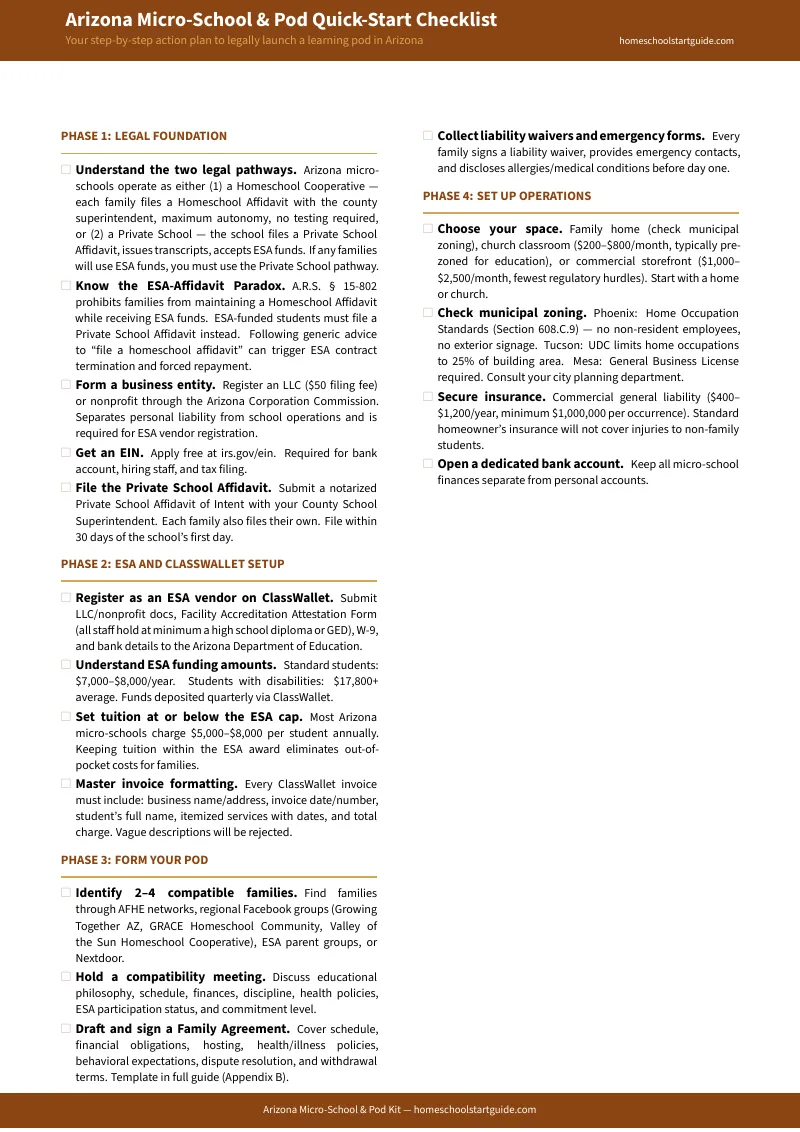
Not ready for the full Kit? Download the free Arizona Homeschool Quick-Start Checklist — a one-page summary of the two legal pathways, ESA-affidavit paradox warning, and the key Arizona-specific regulations that affect your pod from day one. It's enough to understand your rights tonight.
Arizona doesn't require teaching credentials, state testing, or curriculum approval. ESA funding is universal. The law is on your side. The Kit makes sure you use it correctly.