Build Your Alaska Micro-School Legally, Affordably, and Without a Franchise.
Alaska's AS §14.30.010 gives parents the right to homeschool with zero state testing, zero curriculum approval, and zero teacher qualifications — just a notice to your local school district or DEED. That framework is why Alaska is one of the most deregulated homeschool states in the country, and why micro-schools and learning pods are surging in Anchorage, the Mat-Su Valley, Fairbanks, and Juneau. But the moment you invite children from a third household and take on the majority of their instruction, you inadvertently create an exempt private school under AS §14.45.100 — triggering a notarized Affidavit of Compliance, a 180-day school calendar, standardized testing for grades 4, 6, and 8, and corporal punishment policy filings. The state website never mentions "micro-school" or "learning pod." And the ongoing Alexander v. Teshner litigation has every correspondence program parent terrified about whether pooling their $2,700–$4,500 IDEA or Raven allotment into a shared pod will survive the next court ruling.
You want to pull together three or four families in your area, share the teaching load, and build something that works for your children. Maybe you are enrolled in IDEA or Raven and burning out on solo homeschooling — the allotment covers curriculum, but nobody teaches alongside you during the dark winter months. Maybe you are a military spouse who just PCS'd to JBER or Eielson and need a learning community that survives the next set of orders. Maybe you live in the Mat-Su Valley or Fairbanks and your children have not interacted with other kids since October because temperatures hit -30°F and the sun sets at 3 p.m. Maybe you are in a rural or bush community where the nearest co-op is a bush plane ride away and you need a pod that works with the families you have. Maybe you looked at Prenda's $2,199 per-student platform fee and Acton Academy's $20,000 licensing fee and decided you would rather keep the money, the allotments, and the autonomy. Whatever the reason, you have arrived at the same conclusion: I need to build this myself.
The problem is that the internet gives you fragments. DEED talks about "exempt private schools" and "correspondence programs" — it does not explain how three families can legally share a living room without filing a notarized affidavit. APHEA fiercely defends your right to homeschool but does not provide multi-family contracts, winter scheduling templates, or allotment pooling strategies. Facebook groups in Alaska Homeschool Community and Mat-Su Homeschoolers confidently declare that pods need no insurance, that the 3-household rule is a myth, and that IDEA allotments can be spent however you want — until the audit letter arrives. You need an Alaska Pod Founder's Playbook — the complete operational framework without the dangerous legal guesswork, the franchise costs, or the Lower 48 assumptions.
The Alaska Micro-School & Pod Kit is that Pod Founder's Playbook.
What's Inside the Pod Founder's Playbook
The Four Pathways Legal Framework — Option 1 vs. Option 4
Because the single most dangerous assumption in Alaska micro-schooling is that the state's minimal homeschool requirements extend to group learning. Alaska recognizes four non-public education pathways: independent homeschool (Option 1, the zero-paperwork path), certified private tutor (Option 2), correspondence program enrollment (Option 3), and exempt private school (Option 4). As soon as one parent or guide accepts majority instructional responsibility for children from three or more households, the operation legally becomes an Option 4 exempt private school — requiring a notarized Affidavit of Compliance, a corporal punishment policy, a 180-day school calendar, and standardized testing at grades 4, 6, and 8. The guide walks you through the exact criteria that distinguish a group of cooperating homeschool families from an unregistered private school, so you choose the right legal structure before your first family meeting — not after DEED contacts you.
The Correspondence Allotment Integration Guide
Because IDEA, Raven, FOCUS, Galena IDEA, CyberLynx, and Mat-Su Central provide $1,500 to $4,500 per student annually — and most pod founders have no idea whether they can legally pool those funds for shared space, tutors, and curriculum. The guide explains exactly how allotments work, what correspondence programs approve, what they prohibit, and how to structure pod expenses so allotment spending survives the compliance review your advisory teacher conducts each semester. It addresses the Alexander v. Teshner litigation directly — what the 2024 Supreme Court ruling preserved, what the active 2026 discovery phase means for allotment recipients, and how to build defensively compliant budgets that separate pod-related expenses from allotment-funded purchases.
The Municipal Zoning Matrix — Anchorage, Fairbanks, Juneau, and Mat-Su
Because operating a learning pod from your home in Anchorage under Title 21 has different rules than operating one in Fairbanks North Star Borough, Juneau CBJ, or the unincorporated Mat-Su Valley. The guide maps zoning considerations for Alaska's major municipalities: how many children trigger commercial use classification, when you need a conditional use permit, the 12-student threshold that separates a residential home occupation from a commercial operation in most Alaska boroughs, and which institutional alternatives (churches, community centers, public libraries) eliminate residential zoning risk entirely.
The Winter Operations and Extreme Weather Framework
Because every national micro-school guide tells you to build a "forest school" and "embrace outdoor learning" — advice that will get someone hurt when it is -40°F with 4 hours of daylight in January. The guide provides Alaska-specific winter scheduling templates that account for reduced daylight, extreme cold weather cancellation protocols, indoor activity rotations that prevent cabin fever across weeks of indoor confinement, and strategies for maintaining pod continuity when roads are impassable. This chapter is why national templates are useless in Alaska and why this kit exists.
The Family Agreement and Liability Templates
Because a child breaking a wrist in your Wasilla living room should not end the pod — and it will not, if you are prepared. Customizable parent agreements covering educational philosophy, schedule, tuition, attendance, behavior, conflict resolution, withdrawal, weather cancellation policies, and media privacy. Plus a liability waiver with indemnification, medical consent, and emergency contact forms. A facilitator contract for W-2 or 1099 educators with Alaska-specific employment terms. Every family signs these before day one. These are not generic Etsy templates — they are written for the specific legal context of Alaska home education under AS §14.30.010.
The Alaska Budget Planner and Cost-Sharing Models
Because running a pod with hired help in Anchorage costs nothing like running one from a cabin outside Fairbanks. Budget templates covering facilitator compensation (Alaska wages, not Lower 48 benchmarks), space rental, curriculum materials, insurance, field trips, and winter-specific costs — with real Alaska cost data by region. Includes cost-sharing models for 3-family, 5-family, and 8-family pods, allotment-offset calculations showing how correspondence program funds reduce out-of-pocket costs, and a tuition calculator that accounts for Alaska's high cost of living.
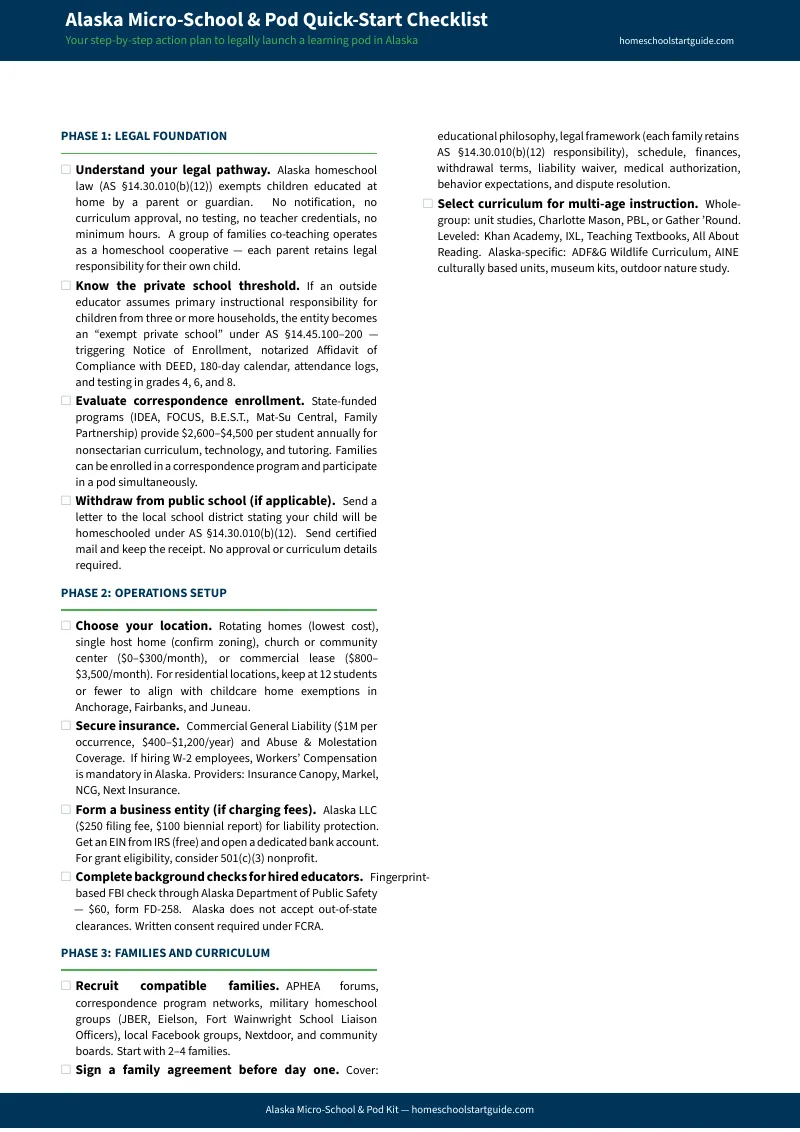
The Alaska Pod Launch Checklist
Because most parents spend forty-plus hours assembling the launch sequence from DEED forms, APHEA resources, correspondence program handbooks, and contradictory Facebook posts. A single-page, print-and-pin document that walks you from "I have an idea" to "the first day of pod school" — covering the legal, operational, financial, and community formation steps in the correct order, with Alaska-specific thresholds and legal references at every step.
Who This Kit Is For
- Solo homeschoolers who have reached the burnout threshold and need a shared-responsibility model where the instructional and social burden is distributed among trusted families — without losing control of your child's education or accidentally creating an unregistered private school
- Correspondence program families enrolled in IDEA, Raven, FOCUS, or Galena IDEA who want to pool resources, share instruction, and build community while staying compliant with allotment rules and the current litigation landscape
- Military families at JBER, Eielson AFB, and Fort Wainwright who need a learning community that survives PCS rotations — with transient membership structures, mid-year entry protocols, and portable documentation that transfers cleanly to the next duty station
- Mat-Su Valley and interior Alaska parents whose children lose months of socialization every winter because there is nobody to interact with when the temperature is -30°F and the nearest co-op meets once a week in Anchorage
- Rural and bush community families where geographic isolation makes solo homeschooling lonely for both children and parents — and a pod of even three families transforms the educational experience
- Alaska Native families interested in incorporating traditional knowledge, indigenous languages, subsistence activities, and elder participation into a group learning environment outside the district model
- Parents of neurodivergent children (autism, ADHD, dyslexia, giftedness, 2e) who are exhausted by inadequate services and want a small-group environment designed around their child's actual needs
- Former educators who want to serve their community by running a small paid micro-school — without the $20,000 Acton Academy licensing fee, Prenda's $2,199 per-student extraction, or KaiPod's revenue share
After Using the Kit, You'll Be Able To
- Understand Alaska's four non-public education pathways and know exactly when a multi-family pod crosses the threshold from cooperating homeschool families (Option 1) into exempt private school territory (Option 4) — and what compliance obligations that triggers
- Structure your pod to stay under the 3-household threshold or confidently navigate the Option 4 requirements — Affidavit of Compliance, 180-day calendar, standardized testing, corporal punishment policy — if you choose to scale beyond it
- Layer pod participation on top of your IDEA, Raven, or FOCUS correspondence enrollment without violating allotment rules — and build defensively compliant budgets that survive advisory teacher reviews and the current Alexander v. Teshner litigation
- Choose the right space for your pod based on your municipality's zoning rules — home, church, community center, or commercial — and know the thresholds that separate a permitted home gathering from a prohibited commercial operation in Anchorage, Fairbanks, Juneau, and the Mat-Su Valley
- Run your first parent intake meeting using a signed Family Agreement and liability waiver that protects every family in the pod — without spending $300 on an Alaska education attorney
- Hire and background-check an educator legally under Alaska statutes, classify them correctly for employment taxes, and pay them competitively using real Alaska wage data
- Operate your pod through Alaska's extreme winters with scheduling templates, weather cancellation protocols, and indoor activity frameworks designed for months of reduced daylight and subzero temperatures
Why Not Just Use the Free Resources?
DEED is the legal authority. APHEA has decades of advocacy. The correspondence programs provide allotments and curriculum advisors. Facebook groups have thousands of Alaska parents trading advice. Here is exactly what you run into when you try to build a pod from those sources alone:
- DEED speaks bureaucratic, not parent. The Alaska Department of Education and Early Development website talks about "exempt private schools" and "correspondence study programs" — it has never used the words "micro-school" or "learning pod." A parent searching DEED for instructions on starting a pod finds the Affidavit of Compliance form, corporal punishment policy requirements, and standardized testing mandates for grades 4, 6, and 8. No step-by-step guidance on forming a multi-family learning community that stays under the private school threshold.
- APHEA gives you advocacy but not operations. The Alaska Private and Home Educators Association is the state's most important voice for homeschool rights and actively defends families against regulatory overreach. But APHEA does not provide multi-family formation guides, allotment pooling templates, winter scheduling frameworks, or the operational playbooks that define the post-2020 micro-school movement.
- Correspondence programs provide money, not community. IDEA gives you $2,700 and a curriculum advisor. Raven, FOCUS, and Galena IDEA provide similar allotments. What none of them provide is a framework for pooling those resources across families, sharing instructional duties, or building the multi-family community that prevents the burnout that solo correspondence families report year after year.
- Facebook groups are an echo chamber of contradictory legal advice. Parents in Alaska Homeschool Community and Mat-Su Homeschoolers confidently claim that the 3-household private school threshold does not exist (it does — AS §14.45.100), that IDEA allotments can fund anything (they cannot — each program has strict approved expense categories), and that zoning does not apply to home-based pods (it does in every Alaska borough). A parent who follows Facebook advice discovers the gaps when DEED contacts them, not before.
- Etsy templates are generic daily planners with a micro-school label. Canva templates and enrollment forms priced at $5–$24 on Etsy and TPT. Not one references AS §14.30.010, the Option 4 exempt private school requirements, correspondence allotment pooling rules, municipal zoning in Anchorage or Fairbanks, or extreme weather operations. They help you organize a schedule. They do not help you form a legally protected pod in Alaska.
- Prenda and Acton solve the problem — and take your autonomy and allotments. Prenda charges $2,199 per student per year in platform fees — which consumes nearly all of a family's IDEA allotment for the privilege of running a pod Prenda controls. Acton Academy charges a $20,000 licensing fee plus 3% annual revenue. Both require you to recruit the families, find the space, and build the community yourself. If you are doing the hard work of building local trust in Alaska, you should keep 100% of the revenue and 100% of the curriculum control.
Free resources give you the inspiration and the legal baseline. The Pod Founder's Playbook gives you the templates, checklists, and frameworks to execute this week.
— Less Than 1% of a Single IDEA Allotment
A single student's IDEA correspondence allotment is $2,700. Prenda charges $2,199 per student per year. Acton Academy charges a $20,000 licensing fee. A consultation with an Alaska education attorney costs $200–$400 per hour. The Kit costs a fraction of any of these and gives you the operational independence those platforms are designed to prevent.
Your download includes the complete guide (25 chapters covering Alaska's four legal pathways, correspondence allotment integration with IDEA/Raven/FOCUS/Galena, the Alexander v. Teshner litigation, municipal zoning in Anchorage/Fairbanks/Juneau/Mat-Su, step-by-step setup from decision to first day, hiring educators with Alaska background checks, insurance and liability, curriculum design for multi-age groups with Alaska-specific content, winter operations and extreme weather planning, budget planning with Alaska cost data, family agreements and contracts, corporate structure, assessment and progress tracking, high school operations with transcripts and dual enrollment, neurodivergent learner pods, military family PCS-proof structures, Alaska Native cultural integration, franchise alternatives, scaling, finding families, remote and bush community pods, conversation scripts, tax implications, emergency preparedness, and resources), plus the Alaska Pod Launch Checklist and standalone printable tools: the Parent Participation Agreement, the Liability Waiver and Emergency Contact Form, the Facilitator Contract, and the Alaska Regional Budget Planner. Instant download, no account required.
30-day money-back guarantee. If the Kit does not give you the legal clarity and operational confidence to move forward with your pod, email us and we will refund you. No questions asked.
Not ready for the full Kit? Download the free Alaska Homeschool Quick-Start Checklist — a one-page summary of the legal framework under AS §14.30.010, the correspondence program landscape, the Option 1 vs. Option 4 distinction, zoning considerations, and the four-phase launch sequence. It is enough to understand your rights tonight.
Alaska gave you the legal freedom. The Pod Founder's Playbook makes sure you use it without accidentally creating an unregistered school.