The MOE Gives You the Exam Paper. This Blueprint Gives You the Answer Key.
You've made the decision. Your child is coming home — the bullying the school keeps minimising, the anxiety that's turned into full school refusal, the open-plan MLE classroom that leaves your neurodivergent child overwhelmed every single day. You know you need to withdraw. So you went to the Ministry of Education website.
That's where the confidence evaporated. "As regularly and as well as in a registered school." Certificate of Exemption under Section 38 of the Education and Training Act 2020. An educational plan covering eight learning areas. ERO reviews at six months. A four-to-six week processing period where your child is technically still enrolled at the school you're trying to leave. It reads like you need a teaching degree and a bureaucratic translator just to educate your own child.
Then you found a Facebook group. One parent says the MOE "approved in three weeks, no questions asked." Another says they were declined for mentioning deschooling. Someone tells you Te Kura is free. Someone else explains it costs $1,800 per subject unless your child is 16 or has severe psychological referrals. A parent advises you to keep sending your child to school during processing. Another says their truancy officer showed up at the door and threatened to call Oranga Tamariki.
You still don't know what to actually write in your exemption application, what "as regularly and as well" means in practice, or whether the school can legally stop you from leaving.
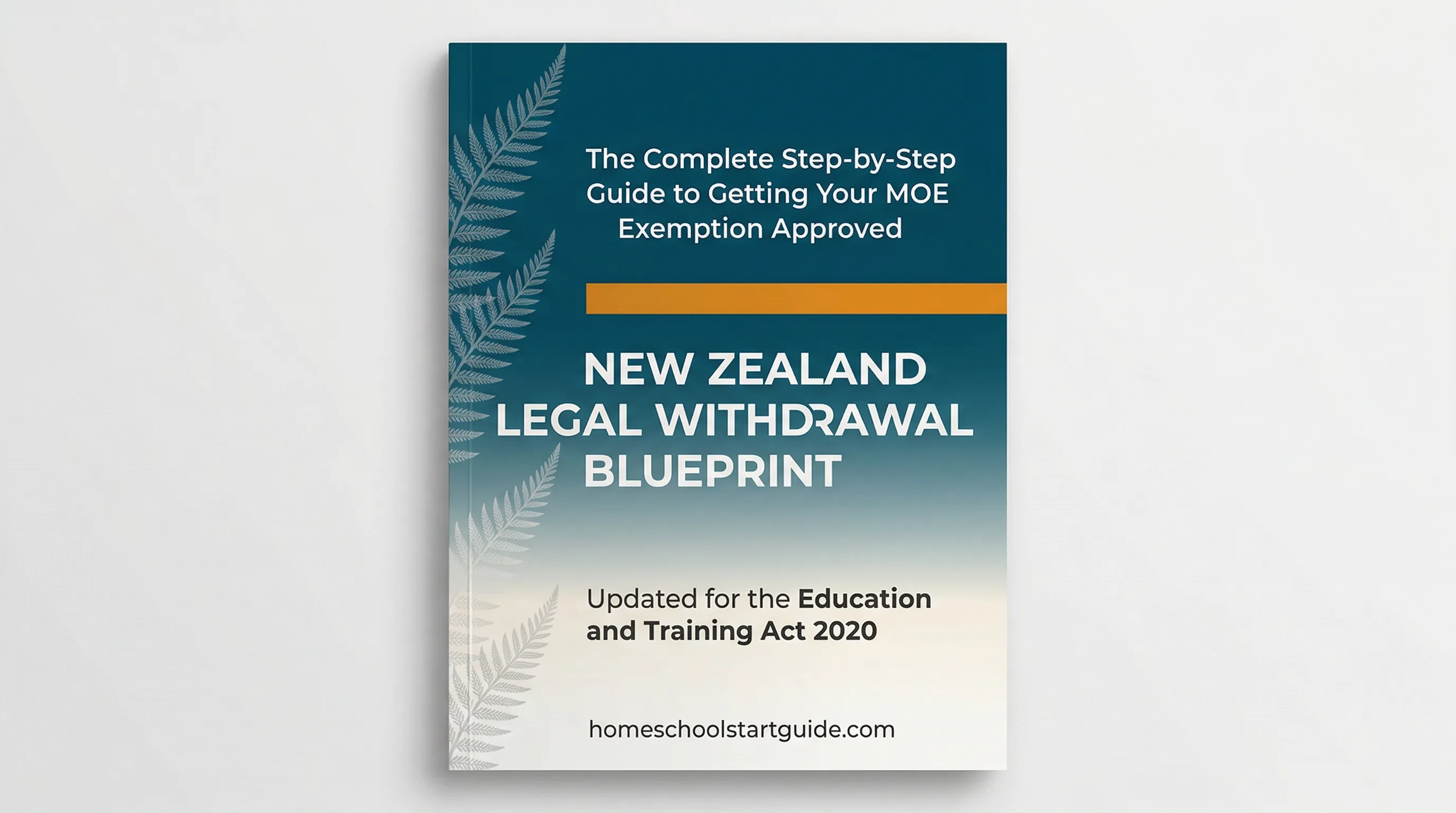
The New Zealand Legal Withdrawal Blueprint is a complete MOE Exemption System — every document, template, and strategy you need from the moment you decide to withdraw through exemption approval and beyond. Not a generic guide with a paragraph about New Zealand law. Every legal citation, every template, every strategy is specific to the Education and Training Act 2020 and the current MOE exemption process.
What's Inside the Blueprint
The MOE Exemption Application Walkthrough
The exemption application is not complicated — it's poorly explained. The Blueprint walks through every section of the MOE form, tells you exactly what the reviewer is looking for in each field, and flags the common mistakes that trigger clarification requests or outright declines. You'll complete the application confidently in one sitting, not three anxious drafts spread across two weeks of second-guessing.
The Educational Plan Builder
This is where most New Zealand parents freeze. The MOE requires an educational plan demonstrating your child will be taught "as regularly and as well as in a registered school" across eight learning areas — English, Mathematics, Science, Technology, Social Sciences, The Arts, Health and Physical Education, and Learning Languages. But the MOE website doesn't explain what that standard actually means in practice. The Blueprint provides educational plan outlines that satisfy the MOE whether you use a structured curriculum, Charlotte Mason, Classical, Steiner, Eclectic, or interest-led learning — and explains the difference between a plan that gets approved quietly and one that invites follow-up questions you don't want to answer.
The ERO Review Preparation Guide
The Education Review Office review generates more anxiety than any other part of the process — and almost none of that anxiety is warranted. The initial review typically happens at six months, with subsequent reviews at one-to-three year intervals. Reviews can be conducted by phone, video call, or at a location you choose. The Blueprint tells you exactly what reviewers are trained to assess, what they report, what they cannot require, and how to prepare your evidence so a review becomes a brief formality rather than a month of panic. Includes a pre-review checklist and an ERO "red flags" list — the phrases and concepts that historically trigger closer scrutiny.
The Withdrawal Letter Templates (Ready to Send)
Pre-written withdrawal letters customised for New Zealand state, state-integrated, and private schools — citing the correct provisions of the Education and Training Act 2020. Not blank templates you have to figure out — ready-to-personalise documents with clear instructions on what to include, what to leave out, and who to send them to. Email one tonight; the school is notified first thing tomorrow.
The Processing Period Strategy
Between submitting your MOE application and receiving your Certificate of Exemption, you face a four-to-six week processing period where your child is legally still enrolled at school. This gap is the period that causes the most legal anxiety for New Zealand parents — especially when the school environment is the very thing harming your child. The Blueprint explains exactly what protections apply, what to do if you receive truancy contact, and how to handle the situation when your child cannot safely continue attending.
The School Pushback Protocol
Some schools accept withdrawal letters without comment. Others demand meetings, threaten truancy reports, insist they need to "approve" your withdrawal, or warn you about Oranga Tamariki. The Blueprint includes email scripts for every common pushback scenario — the principal who insists on a face-to-face meeting, the school that won't release academic records, the attendance officer who implies legal consequences. Every script cites the relevant section of the Act so you respond with law, not emotion.
The Special Situations Section
Mid-year withdrawal timing. Neurodivergent children — autism, ADHD, dyslexia, PDA — and how to write an educational plan that reflects their needs without inviting scrutiny. Māori and Pasifika families incorporating tikanga, te reo, and cultural values into a plan the MOE will approve. Gifted children. Single-parent families. Military families. Migrants without permanent residency. Te Kura dual enrolment — how it works, what it costs, and when it makes sense. NCEA access via Te Kura or NZQA private candidacy. Cambridge exams. University Entrance from home education. The Blueprint covers every scenario the generic guides ignore because they're trying to cover all of Australasia in twenty pages.
Who This Blueprint Is For
- Parents withdrawing mid-year because their child is in crisis — bullying, school refusal, anxiety, unmet special needs — and who need to act this week, not after months of research
- Parents overwhelmed by the MOE exemption process who need someone to walk them through the application form, the educational plan, and the ERO preparation step by step
- Parents terrified of the "as regularly and as well" standard who don't know what it means in practice — and who need the exact phrasing that satisfies the MOE without turning their home into a replica classroom
- Parents of neurodivergent children — autism, ADHD, PDA, anxiety — who are exhausted by failed learning support and Modern Learning Environments that overwhelm their child daily
- Māori and Pasifika parents who want to incorporate cultural values, te reo, and tikanga into their child's education and need to frame that in language the MOE will approve
- Parents getting pushback from the school — demands for meetings, truancy threats, warnings about Oranga Tamariki — who need the exact legal language to shut it down
- Parents who tried to piece together the process from the MOE website, NCHENZ, and Facebook groups and ended up more confused than when they started
Why Not Just Use the Free Resources?
You can research New Zealand home education for free. The information exists. Here's what that process actually looks like:
- The MOE website. The authoritative source. It provides the application form and a guidance document outlining the requirements under Section 38. What it doesn't provide is a plain-English explanation of what "as regularly and as well" means in practice, how to write an educational plan that satisfies the reviewer without triggering follow-up questions, or honest preparation for an ERO review. The MOE's own feedback summary acknowledged their tone "makes people feel that by homeschooling you are doing something wrong." They are the regulator. They are not your advocate.
- NCHENZ. An excellent free organisation with valuable FAQs and community support. But due to their strict philosophical neutrality, they cannot provide a specific, optimised template. They officially advise parents to draft the application themselves and seek a paid consultant for review. Their resources are spread across dozens of web pages — helpful for browsing, overwhelming for a parent in crisis mode who needs to act this week.
- Facebook groups. High on lived experience, dangerously variable on accuracy. In the same thread, one parent says "just mention unschooling, the MOE doesn't care" and another warns it triggered an invasive ERO review. Parents routinely share advice based on the repealed 1989 Education Act — using the wrong legal references in your application can flag it immediately.
- Cynthia Hancox's guide. The legacy option at $50 NZD — 320+ pages of academically exhaustive documentation. Excellent for depth. Overwhelming for a parent who needs their child out of a harmful school by Friday, not a textbook to study over the next fortnight.
Free resources tell you the exemption process exists. The Blueprint walks you through every section of the application, every paragraph of the educational plan, and every stage of the ERO review.
— Less Than a Flat White a Day for a Week
A one-hour consultation with a private homeschool coach in New Zealand runs $60-$120 NZD — and they still expect you to write the application yourself. Cynthia Hancox's guide pack is $50 NZD. The MOE website has the forms but deliberately refuses to tell you how to fill them in. The Facebook groups will give you seventeen conflicting answers by lunchtime.
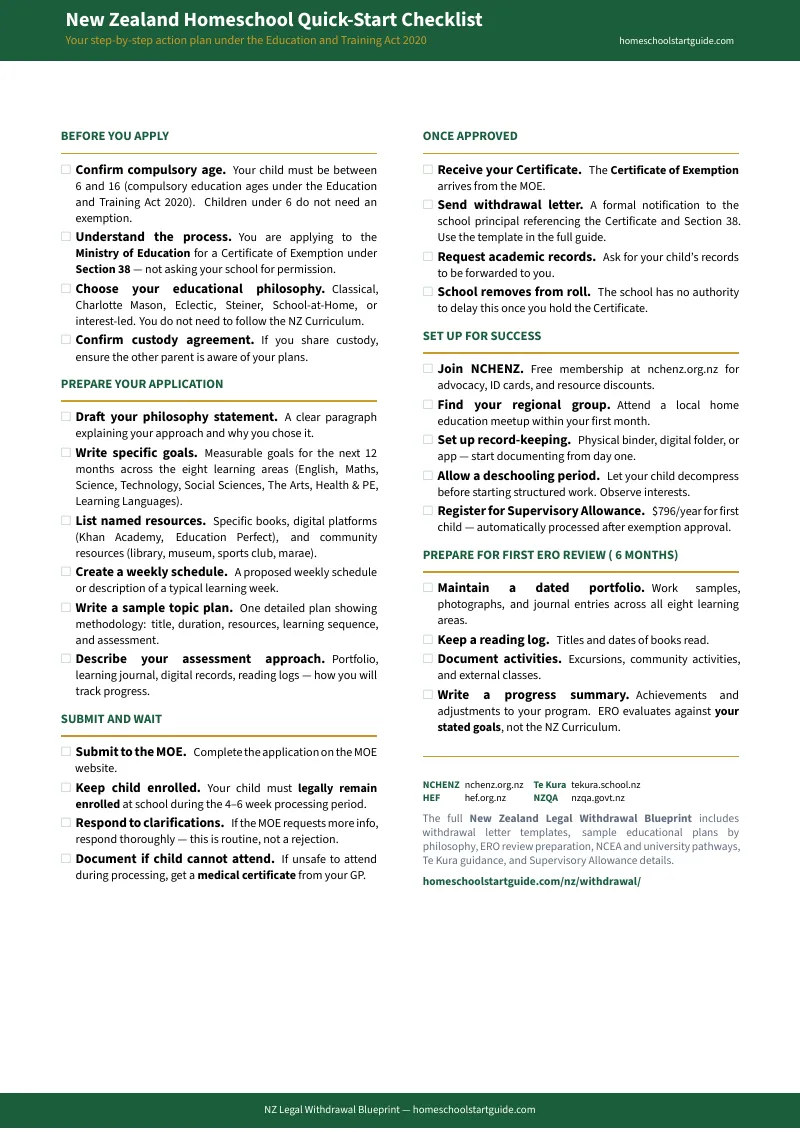
Your download includes the complete Blueprint guide (16 chapters), the New Zealand Homeschool Quick-Start Checklist, and five standalone printable PDFs you can use immediately:
- Withdrawal letter templates — ready-to-personalise letters for state, state-integrated, and private schools, citing the Education and Training Act 2020
- School pushback scripts — copy-paste email responses for when the school demands meetings, threatens truancy reports, or warns about Oranga Tamariki
- ERO review preparation guide — what the reviewer assesses, what they cannot require, your pre-review checklist, and confidence tips
- Educational plan samples — philosophy-specific outlines for Classical, Charlotte Mason, Eclectic, Steiner, School-at-Home, and interest-led approaches
- Quick reference card — what New Zealand requires and what it does not, key legal citations, the Supervisory Allowance, and qualification pathways on one printable page
The full guide also covers the MOE exemption walkthrough (every section of the application explained in plain English), your rights during the 4-6 week processing period, Te Kura dual enrolment, NCEA and Cambridge pathways, and university entrance for home-educated students.
Instant download, no account required.
30-day money-back guarantee. If the Blueprint doesn't give you the confidence and clarity to execute your withdrawal and get your exemption approved, email us and we'll refund you. No questions asked.
Not ready for the full Blueprint? Download the free New Zealand Homeschool Quick-Start Checklist — a printable overview of the MOE exemption process, the eight learning areas you need to cover, and the steps from withdrawal through your first ERO review. It's enough to understand your rights tonight. The full Blueprint is there when you're ready to act.
Over 11,000 New Zealand students are home educated across 6,500+ families — the highest number ever recorded. The MOE exemption process is administrative, not adversarial. You just need someone to walk you through it. That's exactly what this Blueprint does.