Your Child Needs Out of School Tomorrow. Tusla Terrifies You. Here's Your Entire Legal Exit Plan.
Your child is in crisis. The bullying hasn't stopped. The CAMHS waiting list is stretching into its second year. The school "can't accommodate" your child's needs — but expects them to keep showing up. Or you simply looked at what's being taught, how it's being taught, or by whom it's being taught, and decided there has to be another way.
You searched "can I take my child out of school in Ireland" and discovered that yes, Article 42 of the Constitution explicitly protects your right to educate at home. Good news. Then you discovered that Tusla — the Child and Family Agency — runs the registration process, sends an assessor to your home, and must speak directly to your child under the 2024 regulations. Suddenly the constitutional right feels more like a constitutional obstacle course.
The Ireland Legal Withdrawal Blueprint is a Tusla Registration & Assessment Survival System — a complete operational manual that walks you from the moment you decide to withdraw to the moment you sit across from a Tusla AEARS assessor and demonstrate, calmly and with evidence, that your child is receiving an education that exceeds the constitutional minimum. It includes every letter template, every form walkthrough, every assessment preparation strategy, and every legal citation you need to exercise your Article 42 right without a single sleepless night wondering whether you've triggered a welfare investigation.
What's Inside the Blueprint
Copy-Paste Withdrawal Letter Templates for Every School Type
National school. DEIS school. Gaelscoil or Gaelcholáiste. Catholic ethos school. Educate Together. Community National School. Each letter cites the correct sections of the Education (Welfare) Act 2000 and Department of Education Circular 0028/2013, tells the principal exactly what they must do (remove your child from the register), and makes clear that no meeting, discussion, or approval is required. Send it by registered post, keep the tracking receipt, and you're done with the school.
The R1 Form Walkthrough — Line by Line
The Tusla R1 application form is where most parents make their first mistake. Part B asks you to describe your "educational provision" — and anxious parents either overcommit to a rigid timetable they can't sustain, or write so little that the assessor requests a Comprehensive Assessment instead of a Preliminary one. The Blueprint walks you through every section: what to write, what to leave deliberately vague, how to describe non-traditional approaches in Tusla-acceptable language, and the critical Section 12 guardian consent requirement that trips up separated families.
The 2025 Child Interview Preparation Guide
This is the section no other resource in Ireland covers properly. Statutory Instrument No. 758 of 2024 legally mandates that the AEARS assessor must meet and speak directly to your child. Older blog posts, Facebook advice, and even HEN's archived guides may tell you the child doesn't need to be present — that advice is now wrong. The Blueprint provides age-appropriate preparation scripts, boundary-setting strategies for the visit itself, specific accommodations for autistic children, children with severe anxiety, and selectively mute children, and clear guidance on your rights to remain present, intervene, and choose a neutral venue.
The "Certain Minimum Education" Translation Templates
Tusla assesses whether your child is receiving a "certain minimum education" across moral, intellectual, physical, and social development. That phrase appears in the Constitution and the Education Act — but nobody tells you what it actually looks like in practice. The Blueprint provides modular educational plan templates that map any approach — structured curriculum, Charlotte Mason, Montessori, eclectic, or full unschooling — into the four-dimensional framework Tusla assessors are trained to evaluate. You fill in the blanks. The assessor sees exactly what they need to see.
School Pushback & EWO Defence Scripts
Some principals will tell you that you can't withdraw without the school's consent. Some will refuse to remove your child from the register. Some will contact the Educational Welfare Service before you've had time to file your R1 form. The Blueprint gives you the exact wording for every scenario — citing the specific legal provisions that override school-level resistance — so you never enter a meeting, phone call, or email exchange without knowing precisely what the law requires of them and of you.
The Gaeilge & Qualifications Decision Framework
Gaeilge is compulsory in recognised schools but not legally required for home-educated children — you do not need an "exemption" from anyone. However, omitting Irish closes the door to NUI university matriculation without a specific exemption application later. The Blueprint provides a structured decision tree for Irish, plus complete guidance on every qualification pathway: Leaving Certificate as an external candidate through the SEC, Junior Cycle external entry, IGCSEs, GCSEs, A-Levels, QQI/FETAC Level 5, and the CAO points conversion tables that turn these alternatives into university places.
SEN, Neurodivergent & Crisis Withdrawal Pathways
If your child has autism, ADHD, dyslexia, or school-induced anxiety, the standard withdrawal process needs adaptation. The Blueprint covers emergency withdrawal when your child physically cannot attend, how to handle ongoing CAMHS referrals during the transition, documenting adapted educational provision for Tusla assessors unfamiliar with neurodivergent learning profiles, and preparing a distressed child for the mandatory assessor interview without re-traumatising them.
Who This Blueprint Is For
- Parents who have decided to withdraw their child from an Irish school and need to know exactly how to do it legally — the letters, the forms, the timeline, and the Tusla registration process — without spending weeks piecing it together from scattered sources
- Families facing an imminent Tusla AEARS assessment who need to prepare documentation, understand what assessors look for, and handle the new mandatory child interview with confidence
- Parents of neurodivergent children — autism, ADHD, dyslexia, severe anxiety — who are withdrawing because the school system failed to provide adequate support, and need a trauma-informed withdrawal and assessment pathway
- Separated or divorced parents who need both guardian signatures on the R1 form and are facing resistance from a co-parent
- International families — EU/EEA expats, non-EU arrivals, temporary protection beneficiaries — who are unfamiliar with the Irish constitutional framework and Tusla's role, and need rapid, clear legal guidance
- Parents who have been consuming UK or US homeschool content and need to know what actually applies in the Republic of Ireland — because LEAs, standardised testing requirements, and HSLDA do not exist here
- Anyone who has been told by a school principal, a teacher, or a well-meaning relative that "you can't just take your child out of school" — and needs the legal proof that you absolutely can
Why Not Just Use the Free Resources?
You can. Tusla's website has the R1 form. Citizens Information has a summary of your rights. HEN Ireland's free pages cover the broad strokes. Facebook groups have hundreds of parents sharing their experiences. Here's what assembling it yourself actually looks like:
- 40+ hours of cross-referencing. Tusla's guidance documents are dense bureaucratic PDFs written by lawyers. Citizens Information gives you the law but not the templates. HEN's website is a sprawling repository — excellent for long-term community support, but not a linear, emergency-grade action plan. Facebook groups contain years of conflicting advice, outdated legal interpretations, and personal anecdotes that may not apply to your situation. You'll spend evenings trying to work out whether blog posts from 2019 still reflect the current rules — and most of them don't, because of S.I. No. 758/2024.
- No fill-in-the-blank templates. Tusla provides the blank R1 form but zero guidance on how to describe your educational provision in Part B. Nobody provides a legally sound withdrawal letter template that cites the correct Department of Education circulars. Nobody provides modular educational plan templates mapped to Tusla's four assessment areas. You're left drafting from scratch while your anxiety climbs.
- Outdated child interview advice. The 2024 mandatory child interview regulation is the most significant change to the Irish home education assessment process in over a decade. Forum advice, older guides, and even some association materials still reflect the pre-2024 reality where the child's involvement was minimal. Following this advice risks being blindsided during the assessment.
- No school-type-specific guidance. Withdrawing from a DEIS school involves different practical considerations than withdrawing from a Gaelscoil. Withdrawing a child mid-year triggers different attendance reporting obligations than withdrawing at the end of term. Free resources treat all withdrawals identically.
Free resources tell you that you have the right. The Blueprint gives you every letter, template, form walkthrough, and assessment strategy to actually exercise it — correctly, legally, and without triggering the Comprehensive Assessment that turns a straightforward process into months of additional scrutiny.
— Less Than One Hour of a Solicitor's Time
An education solicitor charges €200–€350 per hour. A single consultation to understand your withdrawal rights and Tusla obligations costs more than this entire Blueprint — and the solicitor won't give you fill-in-the-blank templates, assessment preparation strategies, or child interview scripts. HEN Ireland membership is €25/year and provides excellent long-term community support — but you still need to extract the tactical, step-by-step withdrawal process from scattered pages and archived guides.
The Blueprint includes the full 14-chapter guide plus 8 standalone printable PDFs — 9 files in total:
- The Complete Guide (14 chapters) — constitutional framework, Education Act obligations, R1 form walkthrough, withdrawal letter templates, minimum education templates, Tusla assessment process, child interview preparation, school pushback scripts, Gaeilge decision framework, exam and qualification pathways, SEN guidance, separated parent guidance, international family guidance, record-keeping, and re-enrolment
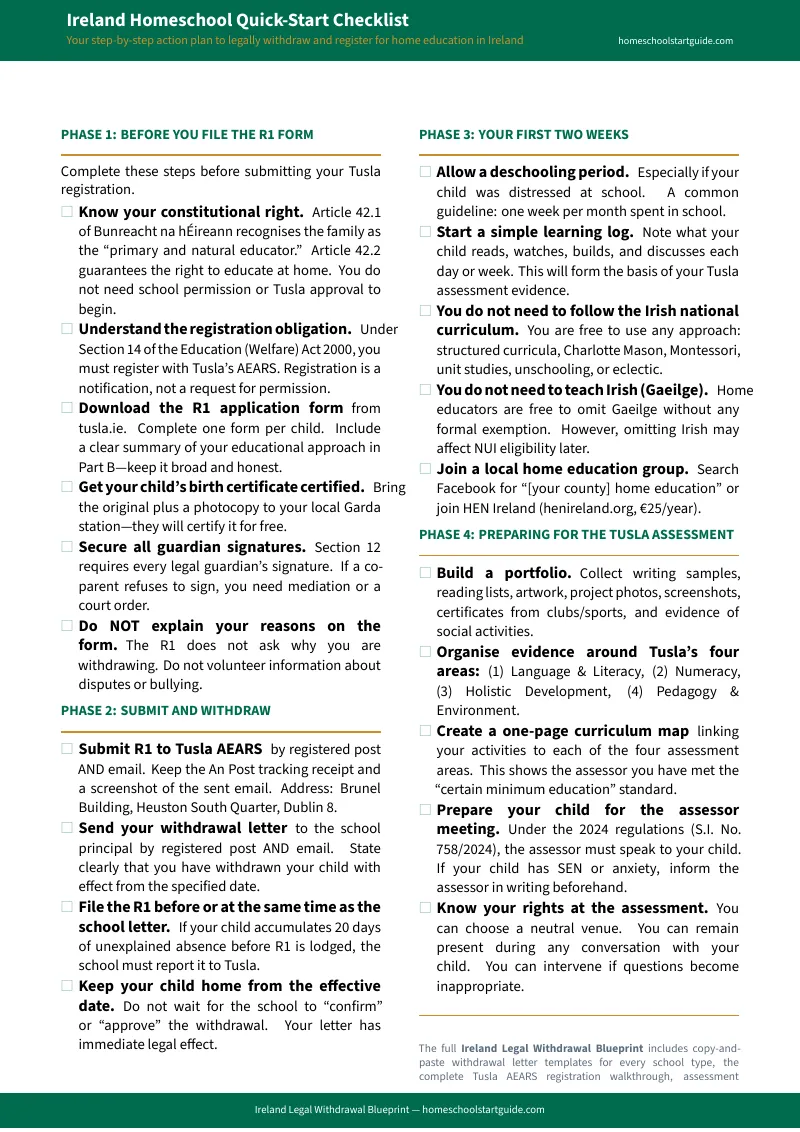
- Quick-Start Checklist — condensed action plan for families who need to act this week
- Withdrawal Letter Templates — ready-to-print letters for every school type
- R1 Form Companion — print alongside the Tusla R1 form and fill in section by section
- Child Interview Prep — 2025 mandatory assessment preparation with SEN accommodations
- Minimum Education Templates — fillable templates mapped to Tusla's four assessment areas
- School Pushback Scripts — copy-paste responses for every pushback scenario
- Record-Keeping Templates — weekly learning log, portfolio checklist, and curriculum mapping document
- First 30 Days Timeline — pin-up checklist from preparation through assessment readiness
Instant download, no account required.
30-day money-back guarantee. If the Blueprint doesn't give you the confidence and legal clarity to withdraw your child and navigate the Tusla process, email us and we'll refund you. No questions asked.
Not ready for the full Blueprint? Download the free Ireland Homeschool Quick-Start Checklist — a step-by-step action plan covering your constitutional rights, the R1 filing process, your first two weeks of home education, and Tusla assessment preparation. It covers the essentials, and it's free.
Your child's education is a constitutional right, not a privilege the school grants. The Blueprint makes sure Tusla, the school, and anyone else who questions your decision sees exactly how seriously you take it.