Your Child Is Learning Beautifully. Your Portfolio Doesn't Show It. Here's How to Fix That Before the Assessor Arrives.
Your child reads voraciously. Builds elaborate things. Asks questions that make you reach for the encyclopedia. You know the education is working — you can see it every day. But when you imagine sitting across from a Tusla AEARS assessor and having to prove it, your stomach drops. Because "certain minimum education" is a phrase in the Constitution that nobody has ever translated into "here's exactly what your portfolio should look like."
You've tried the Etsy templates. They want standardised test scores and attendance hours — neither of which exists in Irish law. You've read HEN's website. Excellent community, but their record-keeping advice amounts to "keep a diary" and "try ChatGPT." You've scrolled through Facebook groups where one parent passed with a shoebox of photographs and another was escalated to a Comprehensive Assessment for insufficient documentation. The advice is contradictory because the standard is subjective — and that subjectivity is precisely what terrifies you.
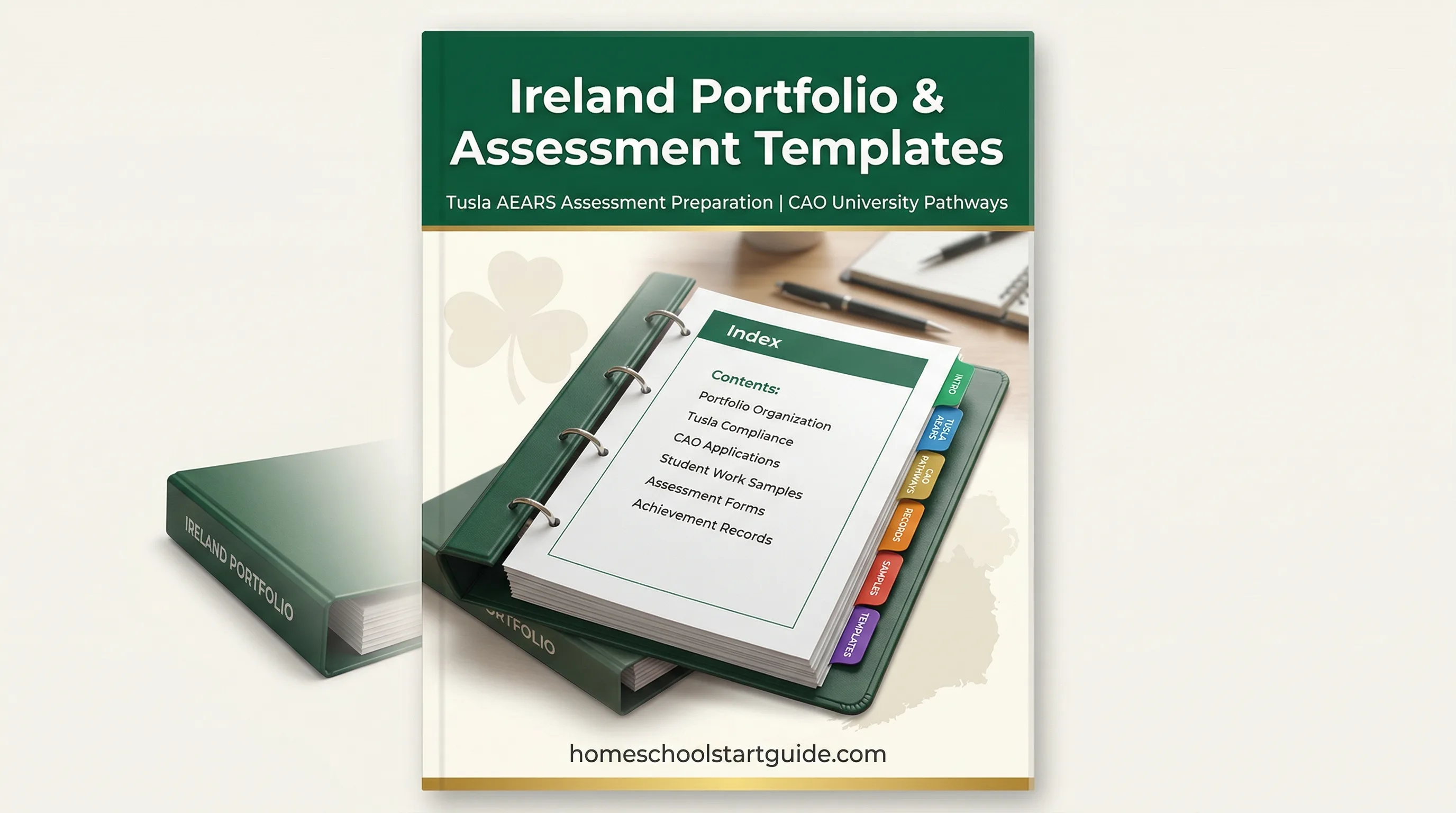
The Ireland Portfolio & Assessment Templates is an AEARS Documentation System — a complete portfolio architecture built around the exact five curriculum areas that Tusla assessors are trained to evaluate. It doesn't tell you what to teach. It gives you a fillable, structured framework that translates whatever your child is already doing — structured curriculum, Charlotte Mason, Montessori, Steiner, unschooling, or anything in between — into the precise documentation format that satisfies the "certain minimum education" standard. Nine templates. A 4-week assessment preparation timeline. And a weekly 15-minute habit that makes portfolio panic a thing of the past.
What's Inside
The Educational Philosophy Statement Template
This is the single most important page in your portfolio — and the one most parents agonise over. The template walks you through articulating your chosen approach in language that Tusla assessors understand, addressing how your philosophy covers all five curriculum areas without forcing you into a prescriptive box. Whether you follow Charlotte Mason's living books, Montessori's prepared environment, Steiner's developmental stages, classical education's trivium, or full autonomous learning, you'll produce a coherent one-page statement that frames your entire provision.
Portfolio Sections Mapped to the Five AEARS Assessment Areas
Tusla assessors evaluate your provision across five broad curriculum areas: language and literacy, numeracy and mathematical skills, physical development, social/emotional/moral development, and creative and aesthetic development. The guide provides a dedicated portfolio section for each area, with specific guidance on what evidence to include, how to annotate it, and what assessors are actually looking for. No more guessing which section a nature walk belongs in, or whether baking counts as numeracy.
The 15-Minute Weekly Documentation Habit
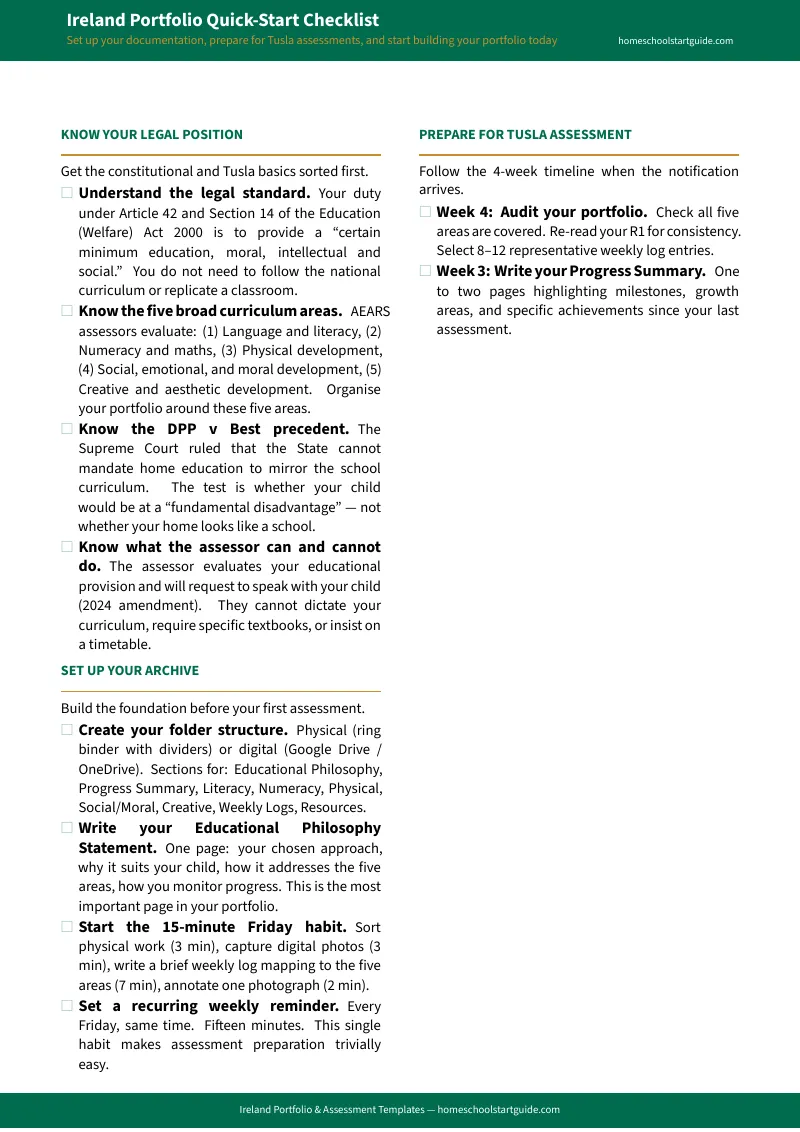
Every Friday, same time: sort physical work (3 minutes), capture digital photos (3 minutes), write a brief weekly log entry mapping that week's activities to the five assessment areas (7 minutes), annotate one photograph (2 minutes). That's it. Fifteen minutes a week eliminates the panicked multi-week reconstruction that most families attempt when the assessment notification arrives. The guide provides the exact log template and annotation format.
The 4-Week Assessment Preparation Timeline
When the Tusla notification arrives — after months or years on the waiting list — you need a structured countdown, not scattered advice. Week 4: audit your portfolio against all five areas. Week 3: write your progress summary. Week 2: prepare the physical environment. Week 1: prepare your child for the mandatory assessor conversation. Each week has specific actions, not vague suggestions.
The Cross-Curricular Activity Matrix
A single trip to the farmers' market covers numeracy (counting change), literacy (reading labels), social development (interacting with vendors), and physical development (walking). But how do you document it so the assessor sees all four dimensions? The matrix system shows you how to map any activity — baking, gardening, museum visits, Minecraft, building a treehouse — to multiple AEARS assessment areas, turning everyday life into documented evidence of a rich, multi-dimensional education.
Nine Fillable Templates
Educational Philosophy Statement. Weekly Documentation Log. Annual Progress Summary. Annotated Photograph Log. Reading Log. Resource and Materials Tracker. Qualification Tracker (post-primary). CAO Application Checklist. Assessment Visit Preparation Checklist. Each template is designed for the Irish context — no US attendance tracking, no UK Ofsted references, no irrelevant standardised test fields.
The CAO & Qualification Tracker (Ages 14+)
When your teenager approaches university age, the portfolio shifts from demonstrating "minimum education" to building a formal academic record. The guide covers every qualification pathway available to Irish home-educated students: Leaving Certificate as an external candidate through the SEC, Junior Cycle external entry, UK IGCSEs and A-Levels, QQI Level 5 (PLC route), and Open University credits. The CAO Application Checklist tracks deadlines, "Other School Leaving Qualifications" documentation, HEAR/DARE eligibility, and the 10-day postal deadline for supporting documents to Galway. University-specific guidance covers Trinity College Dublin, UCD, UCC, NUI Galway, DCU, and University of Limerick.
Who This Guide Is For
- Parents registered with Tusla who have an assessment approaching — whether it's your first preliminary assessment or a periodic review — and need a structured portfolio that covers all five curriculum areas without guesswork
- Families who received assessor feedback that documentation was insufficient or unclear, and need to rebuild their portfolio around the actual AEARS evaluation framework before the next visit
- Unschooling and eclectic families who know their children are learning constantly but struggle to translate organic, child-led activities into the structured evidence format that satisfies Tusla's "certain minimum education" standard
- Parents of teenagers (ages 14–18) who need to start tracking qualifications for CAO university entry — Leaving Certificate external candidate registration, IGCSE/A-Level scheduling, QQI Level 5 planning, HEAR/DARE documentation
- Newly registered families who submitted their R1 form and are now waiting for their first assessment, wanting to build good documentation habits from the start rather than scrambling later
- Parents of neurodivergent children — autism, ADHD, dyslexia — who need to document adapted provision and accommodations in ways that help the assessor understand the educational approach rather than question it
Why Not Just Use the Free Resources?
You can. HEN Ireland's website has record-keeping advice. Tusla's 2003 Guidelines document explains the legal standard. Facebook groups have parents sharing photos of what worked for them. Here's what assembling it yourself actually looks like:
- No pre-built structure. HEN recommends keeping a diary, using Evernote, or generating cross-curricular goals with ChatGPT. All valid approaches — but none of them gives you a portfolio architecture mapped to the five areas your assessor will actually evaluate. You're left designing the structure yourself, which means hours of formatting decisions when you should be documenting learning.
- Generic international templates miss Irish law entirely. Etsy's homeschool portfolio templates require standardised test scores and daily attendance hours — neither exists in Irish home education law. UK EHE templates omit the "moral and social development" tracking that Article 42 and the 2003 Guidelines specifically require. Adapting either for an AEARS assessment means reverse-engineering a document that was never designed for your legal context.
- Anecdotal advice is dangerous when the standard is subjective. An informal portfolio that sailed through assessment in rural Galway may trigger a Comprehensive Assessment escalation in Dublin — because different assessors exercise different "professional discretion." A framework built on the actual statutory requirements protects you regardless of which assessor arrives at your door.
- No CAO or qualification tracking. Free resources focus almost entirely on primary-aged children. When your teenager needs to register as an SEC external candidate, navigate the CAO "Other School Leaving Qualifications" process, or document HEAR/DARE eligibility, you're on your own. The guide covers every pathway with specific deadlines and document requirements.
Free resources explain the law. The guide gives you the execution — nine fillable templates, a weekly system, and a 4-week assessment countdown that turns scattered learning evidence into a portfolio no assessor can question.
— Less Than a HEN Membership
A HEN Ireland membership is €25/year and provides excellent community support — but you still need to build the portfolio yourself from scattered advice. An education consultant charges €100–€200 per session to help you prepare for an assessment. The SEC Leaving Certificate external candidate entry fee alone is €109–€116 per sitting. For less than any of these, you get a permanent documentation system that works for every assessment, every year, from your child's first registration to their CAO university application.
The guide includes the full 16-chapter manual (covering the legal framework, the AEARS assessment process, the 15-minute weekly habit, portfolio architecture for all five curriculum areas, documentation strategies for six educational philosophies, age-specific guidance from primary through post-primary, the 4-week assessment countdown, all nine fillable templates, the CAO qualification tracker, SEN documentation, and key organisation contacts), plus four standalone printables: the Quick-Start Checklist, the Portfolio Templates booklet (all nine templates ready to print and reprint), the 4-Week Assessment Timeline (pin it to your wall), and the Cross-Curricular Activity Matrix worksheets. Instant download, no account required.
30-day money-back guarantee. If the guide doesn't give you the structure and confidence to walk into your Tusla assessment fully prepared, email us and we'll refund you. No questions asked.
Not ready for the full guide? Download the free Ireland Home Education Quick-Start Checklist — covering your legal position, portfolio setup, assessment preparation steps, SEN documentation, and exam planning essentials. It covers the foundations, and it's free.
Your child's education is extraordinary. Your portfolio should make that undeniable — to Tusla, to universities, and to anyone who asks.