You Want to Build a Learning Pod in Ireland. The Law Wasn't Built to Help You. This Kit Was.
You're done going it alone. The solo home education grind — planning every lesson, delivering every subject, being teacher and parent and principal simultaneously — has taken everything you have. Your child needs other children. You need other adults. And you've heard about learning pods, micro-schools, cooperative education — small groups of families sharing the teaching load, hiring a facilitator, building something that actually works.
Then you looked into the legal side and discovered that Ireland doesn't have a "micro-school" category. There's no pod registration. No co-op licence. Under Irish law, every family in your pod must be individually registered with Tusla as home educators — or the entire group risks being classified as an unregistered school under the Education (Welfare) Act 2000, triggering Department of Education inspection requirements, mandatory staffing qualifications, and potential prosecution. Add the Children First Act 2015 (safeguarding statements, Mandated Persons, risk assessments), mandatory Garda vetting for anyone working with the children, public liability insurance that your home policy won't cover, Revenue obligations if you're paying a tutor, and planning permission considerations if you're using a private residence — and what started as "let's get four families together" has become a legal minefield.
The Ireland Micro-School & Pod Kit is a Compliant Pod Launch System — a 19-chapter operational manual that walks you from "I want to start a pod" to "we have families, a venue, a vetted facilitator, Tusla registrations coordinated, safeguarding statements filed, insurance in place, and a 90-day launch timeline on the fridge." It covers every Irish-specific legal requirement, every template, every budget spreadsheet, and every compliance obligation so you can build your pod on solid ground — not on guesswork and Facebook advice.
What's Inside the Kit
The Legal Foundation — Home Education Cooperative vs. Independent School
The single most important distinction in Irish alternative education: when does a group of home educators become an illegal unregistered school? The Kit maps the exact legal boundary — Article 42, the Education (Welfare) Act 2000, S.I. No. 758/2024 — and shows you precisely how to structure your pod so every family stays on the right side of it. Get this wrong, and Tusla doesn't just visit — the Department of Education gets involved.
Multi-Family Tusla Registration Coordination
Each family files their own R1 form, but your pod needs coordinated curriculum descriptions so all families pass assessment without contradicting each other. The Kit provides a pod-wide curriculum alignment framework — what each family should include in Part B, how to describe shared teaching arrangements, and how to handle assessment timing when Tusla schedules visits months apart.
Children First Act 2015 Compliance — Every Template You Need
The moment you hire a facilitator, rent a venue, or formalise your pod in any way, the Children First Act applies. That means a formal risk assessment of harm, a Child Safeguarding Statement displayed in the learning space, a designated Mandated Person, and a Designated Liaison Person (DLP). The Kit provides the risk assessment walkthrough, the safeguarding statement template, and the appointment guidance — because "we're just a group of parents" doesn't exempt you from child protection law.
Garda Vetting — Three Legal Pathways for Pods
Under the National Vetting Bureau Acts 2012–2016, it is a criminal offence to let an unvetted person work with children. But Tusla doesn't vet private tutors. You can't apply for Garda vetting as an individual parent. You need an affiliate organisation — and most Irish parents have never heard of this requirement. The Kit explains three solutions: hiring a Teaching Council-registered teacher (already vetted), using Early Childhood Ireland as your vetting conduit, or registering through Volunteer Ireland. Each pathway includes the process, timeline, 100-point identity verification requirements, and costs.
Insurance, Venue, and Planning Permission
Standard home insurance policies void the moment you run a regular educational group on the premises. The Kit details how to approach specialist Irish brokers for public liability cover, what community centres and parish halls require from you, how GAA clubhouses and Gaeltacht centres handle educational hire, and when using a garden room or converted farm building triggers planning permission under Section 5 of the Planning and Development Act 2000.
Tax, Employment, and Revenue Compliance
Paying a facilitator triggers PAYE/PRSI obligations. The Supreme Court's Karshan test means most facilitators must be classified as employees, not contractors. The Kit provides Revenue-compliant employment guidance, cost-sharing group VAT exemption analysis, and sample employment contracts — because getting the tax classification wrong means penalties, back-taxes, and PRSI arrears.
Budget Planning in Euro
Detailed cost-sharing spreadsheets modelled on real Irish pod costs: tutor fees (€25–€50/hour), venue hire (€100–€300/month for community centres), materials, insurance premiums, and Garda vetting fees. Split across 4–8 families, the Kit shows you how to run a fully compliant pod for €150–€300 per child per month — a fraction of the €3,600–€8,000 annual fees at Steiner or Democratic schools.
90-Day Launch Timeline
A week-by-week action plan: Month 1 covers family recruitment, legal structure, and Tusla registration coordination. Month 2 covers safeguarding, Garda vetting, venue securing, and insurance. Month 3 covers facilitator hiring, curriculum finalisation, and your first day of operations. Print it, pin it, check it off.
Who This Kit Is For
- Parents who are burned out on solo home education and want to share the teaching load with other families — but need to know how to do it legally in Ireland, not just "meet up at the park"
- Families of neurodivergent children — autism, ADHD, sensory processing differences, school refusal — who need a low-ratio, sensory-friendly learning environment that mainstream schools cannot provide and that solo home education cannot sustain
- Parents priced out of Steiner, Waldorf, or Democratic schools (€2,400–€8,000/year) who want the same small-group, child-led philosophy at a fraction of the cost
- Families stuck on Educate Together or Gaelscoil waiting lists who refuse to default to the only school with places — and want to build their own alternative while they wait, or permanently
- Pioneers who want to build something new in Irish education — a Gaeilge-medium pod, a forest school co-op, a project-based learning community — and need the legal and operational infrastructure to make it real
Why Not Just Figure It Out From Free Resources?
You can try. HEN Ireland has excellent advocacy pages. Tusla has the R1 form and dense bureaucratic guidelines. Facebook groups have years of anecdotal advice. Here's what assembling it yourself actually looks like:
- HEN supports individual families, not pods. HEN Ireland is outstanding for solo home education support and community connection. But they do not provide operational blueprints for multi-family micro-schools — no facilitator contracts, no cost-sharing templates, no safeguarding statement frameworks, no Garda vetting conduit guidance for group settings. Their mandate is individual family support, not pod infrastructure.
- Tusla tells you what to do, not how to do it for a group. The R1 form was designed for individual family registration. Nowhere does Tusla explain how to coordinate registrations across 4–8 families sharing a curriculum and a facilitator so that all assessments align without contradicting each other. You're left guessing — and inconsistent R1 submissions across your pod can trigger a Comprehensive Assessment for everyone.
- Facebook groups are anecdotal and often wrong. Advice on Garda vetting requirements, Children First Act compliance, and insurance obligations is scattered across dozens of threads, frequently contradictory, and sometimes dangerously incorrect. One parent's experience withdrawing a single child from a national school is not the same as the legal framework for running a formalised multi-family educational cooperative.
- US and UK guides will actively mislead you. American micro-school guides reference charter networks, ESA vouchers, umbrella schools, and 501(c)(3) structures — none of which exist in Ireland. UK guides reference LEAs, Ofsted, and Freedom of Information requests that have no Irish equivalent. Buying a $15 Etsy pod agreement template built for US liability law and using it in Ireland is not just unhelpful — it exposes you to personal liability under Irish child protection statutes.
Free resources support individual home educators brilliantly. The Kit gives you the group-specific legal, operational, and financial infrastructure that no free resource in Ireland provides — because nobody has built it before.
— Less Than One Month of a Single Child's Pod Contribution
A Steiner school charges €3,600–€4,800 per year. A Democratic school charges €2,400–€8,000 per year. An education solicitor charges €200–€350 per hour to review your safeguarding obligations and employment contracts. A single mistake on Garda vetting compliance — letting an unvetted adult work with your pod's children — is a criminal offence under the National Vetting Bureau Acts.
The Kit includes the full 19-chapter guide, the Quick-Start Checklist, and 7 standalone printable tools — 9 files in total:
- The Complete Guide (19 chapters) — legal foundation, Tusla multi-family coordination, Children First Act compliance, Garda vetting solutions, planning permission and venue selection, tax and employment law, insurance, budget planning in euro, facilitator hiring, curriculum selection (NCCA, Scoilnet, IGCSE), Junior Cycle and Leaving Cert as external candidates, SEN adaptations, Irish-medium pods, family recruitment and onboarding, rural logistics, mainstream re-entry, Traveller community models, 90-day launch timeline, and essential resources
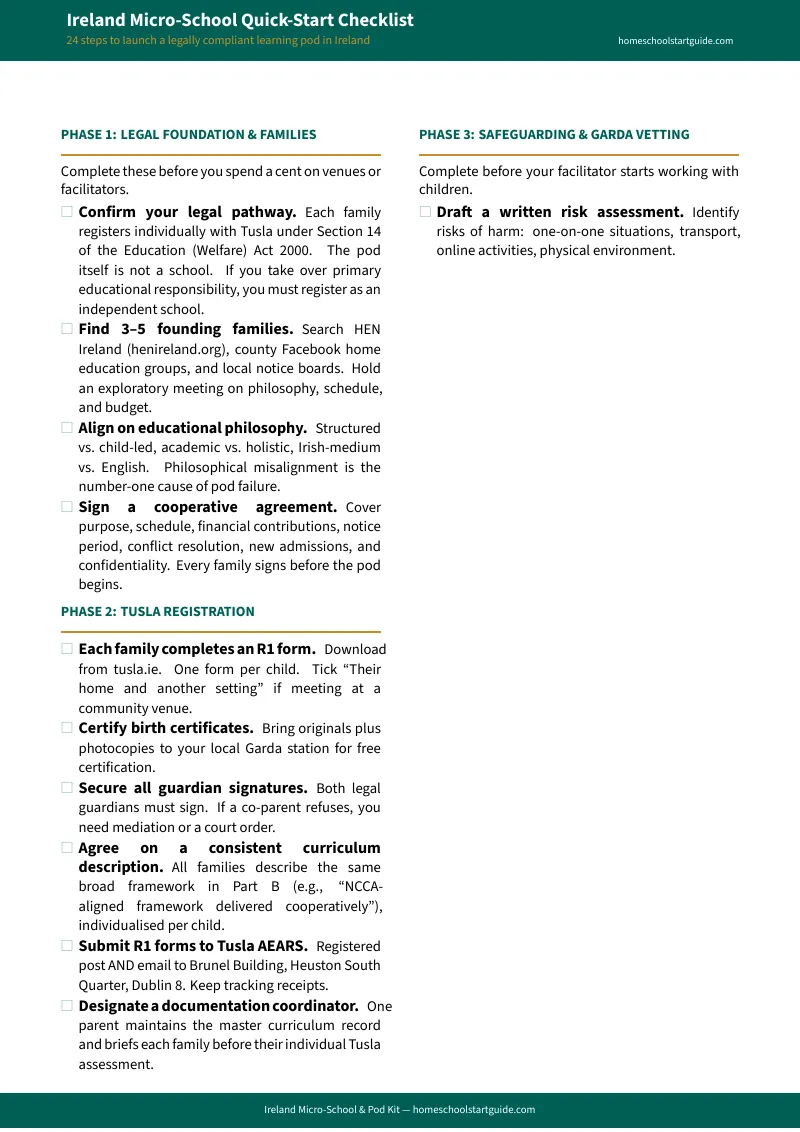
- Quick-Start Checklist — condensed 5-phase action plan covering legal foundation, Tusla registration, safeguarding and vetting, venue and finances, and launch operations
- 90-Day Launch Timeline — week-by-week action plan with checkboxes, from foundation to first day of operations. Print it, pin it, check it off
- Pod Budget Planner — fillable worksheet with EUR expense rows, per-family cost calculation, Irish regional cost reference, and cost-sharing model selection
- Cooperative Agreement — template for all founding families to sign, covering philosophy, schedule, finances, notice period, admissions, conflict resolution, safeguarding, liability, and confidentiality
- Facilitator Contract — employment contract template covering hours, scope, compensation (PAYE/PRSI), Garda vetting, Children First compliance, notice period, IP, and confidentiality
- Children First Safeguarding Checklist — the four mandatory requirements under the Children First Act 2015, with fill-in fields for your DLP, mandated persons, and key reporting contacts
- Garda Vetting Pathways — comparison card for the three legal routes to vet your facilitator (Teaching Council, ECI conduit, Volunteer Ireland), with 100-point ID requirements and record-keeping guidance
- Essential Resources Directory — quick-reference card with all Irish organisations, government bodies, insurance brokers, exam bodies, and cultural partners
Instant download, no account required.
30-day money-back guarantee. If the Kit doesn't give you the confidence and legal clarity to launch your pod, email us and we'll refund you. No questions asked.
Not ready for the full Kit? Download the free Ireland Homeschool Quick-Start Checklist — a step-by-step action plan covering your constitutional rights, legal structure options, Tusla registration basics, and the first steps toward building your pod. It covers the essentials, and it's free.
Ireland's next generation of alternative education is being built by parents like you — not by institutions, not by networks, not by the State. The Kit gives you every legal, operational, and financial tool to build it right.