Your VRQA Review Is Coming. Is Your Portfolio Ready?
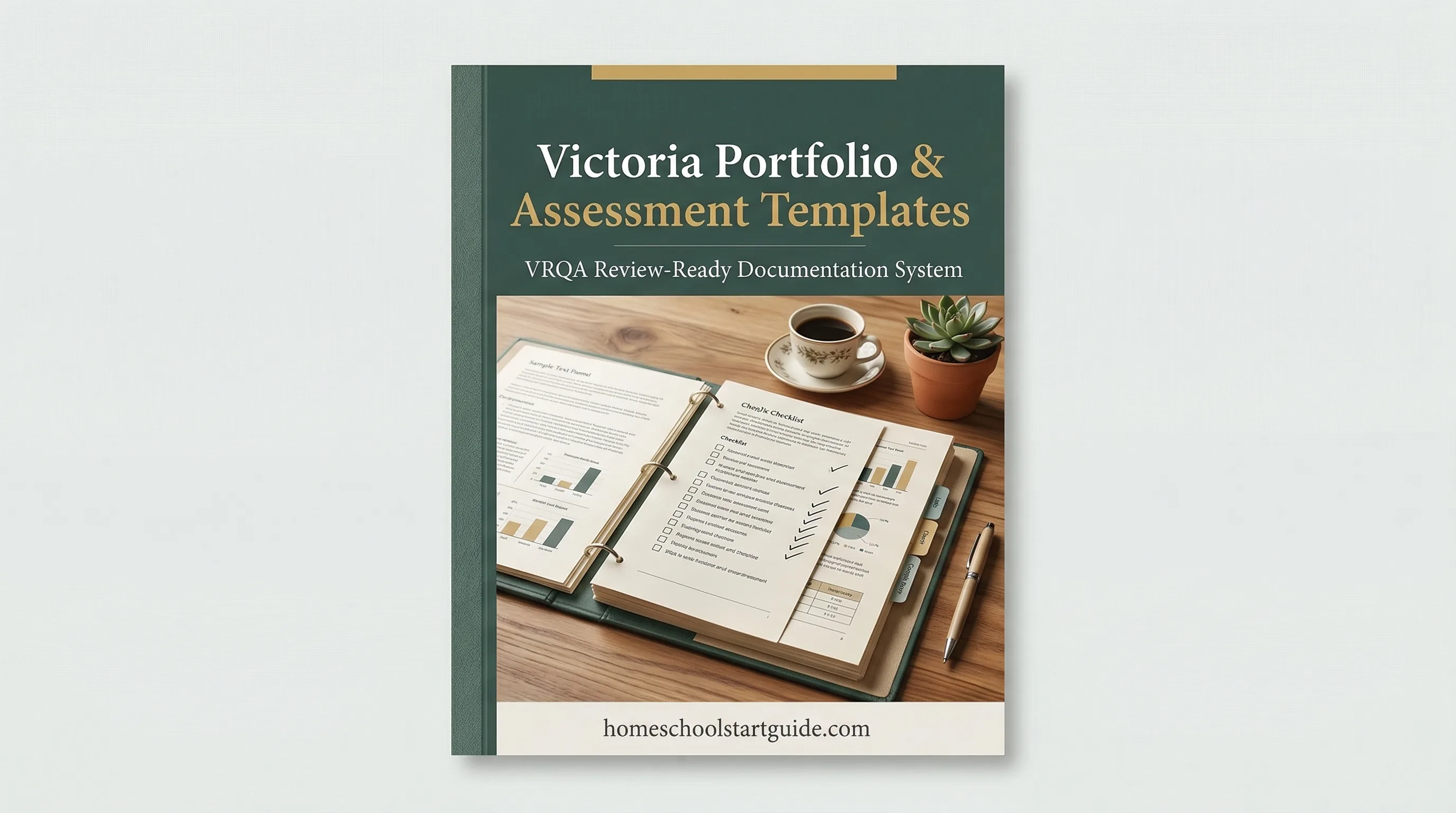
The Victoria Portfolio & Assessment Templates is a VRQA Compliance System — portfolio frameworks, KLA mapping guides, review visit scripts, and stage-by-stage documentation templates that turn your real, everyday home education into the structured, VRQA-aligned evidence that reviewers need to see. Not a curriculum. Not a subscription platform. Not a blank government Word document that assumes you already know what to write. A system that translates how your family actually learns into the documentation language the VRQA requires — built specifically for the Victorian home educator.
Here is what actually happens when the VRQA meets your kitchen table: You register for home education — or you have been registered for years — and the letter arrives. You are one of the 10% selected for a routine review this year. The VRQA wants to see that you are providing "regular and efficient instruction" across all eight Key Learning Areas. You search online and find three things: $550–$880/year curriculum providers like MyHomeschool that will map everything for you but force a rigid school-at-home structure that kills the flexibility your child needs; free VRQA Word templates that give you blank tables labelled "Activity" and "Resources used" with zero guidance on how to fill them; and $8 Etsy planners with boho watercolour covers that track your nature journals beautifully but contain zero KLA mapping, zero review preparation, and zero reference to the Education and Training Reform Act 2006 at all. You are running a Charlotte Mason morning basket, a Steiner craft afternoon, and a Minecraft coding hour — and you have no idea how to make that look like Mathematics, Sciences, and The Arts on paper. HEN will answer your questions on their helpline. But what you need right now is not a phone call — it is a translation system. One that takes the education already happening in your home and renders it in the language the VRQA reviewer expects to see.
Built specifically for Victoria. Uses correct Victorian educational nomenclature — Key Learning Areas, VRQA, Victorian Curriculum, Education and Training Reform Act 2006 — not "standards-based assessment," "state testing," or any US-centric terminology that marks an international template immediately.
Is This For You?
This is for you — the parent who:
- Has a VRQA review notification and needs to know exactly what to have ready — not contradictory Facebook group advice from experienced families whose situations look nothing like yours
- Is registering for the first time and needs a learning plan that actually demonstrates alignment across all eight KLAs without spending forty hours deciphering Victorian Curriculum documents
- Has been registered for years but never built a proper portfolio system — and this year the review letter has your name on it
- Is running an eclectic, Charlotte Mason, Steiner, natural learning, or unschooling approach and has no idea how to map your child's genuine learning into the KLA language that VRQA reviewers understand
- Just pulled your child from school — due to bullying, School Can't, unmet special needs, or a mainstream system that was failing them — and needs immediate structure to demonstrate that a real education is underway
- Refuses to pay $550–$880 per year for a structured curriculum provider — but also cannot walk into a VRQA review with a disorganised folder of worksheets, photos, and handwritten notes that do not map to any KLA outcomes
You are protecting your educational freedom. These templates protect it on paper.
What's Inside the VRQA Compliance System
- Learning Plan Framework — because a VRQA review starts with your learning plan, and a vague two-paragraph philosophy statement is not a plan. A complete registration-ready framework that maps your educational approach to all eight KLAs (English, Mathematics, Sciences, Humanities and Social Sciences, The Arts, Languages Other Than English, Health and Physical Education, and ICT/Design and Technology). Includes guidance on writing your philosophy statement, demonstrating alignment with the Victorian Curriculum, and documenting personalisation for your child's individual needs.
- The KLA Translation Matrix — because your Charlotte Mason nature study, your Minecraft coding session, and your baking afternoon are real education, but only if you can document them in the VRQA's language. A mapping system that categorises non-traditional learning activities into KLA outcome categories. Building a Lego Technic set maps to Sciences (forces, design, materials) and ICT/Design and Technology. Managing the household grocery list maps to Mathematics (number, measurement, money). A family bushwalk through the Dandenongs maps to Humanities and Social Sciences (geography, environment) and Health and Physical Education (physical activity, outdoor safety). This is the single tool that lets eclectic and unschooling families satisfy the "regular and efficient instruction" requirement without abandoning their pedagogy.
- Stage-by-Stage Portfolio Templates — because a Foundation–Year 2 portfolio for your six-year-old looks nothing like a Years 7–10 portfolio for your thirteen-year-old. Tailored documentation frameworks and evidence guidance for Foundation–Year 2, Years 3–6, Years 7–10, and Years 11–12, with specific sample annotations, work sample suggestions, and KLA references for each developmental stage.
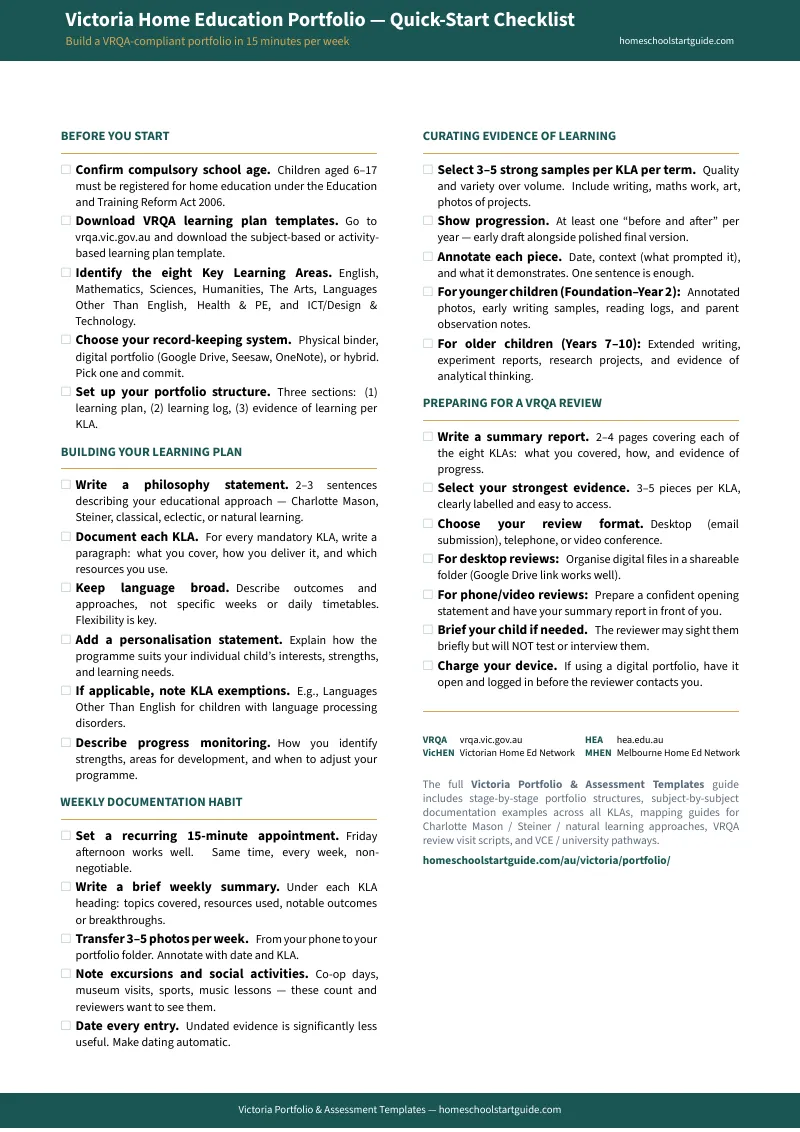
- VRQA Review Preparation Playbook — because no one tells you what the reviewer actually assesses until they are on the phone or at your table. A dedicated checklist of exactly what to have ready, what to say in the opening minutes, scripts for handling difficult questions about curriculum coverage, and a clear briefing on your legal rights — including what reviewers can and cannot require. Covers telephone reviews, desktop reviews, and in-home visits.
- 15-Minute Weekly Learning Log — because reconstructing six months of learning from memory the week before your review is an afternoon of panic that produces records the reviewer can tell were back-dated. A fifteen-minute weekly system that captures activities, links them to KLA outcomes, and builds your portfolio incrementally so it is always current.
- Subject-by-Subject Documentation Strategies — because documenting English is straightforward but documenting The Arts, Languages, or Health and Physical Education trips up almost everyone. Specific guidance for each of the eight KLAs with example entries, suggested evidence types, and cross-curricular opportunities — including the KLAs that catch secondary families off guard.
- Educational Philosophy Mapping — because Charlotte Mason, classical, Steiner, natural learning, unschooling, and eclectic approaches all satisfy VRQA requirements if documented correctly — but each requires a different translation strategy. Dedicated mapping sections for six major educational philosophies showing exactly how to present each approach in VRQA-compatible language.
- VCE & University Pathways — because Years 11–12 raise questions that primary-level guides never address: VCE access for home educated students, the VCE Vocational Major, ATAR options through Virtual School Victoria, transcript creation, and VTAC university admissions to Victorian universities including the University of Melbourne, Monash, RMIT, Deakin, La Trobe, and Swinburne.
Plus 5 Standalone Printable Tools
- VRQA Review Preparation Guide — print before your review: pre-review checklist, opening script, common reviewer questions with responses, and your legal rights
- Learning Plan Template — a fillable two-page template with all required sections ready to complete and present at registration or review
- Weekly Learning Log — a printable landscape log with columns for activities, KLAs, and evidence; print one per week to build your portfolio incrementally
- KLA Mapping Worksheet — map your family's actual activities to all eight VRQA Key Learning Areas in a single landscape spread
- Annual Summary & Progress Report Templates — ready-to-complete frameworks for year-end summaries and per-KLA progress reports
After Using These Templates, You'll Be Able To:
- Walk into your VRQA review with a complete, organised portfolio that demonstrates alignment across every mandatory KLA — without having followed a rigid textbook approach to get there
- Map your existing eclectic, project-based, or child-led activities to Victorian Curriculum outcomes using the KLA Translation Matrix — and do it retroactively for work already completed, not just going forward
- Maintain a weekly documentation habit that takes fifteen minutes and builds a portfolio that reads as the genuine, ongoing record it is — not a document assembled in a panic the week before the review letter arrives
- Submit a registration application with a learning plan that is structured, curriculum-aligned, and professional — reducing the likelihood of follow-up inquiries or additional documentation requests
- Handle any question a VRQA reviewer asks with confidence — including the difficult ones about curriculum gaps, socialisation, and assessment methods — using scripts that redirect the conversation to your documented strengths
- Feel administrative confidence instead of administrative dread — knowing that your records are current, your KLA coverage is demonstrable, and no surprise question will catch you unprepared
Why Templates Built for Victoria — Not Adapted From Somewhere Else
The VRQA free templates are technically the right format but written in dense bureaucratic language for administrators, not parents. They give you blank Word documents labelled "Activity" and "Resources used" with zero guidance on what to actually write. Adapting them into a usable portfolio takes hours of trial-and-error and leaves gaps you cannot identify because the terminology was never explained.
The Etsy and Gumroad planners from Australian homeschool creators are beautifully designed for daily scheduling and nature study journaling. They have no KLA mapping, no VRQA review preparation, no stage-specific checklists, and no reference to the Education and Training Reform Act 2006. They help you track what happened. They cannot help you prove it meets the VRQA's statutory requirements.
The Teachers Pay Teachers templates reference Common Core, "standardised testing," "semesters," and US state law. They are built for American educators. A VRQA reviewer will know immediately that your documentation framework was designed for a different country's regulatory system.
The $550–$880/year curriculum providers provide expert Victorian Curriculum alignment — but at a cost that forces most single-income homeschool families to choose between compliance and actual educational resources. And they enforce a structured, school-at-home methodology that alienates eclectic, natural learning, and unschooling families who simply need a framework to document what they are already doing.
These templates use the correct Victorian terminology, the correct KLA designations, the correct legal references, and the correct stage structure. They were built from the Education and Training Reform Act 2006 and current VRQA guidelines — not adapted from a template designed for someone else.
Less Than One Hour With a Consultant
Private home education consultants who specialise in Victorian compliance charge between $50 and $100 per hour to review your portfolio or help build a learning plan from scratch — and that assumes your documentation is already partially organised when they start. Walking into a consultation without a structured portfolio means the consultant is doing your foundational administrative work on their clock, at their hourly rate. A single one-hour portfolio review costs more than this entire toolkit.
For , you get a complete system, ready to use from the moment you download it. Print the templates. Map the KLAs. Build the portfolio. Your VRQA review does not have to be an emergency project the night before the phone rings.
For — Less Than One Term of Anxiety
Compare it to the alternatives:
- A portfolio review from a home education consultant: $50–$100 per hour — and they still cannot maintain your records for the next twelve months
- A full curriculum provider subscription: $550–$880 per year per child — and they own the structure, the timetable, and the pedagogical approach
- A HEN family membership: $25–$45 per year — invaluable community and advocacy, but their free templates are fragmented Word documents you must assemble yourself
- The cost of a follow-up review because your documentation had gaps: repeating the entire process again within months, with additional stress and scrutiny
30-day money-back guarantee. If these templates do not give you a complete, organised, VRQA-compliant portfolio system, you pay nothing.
This toolkit is an administrative and organisational resource for home-educating families. It is not legal advice. For legal disputes with the VRQA or questions about constitutional protections, contact the Home Education Association (HEA) or a solicitor specialising in education law. For questions about specific registration requirements, consult the VRQA directly.
The VRQA wants evidence of "regular and efficient instruction." These templates create it — without forcing your family into an $880/year curriculum provider, a $100/hour consultant, or a blank Word document from the government website. Get the Victoria Portfolio & Assessment Templates now and stop treating every review notification like a crisis.