The VRQA Draws the Line Between a Legal Pod and a $23,000 Fine. This Kit Shows You Exactly Where That Line Is.
You want to share the load. Your child needs consistent peers, not random park meet-ups where half the families ghost after week two. You've been solo homeschooling for a year and you're exhausted — planning eight learning areas, running excursions alone, watching your kid light up at the one co-op session a month and then deflate for the next three weeks.
So you start researching learning pods. You find Prenda, KaiPod, VELA — beautiful step-by-step guides with professional templates and inspiring stories of micro-school founders. You download a free "How to Start a Pod" guide from Etsy. It tells you to hire a learning guide, find a venue, charge tuition, and set up a five-day-a-week drop-off schedule.
Then you remember you live in Victoria. Where the Education and Training Reform Amendment Bill 2024 just raised the penalty for operating an unregistered school from $1,975 to $23,710 for individuals and $118,554 for organisations. Where the VRQA sent direct warning letters to registered families in October 2024 about the markers of "quasi-school" operations. Where every US micro-school template you downloaded describes a structure that is explicitly illegal under Victorian law.
The Victoria Pod Compliance System is a complete operational blueprint — every template, legal boundary, and governance framework you need to start, run, and sustain a learning pod that stays unambiguously on the right side of the VRQA's quasi-school line. Not a generic Australian guide. Not a US template with "Victoria" pasted over "Texas." Every legal citation, every template, every compliance checkpoint is specific to the Education and Training Reform Act 2006 and the post-2024 penalty regime.
What's Inside the Pod Kit
The VRQA Compliance Blueprint
The exact legal boundary between a compliant learning pod and an illegal unregistered school — explained in plain English with the specific operational markers the VRQA uses to make that determination. You'll understand why the "5 children rule" is a dangerous myth borrowed from early childhood regulations, why parental presence matters more than headcount, and how to structure every session so your pod passes the functional test the VRQA actually applies. This is the chapter that makes the rest of the kit possible.
The Pod Charter & MOU Template
Informal pods collapse. Within six months, unequal workloads create resentment, one family's discipline approach clashes with another's, someone stops paying their share of venue hire, and the group implodes in a Facebook thread. The Charter template covers educational philosophy alignment, financial contributions, scheduling commitments, health and safety protocols, behavioural expectations, conflict resolution mechanisms, and exit terms — customise it to your group and sign it before your first session. It takes 30 minutes to fill in and prevents six months of drama.
The Cost-Sharing Framework
Victorian pods cannot charge tuition — that crosses the line into an unregistered school operating commercially. But the practical costs of running a pod are real: scout hall hire at $40–$80 per session, public liability insurance, bulk art supplies, group excursion tickets. The framework shows you exactly how to pool money at cost-recovery only, set up a transparent shared ledger, and stay within the ATO guidelines that separate legitimate cost-sharing from a business activity that triggers GST registration.
The Tutor Engagement Contract
Hiring a specialist tutor for French, secondary maths, or coding is legal and common. Hiring someone to deliver all eight learning areas while parents drop off children is an unregistered school. The contract template covers scope limits (specific subjects only), WWCC and VIT verification, insurance requirements (Professional Indemnity and Public Liability), ABN invoicing, cancellation terms, and the critical compliance clause that defines the tutor as a specialist supplement — not a replacement for parental instruction.
Governance Models Compared
Four models side by side — informal co-op, structured subject-specialist pod, incorporated cooperative (under the Co-operatives National Law), and tutor-led micro-school — with the legal risk profile, administrative overhead, insurance requirements, and best-fit family count for each. You'll know within ten minutes which model fits your group's size, ambition, and risk tolerance.
The Weekly Schedule Templates
Three scheduling models ready to adapt: the part-time co-op (2–3 pod days plus home days — the safest and most common model), the subject-specialist pod (families meet only for tutored subjects), and the excursion-only pod (group outings with home-based academics). Each template includes a sample timetable, parent rotation roster, and term planning worksheet.
Melbourne and Regional Resources
Group-rate access to Scienceworks, Melbourne Museum, NGV, Zoos Victoria, and STEM centres across Melbourne. The Museum Teachers program provides free entry to Museums Victoria for home educators. Plus venue options, homeschool networks, and excursion ideas for families in Geelong, Ballarat, Bendigo, and the Mornington Peninsula — because not everyone lives within an hour of Flinders Street.
Neurodivergent Pod Adaptations
If your child left mainstream schooling because of unmet needs — autism, ADHD, anxiety, school refusal — the pod needs to be different from the classroom that failed them. This section covers sensory-friendly scheduling, low-demand environment design, NDIS funding integration for pod activities, and an ND-affirming behaviour policy. Built for the families who are building a pod specifically because the mainstream system could not accommodate their child.
Who This Kit Is For
- Solo home-educating parents who are burning out and need to share the teaching load — but want to do it legally, not by guessing and hoping the VRQA doesn't notice
- Parents of neurodivergent children — autism, ADHD, PDA, anxiety, school refusal — who need a safe, structured social environment without the sensory overload and rigid pacing of mainstream classrooms
- Parents who've seen the US micro-school movement and want to replicate that collaborative model in Victoria — without accidentally creating an unregistered school under the 2024 penalty regime
- Former teachers who see the demand for alternative education in their community and want to facilitate a pod or micro-school within the bounds of the law
- Existing informal co-ops that are growing and need governance — a charter, cost-sharing system, and tutor contracts — before the lack of structure tears the group apart
- Families in regional Victoria — Geelong, Ballarat, Bendigo, Mornington Peninsula — where the homeschool community is smaller and a structured pod may be the only consistent source of peer interaction
Why Not Just Use Free Resources?
You can research Victorian pod legality for free. Here's what that process actually looks like:
- The VRQA website. It tells you that "groups of home schooling students coming together for short periods" is permitted and that "quasi-school arrangements" are prohibited. It does not tell you where the line between those two categories sits, how to structure a pod to stay on the right side, or what operational markers the VRQA looks for during a review. The VRQA is your regulator, not your advisor.
- VicHEN's Co-op Guide. Excellent theoretical advice — WWCC requirements, venue insurance, behaviour policies, the difference between an Australian co-op and a US micro-school. But it remains informational prose. There are no downloadable charter templates, no cost-sharing spreadsheets, no tutor contracts. You are told you need a behaviour policy but not given one.
- US micro-school platforms. Prenda, KaiPod, and VELA offer world-class operational frameworks — designed for a legal system that does not exist in Australia. ESA funding, full-time learning guides, drop-off models, and tuition charging are all standard in the US and all illegal in Victoria. Downloading a free KaiPod guide and following it in Melbourne is a fast track to a $23,710 fine.
- Facebook groups. One parent says their pod of six meets five days a week with no issues. Another says the VRQA contacted them after a neighbour complained. Someone recommends an ABN for cost-sharing. Someone else says an ABN triggers GST obligations. The advice is contradictory, unverifiable, and frequently wrong.
- Etsy and Gumroad. Co-op planners that are attendance logs dressed up as governance documents. "How to Start a Pod" guides written for American state laws. Not a single product on either platform addresses the VRQA quasi-school definition, the 2024 penalty increases, or the operational markers that separate a legal Victorian pod from an illegal one.
Free resources tell you that pods exist and that quasi-schools are illegal. This kit gives you the charter, the compliance checklist, the cost-sharing framework, and the tutor contracts to build a pod that stays legal.
— Less Than a Single Session of Hall Hire
A home education consultant in Melbourne charges $175–$229 AUD for a single session. HEA membership runs $84 per year. A scout hall in Kingston or Frankston costs $40–$80 per session just for the venue — before insurance, supplies, or tutor fees. The generic Etsy planners don't mention Victoria. The US guides will get you fined.
Your download includes the complete 19-chapter guide, the Victoria Micro-School Quick-Start Checklist, and standalone printable PDFs you can use immediately:
- Complete pod guide (19 chapters) — legal framework, governance models, family vetting, charter template, scheduling, WWCC, insurance, venues, cost-sharing, tutor contracts, Melbourne resources, regional guide, neurodivergent adaptations, partial enrolment, VRQA review preparation, conflict resolution, and six appendices with ready-to-use templates
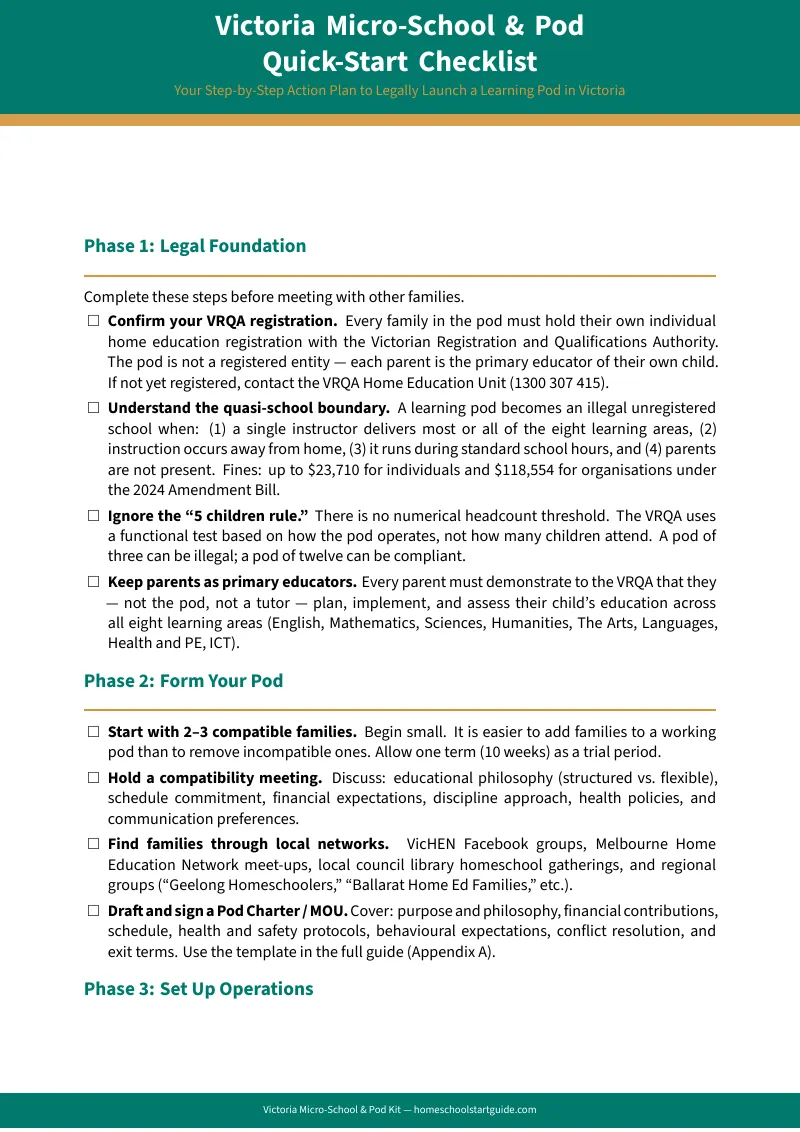
- Quick-Start Checklist — 20 action items across six phases from legal foundation through launch, printed and pinned to your fridge
- Pod Charter & MOU template — customise, sign, and start your pod with governance from day one
- Tutor Engagement Contract — hire specialist tutors with a compliant, clear agreement
- Cost-Sharing Budget template — transparent financial tracking at cost-recovery only
- Weekly Schedule templates — three models with timetables, rotation rosters, and term planners
Instant download, no account required.
30-day money-back guarantee. If the kit doesn't give you the clarity and templates to launch a compliant, sustainable pod, email us and we'll refund you. No questions asked.
Not ready for the full kit? Download the free Victoria Homeschool Quick-Start Checklist — a printable overview of the pod formation process, the key legal boundaries, and the steps from VRQA compliance through your first term. It's enough to understand your obligations tonight. The full kit is there when you're ready to build.
Over 11,600 Victorian students are registered for home education — an 83% increase since 2020. Thousands of their families want to collaborate. The ones who thrive are the ones who structure it properly from the start. That's exactly what this kit does.