Your Home Visit Is Booked. Is Your Portfolio Ready?
The Northern Territory Portfolio & Assessment Templates is a TLAP Compliance System — portfolio frameworks, ACARA learning area mapping guides, inspection preparation tools, and stage-by-stage documentation templates that turn your real, everyday home education into the structured, annotated evidence the NT Department of Education needs to see during your mandatory home visit. Not a curriculum. Not a subscription platform. Not a blank government Word document that assumes you already know what a Teaching, Learning and Assessment Plan is supposed to look like. A system that translates how your family actually learns — whether that is on a cattle station, a defence base, or in a Darwin suburb — into the eight Australian Curriculum learning areas the Department requires. Built specifically for the Northern Territory's unique regulatory framework.
Here is what actually happens when the inspection notification arrives: You have spent an entire year facilitating rich, distinctly Territory education — calculating feed rates during the cattle muster, observing wet season weather patterns, exploring Kakadu's rock art, coding with Scratch on the verandah between rain squalls. Then the Department of Education sends notification that an Authorised Person will conduct your mandatory home visit under Section 47 of the Education Act 2015. You need a current TLAP aligned to ACARA Version 9.0 across all eight learning areas, evidence of satisfactory progress, and a portfolio that demonstrates your child's learning in language a curriculum officer or principal can verify. You search online and find three things: $190+ registration services that lock you into their specific curriculum; free government DOCX templates with eight pages of dense exemplar referencing textbook codes and rubrics designed for teachers, not parents; and $8 Etsy planners from American sellers referencing "grades," "Common Core," and "semesters" — terminology that marks your portfolio as a template designed for a different country's education system. You are running Charlotte Mason nature study, outback science on the station, and an eclectic mix of resources — and you have no idea how to make that look like English, Mathematics, Science, HASS, The Arts, Technologies, HPE, and Languages on paper. Community Facebook groups will share their portfolios. But with roughly 200 registered home education students territory-wide, examples are scarce and every family's file gets individual scrutiny. What you need is not someone else's example — it is a translation system. One that takes the education already happening in your home and renders it in the language the Authorised Person expects to read.
Built specifically for the Northern Territory. Uses correct NT educational nomenclature — TLAP (not "learning plan"), Authorised Person (not "inspector"), home visit (not "audit"), ACARA Version 9.0, Education Act 2015 (NT) — not "standards-based assessment," "state testing," or any US-centric terminology that marks an international template immediately.
Is This For You?
This is for you — the parent who:
- Has a home visit notification and needs to know exactly what the Authorised Person is looking for — not conflicting advice from the tiny NT Home Education Facebook group where five families registered in different years and dealt with different officers
- Lives on a remote cattle station, mining community, or pastoral property and needs to document experiential learning — mustering, fencing, bush medicine, seasonal land management — in ACARA-compliant language without forcing your children into worksheet-based schooling
- Is a defence family recently posted to Darwin or Katherine and needs to register for NT home education quickly without spending three months learning an entirely new jurisdiction's bureaucratic requirements
- Is running Charlotte Mason, Steiner, classical, unschooling, natural learning, or an eclectic approach and has no idea how to map your child's genuine learning into the eight ACARA learning areas the Department requires in your TLAP
- Has a neurodivergent child — ADHD, autism, school refusal, giftedness — and withdrew them from mainstream school to protect their wellbeing, but now needs to demonstrate that a satisfactory education is underway despite the unconventional daily rhythm
- Is approaching the late-November re-registration deadline and needs to compile a renewal portfolio that demonstrates satisfactory progress from the past year while planning the next one
- Refuses to pay $190+ to a registration service that dictates your curriculum — but also cannot afford a failed home visit that triggers cancellation of your registration
You are protecting your educational freedom. These templates protect it on paper.
What's Inside the TLAP Compliance System
- The Real-Life to ACARA Translation Matrix — because your cattle muster, your Kakadu excursion, and your wet season weather journal are real education, but only if you can document them in ACARA's language. A mapping system that categorises non-traditional, experiential learning activities into all eight ACARA learning areas. Calculating feed rates and water tank volumes maps to Mathematics. Observing cyclone patterns and tidal movements maps to Science. Exploring Indigenous rock art and land management practices maps to HASS and cross-curriculum priorities. Building a chicken coop maps to Technologies. This is the single tool that lets remote, eclectic, and unschooling families satisfy the Australian Curriculum alignment requirement without abandoning their pedagogy.
- TLAP Builder Framework — because the government DOCX template gives you blank tables and an 8-page exemplar written in dense pedagogical jargon referencing specific textbook codes. The TLAP Builder walks you through each section with fill-in prompts: educational philosophy statement, learning environment description, resources, weekly rhythm, assessment strategies, and learning area coverage across all eight ACARA areas. Produces a TLAP the Department expects to see — without requiring a teaching degree to write it.
- Stage-by-Stage Portfolio Templates — because a Transition-Year 2 portfolio looks nothing like a Year 10 portfolio. Tailored documentation frameworks and evidence guidance for Transition–Year 2, Years 3–6, Years 7–9, and Years 10–12, with specific sample annotations, suggested evidence types, and learning area references calibrated to each developmental stage and the NT's unique context.
- The Home Visit Survival Protocol — because no generic template on the market tells you what actually happens during the NT Department of Education's mandatory home inspection. A pre-visit checklist, portfolio presentation sequence, common questions the Authorised Person asks, your legal rights under the Education Act 2015, what constitutes "satisfactory progress," and how to handle pushback or unexpected requests. Print it the week before your visit.
- 15-Minute Weekly Documentation Habit — because reconstructing twelve months of learning from memory the week before your home visit produces records the Authorised Person can tell were back-dated. A weekly system that captures activities, links them to learning areas, and builds your portfolio incrementally so it is always current. One strong written sample, one photograph with a two-sentence annotation, done in fifteen minutes.
- Educational Approach Mapping — because Charlotte Mason, classical, Steiner, unschooling, natural learning, and eclectic approaches all satisfy the Department if documented correctly — but each requires a different translation strategy. Dedicated mapping sections for six major educational philosophies showing exactly how to present each approach in ACARA-compatible language.
- Remote & Experiential Learning Documentation — because no other portfolio guide in Australia addresses how to document station life, bush skills, marine ecology, wet season science, or pastoral work as formal curriculum. Specific frameworks for translating the education that happens naturally in remote NT environments into the eight learning areas — without pretending your children sit at desks completing worksheets.
- NTCET, ATAR & University Pathways — because senior secondary raises questions that primary-level guides never address: the NT Certificate of Education and Training (NTCET) through the SACE Board, 200-credit requirements, external candidacy options, ATAR pathway, transcript creation, and Charles Darwin University admissions — including alternative entry via the Tertiary Enabling Program (TEP), STAT, and portfolio-based pathways.
Plus Standalone Printable Tools
- Learning Area Mapping Worksheet (learning-area-mapping.pdf) — a landscape-format matrix for mapping your family's activities to all eight ACARA learning areas, with a quick translation reference for NT station work, bush activities, wet season learning, and common educational approaches. Print it and keep it above your desk.
- Weekly Learning Log (weekly-learning-log.pdf) — a fillable weekly template for the 15-minute documentation habit. One row per day, columns for activities, learning areas covered, and evidence collected. Print one copy per week — your portfolio builds itself over the year.
- Progress Report Framework (progress-report-framework.pdf) — a fill-in template for compiling your annual summary of progress across all eight learning areas, with annotation prompts, a forward programme section, and a compilation checklist.
- Home Visit Preparation Guide (home-visit-preparation.pdf) — a pre-visit checklist, common Authorised Person questions with suggested responses, your legal rights under the Education Act 2015, and what to do if the visit does not go as expected.
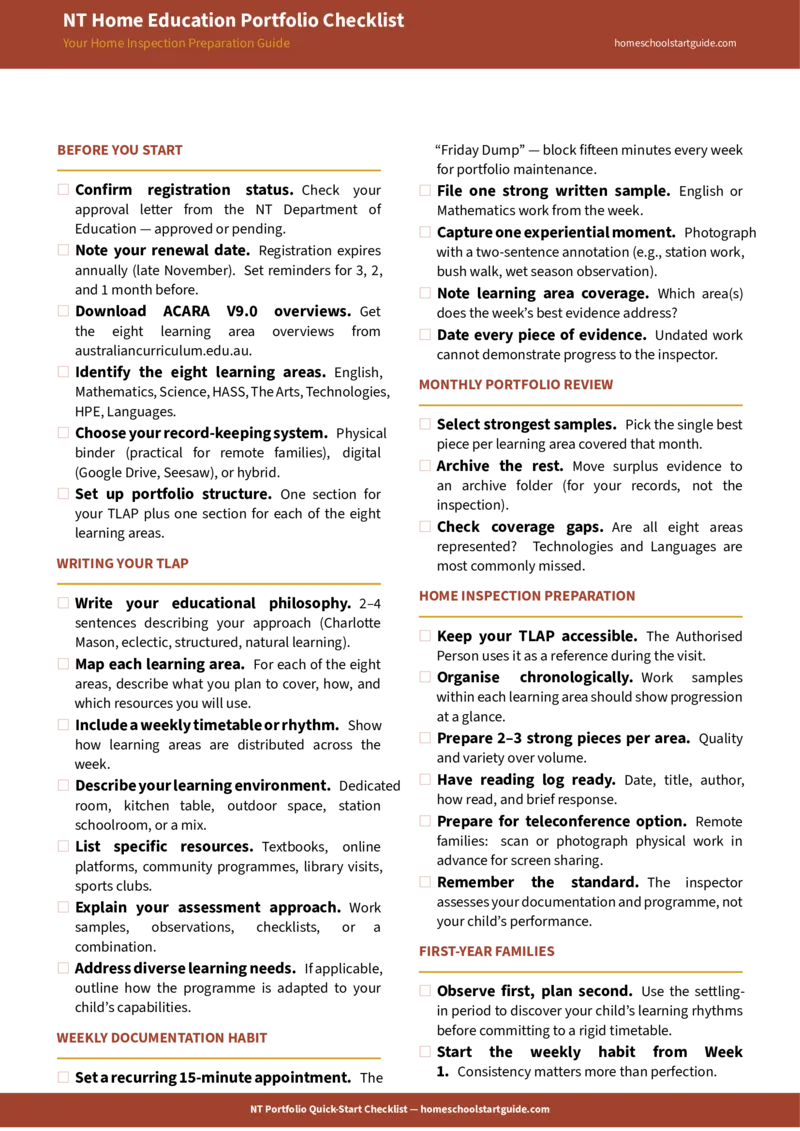
- Northern Territory Home Education Quick-Start Checklist (checklist.pdf) — a printable checklist covering the essential steps from confirming your registration status to building your TLAP and preparing for your first home visit.
After Using These Templates, You'll Be Able To:
- Present a current, organised portfolio during your mandatory home visit containing a TLAP aligned to ACARA Version 9.0 and evidence of satisfactory progress across all eight learning areas — the precise structure the Authorised Person assesses against
- Map your existing experiential, station-based, or eclectic activities to all eight ACARA learning areas using the Translation Matrix — and do it retroactively for learning already completed, not just going forward
- Maintain a weekly documentation habit that takes fifteen minutes and builds a portfolio that reads as the genuine, ongoing record it is — not a document assembled in a panic the week before the home visit
- Write a TLAP that demonstrates alignment with the Australian Curriculum Version 9.0 without following a rigid textbook approach or paying $190 to a registration service
- Prepare for your home visit with confidence — knowing what the Authorised Person looks for, what your legal rights are, and how to present your child's learning in a way that demonstrates satisfactory progress
- Feel administrative confidence instead of administrative dread — knowing that your records are current, your learning area coverage is demonstrable, and your registration will not be cancelled because of a documentation gap
Why Templates Built for the NT — Not Adapted From Somewhere Else
The NT Department's free templates are technically the right format but written in dense bureaucratic language for educators, not parents. The 8-page exemplar references specific textbooks, granular ACARA content description codes, and formal rubrics that assume university-level curriculum knowledge. It shows you exactly what the bureaucracy demands but offers no realistic guidance on how to achieve it. Adapting it into a usable portfolio takes hours and leaves gaps you cannot identify because the terminology was never explained.
The Etsy and TPT planners from American homeschool creators are beautifully designed for daily scheduling and nature study journaling. They reference "grades," "Common Core," "semesters," and US state law. They have no ACARA mapping, no TLAP structure, no home visit preparation, and no reference to the Education Act 2015. They help you track what happened. They cannot help you prove it meets the Northern Territory's statutory requirements.
The $190+ registration services (Simply Homeschool, Euka) provide done-for-you documentation with automated reporting — but at a cost that locks you into their specific curriculum and ongoing annual payments. For an eclectic family designing their own education, paying $190 for a document that forces you to adopt someone else's pedagogy defeats the purpose of home education.
The $50–$90/hour consultants provide personalised portfolio reviews — but at a cost that is prohibitive for single-income pastoral families, remote communities, and defence families managing on a single ADF salary. And their advice requires reliable internet for Zoom appointments — a luxury during the wet season on a remote station.
These templates use the correct NT terminology, the correct ACARA learning area designations, the correct TLAP structure, and the correct Education Act 2015 legal references. They were built from the Northern Territory's regulatory framework — not adapted from a template designed for Queensland, NSW, or the United States.
Less Than One Consultant Session
Educational consultants who work with NT home educators charge between $50 and $90 per hour for portfolio review — and that assumes your documentation is already partially organised when they start. Walking into a consultation without a structured TLAP and portfolio means the consultant is doing your foundational administrative work on their clock, at their hourly rate. A single one-hour session costs more than this entire toolkit.
For , you get a complete system, ready to use from the moment you download it. Print the templates. Map the learning areas. Build the portfolio. Your home visit does not have to be an emergency.
For — Less Than One Term of Anxiety
Compare it to the alternatives:
- A portfolio review from an educational consultant: $50–$90 per hour — and they still cannot maintain your records for the next twelve months
- Simply Homeschool registration service: $190 for the first child — and they dictate the curriculum approach
- A full Euka curriculum subscription: $800+ per year — and they own the structure, the timetable, and the reporting
- HEA membership for general resources: $79 per year — broad national advice that is not tailored to the NT's specific TLAP format and home visit requirements
- The cost of a cancelled registration because your documentation had gaps: re-application stress, legal uncertainty, and your child potentially forced back into the mainstream system that was not working for them
30-day money-back guarantee. If these templates do not give you a complete, organised, TLAP-compliant portfolio system, you pay nothing.
This toolkit is an administrative and organisational resource for home-educating families. It is not legal advice. For legal disputes with the Department of Education or questions about the Education Act 2015, contact the Home Education Association (HEA) or a solicitor specialising in education law. For questions about specific registration requirements, consult the NT Department of Education directly.
The Department wants evidence. These templates create it — without forcing your family into a $190 registration service, a $90/hour consultant, or a blank Word document from the government website. Get the Northern Territory Portfolio & Assessment Templates now and stop treating every home visit like a crisis.