The Directorate Gives You a Blank Statement of Intent. It Doesn't Tell You What Language Gets Approved.
You've made the decision. Your child is struggling — the school refusal that's gotten worse every term, the anxiety that starts on Sunday evening, the specialist who recommended "a different learning environment" while the school said they're "managing fine." You know you need to withdraw your child and start home educating in the ACT. So you went to the Education Directorate website.
That's where the confidence evaporated. Statement of Intent. Education plan covering spiritual, emotional, physical, social and intellectual development. Registration with the Directorate. Initial review meeting with a Home Education Liaison Officer. Annual reporting by 31 December. The Education Act 2004, Part 4.4. You're not sure what the Directorate actually expects to see — the templates they provide are structurally sound but intimidatingly blank.
Then you found a Facebook group. One parent says the HELO meeting "was just a cup of tea and a chat." Another says the officer "went through every section of my education plan with detailed questions." Someone warns you to apply to the Directorate before withdrawing from school. Someone else says they withdrew first and it was fine. A parent in NSW says to look at NESA instead — different state, completely irrelevant to the ACT.
You still don't know what to actually write in your Statement of Intent, what the HELO is really assessing during the review meeting, or what happens if you get the sequence wrong and trigger a truancy flag.
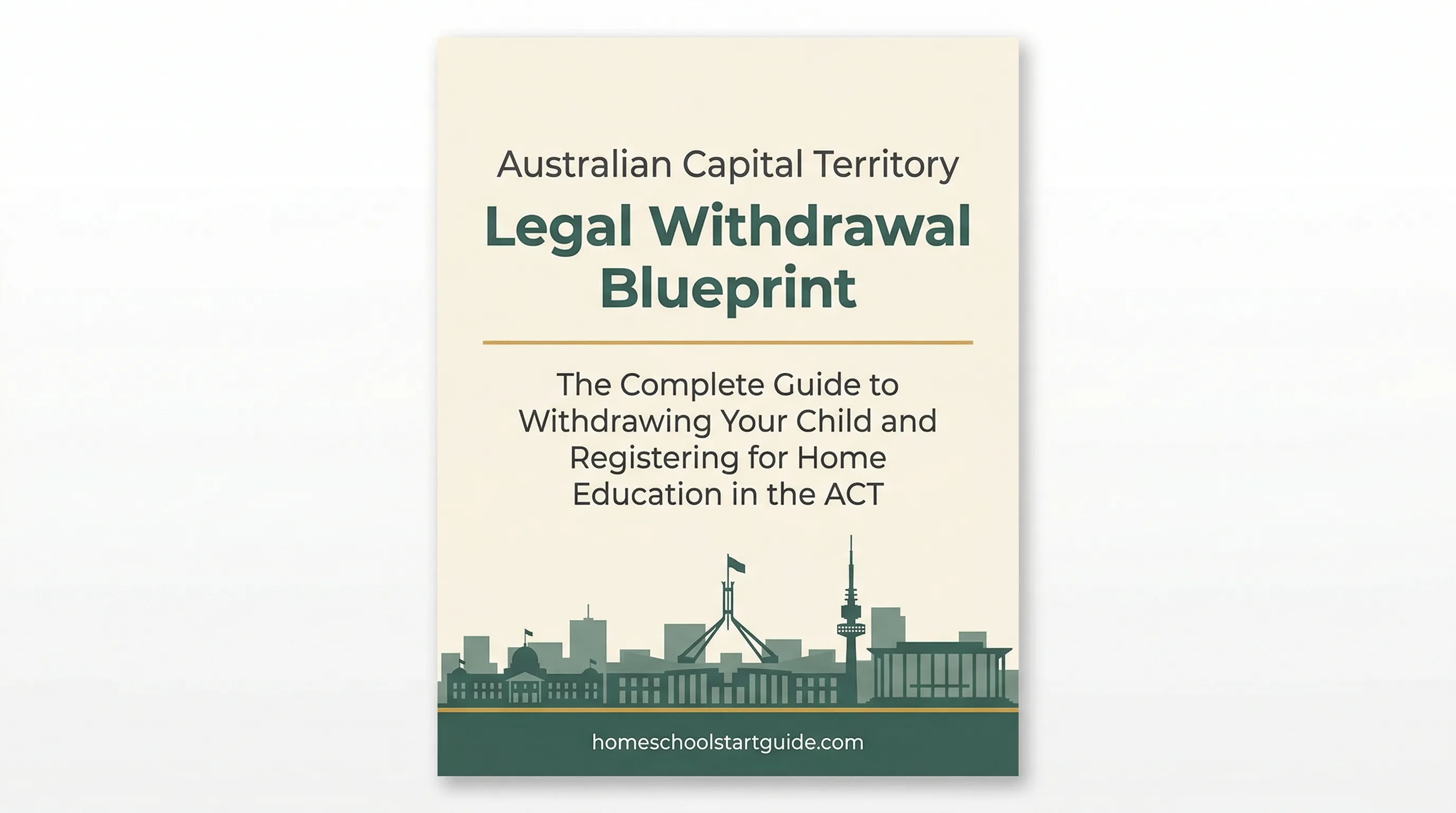
The ACT Legal Withdrawal Blueprint is a complete Directorate Registration System — every document, template, and strategy you need from the moment you decide to withdraw through registration approval and beyond. Not a generic Australian guide with a paragraph about Canberra. Every legal citation, every template, every strategy is specific to the Education Act 2004 (ACT) and the current post-2019 registration process.
What's Inside the Blueprint
The Registration Walkthrough
The Directorate application is not complicated — it's poorly explained. The Blueprint walks through every step of the registration process: what documents you need (and which ones the Directorate explicitly rejects — rates notices and phone bills are not accepted as proof of residency), the correct sequence (apply to the Directorate first, then withdraw from school), the 28-day approval timeline, and the 3-month grace period for your Statement of Intent. You'll complete the process confidently in one sitting, not three anxious weeks of second-guessing.
The Statement of Intent Writing Framework
This is where most ACT parents freeze. The Directorate requires a Statement of Intent demonstrating how you'll develop your child's spiritual, emotional, physical, social and intellectual needs — and prepare them to be a "global citizen." But staring at a blank Word template doesn't tell you what language gets approved. The Blueprint provides modular, pre-written paragraphs, sentence starters, and guided prompts for every section — so you write a Statement of Intent in your own words that satisfies the Directorate whether you use structured curriculum, Charlotte Mason, Steiner, unschooling, or an eclectic approach. Specific frameworks for neurodivergent children included.
The HELO Review Meeting Preparation Guide
The initial review meeting generates more anxiety than any other part of the ACT process — and most of that anxiety comes from not knowing what to expect. The Blueprint tells you exactly what the Home Education Liaison Officer assesses, what evidence to display, what they cannot require, and how to prepare so the meeting is a collaborative conversation, not an interrogation. Includes a pre-meeting checklist and common questions with suggested responses.
The Withdrawal Letter Templates (Ready to Send)
Pre-written withdrawal letters customised for ACT government and non-government schools — citing the Education Act 2004. Not blank templates you have to figure out — ready-to-personalise documents with clear instructions on what to include, what to leave out, and who to send them to. Email one tonight; the school gets notified first thing tomorrow.
The School Pushback Protocol
Some schools accept withdrawal letters without comment. Others demand meetings, threaten truancy reports, or insist your child must finish the term. The Blueprint includes email scripts for every common pushback scenario — the principal who insists on a face-to-face meeting, the school that won't release academic records, the attendance officer who mentions "mandatory reporting." Every script cites the relevant section of the Education Act so you respond with law, not emotion.
The Special Situations Section
Mid-year withdrawal timing. Children with disabilities and existing support plans. NDIS-funded therapies and whether they continue after you leave the school system. Neurodivergent children — drafting the developmental areas without pathologising your child. Gifted learners. Military and diplomatic families on posting to Canberra. Interstate transfers. Senior secondary pathways — BSSS college system, CIT dual enrolment, H-courses, ANU and University of Canberra non-ATAR admission. The Blueprint covers every scenario the generic guides ignore because they're trying to cover all of Australia in 20 pages.
Who This Blueprint Is For
- Parents withdrawing because their child is in crisis — school refusal, bullying, anxiety, unmet special needs — and who need to act this week, not after months of research
- Parents overwhelmed by the Directorate registration process who need someone to walk them through the application, the Statement of Intent, and the HELO review meeting step by step
- Parents worried about the review meeting who've read conflicting stories in Facebook groups and need the facts — what the HELO actually assesses, what they report, and what they cannot demand
- Parents of neurodivergent children who need help articulating their child's developmental areas to the Directorate without reducing their child to a diagnosis
- Parents getting pushback from the school — demands for meetings, truancy threats, refusal to release records — who need the exact legal language to shut it down
- Parents who tried to piece together the process from the Directorate website, the HEA, and Facebook groups and ended up more confused than when they started
Why Not Just Use the Free Resources?
You can research ACT home education registration for free. The information exists. Here's what that process actually looks like:
- The Education Directorate website. The authoritative source. It provides blank Word templates for the Statement of Intent and annual report, lists the documentation requirements, and outlines the 28-day approval timeline. What it doesn't provide is a plain-English explanation of how to translate your educational approach into language the Directorate approves. The templates are blank pages with bureaucratic prompts — "describe how you will develop your child's spiritual, emotional, physical, social and intellectual needs." You need sentence starters and worked examples, not blank boxes.
- The Home Education Association (HEA). Excellent national advocacy body with a volunteer support network. But the HEA serves home educators across all of Australia — and membership runs $79 AUD annually. When your question is "how do I phrase the intellectual development section for an unschooling approach in the ACT?" or "can the HELO ask to see my child during the review meeting?", you need ACT-specific procedural detail, not national guidance.
- Facebook groups and HENCAST. High on lived experience, dangerously variable on accuracy. In the same thread, one parent says the HELO meeting took 20 minutes and another says it lasted two hours. One insists you must reference the Australian Curriculum; another says they explicitly didn't. Every answer is one person's experience presented as universal truth — and some advice still references "provisional registration," which hasn't existed in the ACT since the 2019 amendments.
- Generic Australian homeschool guides. The Etsy downloads cover "Australian home education" as if it were one system. The ACT's Education Directorate registration process, Statement of Intent framework, and HELO review structure are fundamentally different from NESA in NSW, VRQA in Victoria, or HEU in Queensland. A guide that devotes two paragraphs to "the ACT requires Directorate registration" is a footnote dressed up as a product.
Free resources tell you that Directorate registration exists. The Blueprint walks you through every section of the Statement of Intent, every step of the registration process, and every question the HELO might ask.
— Less Than a Single Home Education Consultant Session
A one-hour consultation with a home education registration consultant runs $100-$150 AUD. The HEA offers free peer support — excellent, but general and requires annual membership for deeper access. The generic Etsy guides treat the ACT as an afterthought. The Directorate website has the templates but not the explanation.
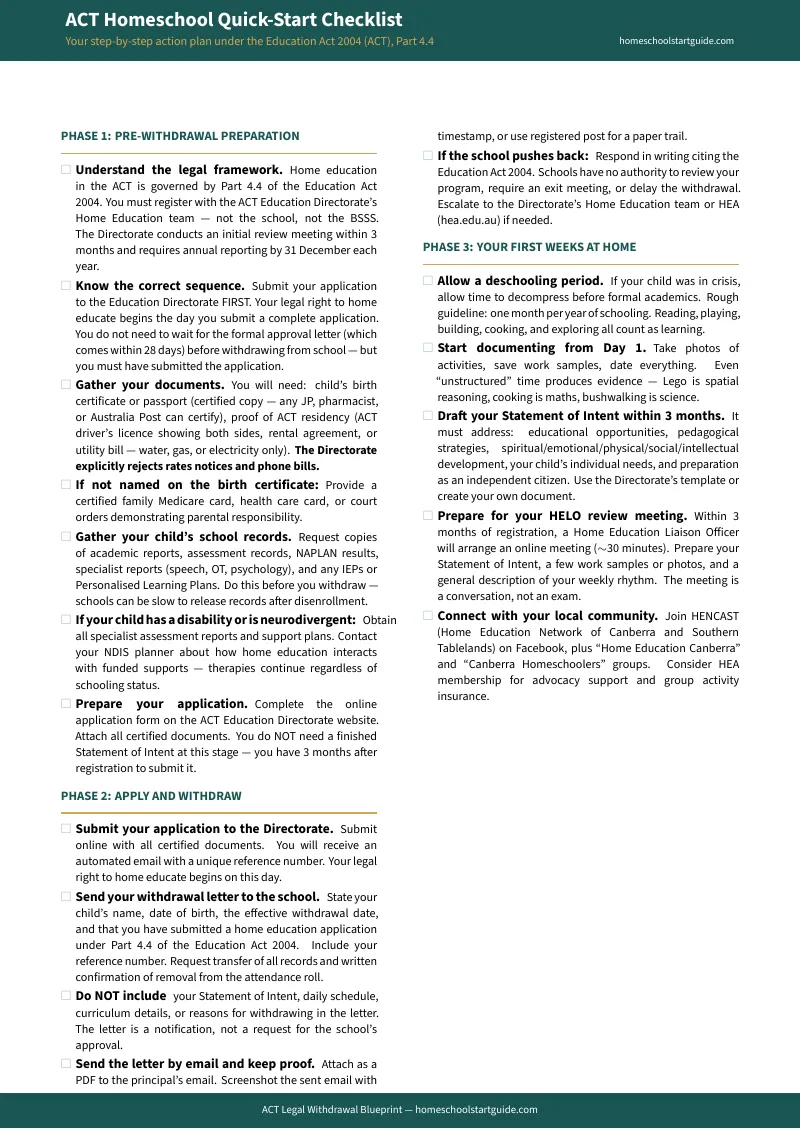
Your download includes the complete Blueprint guide (13 chapters), the ACT Homeschool Quick-Start Checklist, and standalone printable PDFs you can use immediately:
- withdrawal-templates.pdf — ready-to-personalise letters for government, Catholic, and independent schools, citing the Education Act 2004, plus a follow-up records request template
- pushback-scripts.pdf — copy-paste email responses for when the school demands meetings, threatens truancy reports, or refuses to process your withdrawal, plus escalation steps
- helo-review-prep.pdf — what the Liaison Officer assesses, a pre-meeting checklist, common questions with suggested responses, and your legal rights during the meeting
- quick-reference.pdf — what the ACT requires and what it does not, the Statement of Intent structure, and key legal citations on one printable page
- Directorate registration walkthrough — every step of the application process explained in plain English
- Statement of Intent writing framework — sentence starters, modular paragraphs, and guided prompts for every developmental area that work for structured, eclectic, or child-led approaches
- Special situations guide — mid-year withdrawal, disability and NDIS, neurodivergent children, senior secondary pathways, military and diplomatic families, interstate transfers
Instant download, no account required.
30-day money-back guarantee. If the Blueprint doesn't give you the confidence and clarity to execute your withdrawal and Directorate registration, email us and we'll refund you. No questions asked.
Not ready for the full Blueprint? Download the free ACT Homeschool Quick-Start Checklist — a printable overview of the Directorate registration process, the Statement of Intent requirements, and the steps from withdrawal through your first HELO review meeting. It's enough to understand your rights tonight. The full Blueprint is there when you're ready to act.
More than 500 ACT students are already being home educated. The process is structured, not impossible — you just need someone to walk you through it. That's exactly what this Blueprint does.