The MOE Can Reject Your Homeschool Application — and You're Preparing It with Facebook Group Advice
You've spent the last three weeks scrolling through the Singapore Homeschooling Group. One parent says to call the CEU first. Another says to email. A third posted her experience from 2019 — before the SEN amendment changed everything. Someone recommends a private consultant who charges S$300 for a two-hour session. And every time you think you understand what the MOE wants in the academic learning plan, another comment contradicts the last one.
Meanwhile, the Compulsory Education Act makes this crystal clear: if your Singaporean citizen child does not attend a national primary school and you do not hold an exemption, you are committing a criminal offence. Fines up to $5,000. Imprisonment up to 12 months. The MOE's Compulsory Education Unit does not publish templates. They do not provide examples of approved applications. They do not tell you what a "suitable alternative" education actually looks like. They give you requirements and expect you to figure out the execution yourself.
You don't need another reassuring forum post. You need the exact roadmap that turns a terrifying bureaucratic process into a structured, step-by-step application.
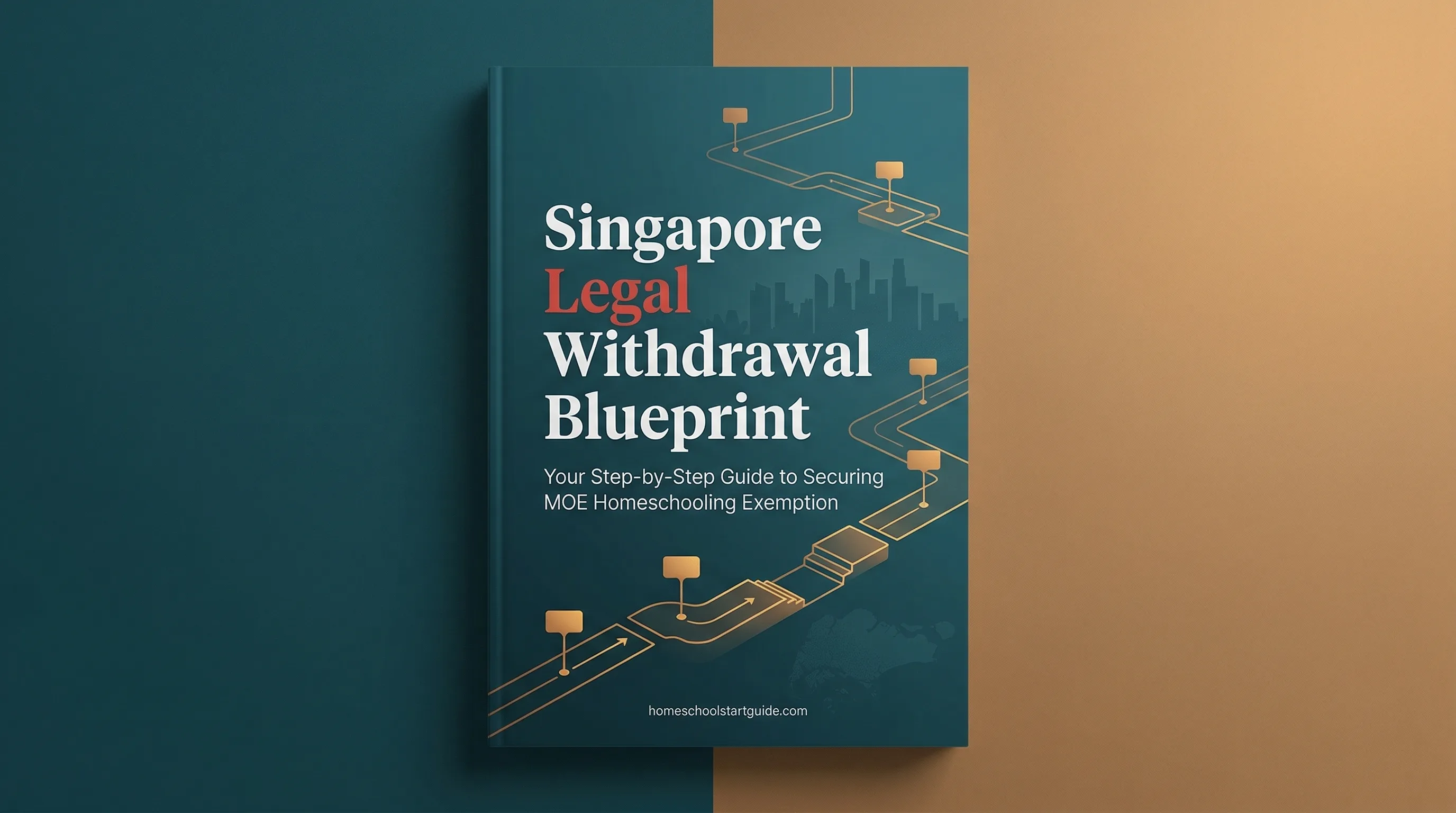
The Singapore Legal Withdrawal Blueprint is a 19-chapter guide — what we call a CEA Compliance Roadmap. It walks you through every stage of the MOE exemption process: from the initial CEU telephone interview, through drafting your academic learning plan for English, MTL, Mathematics, and Science, to submitting your CCE plan, navigating the review period, receiving your exemption letter, and withdrawing your child from school. It covers the PSLE 33rd percentile benchmark, SEAB private candidate registration, the Primary 4 mid-term assessment, annual review preparation, Mother Tongue Language strategies, NS backward planning for boys, and university pathways from homeschool to NUS, NTU, SMU, and SUTD. It is built exclusively for Singapore's legal framework — not adapted from an American guide, not generic, not philosophical.
What's Inside the Blueprint
The Legal Foundation — What the CEA Actually Says
Section 3 of the Compulsory Education Act, the exemption provisions, the criminal penalties, and the critical distinction between citizens, PRs, and expatriates. Not the MOE's bureaucratic language — a practical explanation of your legal standing, who needs an exemption, and who doesn't. Because the first question you need answered definitively is whether the CEA applies to your child at all.
The MOE Application — Step by Step
The complete six-step process: calling the CEU (what to expect in the 30–45 minute telephone interview), receiving the official application packet (which is not available online — it is issued only after the initial screening), preparing your CV, writing your Statement of Motivation, drafting the academic learning plan, and composing the CCE plan. Each step includes what the MOE is evaluating and how to frame your submission to demonstrate compliance rather than philosophy.
The Academic Learning Plan — The Document That Gets You Approved or Rejected
The MOE requires an Individualised Education Plan covering English, Mother Tongue Language, Mathematics, and Science. The Blueprint breaks down what each subject plan must include: curriculum resources with specific titles, scope and sequence covering six years, assessment methods, and alignment to MOE learning objectives. Because "we plan to use Singapore Math" is not an academic learning plan — it's a sentence that gets your application sent back for revision.
The CCE Plan — The Requirement Most Parents Discover Too Late
Character and Citizenship Education is a separate mandatory submission covering six domains: National Education, Cyber Wellness, Family Education, Sexuality Education, Mental Health, and Education and Career Guidance. The Blueprint maps specific activities to each domain — community service hours, National Day observances, Total Defence activities, current affairs discussions — so your CCE plan demonstrates substance, not vague intentions.
The PSLE Benchmark — What the 33rd Percentile Actually Means
Your homeschooled child must sit the PSLE and score at or above the 33rd percentile aggregate — approximately Achievement Level 21 under the current AL scoring system. The Blueprint explains the scoring methodology, the consequences of missing the benchmark, the mandatory Primary 4 mid-term assessment, and how to structure your curriculum to ensure PSLE readiness without turning your home into a tuition centre.
SEAB Private Candidate Registration
How to register with the Singapore Examinations and Assessment Board for the PSLE, the registration timeline, fee structure, and the logistics of sitting national exams as a private candidate. Plus the alternative pathways: IGCSE through British Council Singapore, O-Level registration, and the incoming SEC 2027 framework.
Mother Tongue Language — The Subject That Derails More Applications Than Any Other
MTL is the single most common gap in homeschool applications. The Blueprint covers self-teaching strategies for bilingual families, private tutor costing (S$40–$80/hour), enrichment centre options (S$200–$400/month), the exemption criteria for returning Singaporeans and children with diagnosed learning difficulties, and how to present a credible MTL plan in your application when your household language doesn't match the required medium.
Annual Review Preparation
What to expect in MOE's annual review of your homeschooling arrangement: portfolio requirements, progress report format, home visit preparation, and the evidence you need to demonstrate continued compliance. Because the exemption is not permanent — it is renewed annually, and inadequate reviews can result in revocation.
National Service Planning for Boys
Male Singaporean citizens face a non-negotiable NS enlistment timeline. The Blueprint maps the backward planning required: when to complete O-Levels or IGCSE, when to sit A-Levels or begin polytechnic, and the deferment rules for pre-university studies. A chapter most guides don't include — but for families with sons, it changes every educational decision from Primary 5 onward.
University Pathways from Homeschool
NUS, NTU, SMU, and SUTD admission requirements for homeschooled applicants — including which qualifications each university accepts, how they calculate equivalencies, and what supplementary documentation (portfolios, SAT scores, AP results) strengthens an application. Plus overseas university pathways for families planning beyond Singapore.
Your First 30 Days After Receiving the Exemption
A day-by-day action plan from administrative closure at the school through establishing your framework, beginning instruction, and building your daily routine. Includes the deschooling period — the critical transition phase that most new homeschooling families either rush or ignore.
Who This Blueprint Is For
- Parents whose child is suffering from bullying, severe anxiety, or school refusal — and who need to withdraw legally and quickly, without risking a rejected application or a truancy investigation
- Parents of neurodivergent children (ASD, ADHD, dyslexia) who are too high-functioning for SPED but overwhelmed by mainstream class sizes of 30–40 — and who need to submit an IEP-based exemption application under the 2019 CEA amendment
- Families approaching the P1 registration window who have decided to homeschool but don't know how to apply for exemption while simultaneously registering at a national primary school as a safety net
- Parents who have already contacted the CEU and received the application packet — and are staring at the requirements for an academic learning plan, CCE plan, and CV with no idea what a successful submission actually looks like
- Families struggling with the Mother Tongue Language component — whether that's finding a credible MTL plan for a non-Chinese-speaking household, budgeting for a private tutor, or understanding the exemption criteria
- Parents of boys who need to backward-plan from NS enlistment to ensure all qualifications are completed before the deadline — a constraint that reshapes every pathway decision from upper primary onward
Why Not Just Use the Free Resources?
You can. The information exists — scattered across MOE guidelines, the HSSN Information Guide, SHG Facebook group archives, KiasuParents threads, Reddit posts, and US-centric homeschool blogs that have never heard of the CEA. Here's what assembling it yourself actually looks like:
- 40+ hours of cross-referencing contradictory advice. Forum advice spans a decade of changing policies. The SEN amendment changed the rules in 2019. The PSLE scoring shifted from T-score to Achievement Levels. The SEC 2027 framework is rewriting secondary pathways. A parent relying on a 2021 forum thread is working with outdated information — and won't know until the CEU sends the application back.
- No templates, anywhere. The MOE publishes requirements but provides zero downloadable templates. The HSSN Information Guide is an excellent general overview — but fill-in-the-blank application scaffolding is reserved for their paid consultation tier at S$300+ per session. Free resources tell you what to submit. They do not show you how to structure it.
- No CCE plan guidance. Most forum discussions focus on the academic subjects. The CCE plan — covering six domains including National Education, Cyber Wellness, and Sexuality Education — is barely mentioned. But it is a mandatory submission, and a vague "we'll discuss current affairs" plan is the kind of gap that triggers follow-up requests from the CEU.
- No PSLE logistics in one place. The 33rd percentile benchmark, the AL scoring system, the P4 mid-term assessment, SEAB private candidate registration, alternative examination pathways — this information exists in separate documents across the MOE, SEAB, and British Council websites. No free resource consolidates the assessment framework into a single, actionable protocol.
- No NS planning guidance. Forum advice for families with daughters doesn't apply to families with sons. NS backward planning is a constraint unique to male citizens that changes the entire educational timeline — and it's absent from every generic homeschool guide.
Free resources give you fragments. The Blueprint gives you the complete compliance roadmap — from the first CEU phone call to annual review preparation, PSLE readiness, and university admission.
— Less Than One Hour of Private Tuition
A single hour of private tuition in Singapore costs S$40–$55 at the primary level and up to S$95 at JC level. A paid consultation with an experienced homeschool advisor runs S$300 or more for a two-hour session. A rejected MOE application costs you months — resubmitting during the next July–October window while your child remains trapped in the environment you were trying to leave.
The Blueprint includes the full guide (19 chapters covering the legal foundation through your first 30 days), the Quick-Start Checklist, and 7 standalone printable references: the MOE Application Document Checklist, the Annual Review Preparation Checklist, Key Contacts and Resources, Key Timeline, Budget Planner, Post-PSLE Pathway Comparison, and University Admissions Matrix. 9 PDFs total. Instant download, no account required.
30-day money-back guarantee. If the Blueprint doesn't give you the clarity and structure to prepare your MOE application with confidence, email us and we'll refund you. No questions asked.
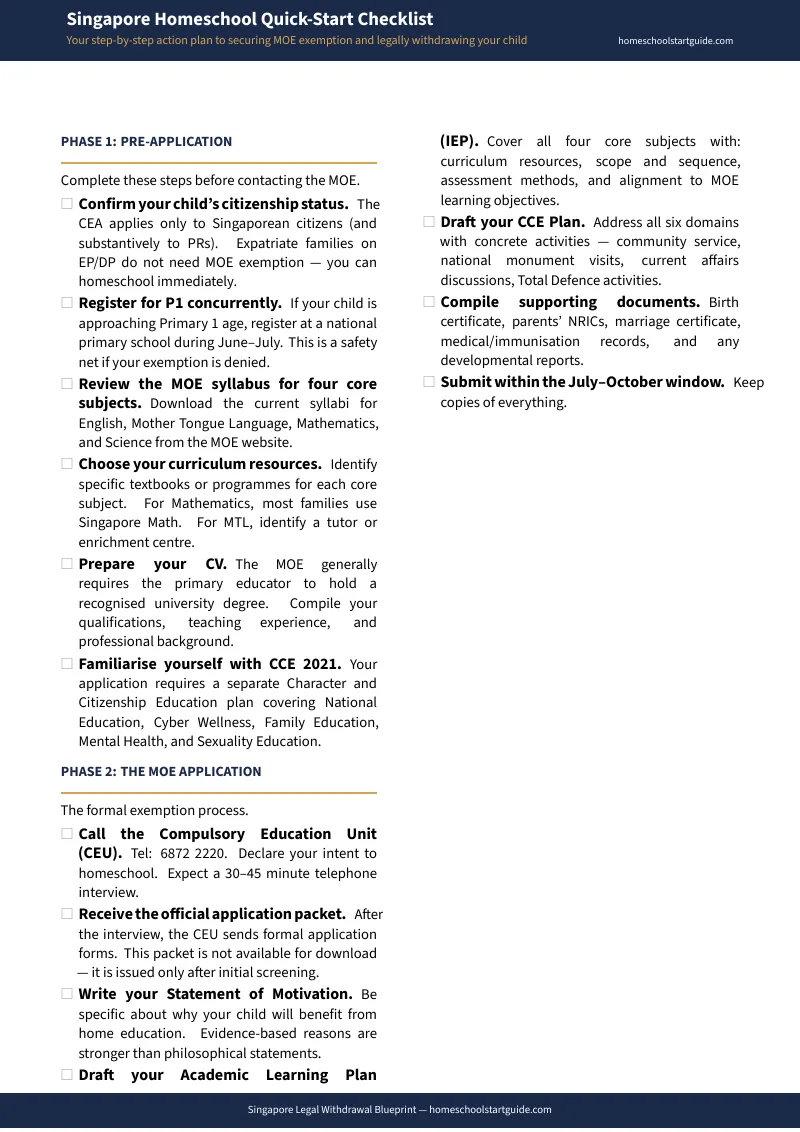
Not ready for the full Blueprint? Download the free Singapore Homeschool Quick-Start Checklist — a 4-phase action plan covering legal status confirmation, the MOE application steps, post-approval actions, and ongoing compliance requirements. It's enough to understand the process at a glance, and it's free.
Your child doesn't need to suffer through another term while you piece together contradictory forum advice. They need you to have a clear, legally sound plan — and the Blueprint gives you one in the time it takes to drink a cup of kopi.