Your Child Isn't Lazy. They're Decompressing.
You pulled your child out of school. Maybe it was bullying, maybe it was burnout, maybe they simply couldn't walk through the doors anymore. The relief was immediate — no more morning battles, no more after-school meltdowns, no more emails from teachers who don't understand. For two or three days, the whole house exhaled.
And then the panic set in.
Your child is lying on the couch watching YouTube. They're playing video games until noon. They show zero interest in the workbooks you bought, the curriculum you researched, the desk you set up in the spare room. Your partner is asking what exactly you're doing all day. Your mother-in-law is wondering aloud whether this was the right decision. And you're Googling "how long should deschooling take" at 11pm, reading blog posts that all say the same vague thing: just wait.
"Give it time." "Follow their interests." "It could take weeks or months." Every article, every Reddit thread, every podcast says some version of the same unhelpful advice — wait, be patient, it'll happen naturally. But nobody tells you what to actually do on Tuesday morning while you're waiting. Nobody tells you how to explain "doing nothing" to a skeptical spouse. Nobody tells you how to know when the waiting is over and your child is ready to learn again.
That gap — between "pull them out" and "start homeschooling" — is where most new homeschooling families silently fall apart. Parents panic-buy a $300 curriculum their child rejects on day one. They force school-at-home because doing nothing feels irresponsible. They burn through their confidence before they ever start teaching. And the child, who needed six weeks to heal, gets six days before the worksheets come back out and the resistance starts all over again.
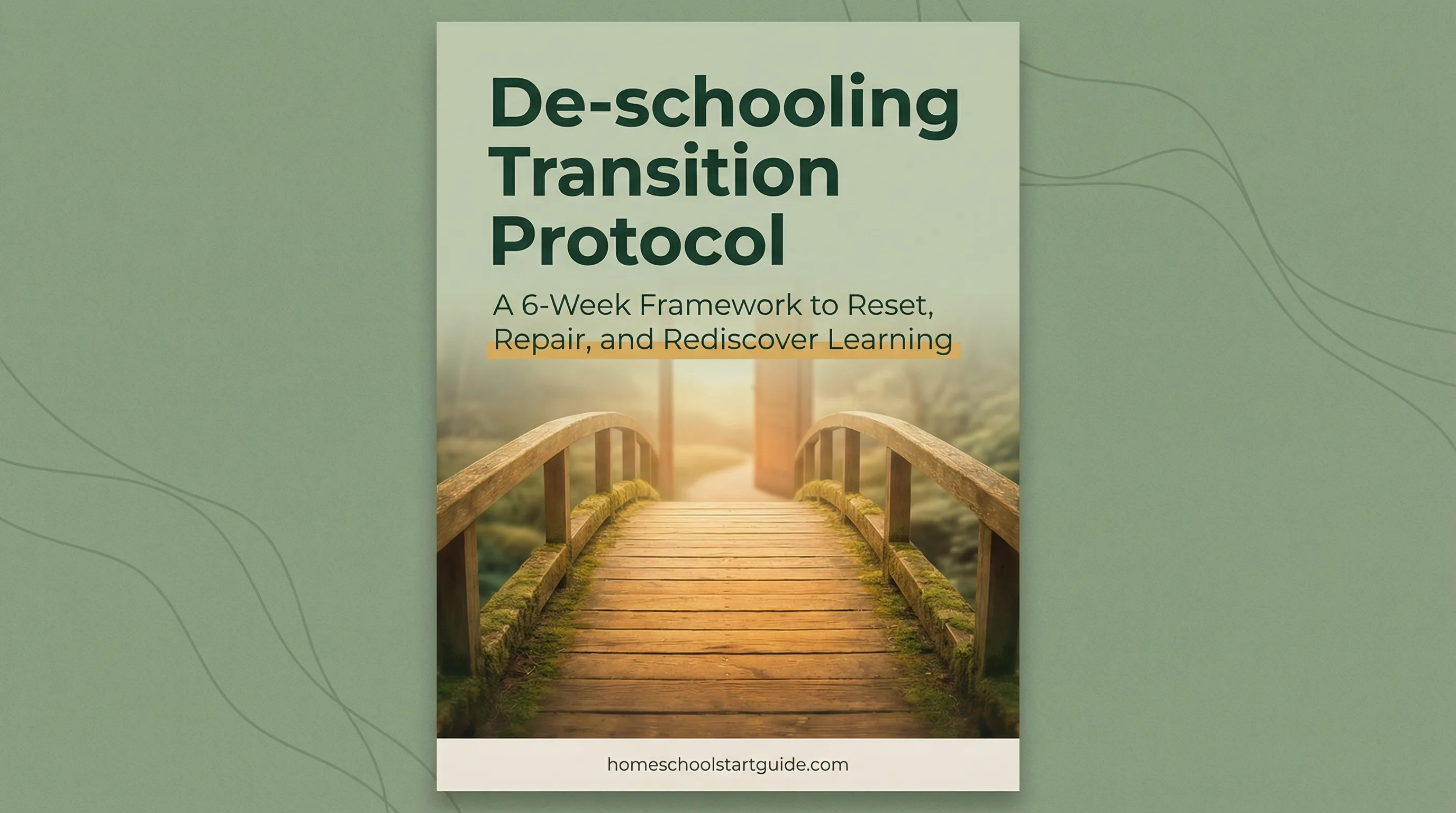
The De-schooling Transition Protocol fills that gap. It's a structured, week-by-week framework for the critical transition period between leaving school and beginning home education — designed for parents who need more than "just wait" but aren't ready to commit to a $150 course or $200/hour consultant.
What's Inside the Protocol
The 6-Week Framework
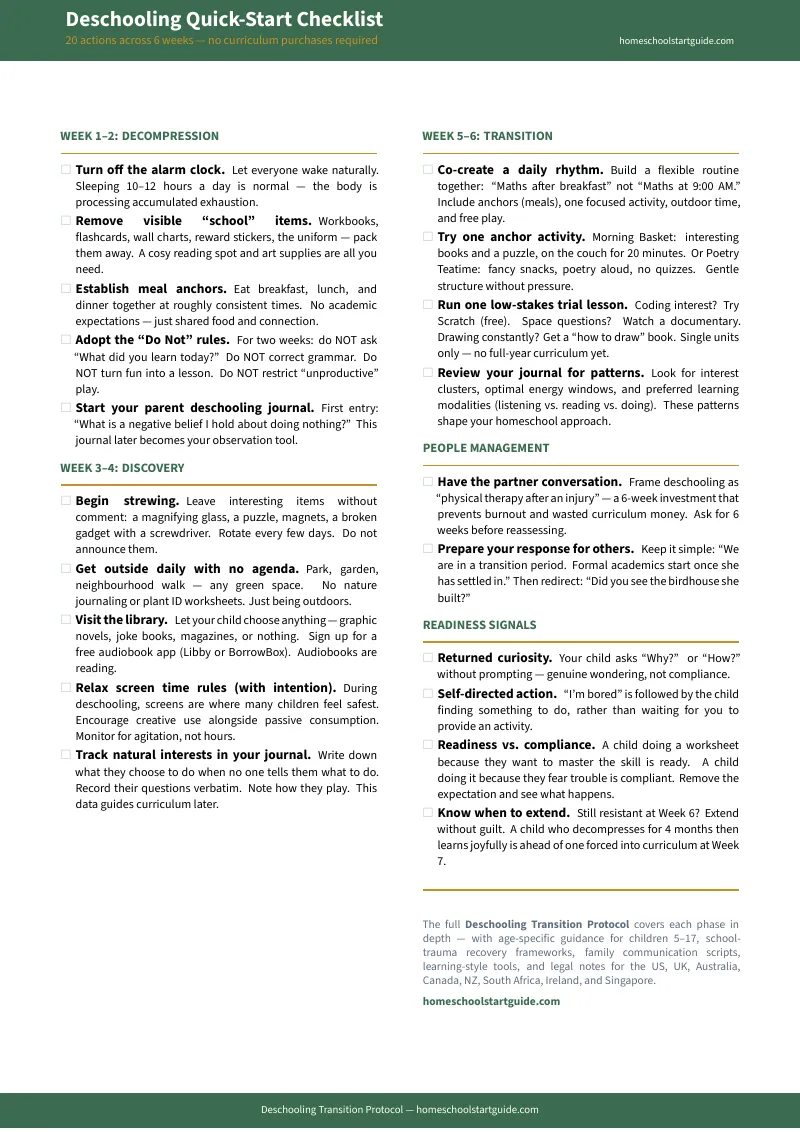
A week-by-week progression from full rest through gradual re-engagement to readiness assessment. Week 1 focuses on sleep, regulation, and establishing safety. By Week 3, you're introducing connection activities and observing emerging interests. By Week 6, you have concrete data on your child's learning preferences and a clear signal that they're ready for formal learning — or that they need more time, and exactly why.
Daily Rhythm Templates
Not rigid timetables. Gentle, flexible daily structures for each phase of the protocol — enough predictability to calm an anxious child, enough flexibility to honour bad days. These aren't schedules that break when someone has a meltdown at 9am. They're rhythms that absorb disruption because disruption is expected.
Observation Logs & Readiness Assessment
The printable observation system that replaces grading with noticing. You'll track engagement, curiosity, mood, and energy — not test scores. The readiness assessment gives you specific, measurable indicators so you'll know exactly when your child is ready to start learning again, instead of guessing or hoping.
Emotional Recovery Framework
Guidance for navigating the emotional arc that every deschooling family experiences: the initial relief, the void of uncertainty, the doubt when "nothing" seems to be happening, and the gradual return of curiosity. Covers both your child's healing process and your own anxiety as a parent watching it unfold.
The Skeptical Partner Script
A one-page, science-backed explanation you can hand directly to a nervous spouse, co-parent, or grandparent who thinks deschooling means "doing nothing." Written in plain language, no educational jargon, no "woo-woo" philosophy — just the neurological and psychological case for why this transition period is productive, not wasteful.
Regional Safe Language Glossary
What to say — and what to never say — when communicating with officials during your transition. UK parents: the word "deschooling" in a letter to your Local Authority can trigger a School Attendance Order. Australian parents: how to frame your transition within the "School Can't" movement. US parents: which states require notification and what language to use. This section prevents the legal mistakes that turn a healthy transition into a bureaucratic crisis.
Family Communication Templates
Ready-to-use scripts for the conversations you're dreading: explaining your decision to extended family, responding to "but what about socialisation?" for the hundredth time, and setting boundaries with well-meaning relatives who keep sending links to online school programs.
Learning Style Discovery Activities
Age-appropriate activities for Weeks 3-6 that reveal your child's natural learning preferences without pressure or performance. These aren't tests — they're invitations. By the end of the protocol, you'll understand whether your child learns best through movement, conversation, reading, building, or some combination — so when you do buy curriculum, you buy the right one the first time.
Who This Protocol Is For
- Parents who have just withdrawn (or are about to withdraw) a child from school — whether due to bullying, burnout, school refusal, neurodivergent needs, or simply knowing the system isn't working
- Parents who tried "school-at-home" (desks, timetables, workbooks) and watched it fail within the first week — your child didn't leave one rigid system to enter another
- Parents whose child is lying on the couch doing "nothing" and who need reassurance that this is recovery, not laziness — plus concrete tools to track the invisible progress
- Parents with a skeptical partner or extended family members who think deschooling means educational neglect — and who need something to show them that isn't a blog post or a Reddit thread
- Parents in the UK, Australia, New Zealand, or other countries where the term "deschooling" carries legal risk if used with education officials — who need safe language alternatives
- Parents who are tempted to panic-buy curriculum and need someone to tell them: not yet — and here's how to know when
After Reading This Protocol, You'll Be Able To
- Follow a structured, week-by-week plan for the transition period — replacing the anxiety of "just wait and see" with specific actions, observation tools, and measurable milestones for each phase
- Recognise the signs that your child is healing — distinguishing between genuine recovery (which looks like "doing nothing") and actual disengagement that needs intervention
- Track your child's progress through observation logs that measure engagement, curiosity, and emotional regulation — giving you (and your partner) visible proof that learning is happening even without worksheets
- Explain your deschooling approach to a skeptical spouse, co-parent, or grandparent using a ready-made, science-backed script that avoids jargon and makes the case in terms they'll respect
- Communicate with education officials in your country using language that protects your family — avoiding terms that trigger compliance reviews or attendance orders
- Identify your child's natural learning style through low-pressure discovery activities — so when you do choose curriculum, you invest in the right one instead of wasting hundreds on materials your child will reject
- Know exactly when the deschooling period is over and your child is genuinely ready to begin formal learning — not based on a calendar date, but based on specific readiness indicators you've been tracking
Why Not Just Follow the Free Blog Advice?
You can. The free advice exists — on homeschool blogs, in Reddit threads, across Facebook groups. And almost all of it says the same thing: "Just wait. Give it time. Follow their lead." That advice isn't wrong. It's just incomplete. Here's what it actually costs to follow it without a framework:
- Wasted curriculum money. The most common pattern: a parent deschools for two weeks, panics, buys a $200-$500 curriculum, forces it on a child who isn't ready, watches the child reject it, and starts the deschooling clock over. One premature curriculum purchase costs more than this protocol and sets the transition back by weeks.
- Partner conflict. Without a framework to show progress, "deschooling" looks identical to "neglect" from the outside. The fights with a skeptical spouse during this period are the #1 reason families abandon homeschooling before it starts.
- Lost confidence. Every day without visible progress erodes your belief that you made the right decision. By week three of unstructured waiting, most parents are either forcing worksheets or second-guessing the withdrawal entirely. A protocol with milestones prevents this spiral.
- Legal exposure. UK parents who use the word "deschooling" in correspondence with their Local Authority risk triggering compliance reviews. Australian parents who don't frame their transition correctly face registration challenges. The free blog advice never mentions this.
Blogs tell you deschooling is important. This protocol tells you how to do it — week by week, day by day, with tools to track progress and scripts to handle everyone who questions you along the way.
— Less Than a Single Wasted Curriculum
A homeschool curriculum runs $200-$500. A homeschool consultant charges $100-$200 per hour. The "Mindful Deschooling" course costs over $150. Even the thin Etsy checklists run $3-$8 without covering the psychology, the partner communication, or the legal nuance. This protocol costs less than the textbook your child would reject next week — and it prevents the expensive mistakes that happen when you skip the transition and rush straight to teaching.
The protocol includes 9 PDFs: the full 76-page guide, the De-schooling Quick-Start Checklist, plus 7 standalone printable tools — the Weekly Observation Log, Readiness Assessment Checklist, Skeptical Partner Script, Regional Safe Language Glossary, Family Communication Scripts, Activity Bank, and Daily Rhythm Template. Instant download, no account required.
30-day money-back guarantee. If you don't find it useful, email us and we'll refund you. No questions asked.
Not ready for the full protocol? Download the free De-schooling Quick-Start Checklist — a one-page overview of the 6-week deschooling timeline, daily rhythm suggestions for the first week, and the warning signs that mean your child needs more time. It's enough to start tonight, and it's free.
Your child isn't broken. They aren't lazy. They're recovering from a system that wasn't built for them — and you just gave them the space to heal. This protocol shows you how to use that space wisely, one week at a time.